How to Read a Tyre Size: Sidewall Markings Explained
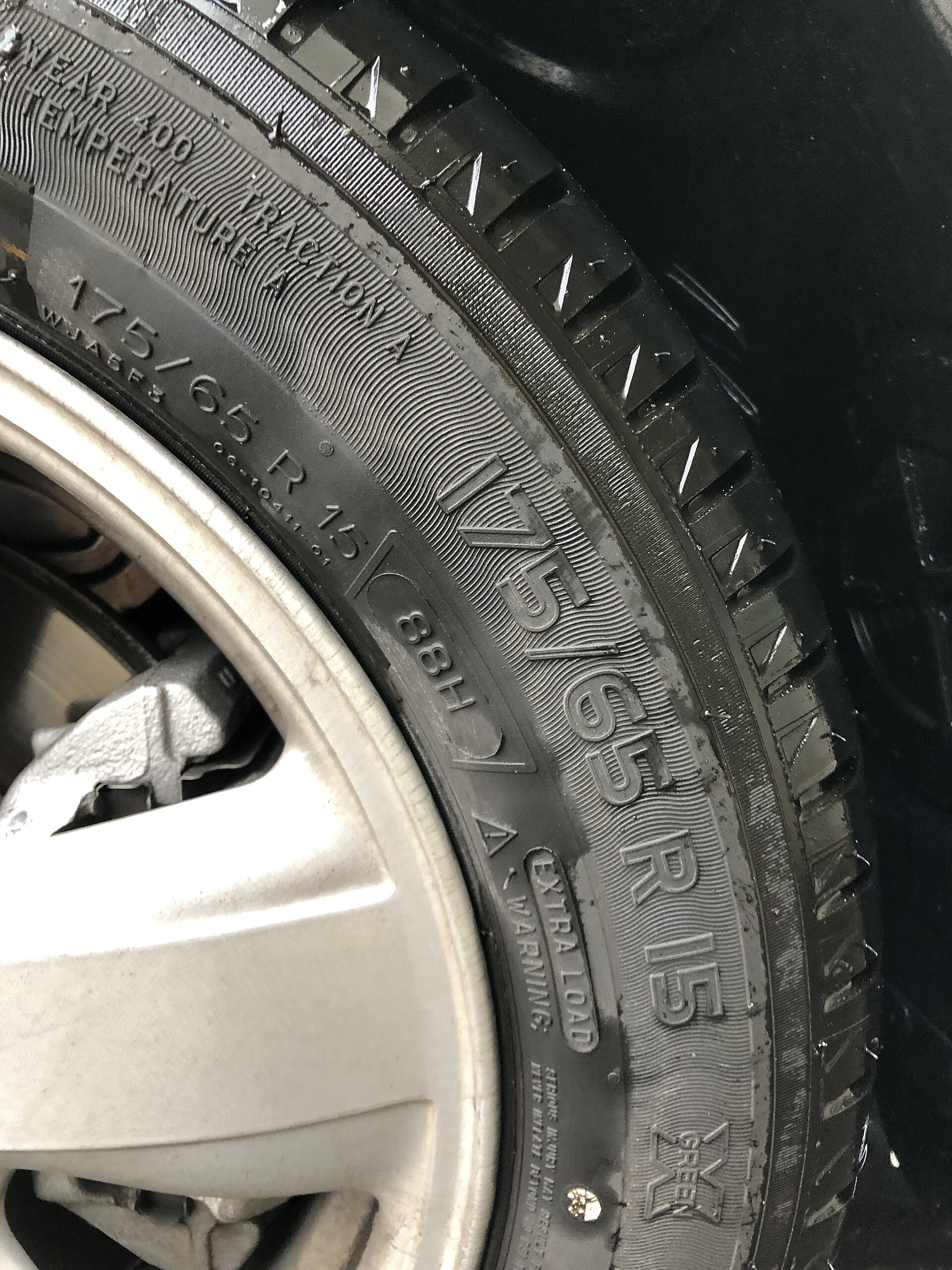
To read a tyre size, take a code such as 205/55 R16 91V from left to right: 205 is the width in millimetres, 55 is the sidewall height as a percentage of that width, R means radial construction, 16 is the rim diameter in inches, 91 is the load index (615 kg per tyre) and V is the speed rating (240 km/h). Everything else on the sidewall, from the production date to the snowflake symbol, tells you how old the tyre is and where it may be used. This guide decodes each marking and shows how to check whether a different size will fit your car.
Key takeaways
- The size (205/55 R16) must match a size approved for your car; the load index and speed rating must be at least what the vehicle papers specify.
- The four-digit date code shows the week and year of production: 4523 means week 45 of 2023.
- The Alpine symbol (3PMSF) marks tyres tested for severe snow; M+S alone is only a manufacturer's claim.
- When changing size, keep the overall diameter within about ±3% of the original, and check it with our tyre size calculator.
Anatomy of a tyre size
Here is the most common European passenger car size, decoded:
| Marking | Meaning | Example 205/55 R16 91V |
|---|---|---|
| 205 | Section width in mm, sidewall to sidewall | 205 mm |
| 55 | Aspect ratio: sidewall height as % of width | 55% of 205 = 112.8 mm |
| R | Construction: radial (almost all modern car tyres) | Radial |
| 16 | Rim diameter in inches | 16 in = 406.4 mm |
| 91 | Load index | 615 kg per tyre |
| V | Speed symbol | up to 240 km/h |
You may also see a "Z" inside the size (for example 225/45 ZR17) on older high-performance tyres; it simply means the tyre is rated above 240 km/h, and the speed symbol after the load index gives the exact rating.
From these numbers you can calculate the tyre's overall diameter: rim diameter plus two sidewalls. For 205/55 R16 that is 406.4 + 2 × 112.8 = 631.9 mm, giving a circumference of about 1,985 mm, or roughly 504 wheel revolutions per kilometre. Our tyre size calculator does this for any size in one step.
Load index: how much weight each tyre can carry
The load index is a code, not a weight. The table shows the most common values for cars, from tyre maker Pirelli's load index chart:
| Load index | Max load per tyre | Load index | Max load per tyre |
|---|---|---|---|
| 82 | 475 kg | 94 | 670 kg |
| 84 | 500 kg | 95 | 690 kg |
| 86 | 530 kg | 96 | 710 kg |
| 88 | 560 kg | 97 | 730 kg |
| 90 | 600 kg | 98 | 750 kg |
| 91 | 615 kg | 100 | 800 kg |
| 92 | 630 kg | 102 | 850 kg |
| 93 | 650 kg | 104 | 900 kg |
Never fit a tyre with a lower load index than the one specified for your car. A higher index is fine. The minimum is not linked to the car's kerb weight alone: it is set by the maximum permitted axle load, so heavy SUVs, vans and many electric cars need higher indices than their size suggests. You will often see XL (extra load) or Reinforced next to the size; these tyres carry a higher load index than a standard tyre of the same size and usually need higher pressures, so check the pressure table on the door pillar or fuel flap.
Speed rating: the letter after the load index
The speed symbol shows the maximum speed the tyre is designed for at its rated load.
| Symbol | Max speed | Symbol | Max speed |
|---|---|---|---|
| Q | 160 km/h | H | 210 km/h |
| R | 170 km/h | V | 240 km/h |
| S | 180 km/h | W | 270 km/h |
| T | 190 km/h | Y | 300 km/h |
Your tyres must normally match or exceed the speed rating in the vehicle documents, which is tied to the car's top speed. There is one common exception: winter and all-season (M+S) tyres may have a lower speed rating than the car's maximum, provided a sticker showing the maximum permitted speed is visible to the driver and you do not exceed it. Goodyear's sidewall guide spells this out, and rules on the sticker are strict in several countries, so check before you rely on it.
If you ever have to mix tyres with different speed ratings, for example after a puncture abroad, Pirelli advises fitting the higher-rated pair on the rear axle. Better still, replace tyres in axle pairs with the same model.
Other sidewall markings you should know
- Date code (DOT): a four-digit number at the end of the long DOT code, usually in an oval. The first two digits are the week, the last two the year: 0824 is week 8 of 2024. Tyres age even when unused, so check this when buying; many experts recommend replacing car tyres around ten years old regardless of tread.
- M+S: mud and snow. It is a manufacturer's own marking with no performance test behind it.
- 3PMSF (Alpine symbol): three mountain peaks with a snowflake. The tyre has passed a standardised snow grip test under UNECE Regulation 117. This is the symbol that counts where winter tyres are compulsory in Europe. See our guide to choosing winter tyres.
- Ice grip symbol: a mountain-like ice stalagmite. It marks Nordic tyres designed for ice and is tested under ISO 19447.
- TWI: tread wear indicator. Small arrows point to raised bars in the grooves. When the tread is worn down to them, it has reached 1.6 mm, the legal minimum in most EU countries.
- E mark (a letter E and a number in a circle): approval under UNECE rules for sale in Europe.
- OE markings: tyres developed for a specific car maker, such as AO or RO1 (Audi), MO (Mercedes-Benz), a star (BMW) or N0, N1 (Porsche). They are not compulsory, but some cars, especially sports models, are tuned around them.
- Max pressure: the maximum pressure the tyre structure allows, not the pressure to use. The correct pressure is on the car's label.
The EU tyre label is not on the sidewall, but it comes with every new car tyre sold in the EU under Regulation (EU) 2020/740. It rates rolling resistance and wet grip from A to E, shows external noise in decibels, and adds snow and ice symbols where relevant. A QR code links to the tyre's entry in the EU's EPREL database.
Which tyre sizes are allowed on your car?
The sizes your car may use are listed in its papers: the certificate of conformity (COC), and in many countries the registration certificate itself. The sticker inside the driver's door or fuel flap usually shows the main sizes with their pressures. Fitting a size that is not listed can require an approval or inspection in many EU countries and may affect your insurance, so always start from the papers.
Changing tyre size: the ±3% rule
People change size to fit larger alloy wheels, to get a cheaper winter size or to fit a narrower tyre for snow. The key is to keep the overall diameter close to the original, because the speedometer, ABS and stability control are calibrated for it. Tyre fitters generally keep the difference within about ±3%.
| Size | Sidewall | Overall diameter | vs 205/55 R16 |
|---|---|---|---|
| 205/55 R16 | 112.8 mm | 631.9 mm | reference |
| 195/65 R15 | 126.8 mm | 634.5 mm | +0.4% |
| 225/45 R17 | 101.3 mm | 634.3 mm | +0.4% |
| 225/40 R18 | 90.0 mm | 637.2 mm | +0.8% |
| 215/60 R16 | 129.0 mm | 664.4 mm | +5.1% (too big) |
The first four are classic "plus sizes" of the same rolling diameter. The last one would make the speedometer read about 5% low: at an indicated 100 km/h you would actually be doing about 105 km/h. Wider tyres also change how the steering feels and can rub on suspension parts or the wheel arch on full lock. Wheel width, offset and the choice between steel and alloy wheels matter too.
Run any two sizes through the tyre size calculator: it shows sidewall height, diameter, circumference and the real speed at an indicated 100 km/h.
Try our calculator
Tyre size calculatorFAQ
What does 91V mean on a tyre?
91 is the load index and V the speed rating. A load index of 91 means each tyre can carry up to 615 kg, and V means the tyre is rated for up to 240 km/h. Both must be at least as high as the values in your vehicle documents.
How do I find out how old my tyres are?
Look for the end of the DOT code on the sidewall. The last four digits show the production week and year: 3622 means week 36 of 2022. The code may only be moulded on one side of the tyre, so check both sides.
Can I fit tyres with a higher load index or speed rating?
Yes. A higher load index or speed rating than specified is allowed and safe. XL tyres may need higher pressures, so check the tyre maker's recommendation for your load.
Is 225/45 R17 the same as 205/55 R16?
Not the same size, but almost the same overall diameter: 634.3 mm against 631.9 mm, a difference of 0.4%. That is why 225/45 R17 is a common upsize for cars that originally came on 205/55 R16. Only fit it if it is approved for your car and your wheels.
What is the difference between M+S and the snowflake symbol?
M+S is a manufacturer's claim with no standard test. The three-peak mountain snowflake (3PMSF) shows the tyre has passed an official snow grip test. Where winter tyres are compulsory, the snowflake symbol is increasingly the legal requirement.
Sources
- Goodyear — How to read your tyre sidewall markings (accessed 21 Oct 2026)
- Pirelli — Tyre load index & chart (accessed 21 Oct 2026)
- Pirelli — What is tyre speed rating? (accessed 21 Oct 2026)
- European Commission — Tyres (EU tyre label, Regulation (EU) 2020/740, EPREL) (accessed 21 Oct 2026)
Found a mistake? Report an error