 Chevrolet Corvair
All generations, specs and history
Published Sources (1) Report an error
By Sarah Whitmore, Senior Automotive Writer
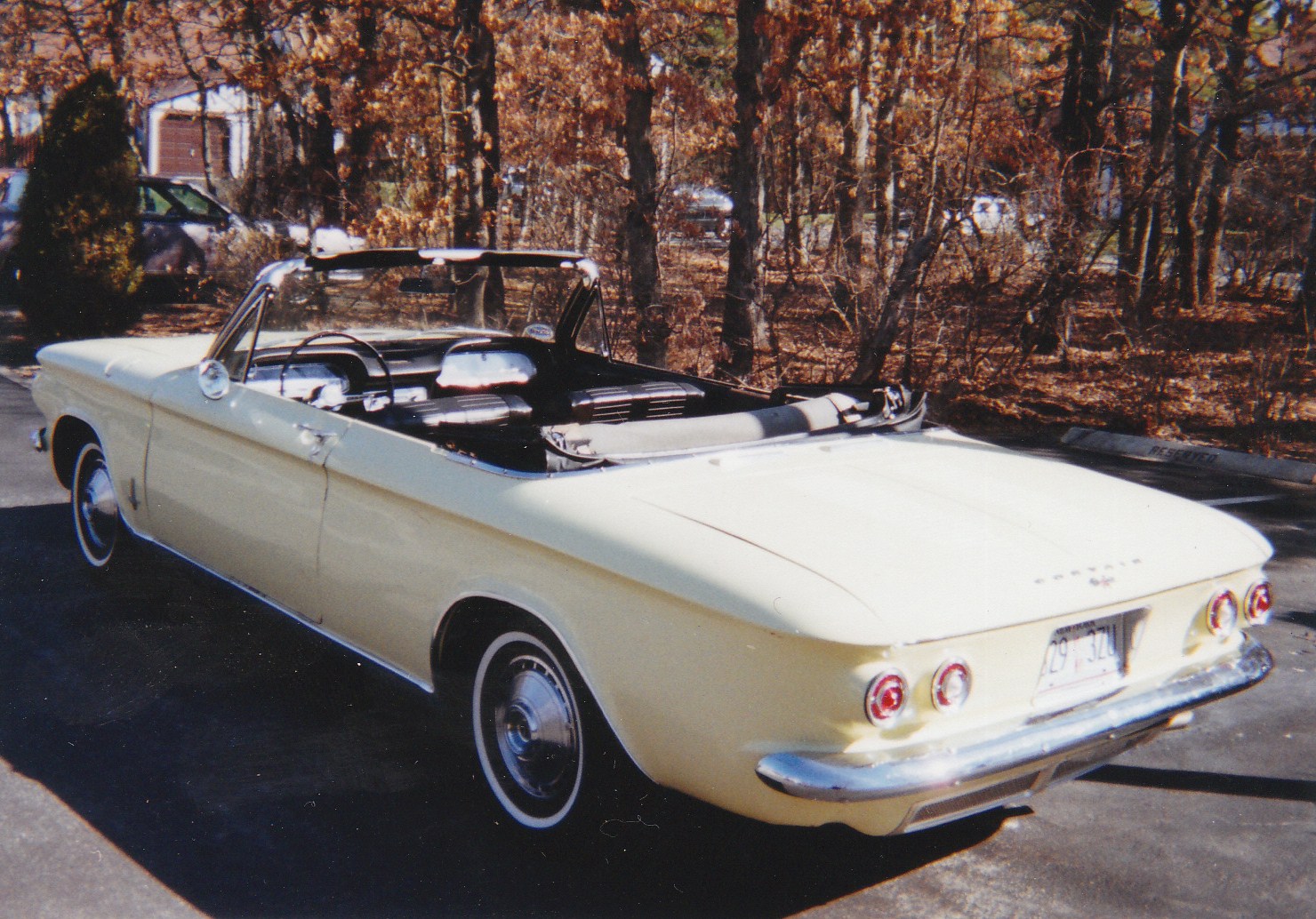
- Built
- 1959–1969
- Generations
- 2
- Top power
- 134 kW (182 PS)
Timeline
Corvair generations
Click a generation for its own page
- Corvair I 1960–1964 · Sedan, Station wagon · 60–112 kW (82–152 PS)
- Corvair II 1965–1969 · Sedan, Coupe · 71–134 kW (97–182 PS)
Newest first · 2 generations since 1960
-
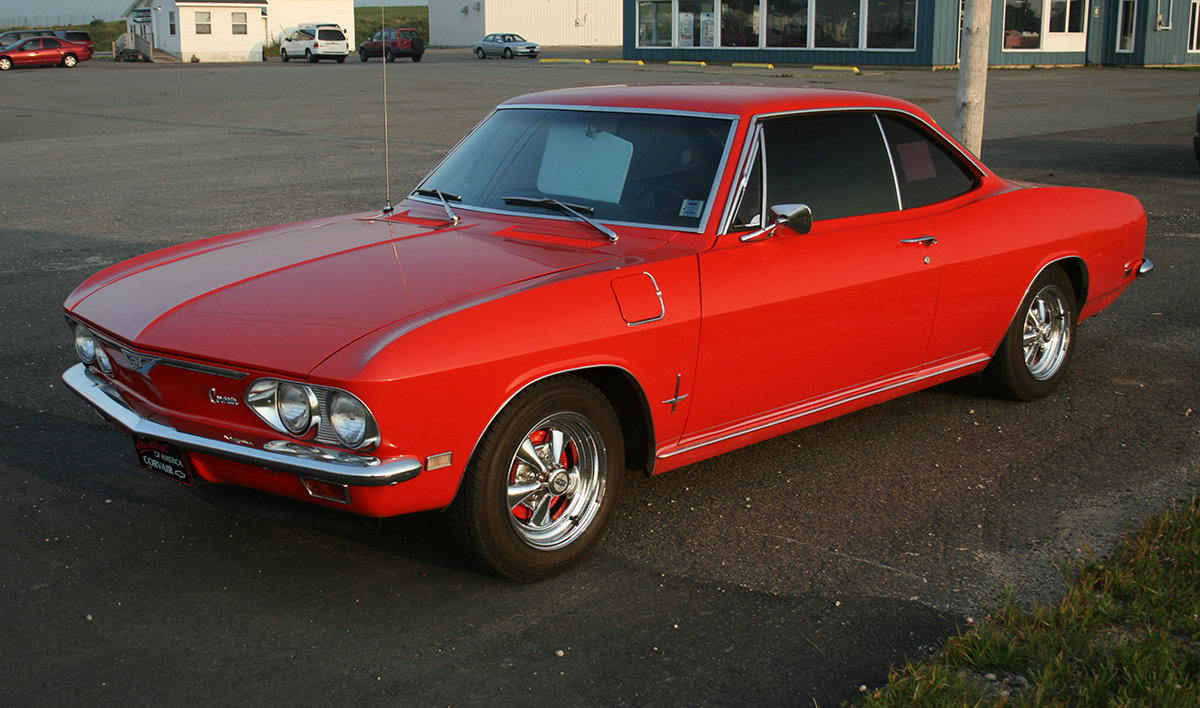
1965
-
1960
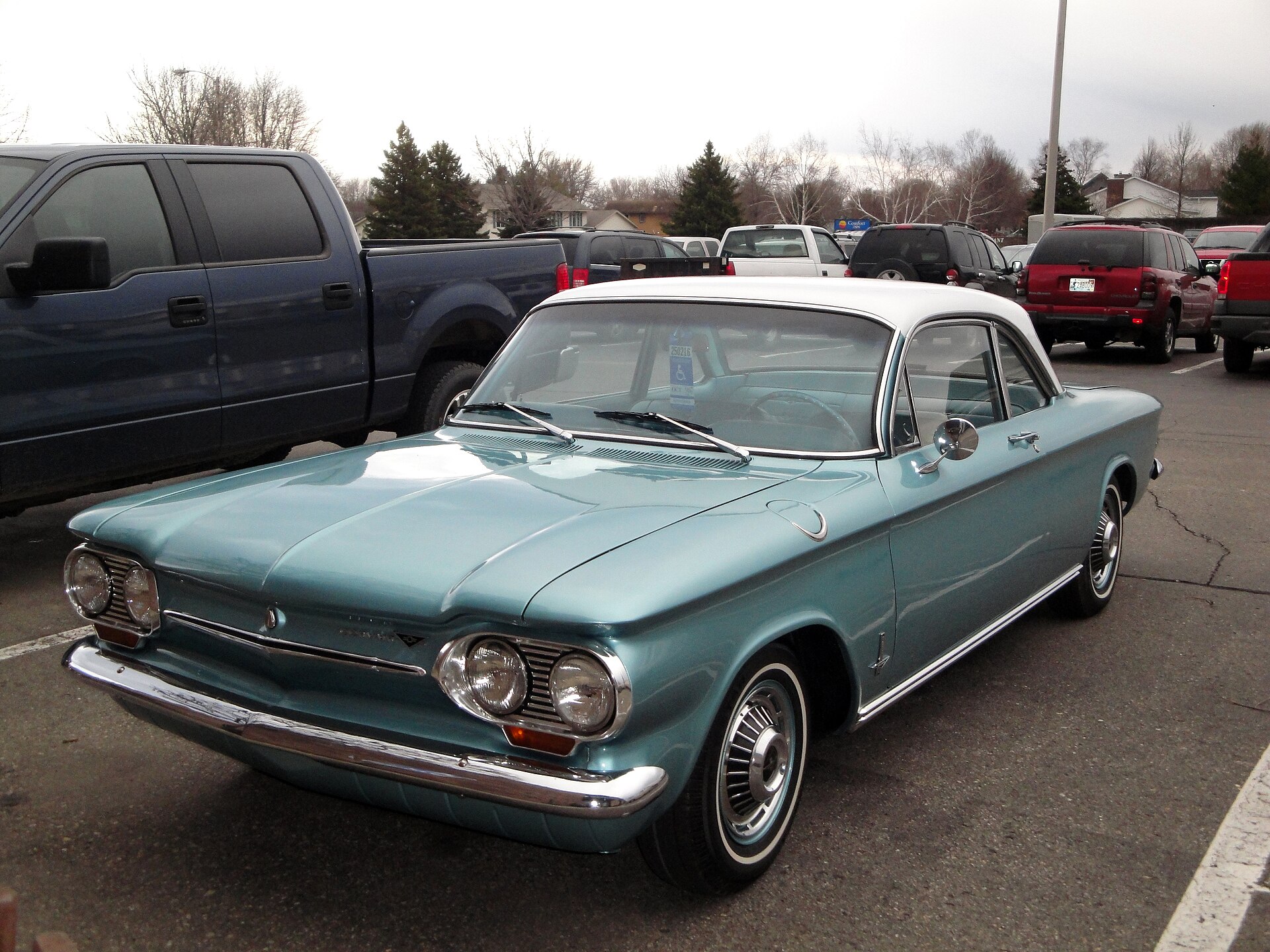


All generations by year: Corvair II (1965–1969) · Corvair I (1960–1964)
Which one is mine?
Pick the year of first registration to see which generation it is.
- Corvair II 1965–1969
- Corvair I 1960–1964
Which Corvair to choose
Our verdict · Sarah Whitmore
- For style and usability: a 1965–1966 Monza coupé or convertible with the 82 kW (110 hp) engine and independent rear suspension.
- For performance: a Corsa turbo of 1965–1966, the most powerful Corvair at 134 kW.
- For history: a 1960–1963 Monza, the car that started the sporty-compact idea.
- For something different: a Greenbrier or Rampside from the Corvair 95 range.
Other 1960s cars appear in our 1960s classics guide, and our General Motors history describes the parent company in those years. The Chevrolet catalogue lists both Corvair generations with their engines.
The Chevrolet Corvair was General Motors' compact car of the 1960 to 1969 model years and stood out with an air-cooled flat-six mounted behind the rear axle. Built from July 1959 to May 1969, it covered sedans, coupés, convertibles, a station wagon and even vans and pickups. Its successor was the Vega of 1970.
In short
- About 1.8 million built in two generations: 1960–1964 and 1965–1969.
- Aluminium flat-six of 2.3 to 2.7 litres, from 60 kW (80 hp gross) to 134 kW (180 hp) in the turbocharged Corsa.
- Motor Trend Car of the Year 1960; the Monza coupé turned it into a sporty compact.
- Criticised in Ralph Nader's 1965 book Unsafe at Any Speed; a 1972 NHTSA study found no abnormal tendency to lose control or roll over in the 1960–1963 cars.
Specs by version
Engines
| Version | Engine | Power | Torque | Drive | Production years |
|---|---|---|---|---|---|
| Corvair I · 140 Turbo-Air | 2.3 l · 6 cyl · Petrol 2,295 cc | 60 kW 82 PS80 hp | 169 Nm125 lb-ft | Rear-wheel drive | 1960–1961 |
| Corvair I · 145 Super Turbo-Air | 2.4 l · 6 cyl · Petrol 2,375 cc | 73 kW 99 PS98 hp | 179 Nm132 lb-ft | Rear-wheel drive | 1961–1963 |
| Corvair I · 164 High-Performance Turbo-Air | 2.7 l · 6 cyl · Petrol 2,683 cc | 82 kW 111 PS110 hp | 217 Nm160 lb-ft | Rear-wheel drive | 1964 |
| Corvair I · Monza Spyder Turbo | 2.4 l · 6 cyl · Petrol 2,375 cc | 112 kW 152 PS150 hp | 285 Nm210 lb-ft | Rear-wheel drive | 1962–1964 |
| Corvair II · 164 Turbo-Air | 2.7 l · 6 cyl · Petrol 2,683 cc | 71 kW 97 PS95 hp | 209 Nm154 lb-ft | Rear-wheel drive | 1965–1969 |
| Corvair II · 164 Turbo-Air (high-performance) | 2.7 l · 6 cyl · Petrol 2,683 cc | 82 kW 111 PS110 hp | 217 Nm160 lb-ft | Rear-wheel drive | 1965–1969 |
| Corvair II · Corsa 140 (four carburettors) | 2.7 l · 6 cyl · Petrol 2,683 cc | 104 kW 141 PS139 hp | 217 Nm160 lb-ft | Rear-wheel drive | 1965–1966 |
| Corvair II · Corsa Turbo | 2.7 l · 6 cyl · Petrol 2,683 cc | 134 kW 182 PS180 hp | 359 Nm265 lb-ft | Rear-wheel drive | 1965–1966 |
Dimensions and weight
Show all 8 versions
| Version | Wheelbase |
|---|---|
| Corvair I · 140 Turbo-Air | 2,743 mm108.0 in |
| Corvair I · 145 Super Turbo-Air | 2,743 mm108.0 in |
| Corvair I · 164 High-Performance Turbo-Air | 2,743 mm108.0 in |
| Corvair I · Monza Spyder Turbo | 2,743 mm108.0 in |
| Corvair II · 164 Turbo-Air | 2,743 mm108.0 in |
| Corvair II · 164 Turbo-Air (high-performance) | 2,743 mm108.0 in |
| Corvair II · Corsa 140 (four carburettors) | 2,743 mm108.0 in |
| Corvair II · Corsa Turbo | 2,743 mm108.0 in |
Verified Manufacturer and type-approval data from our catalog · Sources and methodology
Chevrolet Corvair at a glance
| Parameter | Metric | Imperial / note |
|---|---|---|
| Production | July 1959 – 14 May 1969 | model years 1960–1969 |
| Layout | rear engine, rear-wheel drive, unibody | GM Z-body |
| Engine | air-cooled flat-six, 2,295–2,683 cc | 140, 145 and 164 cu in |
| Power | 60–134 kW | 80–180 hp (SAE gross) |
| Torque | 169–359 Nm | — |
| Gearbox | 3- or 4-speed manual, 2-speed Powerglide | — |
| Wheelbase | 2,743 mm | 108 in |
| Built | about 1.835 million | two generations |
| Successor | Chevrolet Vega | 1970 |
Corvair timeline
| Model year | Event |
|---|---|
| 1960 | launch as a four-door sedan, then coupé; Monza club coupé; Car of the Year |
| 1961 | 145 cu in engine, Lakewood wagon, four-speed manual, Corvair 95 vans and pickups |
| 1962 | Monza convertible, turbocharged Spyder option, wagon dropped mid-year |
| 1964 | 164 cu in engine, front anti-roll bar standard |
| 1965 | second generation with independent rear suspension, Corsa 140 and 180 |
| 1966–1969 | sales fall; the last car is hand-built at Willow Run on 14 May 1969 |
First generation (1960–1964): swing axles and the Monza
The first Corvair went on sale for the 1960 model year with a 60 kW (80 hp) engine; in 1960 prices started at US$1,984 for the base coupé, and the 500-series sedan cost US$2,038. Motor Trend made it Car of the Year. The Monza club coupé, added late in the first year, set the course: in 1962 it was the most popular model, with 151,738 of the 292,531 passenger cars built.
A front anti-roll bar became optional in 1962 and standard in 1964. A convertible arrived in spring 1962, the same year the station wagon was dropped. Base prices stayed close to US$2,000 throughout this generation.
| Model year | Built (Wikipedia EN) | Built (Wikipedia DE) |
|---|---|---|
| 1960 | 253,268 | 250,007 |
| 1961 | 337,371 | 297,881 |
| 1962 | 336,005 | 306,023 |
| 1963 | 288,419 | 254,571 |
| 1964 | 215,300 | 199,387 |
The two Wikipedia editions count differently, so both columns are shown.

The air-cooled flat-six
Every Corvair used the same basic engine: an aluminium, air-cooled horizontally opposed six with overhead valves, mounted behind the rear axle. It grew in two steps, from 2,295 cc (140 cu in) to 2,375 cc (145 cu in) in 1961 and 2,683 cc (164 cu in) for 1964.
| Version | Years | Displacement | Power (gross) | Torque |
|---|---|---|---|---|
| Turbo-Air 140 | 1960–1961 | 2,295 cc | 60 kW (80 hp) | 169 Nm |
| Super Turbo-Air 145 | 1961–1963 | 2,375 cc | 73 kW (98 hp) | 179 Nm |
| Monza Spyder (turbo) | 1962–1964 | 2,375 / 2,683 cc | 112 kW (150 hp) | 285–315 Nm |
| Turbo-Air 164 | 1964–1969 | 2,683 cc | 71 kW (95 hp) | 209 Nm |
| High-Performance 164 | 1964–1969 | 2,683 cc | 82 kW (110 hp) | 217 Nm |
| Corsa 140 | 1965–1966 | 2,683 cc | 104 kW (140 hp) | 217 Nm |
| Corsa Turbo | 1965–1966 | 2,683 cc | 134 kW (180 hp) | 359 Nm |
The Spyder's torque figures and the displacements in cc come from German Wikipedia; the horsepower figures are SAE gross values, so they read higher than modern net ratings. To compare them with today's cars, use our power converter.

Corvair 95: Greenbrier, Corvan and Rampside
From 1961 the flat-six also powered a family of forward-control commercial vehicles with the driver sitting over the front wheels. The Greenbrier was a window van for passengers, the Corvan a panel van, and the Rampside a pickup with a fold-down ramp in the side of the bed, ideal for loading wheeled goods. A conventional Loadside pickup was offered in 1961 and 1962 only.
The Corvan and the pickups ended in 1964, and the Greenbrier followed in the 1965 model year after 1,528 final units. Between the first and second El Camino, these Corvair-based models filled Chevrolet's car-based pickup role.

Second generation (1965–1969): Corsa and independent rear
The 1965 Corvair was all new: pillarless two- and four-door hardtops and a convertible, all without a B-pillar. Its rear suspension now used a fully independent layout with coil springs, similar in concept to the Corvette Sting Ray. The sporty Corsa replaced the Spyder, with either a 104 kW (140 hp) engine on four single-barrel carburettors or a 134 kW (180 hp) turbo.
Prices started at US$2,022 for a 1965 500 coupé, while a Corsa convertible cost US$2,608. Sales nevertheless fell fast after a strong first year. Octane names the reasons: Chevrolet stopped major Corvair development and concentrated on the Camaro, partly because of the Ford Mustang, while Ralph Nader's book raised doubts about the earlier cars' handling.
| Model year | Built |
|---|---|
| 1965 | about 235,500–247,092 |
| 1966 | about 103,700–109,880 |
| 1967 | 27,253 |
| 1968 | about 15,400 |
| 1969 | about 6,000 (521 convertibles) |
The four-door hardtop was dropped after 1967 and the Corsa after 1966, although the 104 kW (140 hp) engine returned as a regular option in 1968. In the last year a 1969 Monza convertible cost US$2,641.

Corvair prices by model year
German Wikipedia preserves the factory price lists, which show how the range moved upmarket. In 1960 the cheapest car was the 500 coupé at US$1,984, the 700 sedan cost US$2,103 and the Monza 900 coupé US$2,238. By 1965 the cheapest model, again a 500 coupé, cost US$2,022, while the new Corsa coupé was listed at US$2,462 (1965) and the Corsa convertible at US$2,608 (1965).
| Model year | Cheapest coupé | Monza coupé | Top convertible |
|---|---|---|---|
| 1960 | US$1,984 | US$2,238 | — |
| 1964 | US$2,000 | US$2,281 | — |
| 1965 | US$2,022 | US$2,297 | US$2,608 (Corsa) |
| 1969 | — | US$2,522 | US$2,641 (Monza, 1969) |
The spread between the basic and the sporty versions stayed at a few hundred dollars. Outside North America the Corvair was assembled in South Africa, Mexico, Venezuela, Belgium, Denmark and in Biel, Switzerland, where a four-door 700 was built for European customers.
Nader, the 1972 study and the end
Unsafe at Any Speed (1965) criticised the handling of the first-generation Corvair with its swing axles; Octane notes that the earliest cars, without a front anti-roll bar, were sensitive to tyre pressures. The book helped the passage of the National Traffic and Motor Vehicle Safety Act of 1966 and hurt Corvair sales. In 1972 a study carried out by Texas A&M University for NHTSA concluded that the 1960–1963 Corvair's handling "does not result in an abnormal potential for loss of control or rollover". By then the car had been out of production for three years.
Buying a Corvair today
Octane's buying guide of April 2024 describes the engines and gearboxes as durable when maintained. Overheating is rare and usually a sign of neglect, while dropped valve seats are a growing problem, so a car with rebuilt cylinder heads is a plus. Rust is the main concern: check the lower windscreen surround, the battery tray, wheel arches, sills and floor, and look for poor repairs. Early cars without a front anti-roll bar need correct tyre pressures.
Octane put good examples of regular versions at £6,000–£10,000 in 2024 (about €7,000–€11,700), with turbocharged Spyders and Corsas from £30,000 (about €35,000). Second-generation cars are generally more sought-after than the first.
Chevrolet Corvair: first vs latest generation
| Spec | Corvair I | Corvair II | Change |
|---|---|---|---|
| Years | 1960–1964 | 1965–1969 | 5 years apart |
| Most powerful version | 112 kW (152 PS) | 134 kW (182 PS) | +22 kW (+20%) |
| Wheelbase | 2,743 mm | 2,743 mm | same |
Oldest and newest generation in the 1cars catalog. Power is the strongest version of each; other rows are shown only when both generations have the figure.
Image credits · Photos from Wikimedia Commons under free licences
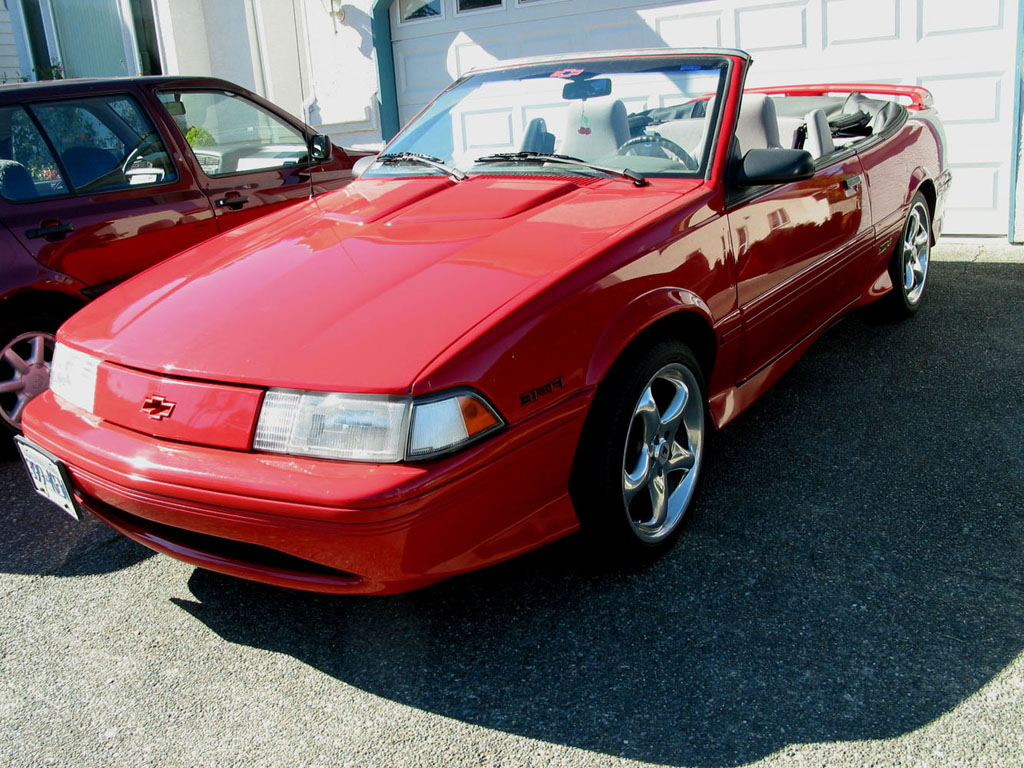
- Chevrolet Corvair II · Photo: Crwpitman / Wikimedia Commons, CC BY-SA 4.0
Chevrolet Corvair in our rankings
- No. 307 of 557 · Biggest engines: cars (2,683 cc · top 56%)
- No. 76 of 131 · Biggest engines: sedans (2,295 cc · top 59%)
- No. 235 of 368 · Most torque: cars (359 Nm · top 64%)
- No. 64 of 94 · Most powerful cars of the 1960s (134 kW · top 69%)
- No. 615 of 859 · Most powerful cars (134 kW · top 72%)
- No. 55 of 68 · Most torque: sedans (169 Nm · top 81%)
Bigger engine than 44% of ranked cars in the 1CARS catalog (No. 307 of 557).
FAQ
Where is the Corvair's engine?
Behind the rear axle: an air-cooled aluminium flat-six of 2.3 to 2.7 litres drives the rear wheels, as in every Corvair including the vans.
How many Corvairs were made?
About 1.8 million between 1959 and 1969; English Wikipedia gives 1,835,170 in total.
Was the Corvair really unsafe?
Ralph Nader criticised the handling of the 1960–1963 cars, but a 1972 NHTSA study found that they had no abnormal potential for loss of control or rollover.
What is the most powerful Corvair?
The 1965–1966 Corsa with the turbocharged 2.7-litre flat-six, rated at 134 kW (180 hp gross) and 359 Nm.
What replaced the Chevrolet Corvair?
The Chevrolet Vega took over as the small Chevrolet in 1970; the last Corvair was built on 14 May 1969.
Data sources
Data checked by an editor against the sources below.