Mercedes-Benz GLS: Specs, Engines and History
The Mercedes-Benz GLS is a full-size premium SUV with seven seats, which Mercedes proudly calls "the S-Class of SUVs". It continues the line of the GL-Class: when the second-generation GL was facelifted for 2016, it was renamed GLS to match the brand's new naming system, with the S signalling its place at the top of the SUV range. The all-new X167 GLS followed in 2019 and became larger, more modern, more technologically advanced and more comfortable.
Key takeaways
- The renamed, facelifted GL was revealed as the GLS in November 2015; the all-new X167 debuted at the New York International Auto Show in April 2019.
- Engines range from the 210 kW (286 PS) GLS 350 d to the 450 kW (612 PS) Mercedes-AMG GLS 63, all with a nine-speed automatic and 4MATIC all-wheel drive.
- Petrol versions have EQ Boost, a 48-volt system adding 16 kW (22 PS) and 250 Nm.
- Air suspension is standard, and the optional E-Active Body Control can even rock the car to free it from sand or mud.
Mercedes-Benz GLS at a glance
The first GLS was not a new model but an updated version of the second-generation GL-Class, renamed in line with the brand's new approach and presented in November 2015 at the Los Angeles motor show. Mercedes then unveiled the new X167 at the New York show in 2019, with a more modern cabin, upgraded equipment and revised engines. US sales began in October 2019, and most cars are built at the company's plant in Alabama. Facelifts were unveiled on 4 April 2023 and on 31 March 2026. A super-luxurious Mercedes-Maybach GLS 600 tops the range. More of the brand's models are in our Mercedes-Benz catalogue, and its flagship sedan is covered in Mercedes-Benz S-Class.
Exterior
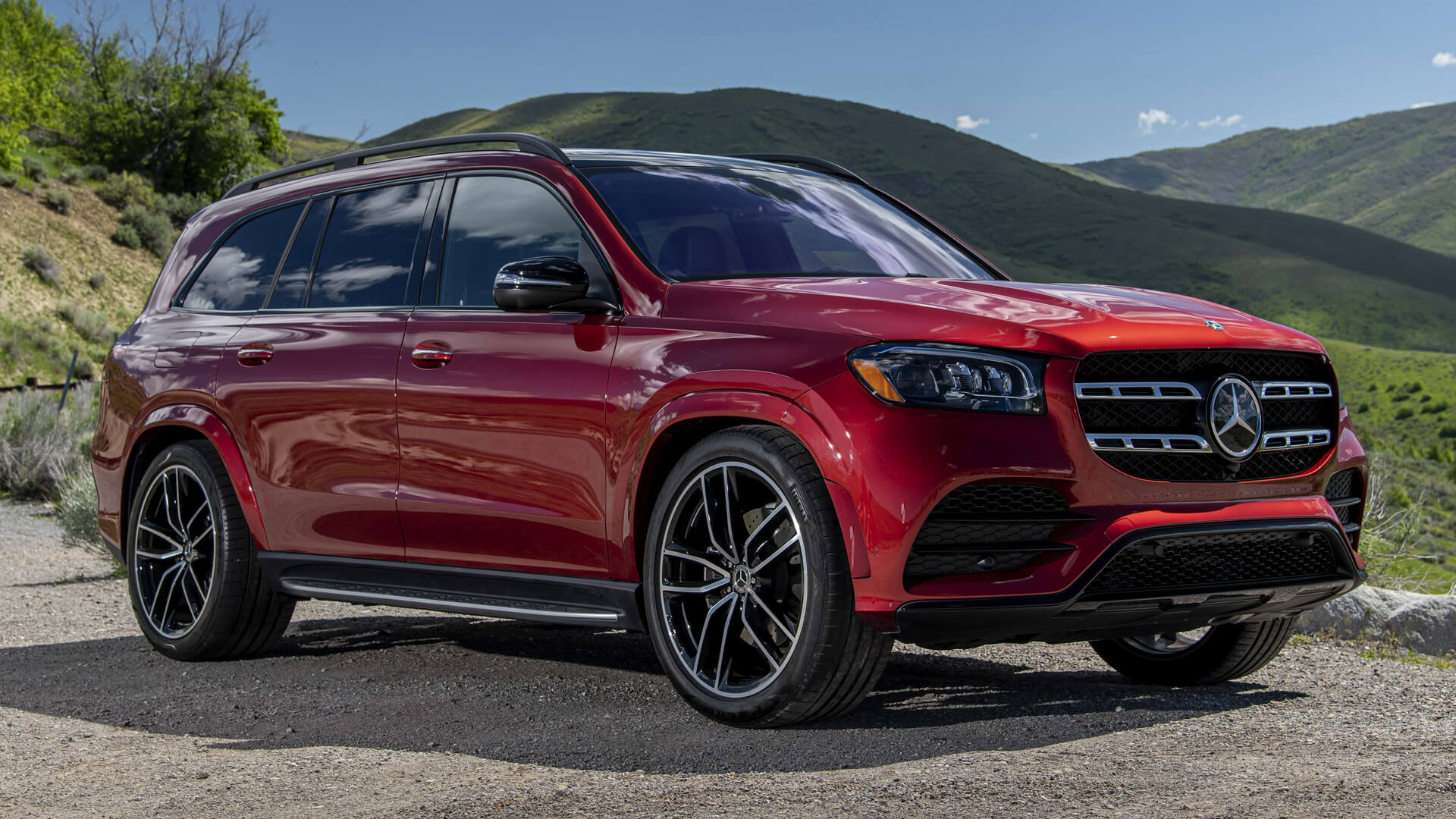
While many of the brand's SUVs look like crossovers, the GLS is unmistakably big and imposing, yet still elegant. Compared with its predecessor it has a reshaped grille, new surface details and larger windows. Most of the changes are at the front, which is longer but slightly raked so that visibility does not suffer. The bonnet has flowing sculpting, and below it is a large grille with a fine mesh, two chrome horizontal bars and a large three-pointed star in the centre.
The X167 introduced Multibeam LED headlights with 112 individually controlled LEDs, greatly improving illumination at night. The headlights are slightly smaller than before but no less effective. Below them, extra intakes help cool the engine; their size and shape depend on the version. Less powerful versions have small cut-outs and a chrome skid-plate insert, while more powerful ones have three large intakes in the bumper: a trapezoidal central one with chrome surround and two almost square side ones, with slim LED fog lights.
The side view is clean and purposeful. A long glasshouse is divided by slim gloss-black pillars and framed in chrome, the doors have gentle sculpting, the wheel arches are slightly flared, and chrome-trimmed retractable running boards sit below. Wheels range from 21 inches as standard to 23 inches, and ground clearance is a generous 200 mm. The upright rear has a small roof spoiler that frames the rear window, large LED tail lights linked by a chrome strip, and a substantial bumper with chrome inserts, a protective panel and two exhaust outlets at the corners.
Interior and practicality
The cabin is completely new and largely follows the smaller GLE, with a more modern and minimalist look. Leather, wood and aluminium are used throughout, and leather covers almost every surface within reach. The driver has a three-spoke multifunction steering wheel with aluminium trim and touch-sensitive controls, and two 12.3-inch MBUX screens under a single glass panel serve as the digital instrument display and the infotainment system; the software can be updated over the internet. A head-up display is optional.
The MBUX system understands voice commands and gestures. Below the screen are four rectangular air vents and a slim row of climate-control buttons. The console flows into a tunnel with two grab handles reminiscent of Porsche, a wood panel covering the cupholders, a touchpad with a leather wrist rest for the infotainment system and buttons for the off-road functions.
The front seats were redesigned to be more supportive and offer ventilation and full electric adjustment, and the driver can enter their height so that the car sets the seat automatically. The side support is modest, however. The second row is roomier than before, with its own climate control, a multifunction armrest and a removable 7-inch Android tablet that controls the climate and media systems; two 11.6-inch rear entertainment screens are also available. Buyers can choose a three-seat bench or two individual seats with armrests and electric adjustment. The second and third rows fold electrically at the touch of a button. The third row has two seats designed mainly for children, though adults can fit, and on the most expensive version it has its own climate control and two USB ports. The boot holds 355 litres with all seats in use and up to 2,400 litres with the second and third rows folded. The rear bench slides fore and aft, with a 60/40 split cushion and a 40/20/40 split backrest.
Engines and transmission (X167)
| Version | Engine | Power (kW / PS) | Torque |
|---|---|---|---|
| GLS 350 d 4MATIC | 2.9 inline-6 diesel | 210 kW / 286 PS | 600 Nm |
| GLS 400 d 4MATIC | 2.9 inline-6 diesel | 243 kW / 330 PS | 700 Nm |
| GLS 450 4MATIC | 3.0 inline-6 petrol + EQ Boost | 270 kW / 367 PS | 500 Nm |
| GLS 580 4MATIC | 4.0 V8 biturbo + EQ Boost | 360 kW / 489 PS | 700 Nm |
| Mercedes-Maybach GLS 600 | 4.0 V8 biturbo + EQ Boost | 410 kW / 557 PS | 730 Nm |
| Mercedes-AMG GLS 63 | 4.0 V8 biturbo + EQ Boost | 450 kW / 612 PS | 850 Nm |
The GLS 400 d uses the 2.9-litre OM656 diesel also found in the G-Class. It takes the GLS from 0 to 100 km/h in 6.3 seconds and uses around 11 l/100 km, according to published figures. The 3.0-litre M256 petrol six in the GLS 450 is not much quicker but noticeably thirstier. The petrol engines use EQ Boost: a 48-volt starter-generator that adds 16 kW (22 PS) and 250 Nm, smooths the engine's operation, restarts it in stop-start traffic and recovers energy under braking.
Every version uses the nine-speed 9G-TRONIC automatic and 4MATIC all-wheel drive, whose electronically controlled multi-plate clutch distributes torque between the axles. An optional Off-Road package adds a low-range gear.
Chassis
The GLS shares its architecture with the latest GLE. Suspension uses double wishbones at the front and a multi-link rear, with AIRMATIC air suspension and adaptive dampers as standard. Optional E-Active Body Control uses hydropneumatic struts powered by the 48-volt system: each wheel is controlled individually according to the road surface, the body can lean into bends, and a "free-driving" mode can rock the car up and down to help it escape from mud or sand. There are no true locking differentials; the brakes imitate them, which helps but cannot fully match mechanical locks.
Safety and equipment
The GLS has numerous airbags, traffic-sign recognition, blind-spot monitoring, Active Distance Assist DISTRONIC adaptive cruise control with semi-automated driving, automatic parking, PRE-SAFE occupant protection, adaptive Multibeam LED lights and a trailer manoeuvring assistant. Depending on the market, base versions include matrix LED headlights, dual-zone climate control, heating for all seats and the steering wheel, MBUX with navigation and a reversing camera, three rows of seats, a panoramic roof, automatic parking and 21-inch wheels; the top-spec version adds multi-contour massage seats, more expensive upholstery and E-Active Body Control.
Strengths and weaknesses
Owners praise the imposing looks, comfort, safety, excellent road manners and high reliability, as well as the spacious and modern cabin with its large screens and three rows of seats, the powerful engines and four-wheel drive, which together with the high ground clearance make it confident off tarmac too. The downsides are the very high price, expensive servicing and high fuel consumption. Rivals include the BMW X7, Range Rover, Lexus LX, Cadillac Escalade, Lincoln Navigator, Infiniti QX80 and Bentley Bentayga.
FAQ
When did the current Mercedes-Benz GLS come out?
The X167 debuted at the New York International Auto Show in April 2019 and went on sale in the US in October 2019.
How many seats does the Mercedes-Benz GLS have?
Seven as standard, in three rows; the second row can have two individual seats instead of a bench.
What is the most powerful GLS?
The Mercedes-AMG GLS 63, with a 4.0-litre biturbo V8 producing 450 kW (612 PS) and 850 Nm.
How big is the Mercedes-Benz GLS boot?
355 litres with all seats in use and up to 2,400 litres with the second and third rows folded.
What is E-Active Body Control?
An optional active suspension that controls each wheel individually, leans into corners and can rock the car to free it from sand or mud.