 Audi A7
All generations, specs and history
Published Sources (2) Report an error
By Felix Hartmann, Automotive Technology & EV Contributor
- Built
- 2010–2025
- Generations
- 2 · C7 to C8
Timeline
A7 generations
Click a generation for its own page


Newest first · 2 generations since 2010
All generations by year: A7 C8 (2018–2025) · A7 C7 (2010–2018)
Which one is mine?
Pick the year of first registration to see which generation it is.
- C8 2018–2025
- C7 2010–2018
The Audi A7 Sportback is a full-size premium liftback that Audi itself calls a four-door coupé, even though it has a fifth door at the back. It sits one step below the flagship Audi A8 and was built in two generations between 2010 and 2025. The A7 combines a sweeping coupé roofline with the practicality of a large hatchback.
In short
- Previewed by the Sportback concept at the 2009 Detroit motor show; the first generation (C7) was revealed in Munich on 26 July 2010 and shown at the Paris motor show that autumn.
- The second generation (C8) was revealed in October 2017 and built at Neckarsulm from February 2018.
- C8 engines range from 140 kW (190 PS) to the 463 kW (630 PS) of the RS 7 Performance; all use a 48-volt mild-hybrid system.
- Rear-wheel steering, air suspension and HD Matrix LED lights with laser high beam are available.
Running cost
Fuel · A7 C8 3 L 6 cyl Automatic (AM-S7) · 2023 (EPA)
about 2,550 EUR fuel a year at 15,000 km
9.8 l/100 km · petrol at 1.75 EUR/l · change mileage, fuel price or version
Specs by version
Engines
| Version | Engine | Gearbox | Drive | Production years |
|---|---|---|---|---|
| C8 · 2018–2025 | ||||
| C8 · 3 L 6 cyl Automatic (AM-S7) · 2023 (EPA) | 3.0 l · 6 cyl · Hybrid 3,000 cc | 7-sp Dual-clutch | All-wheel drive | 2023 |
Performance
Show all 1 versions
| Version | Fuel consumption |
|---|---|
| C8 · 2018–2025 | |
| C8 · 3 L 6 cyl Automatic (AM-S7) · 2023 (EPA) | 9.8 l/100 km24.0 mpg US · 28.8 mpg UK |
Verified Manufacturer and type-approval data from our catalog · Sources and methodology
Audi A7 at a glance
The A7 story began with the Audi Sportback concept at the Detroit motor show in January 2009. The production car was unveiled on 26 July 2010 and made its public debut at the Paris motor show, with sales starting that autumn. The facelifted A7, unveiled in May 2014, brought Matrix LED headlights, a new MMI system and revised engines that all met Euro 6. As rivals moved on, Audi prepared a new generation, revealed on 19 October 2017, with attractive styling, a luxurious cabin, advanced technology and a rich list of equipment. Sporty S7 and RS 7 versions sit at the top of the range. More models are in our Audi catalogue, and the flagship that sits above it is covered in Audi A8.
Generations
| Generation | Years | Notes |
|---|---|---|
| C7 | 2010–2018 | Revealed in Munich in July 2010; facelift 2014 with Matrix LED lights |
| C8 | 2018–2025 | MLB platform, 48-volt mild hybrid on all engines, new MMI touch response |
Exterior of the second generation
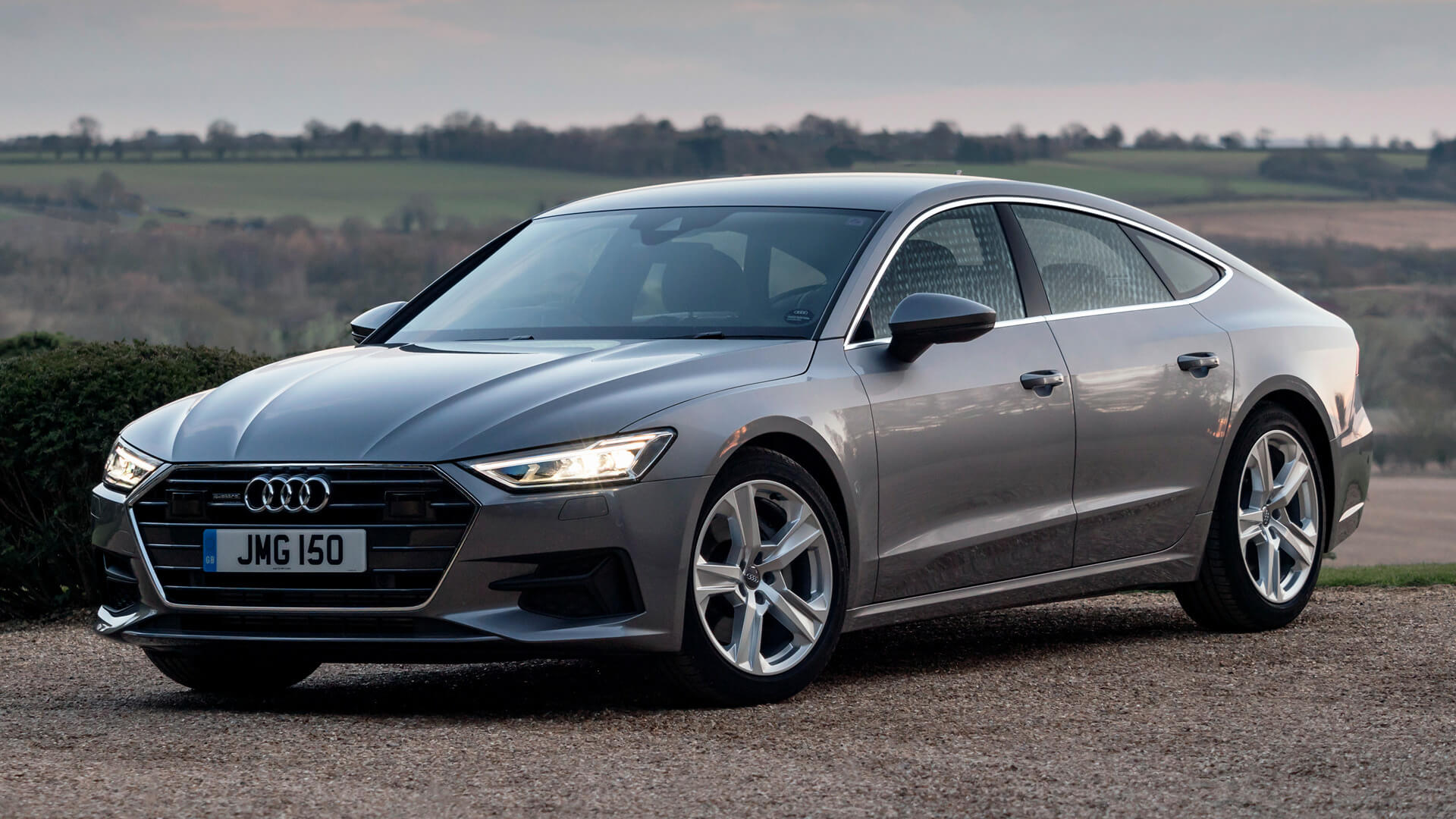
Like every Audi, the A7 looks very attractive and appeals to young and experienced drivers alike. The front is the most striking part: it is raked for a more purposeful look, and the bonnet has wide, flowing ridges that rise and fall along its length, which also helps visibility and aerodynamics. The almost rectangular, slightly angled headlights give excellent illumination at any time of day. LED headlights are standard; HD Matrix LED lights, which switch off individual segments to avoid dazzling other drivers, are optional, and the top option adds Audi laser light high beam.
Between the headlights sits Audi's polygonal Singleframe grille, slightly recessed into the body with a thin chrome surround and a large gloss-black mesh. The lower bumper has two large rectangular side intakes with grilles that cool the brakes, a small trapezoidal intake below the main grille and a compact splitter.
In profile, stepped sculpting on the doors stands out. The long, slim window line is framed in chrome or black, with gloss-black pillars, and the mirrors have a triangular shape, with indicators on some versions. The wheel arches are strongly flared and the sills sporty. Ground clearance is 145 mm, and wheels range from 18 inches as standard to 21 inches.
At the rear, the long, steeply sloping roof flows into a short tailgate with an aerodynamic lip. A full-width light strip runs across it, narrow in the middle and wider at the sides. The bumper has a black diffuser, chrome trim and two large exhaust outlets. An active rear spoiler deploys automatically above 120 km/h to improve stability.
Interior and practicality
The cabin introduced a style that Audi planned to use across its range. Materials are of high quality, with Milano or Valcona leather and aluminium and wood inserts that buyers can choose to personalise the car. Upholstery options include two-tone leather, perforated leather and combinations of Alcantara and fabric. Comfort, sports and S sports seats are available; base versions have manually adjustable seats, which feels out of place in this class, but electric adjustment is optional. The best front seats have well-judged padding, pronounced side bolsters, many adjustments, massage, heating and ventilation.
Depending on the version, the driver has a three- or four-spoke steering wheel with controls for the instruments and infotainment; paddle shifters and heating are optional. A 12.3-inch fully digital instrument display can imitate analogue dials or show navigation.
The two-level centre console carries two screens. The upper 10.1-inch MMI touch response display handles infotainment and navigation, and the lower 8.6-inch one controls climate and accepts handwriting input. Both give haptic and acoustic feedback, so inputs register only with a deliberate press. MMI navigation plus can show 3D images using Google Earth. The tunnel holds a compact gear selector in aluminium and leather, the electronic parking brake switch and covered cupholders.
The rear bench is designed for three, though the centre passenger is less comfortable; two individual rear seats are also available. Rear passengers get their own climate controls, a 12-volt socket and two USB ports, and with optional four-zone climate control a small touchscreen in the rear. Audio options include a Bang & Olufsen 3D Premium Sound System with 16 speakers and a subwoofer, and an Advanced Sound System with 19 speakers. The boot holds 535 litres, rising to 1,390 litres with the rear seats folded to a completely flat floor. The power tailgate opens with a kick under the bumper.
Engines and transmissions (C8)
| Version | Engine | Power (kW / PS) | Torque |
|---|---|---|---|
| 40 TFSI | 2.0 inline-4 turbo petrol | 140 kW / 190 PS | 320 Nm |
| 45 TFSI | 2.0 inline-4 turbo petrol | 180–185 kW / 245–252 PS | 370 Nm |
| 55 TFSI | 3.0 V6 turbo petrol | 250 kW / 340 PS | 500 Nm |
| 55 TFSI e | 2.0 petrol plug-in hybrid | 270 kW / 367 PS (system) | 500 Nm |
| 40 TDI | 2.0 inline-4 diesel | 150 kW / 204 PS | 400 Nm |
| 45 TDI | 3.0 V6 diesel | 170 kW / 231 PS | 500 Nm |
| 50 TDI | 3.0 V6 diesel | 210 kW / 286 PS | 600–620 Nm |
| S7 | 2.9 V6 biturbo petrol / 3.0 V6 TDI | 331 kW / 450 PS or 257 kW / 349 PS | 600 / 700 Nm |
| RS 7 Performance | 4.0 V8 biturbo petrol | 463 kW / 630 PS | 850 Nm |
At launch, the C8 was offered with the 3.0 TFSI V6, featuring direct injection, turbocharging, variable valve timing and 24 valves. It reaches 100 km/h in 5.3 seconds and a limited 250 km/h, using about 6.8 l/100 km. All engines work with a 48-volt mild-hybrid system: a belt-driven starter-generator allows the engine to switch off in traffic and to coast with the engine off between 55 and 160 km/h. The 2.0 45 TFSI with quattro reaches 100 km/h in 6.2 seconds.
The 55 TFSI uses a seven-speed S tronic dual-clutch transmission with quattro ultra all-wheel drive, which uses two clutches to send torque to the rear axle when needed. The V6 diesels use an eight-speed tiptronic automatic with torque converter and permanent quattro.
Chassis
The A7 uses Audi's MLB modular platform with a longitudinal engine and a body made mainly of steel, with large outer panels in aluminium. The combination of high-strength steel and aluminium made the car lighter than its predecessor and stiffer. Suspension is independent, with five-link (double-wishbone type) front and multi-link rear axles, offered in three versions: standard steel springs, a sports suspension 10 mm lower, and adaptive air suspension with conventional or electronically controlled dampers. Progressive steering is standard, and dynamic all-wheel steering is optional, turning the rear wheels by up to 5 degrees for better manoeuvrability and stability. Brakes are ventilated discs all round.
Safety and equipment
As the model just below the A8, the A7 offers a long list of safety and assistance systems: airbags around the cabin, cruise control with a speed limiter, traffic-sign recognition, night vision with pedestrian detection, a parking assistant, reversing and surround-view cameras, lane-change and lane-departure warning, driver-fatigue monitoring, blind-spot warning, up to 24 sensors including radar, ultrasonic sensors and a laser scanner, ABS, EBD and stability control, hold assist, three-point belts with pretensioners, HD Matrix LED lights and ISOFIX mounts. Depending on the market, base versions have six airbags, leather, full LED lights, heated electric front seats, dual-zone climate control, automatic parking, 18-inch wheels, cruise control and a ten-speaker audio system; higher trims add heated windscreen and steering wheel, an electric steering column, keyless entry, wireless charging, 19-inch wheels and four-zone climate control.
Strengths and weaknesses
Owners praise the stylish looks, roomy cabin, excellent lighting, strong performance, innovative assistance systems, reasonable fuel consumption, practical boot and outstanding handling and suspension. Complaints include occasional reliability issues, expensive dealer servicing and parts, frameless door windows that can freeze in winter, and steering racks that some owners find weak. Rivals include the Mercedes-Benz CLS, BMW 6 Series Gran Turismo and 8 Series Gran Coupé, and the Porsche Panamera.
Image credits · Photos from Wikimedia Commons under free licences
- Audi A7 C7 · Photo: Vauxford / Wikimedia Commons, CC BY-SA 4.0
- Audi A7 C8 · Photo: Damian B Oh / Wikimedia Commons, CC BY-SA 4.0
Audi A7 in our rankings
- No. 4 of 70 · Biggest engines: hatchbacks (3,000 cc)
- No. 250 of 912 · Longest-running car nameplates (15 years · top 28%)
- No. 259 of 557 · Biggest engines: cars (3,000 cc · top 51%)
- No. 154 of 256 · Most economical cars (9.8 l/100 km · top 62%)
- No. 40 of 42 · Most economical hatchbacks (9.8 l/100 km · top 96%)
- No. 295 of 345 · Cars with the most generations (2 generations)
Bigger engine than 94% of ranked hatchbacks in the 1CARS catalog (No. 4 of 70).
FAQ
How many generations of the Audi A7 are there?
Two: the C7 (2010–2018) and the C8, revealed in October 2017 and built until 2025.
Is the Audi A7 a coupé or a hatchback?
Audi calls it a four-door coupé, but it is a five-door liftback with a large tailgate.
How big is the Audi A7 boot?
535 litres, or 1,390 litres with the rear seats folded to a flat floor.
What is the most powerful Audi A7?
The RS 7 Performance, with a 4.0-litre biturbo V8 producing 463 kW (630 PS) and 850 Nm.
Does the Audi A7 have rear-wheel steering?
Yes, as an option on the C8: dynamic all-wheel steering turns the rear wheels by up to 5 degrees.
Data sources
Data checked by an editor against the sources below.
- Wikipedia — Audi A7
- US EPA fueleconomy.gov — 45656.shtml