Volkswagen Teramont: Volkswagen's Seven-Seat SUV
The Volkswagen Teramont is a large SUV with six or seven seats and the biggest model in Volkswagen's SUV range. Volkswagen first showed it on 27 October 2016 at a special event in Santa Monica, California, under its North American name, Volkswagen Atlas, followed by a full presentation at the Los Angeles Auto Show in November 2016. The car is called Atlas in the United States, Canada and a few other countries and Teramont in most other markets, including China, Mexico and much of the Middle East. A facelift was unveiled at the Chicago Auto Show in February 2020.
Key takeaways
- Revealed in 2016 as the VW Atlas; on sale in the US from May 2017; facelifted for the 2021 model year and again for 2024.
- Built in Chattanooga, Tennessee, and by SAIC Volkswagen in Ningbo, China, on the MQB platform.
- Engines: 2.0 TSI four-cylinder with 162–175 kW (220–238 PS) and a 3.6 VR6 with 206 kW (280 PS), both with an eight-speed automatic.
- Six or seven seats, 203 mm of ground clearance and up to 2,740 litres of cargo space.
Volkswagen Teramont at a glance
A shorter, two-row version with a lower roof, the Atlas Cross Sport (Teramont X in some markets), joined the range for the 2020 model year. More Volkswagen models are listed in our Volkswagen catalogue, and its more upmarket sibling is covered in our Volkswagen Touareg article.
| Item | Detail |
|---|---|
| Reveal | 27 October 2016, Santa Monica (as the Atlas) |
| Show debut | Los Angeles Auto Show, November 2016 |
| Platform | MQB |
| Plants | Chattanooga (USA); Ningbo (China) |
| Facelifts | 2021 model year (Chicago 2020); 2024 model year |
| Seats | 6 or 7 |
Exterior
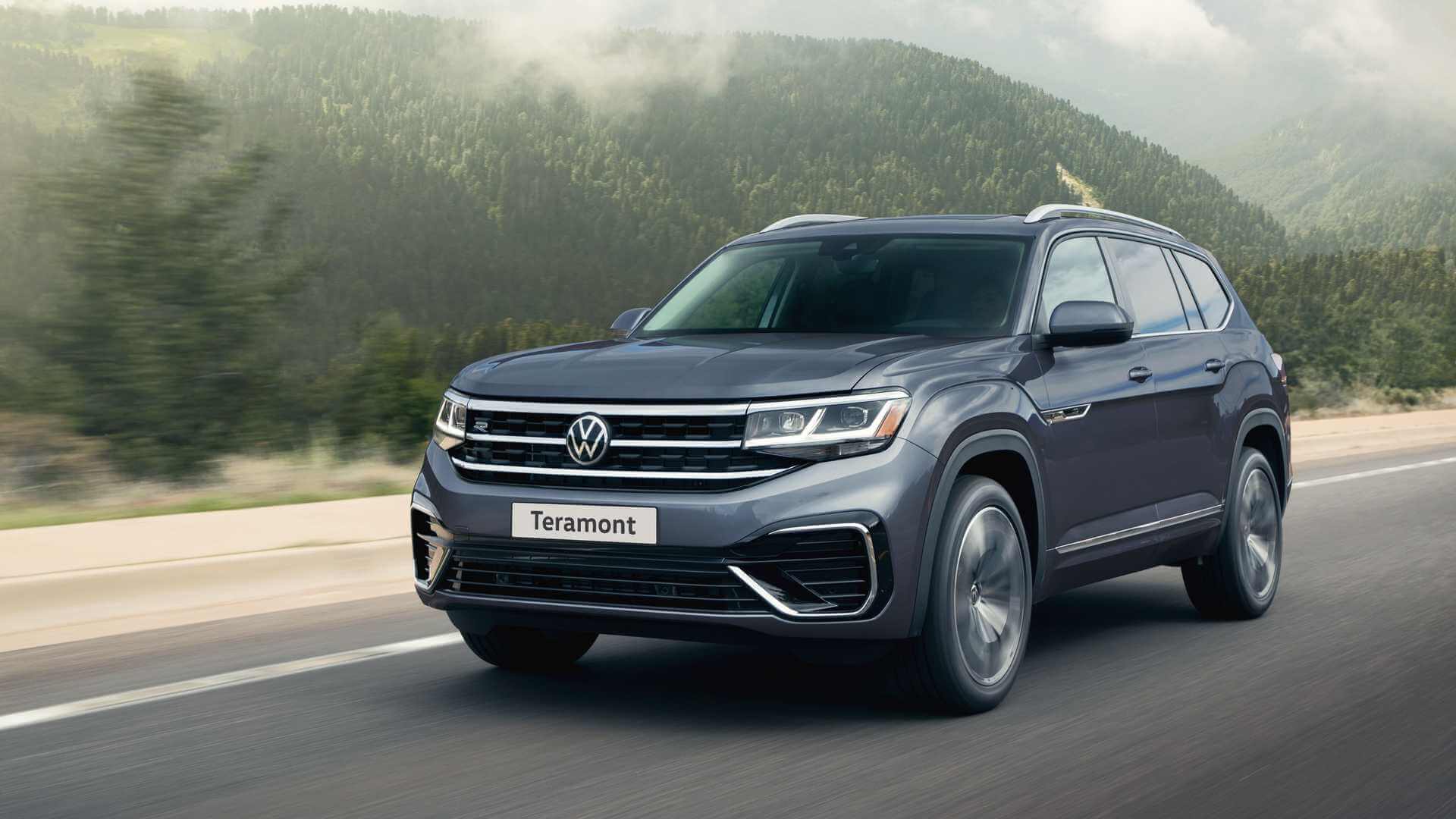
The facelifted Teramont's styling is one of its strengths. The earlier car simply looked solid; the updated one gained more elements that make it look tougher and help it stand out in traffic: chrome inserts and both stepped and wave-like surfacing, assertive lights and air intakes.
The front is large and set high, as is usual in this class, which makes it harder for shorter drivers to judge the road ahead, although good seat-height adjustment and the slight slope of the nose help. The bonnet is covered with sculpted surfaces of various shapes and sizes. The wide grille takes the form of a band with several horizontal chrome bars and the VW badge in the centre, flanked by large headlights; even the entry-level Teramont gets LED headlights with daytime running lights.
The bumper below is assertive and protrudes slightly. It has stepped surfaces, triangular recesses at the sides with grilles that guide air to the brakes and, on some versions, fog lamps, plus a trapezoidal lower intake with a large mesh and chrome surround, and protective elements in unpainted plastic and metal.
The profile looks solid rather than aggressive. At the top there are chrome roof rails and a long window line divided by thin chrome strips that also frame it. The neat mirrors carry indicators, the body sides feature stepped and wave-like surfacing, and the almost square wheel arches and sills are protected by unpainted plastic. Standard wheels are 18-inch alloys with wide spokes, with 19- and 20-inch wheels optional. Ground clearance is a practical 203 mm. The rear windows of the facelifted car have privacy glass that blocks up to 65% of light.
The rear is almost vertical and dominated by the tailgate. A small spoiler with a brake light sits at the top, followed by a large rectangular window and stylish LED tail lights connected by a decorative chrome strip. The rear bumper protrudes slightly like the front one and has fog lamps, reflectors, chrome inserts, a metal-look diffuser, plastic protection and large trapezoidal exhaust outlets.
Interior
The cabin is designed for comfort and practicality, and its size allows three rows of seats, although the third is better suited to children on long trips. Materials include premium leather, ergonomic quality plastics and wood inserts.
The driver's seat is comfortable and modern, and getting in and out is easy. The bonnet line is clearly visible, and large mirrors help visibility, although they lack auto-dimming. The standard instrument panel has two dials and a large information display between them showing extra data or navigation maps; more expensive versions have a 12.3-inch digital cockpit. The three-spoke multifunction steering wheel is slightly flattened at the bottom. The seats are trimmed in premium leather and have extensive electric adjustment; depending on the market, even the base car can have memory and heating, and higher versions add ventilation. The front seats are ergonomic, with good side support and many adjustments.
The centre console has a typically restrained German design with clean lines, rectangular air vents and silver plastic trim. The infotainment system has a 6.5-inch screen with Android Auto and Apple CarPlay, and more expensive versions get an 8-inch screen. Next to it is a neat climate control unit with three knobs. The tunnel has a deep tray - with wireless charging on higher trims - two cupholders, the gear selector and a rotary controller for the audio system; it ends at the second row with air vents and USB ports.
The second row is raised slightly and has three ISOFIX mounts; two individual captain's chairs can replace the bench. Volkswagen recommends the third row for children, but two adults can sit there for short journeys, and the second row slides forward for easier access. With seven seats in use, the boot holds 583 litres; folding the third row increases this to 1,500 litres, and folding both rear rows gives 2,740 litres. A space-saver spare and tools are stored under the floor.
Engines and transmission
| Engine | Power | Torque | 0–100 km/h | Notes |
|---|---|---|---|---|
| 2.0 TSI four-cylinder turbo | 162 kW (220 PS) | 350 Nm | 8.6 s | Rating outside North America; about 9.4 l/100 km; 190 km/h |
| 2.0 TSI four-cylinder turbo (US) | 175 kW (235 hp) | 350 Nm | - | 2018–2023 model years |
| 3.6 VR6, naturally aspirated | 206 kW (280 PS) | 361 Nm | 8.9 s | Dropped for the 2024 model year |
The 2.0 TSI has direct injection, a turbocharger, 16 valves and variable valve timing. The 3.6-litre VR6 has direct injection, a chain-driven valvetrain, 24 valves and variable timing on both camshafts; published figures give combined consumption of about 8.4 l/100 km for it. Both engines are paired with an eight-speed automatic. Front-wheel drive is offered in some markets, and 4Motion all-wheel drive with a fifth-generation Haldex clutch at the rear axle is available on most models. The drive mode is selected with a rotary controller on the tunnel. Normally all torque goes to the front wheels; when needed, the clutch sends up to 50% to the rear.
Chassis
The Teramont is built on Volkswagen's modular MQB platform, with a transverse engine and extensive use of high-strength steel in the body. The suspension is fully independent, with MacPherson struts at the front and a multi-link rear axle, telescopic dampers, coil springs and anti-roll bars at both ends. Rack-and-pinion steering with electric assistance makes the big SUV easy to drive. All four wheels have disc brakes, with 335 mm ventilated discs at the front, supported by electronic assistance systems.
Safety and equipment
The facelifted Teramont offers a 360-degree camera, traffic jam assist, lane keeping assist, blind-spot monitoring, parking sensors, automatic high-beam control, front and curtain airbags, LED headlights, ABS, ESP, traction control and cruise control.
A well-equipped pre-facelift entry version has six airbags, three-zone climate control, 18-inch alloy wheels, heated electric front seats, LED headlights, ABS and ESP, cruise control, an 8-inch infotainment screen and a six-speaker audio system. Higher trims add light and rain sensors, leather upholstery, surround-view cameras, blind-spot monitoring, a power tailgate, the digital instrument cluster, a heated windscreen and second-row seats, lane assist, a panoramic roof, automatic parking and ventilated seats.
Rivals
The Teramont competes with the Ford Explorer, Skoda Kodiaq, Mazda CX-90, Toyota Highlander, Chevrolet Traverse, Ford Edge, Nissan Murano, Infiniti QX60 and Lexus RX.
Verdict
The facelift did not change the Teramont radically, but Volkswagen's engineers improved it in many details. It looks more modern outside and has more advanced equipment inside, and it remains a powerful, roomy seven-seat SUV. Good all-wheel drive and decent ground clearance let it go where many crossovers would get stuck, and the new lighting illuminates the road better.
FAQ
Is the Volkswagen Teramont the same as the Atlas?
Yes. The car is sold as the Atlas in the United States, Canada and a few other countries and as the Teramont in most other markets.
Where is the Volkswagen Teramont built?
In Chattanooga, Tennessee, and by SAIC Volkswagen in Ningbo, China.
What engines does the Volkswagen Teramont have?
A 2.0 TSI four-cylinder with 162–175 kW (220–238 PS) and, until the 2024 model year, a 3.6 VR6 with 206 kW (280 PS), both with an eight-speed automatic.
How big is the Volkswagen Teramont boot?
583 litres with seven seats in use, 1,500 litres with the third row folded and up to 2,740 litres with both rear rows folded.