 Rolls-Royce Ghost
All generations, specs and history
Published Sources (5) Report an error
By Felix Hartmann, Automotive Technology & EV Contributor
- Built
- 2009–present
- Generations
- 2
Timeline
Ghost generations
Click a generation for its own page


Newest first · 2 generations since 2009
All generations by year: Ghost II (2020–now) · Ghost I (2009–2020)
Which one is mine?
Pick the year of first registration to see which generation it is.
Check by VINVerdict
Our verdict · Felix Hartmann
Rolls-Royce improved the Ghost while keeping the marque's hallmarks. The second generation is quieter, more comfortable and more technologically advanced than before. It is not the flagship Phantom, but it costs considerably less. Rolls-Royce cars do not try to win speed contests; they are chosen by people who are sure of themselves. Yet although the Ghost rides with exceptional smoothness, it can be very fast when needed.
The Rolls-Royce Ghost is a full-size luxury saloon that combines traditional British refinement with strong performance. The first generation, rear-wheel drive, was unveiled at the Frankfurt motor show in September 2009 and updated as the Series II at the Geneva motor show in March 2014. The second generation, revealed on 1 September 2020, switched to all-wheel drive and all-wheel steering, while keeping the Ghost's recognisable shape with far fewer superfluous lines.
In short
- First generation 2009–2020 on the BMW 7 Series (F01) platform; Series II from 2014, plus a Black Badge version.
- Second generation since 2020 on Rolls-Royce's aluminium "Architecture of Luxury", shared with the Phantom and Cullinan.
- Twin-turbo V12 engines: 6.6 litres with 419–450 kW (570–612 PS), then 6.75 litres with 420 kW (571 PS).
- Standard and extended wheelbases; 490 and 507 litres of boot space.
Specs by version
Engines
| Version | Engine | Gearbox | Drive | Production years |
|---|---|---|---|---|
| Ghost I · 6.6 L 12 cyl Automatic (S8) · 2019 (EPA) | 6.6 l · 12 cyl 6,600 cc | 8-sp Automatic | Rear-wheel drive | 2019 |
| Ghost II · 6.6 L 12 cyl Automatic (S8) · 2020 (EPA) | 6.6 l · 12 cyl 6,600 cc | 8-sp Automatic | Rear-wheel drive | 2020 |
| Ghost II · 6.7 L 12 cyl Automatic (S8) · 2026 (EPA) | 6.7 l · 12 cyl 6,700 cc | 8-sp Automatic | All-wheel drive | 2026 |
| Ghost II · 6.7 L 12 cyl Automatic (S8) · 2025 (EPA) | 6.7 l · 12 cyl 6,700 cc | 8-sp Automatic | All-wheel drive | 2025 |
| Ghost II · 6.7 L 12 cyl Automatic (S8) · 2024 (EPA) | 6.7 l · 12 cyl 6,700 cc | 8-sp Automatic | All-wheel drive | 2024 |
| Ghost II · 6.7 L 12 cyl Automatic (S8) · 2023 (EPA) | 6.7 l · 12 cyl 6,700 cc | 8-sp Automatic | All-wheel drive | 2023 |
| Ghost II · 6.7 L 12 cyl Automatic (S8) · 2022 (EPA) | 6.7 l · 12 cyl 6,700 cc | 8-sp Automatic | All-wheel drive | 2022 |
| Ghost II · 6.7 L 12 cyl Automatic (S8) · 2021 (EPA) | 6.7 l · 12 cyl 6,700 cc | 8-sp Automatic | All-wheel drive | 2021 |
Performance
Show all 8 versions
| Version | Fuel consumption |
|---|---|
| Ghost I · 6.6 L 12 cyl Automatic (S8) · 2019 (EPA) | 16.8 l/100 km14.0 mpg US · 16.8 mpg UK |
| Ghost II · 6.6 L 12 cyl Automatic (S8) · 2020 (EPA) | 16.8 l/100 km14.0 mpg US · 16.8 mpg UK |
| Ghost II · 6.7 L 12 cyl Automatic (S8) · 2026 (EPA) | 16.8 l/100 km14.0 mpg US · 16.8 mpg UK |
| Ghost II · 6.7 L 12 cyl Automatic (S8) · 2025 (EPA) | 16.8 l/100 km14.0 mpg US · 16.8 mpg UK |
| Ghost II · 6.7 L 12 cyl Automatic (S8) · 2024 (EPA) | 16.8 l/100 km14.0 mpg US · 16.8 mpg UK |
| Ghost II · 6.7 L 12 cyl Automatic (S8) · 2023 (EPA) | 16.8 l/100 km14.0 mpg US · 16.8 mpg UK |
| Ghost II · 6.7 L 12 cyl Automatic (S8) · 2022 (EPA) | 16.8 l/100 km14.0 mpg US · 16.8 mpg UK |
| Ghost II · 6.7 L 12 cyl Automatic (S8) · 2021 (EPA) | 16.8 l/100 km14.0 mpg US · 16.8 mpg UK |
Verified Manufacturer and type-approval data from our catalog · Sources and methodology
Rolls-Royce Ghost at a glance
The Ghost sits below the flagship Phantom and has become the brand's best-selling model. More Rolls-Royce models are listed in our Rolls-Royce catalogue, and the story of the marque is told in our history of Rolls-Royce.
| Generation | Years | Platform | Engine | Power (kW / PS) | Drive |
|---|---|---|---|---|---|
| First | 2009–2020 (Series II from 2014) | BMW F01 | 6.6 V12 twin-turbo | 419–450 kW / 570–612 PS | Rear |
| Second | 2020 onwards (Series II from 2024) | Architecture of Luxury | 6.75 V12 twin-turbo | 420 kW / 571 PS | All-wheel |
First generation (2009–2020)
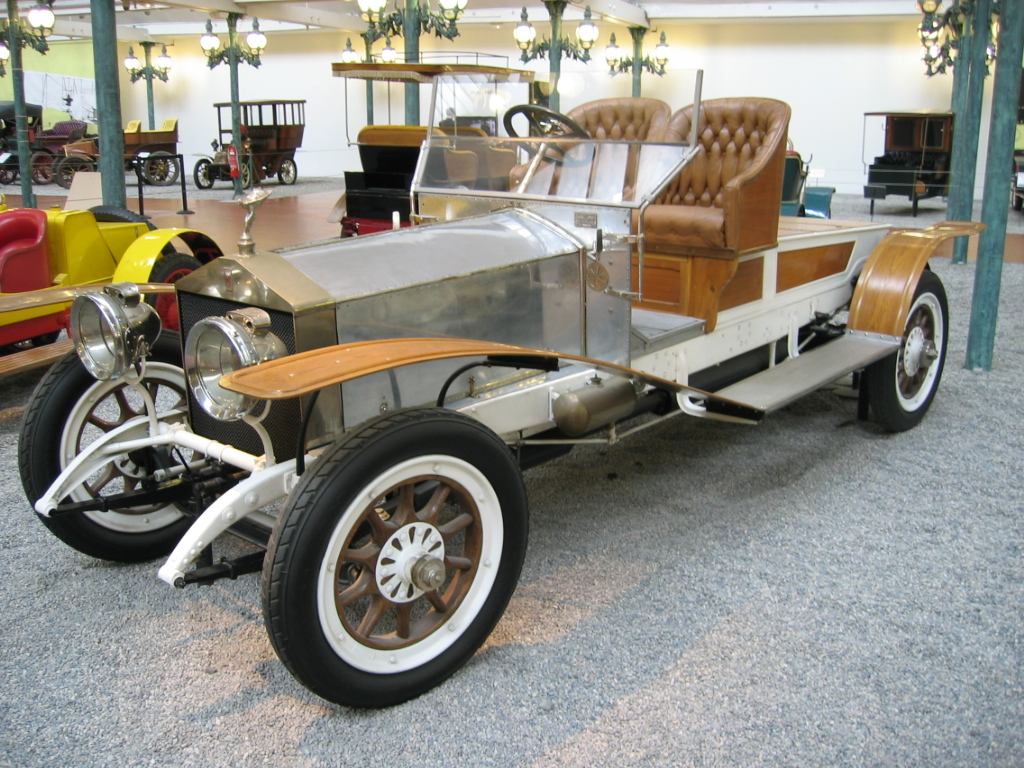
The saloon was named after the 1906 Silver Ghost, one of the most famous cars in the company's history. It has the brand's unmistakable grille and the Spirit of Ecstasy, the "flying lady" mascot, which retracts into the bonnet.
Exterior
The Ghost looks solid and is just that. A long, sculpted bonnet with a chrome centre strip ends with the retractable mascot, and the large rectangular grille is all chrome. The narrow headlights have LED internals, with sidelights below them. The front bumper is modest, with only air intakes in its lower section.
From the side the car looks fairly plain, apart from large mirrors, massive door handles of polished aluminium and chrome window surrounds. Ground clearance is 150 mm, and the air suspension can vary it between 125 and 175 mm. Large wheel arches carry 19-inch wheels as standard, with 21-inch factory wheels available. The rear has compact oval LED lights, a large boot lid with a chrome strip and two big exhaust pipes in the bumper. The Ghost is just as imposing as its big brother, the Rolls-Royce Phantom, but its design is more cohesive. It was offered with a standard or, from 2011, an extended wheelbase.
Interior
As in every Rolls-Royce, build quality is exceptional and only the best materials are used. The leather front and rear seats have electric adjustment with memory, heating and ventilation, and there is space to spare.
The driver faces a comfortable leather-trimmed three-spoke wheel with gloss inserts, electric adjustment and buttons for the various systems, and analogue instruments; the electronic parking brake switch sits behind the wheel. A head-up display shows plenty of information. The dashboard carries a large wooden panel whose veneer the buyer chooses when ordering. At the top of the console, a 10.25-inch screen for the infotainment and navigation system emerges from behind a panel. Below it are air vents, various buttons and the unusual climate controls: chrome organ-stop levers that adjust temperature in steps rather than to an exact figure. Further down are the controls for seat heating, ventilation and infotainment.
The tunnel has large storage compartments, a big rotary controller topped with the Spirit of Ecstasy for the infotainment system and cupholders. Rear passengers get similar functions. The boot holds 490 litres in every version and is trimmed in high-quality materials. There is no spare wheel, as the car runs on run-flat tyres.
Engine and transmission
The first-generation Ghost uses an aluminium 6.6-litre twin-turbo V12 with 48 valves, direct injection and variable valve timing. It produces 419 kW (570 PS) and 780 Nm (820 Nm from 2016); the Black Badge version has 450 kW (612 PS) and 840 Nm. Fuel consumption is 14–14.6 l/100 km.
A ZF eight-speed automatic uses navigation data to select the best gear for the road ahead. The first generation is rear-wheel drive only. It reaches 100 km/h in 4.8–5.0 seconds, and top speed is limited to 250 km/h.
Chassis
The Ghost is based on the platform of the BMW 7 Series (F01). The monocoque body uses high-strength steel and aluminium. The fully independent air suspension, with double wishbones at the front and a multi-link rear axle, has adaptive dampers and active anti-roll bars and can adjust its settings every 2.5 milliseconds. Rack-and-pinion steering with hydraulic assistance makes the big car easy to manoeuvre. All four brakes are ventilated discs, 410 mm at the front and 402 mm at the rear.
Equipment
Few buyers order a Ghost in standard form; most specify their car individually. Even the standard car has six airbags, four-zone climate control, 19-inch wheels, ABS and stability control, LED headlights and tail lights, adaptive cruise control, power-closing doors and boot lid, heated front and rear seats, surround-view cameras and a sound system with 14 speakers and two subwoofers.
Second generation (2020 onwards)
Revealed in September 2020, the new Ghost is the brand's most popular model. According to Rolls-Royce, it carries over only the Spirit of Ecstasy and the umbrellas in the doors from its predecessor. The first car shared its platform with the BMW 7 Series; the new one shares Rolls-Royce's own aluminium architecture with the Phantom, which changed generation three years earlier, and with the Cullinan. It is more dynamic, better equipped and noticeably more expensive.
Exterior
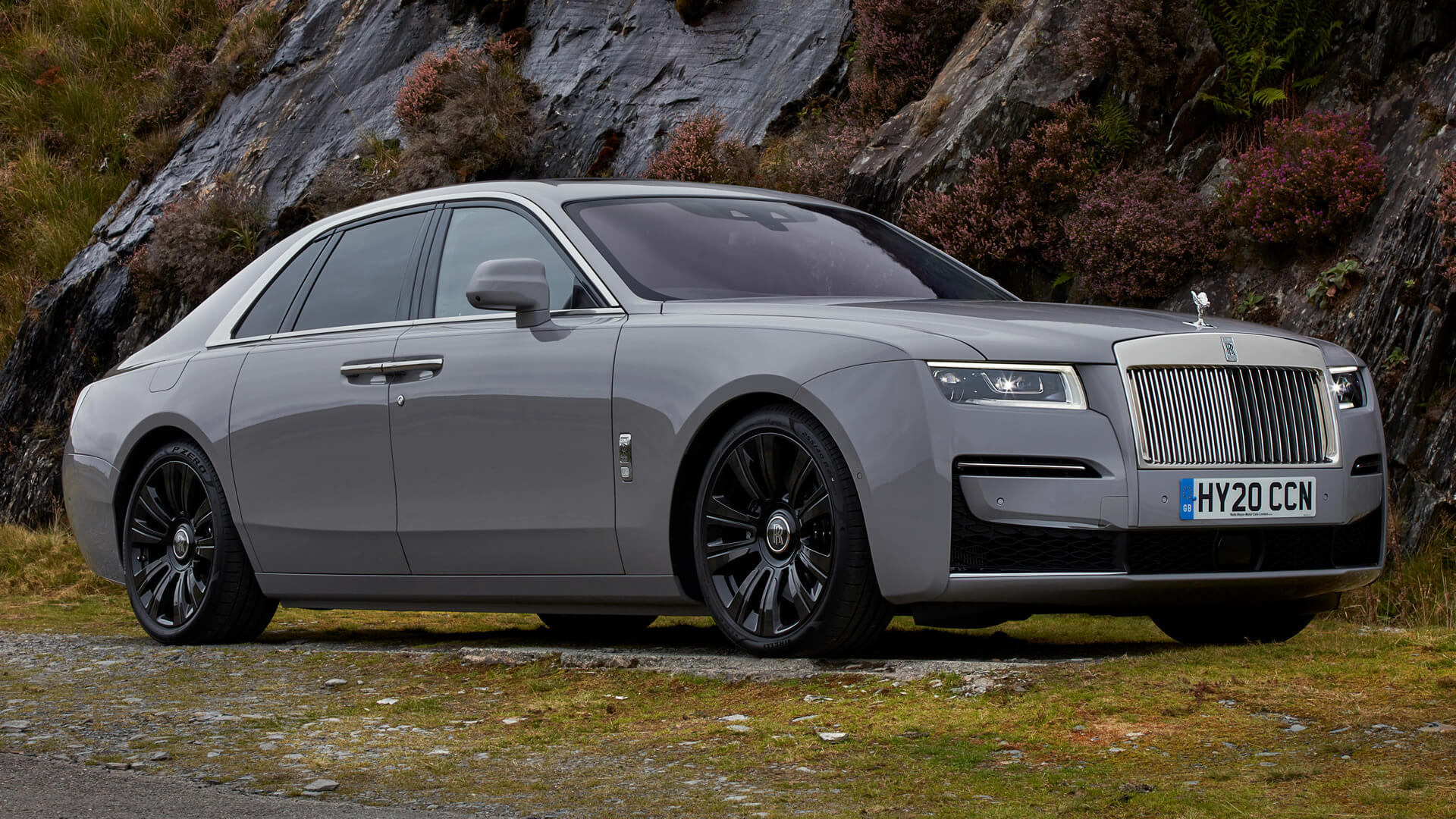
The second Ghost keeps the brand's style but loses most of the lines of the previous model, following the "Post Opulence" idea of restraint and fewer decorative elements. Twenty LEDs illuminate the grille. For the first time in the company's history, the Spirit of Ecstasy no longer stands on the grille but on a separate panel set into the bonnet.
There are no separate daytime running lights: all lighting is combined in single units, and the high beams use laser-phosphor elements that light the road up to 600 metres ahead. The lower front has slim fog lamps, a central number-plate mount and a block-style air intake with fine mesh flanked by side vents.
The profile keeps the familiar proportions: a long nose, a gently sloping roof and a massive rear. The doors are power-operated again but now work almost unnoticed, and they take the slope of the road into account. Perfectly shaped wheel arches house two-tone 21-inch wheels. At the rear, the tail lights have a new, softer outline, the boot lid has a vertical edge and the wide bumper has rounded corners and integrated chrome exhaust tips. The rain channels in the roof are gone; stainless-steel door frames now guide water away from the windows when the doors are opened.
Interior
The rear-hinged rear doors remain. New features include:
- a digital instrument panel - still without a rev counter, but with a gauge showing how much power is in reserve;
- a starlight effect in the dashboard fascia created by 850-plus LEDs;
- the Micro-Environment Purification System for ultra-fine air filtration;
- a Bespoke audio system with 18 speakers and 1,300 W;
- two 10-inch screens.
Rolls-Royce engineers worked hard to reduce noise. Major components were tuned so that they share the same resonant frequency, about 100 kg of extra sound insulation was added, and the ventilation ducts were polished to reduce airflow noise. The open-pore wood on the dashboard looks more classical than the highly polished walnut of earlier models. There is plenty of space, and the boot holds 507 litres - not a record, but more than enough for everyday use.
Engine and transmission
The second-generation Ghost has a 6.75-litre twin-turbo V12 mounted behind the front axle, giving 50:50 weight distribution. It develops 420 kW (571 PS) and 850 Nm (900 Nm in the extended-wheelbase version). It reaches 100 km/h in 4.8 seconds, and top speed is limited to 250 km/h.
The eight-speed automatic is carried over with revised software. New is all-wheel drive, borrowed from the Cullinan SUV, together with all-wheel steering. Rolls-Royce says this makes the car more composed, especially in winter.
Chassis and safety
The independent air suspension with adaptive long-travel dampers is called the Planar Suspension System. It adds an extra damper above the upper wishbones at the front and works actively: a stereo camera behind the windscreen scans the road ahead and prepares the suspension and anti-roll bars for surface changes. Ventilated discs are fitted all round.
Safety and assistance systems include active cruise control, several surround-view cameras, an automatic parking assistant, night vision that detects pedestrians and animals, lane departure warning, emergency braking and rear cross-traffic alert.
In October 2024 the second-generation Ghost was updated as the Series II, with slimmer headlights, a larger illuminated grille, redesigned bumpers and tail-light graphics and new 22-inch wheels.
Rivals
In this rarefied class the Ghost's main rivals are the Bentley Flying Spur and the Mercedes-Maybach S-Class. Few cars, however, carry the same status.
Image credits · Photos from Wikimedia Commons under free licences
- Rolls-Royce Ghost I · Photo: Kārlis Dambrāns from Latvia / Wikimedia Commons, CC BY 2.0
- Rolls-Royce Ghost II · Photo: This picture has been taken by Oleg Yunakov. Contact e-mail: yunakovgmail.com. Image can be used in accordance with the terms of the СС-BY-SA license. Other photos can be seen here. / Wikimedia Commons, CC BY-SA 4.0
Rolls-Royce Ghost in our rankings
- No. 10 of 131 · Biggest engines: sedans (6,700 cc)
- No. 49 of 557 · Biggest engines: cars (6,700 cc · top 9%)
- No. 225 of 912 · Longest-running car nameplates (17 years · top 25%)
- No. 126 of 305 · Oldest car models still on sale (17 years · top 42%)
- No. 236 of 256 · Most economical cars (16.8 l/100 km · top 93%)
- No. 47 of 49 · Most economical sedans (16.8 l/100 km · top 98%)
Bigger engine than 91% of ranked sedans in the 1CARS catalog (No. 10 of 131).
FAQ
When was the first Rolls-Royce Ghost launched?
The first generation was unveiled at the Frankfurt motor show in September 2009 and updated as the Series II in 2014.
Is the Rolls-Royce Ghost all-wheel drive?
The first generation is rear-wheel drive. The second generation, launched in 2020, has all-wheel drive and all-wheel steering.
What engine does the Rolls-Royce Ghost have?
A twin-turbo V12: 6.6 litres with 419 kW (570 PS) in the first generation and 6.75 litres with 420 kW (571 PS) in the second.
How big is the Rolls-Royce Ghost boot?
490 litres in the first generation and 507 litres in the second.
Data sources
Data checked by an editor against the sources below.
- Wikipedia - Rolls Royce Ghost
- US EPA fueleconomy.gov - 40499.shtml
- US EPA fueleconomy.gov - 49333.shtml
- US EPA fueleconomy.gov - 48864.shtml
- US EPA fueleconomy.gov - 46804.shtml