 Rolls-Royce 20
Specs, engines and history
Published Sources (1) Report an error
By Felix Hartmann, Automotive Technology & EV Contributor
The Rolls-Royce 20 HP is one of the four original Rolls-Royce models, a four-cylinder touring car built in Manchester in 1905 and 1906. Designed by Henry Royce and sold by Charles Rolls's dealership, it was made in only about 40 chassis, yet it gave the young brand its first major racing success: Rolls won the 1906 Isle of Man Tourist Trophy in a 20 HP. It should not be confused with the much later Rolls-Royce Twenty of 1922–1929.
In short
- About 40 chassis built in 1905–1906 at Royce's Cooke Street works in Hulme, Manchester.
- 4,118 cc four-cylinder engine with 15 kW (20 bhp) at 1,000 rpm.
- Sold as a bare chassis for £650 in 1905; customers ordered their own bodies.
- Three cars survive, with chassis numbers 26350, 40509 and 40520.
Rolls-Royce 20 HP at a glance
| Specification | Rolls-Royce 20 HP |
|---|---|
| Maker | Royce Ltd., Manchester, badged Rolls-Royce (Rolls-Royce Limited was formed in 1906) |
| Production | 1905–1906 |
| Number built | about 40 chassis |
| Purpose | fast touring car, chassis for customer coachwork |
| Engine | 4,118 cc inline four, water-cooled, inlet-over-exhaust valves |
| Power | 15 kW (20 bhp) at 1,000 rpm |
| Gearbox | three-speed, later four-speed with overdrive top |
| Wheelbase | 2,896 mm, later 2,692 mm (Light 20 and Heavy 20) |
| Top speed | 76–84 km/h depending on version |
| Price | £650 for the chassis (1905) |
The 20 HP is listed in our Rolls-Royce catalogue. How the partnership of Charles Rolls and Henry Royce grew into the Goodwood company of today is told in our history of Rolls-Royce.
Rolls-Royce 20 HP production timeline
| Year | Event |
|---|---|
| 1904 | 23 December: agreement between Charles Rolls and Henry Royce on a range of four models |
| 1904 | December: 20 HP shown at the Paris Salon with the 10 HP, the 15 HP and a 30 HP engine |
| 1905 | First chassis built in Manchester; two cars run in the Isle of Man Tourist Trophy, Percy Northey finishes second |
| 1906 | Charles Rolls wins the Tourist Trophy in a lightweight 20 HP |
| 1906 | Rolls-Royce Limited formed; in December Rolls wins a race at Yonkers in the United States |
| 1906 | Production ends after about 40 chassis |
Development and production history
Henry Royce designed and built the cars in Manchester, and Charles Rolls's dealership, C.S. Rolls & Co., sold them. The two men's agreement of 23 December 1904 set out a family of four cars to be built by Royce and sold only through Rolls: a two-cylinder 10 HP, a 15 HP, the four-cylinder 20 HP and a six-cylinder 30 HP. All four were to carry the new Rolls-Royce name, although the company Rolls-Royce Limited was not formed until 1906.
The cars were built at Royce's works in Cooke Street, Hulme. The 20 HP was the most important of the four for the brand's image, because it was the car that Rolls took racing. Production remained tiny: Wikipedia gives about 40 chassis built in 1905 and 1906. Each was sold through Rolls's company for £650 in 1905 as a running chassis, and the customer then commissioned an open or closed body from a coachbuilder of his choice.
The early Rolls-Royce models, including the 10 HP built at the same works, are the ancestors of every later car of the brand, from the Silver Ghost to the current Rolls-Royce Phantom.

Design and engineering
Royce's design followed a modular idea. The engine was not cast as a single block but as two separately cast two-cylinder units, which shared their bore of 102 mm (4 in) and stroke of 127 mm (5 in) with the two-cylinder 10 HP and the six-cylinder 30 HP. The same cylinder size could therefore be combined into engines of two, four or six cylinders.
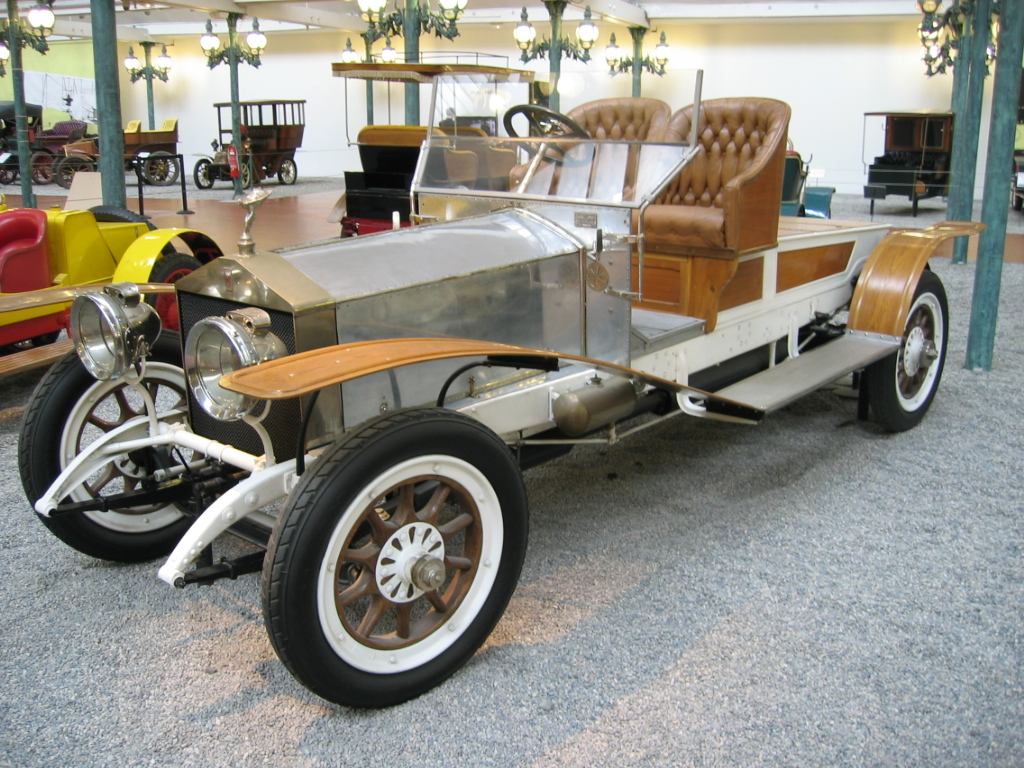
The chassis used semi-elliptic leaf springs front and rear, with an additional transverse helper spring at the rear, and wooden-spoked artillery wheels. The first cars had a wheelbase of 2,896 mm (114 in). After the lightweight Tourist Trophy cars, a shorter 2,692 mm (106 in) chassis followed, and the range was divided into the Light 20, with a track of 1,321 mm (52 in), and the Heavy 20, with 1,422 mm (56 in).
Braking was typical of the time. A foot pedal worked a transmission brake on a drum behind the gearbox, and the handbrake lever operated internal expanding drums on the rear axle. Lighting used oil for the side and tail lamps and acetylene for the headlamps.
Engine and drivetrain
The 4,118 cc four-cylinder engine was water-cooled, with overhead inlet valves and side exhaust valves. It produced 15 kW (20 bhp) at only 1,000 rpm. Engine speed was held by a governor, which the driver could override with a pedal-operated accelerator. Early cars had high-tension ignition with accumulators, a trembler and a coil; a magneto became an option later.
Power reached the gearbox through a leather-lined cone clutch and a short shaft. The first cars had three forward speeds. A four-speed gearbox arrived with the Light 20 and was later fitted to all cars; on it third gear was direct and fourth an overdrive.
Rolls-Royce 20 HP specifications
| Parameter | Metric | Imperial |
|---|---|---|
| Engine | 4,118 cc, four cylinders in two pairs | 251 cu in |
| Bore × stroke | 102 × 127 mm | 4 × 5 in |
| Power | 15 kW at 1,000 rpm | 20 bhp |
| Wheelbase (early) | 2,896 mm | 114 in |
| Wheelbase (Light and Heavy 20) | 2,692 mm | 106 in |
| Track, Light 20 | 1,321 mm | 52 in |
| Track, Heavy 20 | 1,422 mm | 56 in |
| Top speed, Light 20 | 80 km/h | 50 mph |
| Top speed, TT cars | 84 km/h | 52 mph |
| Top speed, Heavy 20 | 76 km/h | 47 mph |
A heavy body reduced the top speed further, which is why Wikipedia stresses that the figures depend on the coachwork.
Rolls-Royce 20 HP variants
| Variant | Years | Body / purpose | Engine | Notes |
|---|---|---|---|---|
| 20 HP (long chassis) | 1905 | touring chassis | 4,118 cc four | 2,896 mm wheelbase, three-speed gearbox |
| Tourist Trophy cars | 1905–1906 | lightweight racing cars | 4,118 cc four | shorter chassis, 84 km/h |
| Light 20 | 1905–1906 | lighter touring chassis | 4,118 cc four | 2,692 mm wheelbase, four-speed gearbox |
| Heavy 20 | 1905–1906 | heavier touring chassis | 4,118 cc four | 1,422 mm track, 76 km/h |
Racing: the Tourist Trophy cars
The 20 HP made the Rolls-Royce name known through racing. Two cars ran in the first Isle of Man Tourist Trophy in 1905: Percy Northey finished second overall, while Charles Rolls retired with gearbox trouble. A year later Rolls returned and won the 1906 race. In December 1906 he shipped a car to the United States and won a race at Yonkers, New York. For a company that had only just been formed, these results were valuable publicity.

Legacy and surviving cars
Production of the 20 HP ended in 1906 after about 40 chassis. Three cars survive today, with chassis numbers 26350, 40509 and 40520, which makes them among the earliest Rolls-Royce cars in existence. Anyone researching one of them should start from these chassis numbers, since no other complete 20 HP is known. For other veteran and vintage cars, see our classic car section.
Rolls-Royce 20 in our rankings
FAQ
When was the Rolls-Royce 20 HP produced, and where?
In 1905 and 1906 at Henry Royce's Cooke Street works in Hulme, Manchester.
How many Rolls-Royce 20 HP were built?
About 40 chassis. Three survive.
What engine does the Rolls-Royce 20 HP have?
A 4,118 cc water-cooled four-cylinder, cast in two pairs, with 15 kW (20 bhp) at 1,000 rpm.
Did the Rolls-Royce 20 HP win races?
Yes. Charles Rolls won the 1906 Isle of Man Tourist Trophy in a 20 HP, a year after Percy Northey had finished second in the 1905 race.
Is the 20 HP the same car as the Rolls-Royce Twenty?
No. The 20 HP of 1905–1906 is one of the first four Rolls-Royce models; the Twenty is a different, later model built from 1922 to 1929.
Data sources
Data checked by an editor against the sources below.