 Hudson Hornet
All generations, specs and history
Published Sources (1) Report an error
By Sarah Whitmore, Senior Automotive Writer
- Built
- 1951–1957
- Generations
- 2
- Top power
- 190 kW (258 PS)
Timeline
Hornet generations
Click a generation for its own page
- Hornet I 1951–1954 · Sedan, Coupe · 108–127 kW (147–173 PS)
- Hornet II 1955–1957 · Sedan · 119–190 kW (162–258 PS)
Newest first · 2 generations since 1951
-
1955
-
1951


All generations by year: Hornet II (1955–1957) · Hornet I (1951–1954)
Which one is mine?
Pick the year of first registration to see which generation it is.
Check by VINVerdict
Our verdict · Sarah Whitmore
In many ways the Hornet was an ordinary American car of its time, but it stood out thanks to its racing results, solid build and value. Hudson tried to make it strong, comfortable and safe, and the step-down design gave it a low centre of gravity and handling that its rivals could not match on the race track.
The Hudson Hornet is a full-size American car built by the Hudson Motor Car Company in Detroit, Michigan, from 1951 to 1954 and then, after Hudson merged with Nash to form American Motors, in Kenosha, Wisconsin, until 1957. Many people know it from the Pixar film "Cars", where the character Doc Hudson is a 1951 Hornet. In its day the Hornet was known as a well-built, affordable car and a formidable racer.
In short
- Built from 1951 to 1957 in two generations: Detroit-built Hudsons (1951–1954) and Nash-based AMC cars (1955–1957).
- "Step-down" construction with the floor recessed into the frame, giving a low centre of gravity and excellent handling.
- A 5.0-litre (308 cu in) side-valve straight-six with 108 kW (145 hp) at launch, up to 127 kW (170 hp) by 1954, and Twin H-Power dual carburettors.
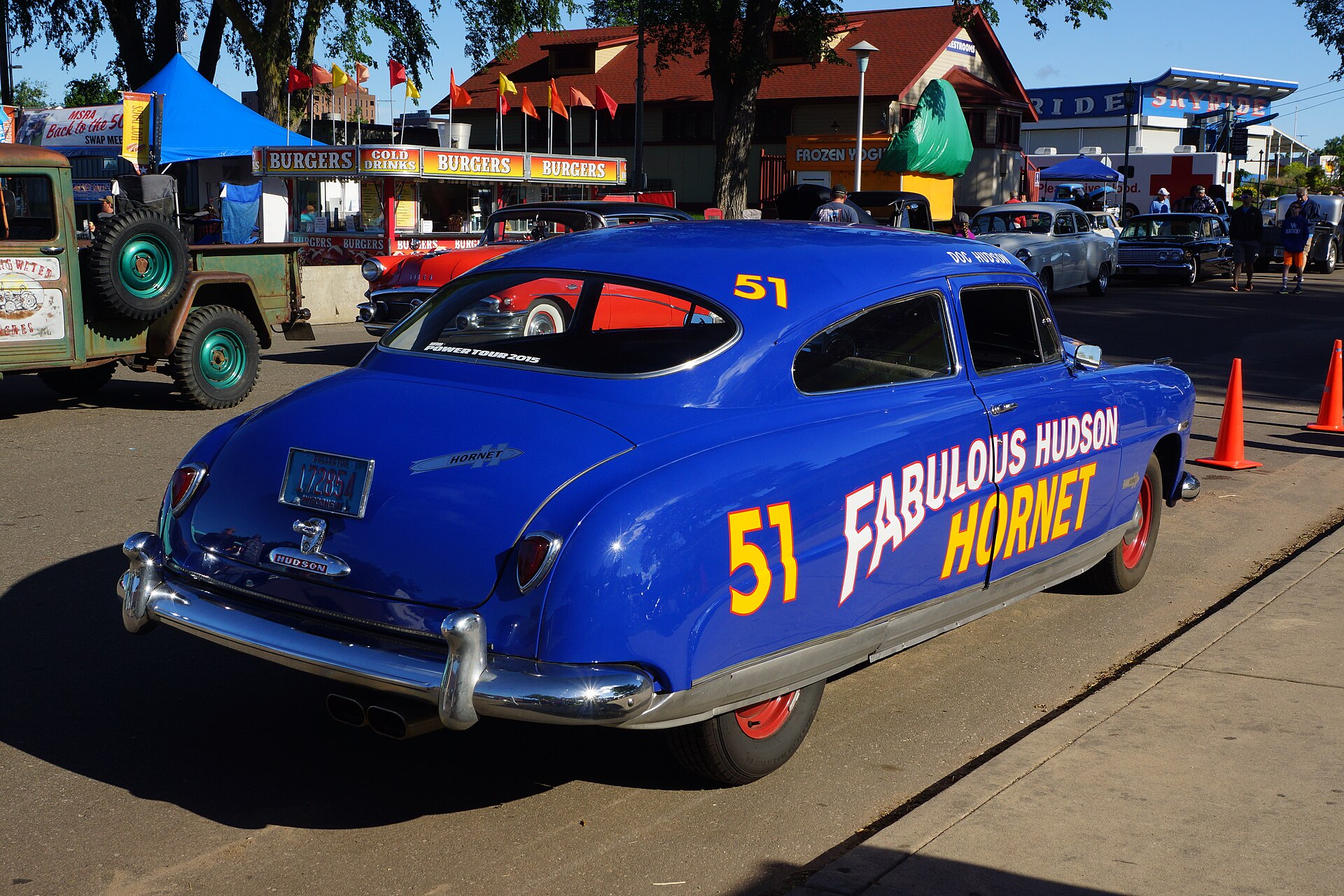
- Dominated NASCAR in the early 1950s; Marshall Teague's "Fabulous Hudson Hornet" became a legend.
Specs by version
Engines
| Version | Engine | Power | Drive | Production years |
|---|---|---|---|---|
| Hornet I · 308 I6 Twin H-Power | 5.0 l · 6 cyl · Petrol 5,000 cc | 108 kW 147 PS145 hp | Rear-wheel drive | 1951–1952 |
| Hornet I · 308 I6 | 5.0 l · 6 cyl · Petrol 5,000 cc | 119 kW 162 PS160 hp | Rear-wheel drive | 1953 |
| Hornet I · 308 I6 Twin H-Power | 5.0 l · 6 cyl · Petrol 5,000 cc | 127 kW 173 PS170 hp | Rear-wheel drive | 1953–1954 |
| Hornet II · 308 I6 | 5.0 l · 6 cyl · Petrol 5,000 cc | 119 kW 162 PS160 hp | - | - |
| Hornet II · 327 V8 | 5.4 l · 8 cyl · Petrol 5,400 cc | 190 kW 258 PS255 hp | - | 1957 |
Performance
Show all 3 versions
| Version | Top speed |
|---|---|
| Hornet I · 308 I6 Twin H-Power | 161 km/h100 mph |
| Hornet I · 308 I6 | 161 km/h100 mph |
| Hornet I · 308 I6 Twin H-Power | 161 km/h100 mph |
Dimensions and weight
Show all 2 versions
| Version | Length | Wheelbase | Kerb weight |
|---|---|---|---|
| Hornet II · 308 I6 | 5,309 mm209.0 in | 3,080 mm121.3 in | 1,585 kg3,494 lb |
| Hornet II · 327 V8 | 5,309 mm209.0 in | 3,080 mm121.3 in | - |
Verified Manufacturer and type-approval data from our catalog · Sources and methodology
Hudson Hornet at a glance
| Item | Detail |
|---|---|
| Production | 1951–1954 Detroit (Hudson); 1955–1957 Kenosha (American Motors) |
| Bodies (first generation) | Coupé, saloon, convertible, hardtop |
| Engine (first generation) | 5.0 (308 cu in) side-valve straight-six |
| Power | 108 kW (145 hp) at launch; 127 kW (170 hp) by 1954; 7-X option over 155 kW (210 hp) |
| Wheelbase | 3,150 mm |
| Weight | About 1,642 kg |
More classic models are collected in our classic cars section.
History
The Hudson Motor Car Company was founded in Detroit in 1909 by a group of young entrepreneurs. It was named not after its founders but after its main investor, Joseph L. Hudson, a Detroit department-store owner who provided the money; the investment soon paid off many times over. The name Hornet speaks for itself, and many enthusiasts still call the car simply "the Hornet".
Design and body
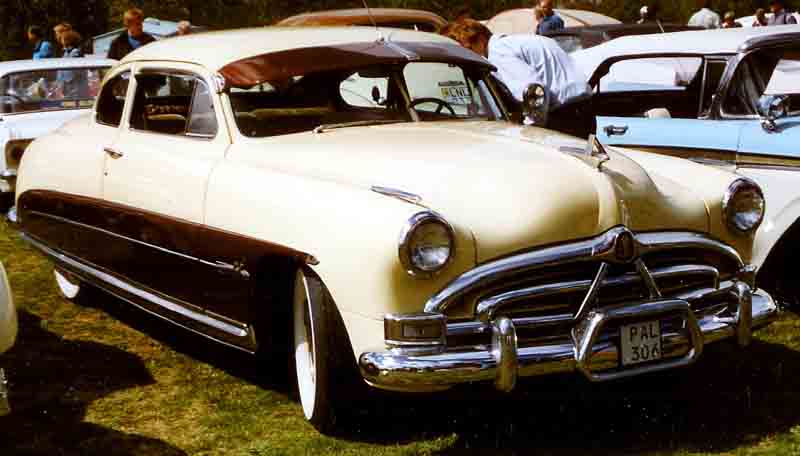
The first-generation Hornet of 1951 used the "step-down" design that Hudson had introduced three years earlier on the 1948 Commodore. The idea was to combine the body and the frame into a single structure, with the floor recessed into the frame. Together with the lowered centre of gravity, this produced a sleek, streamlined shape and a cabin that could comfortably carry six people. Despite its large size and robust construction, the car weighed about 1,642 kg on a 3,150 mm wheelbase.
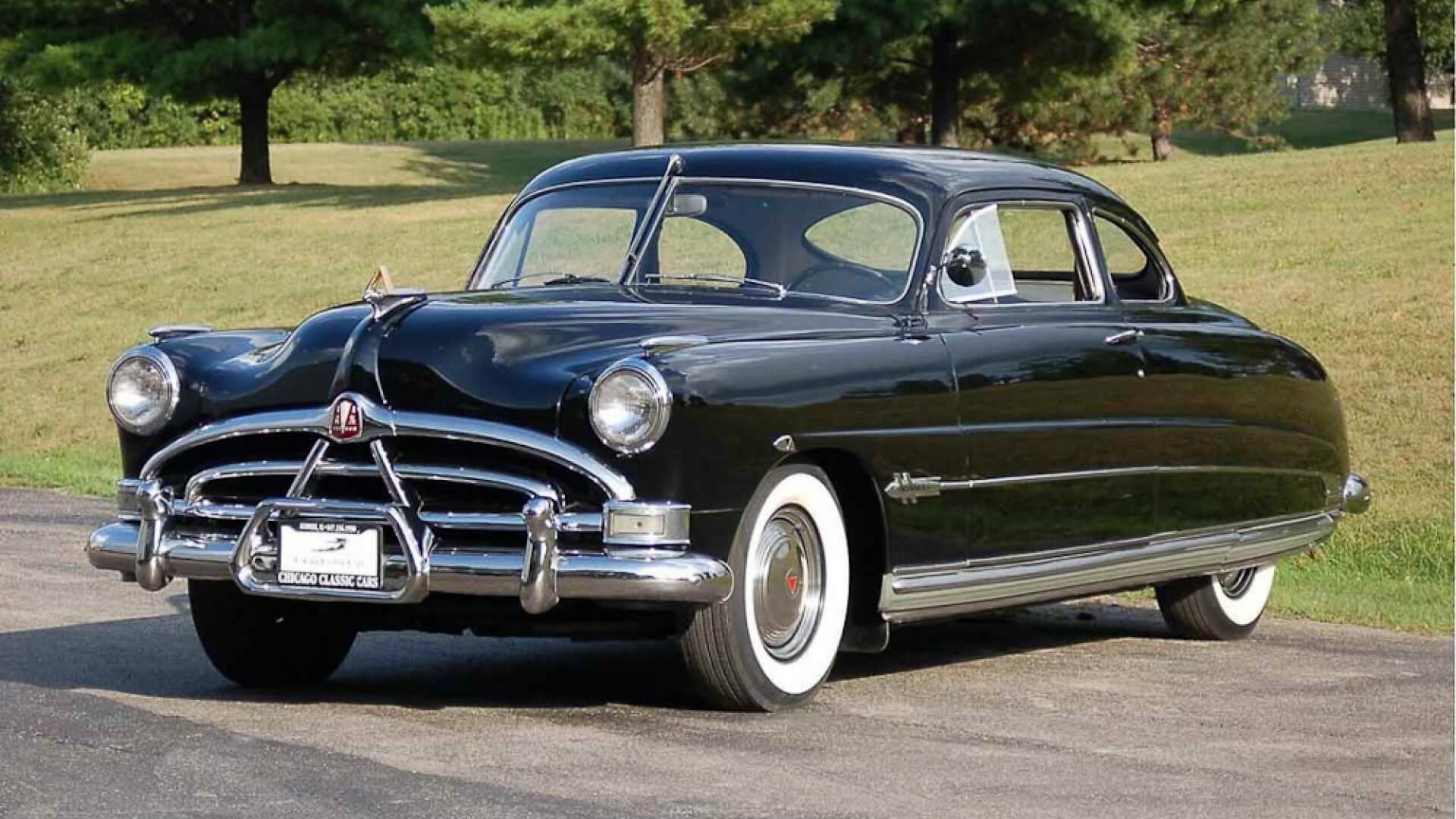
The Hornet looked streamlined and low - a bold choice for the time - with an overall height of only about 1.5 metres. A high waistline and modest glass area made it look sporty, even aggressive, and plenty of chrome decorated the body. Many people liked the rear wheel arches covered flush with the sills. For 1954 the car was updated with a more curved windscreen, new tail lights, crisper body sides, chrome trims ahead of the rear wheels, small fins with triangular lights, a functional bonnet scoop and a two-level grille that gave it a more serious and modern look.
Interior
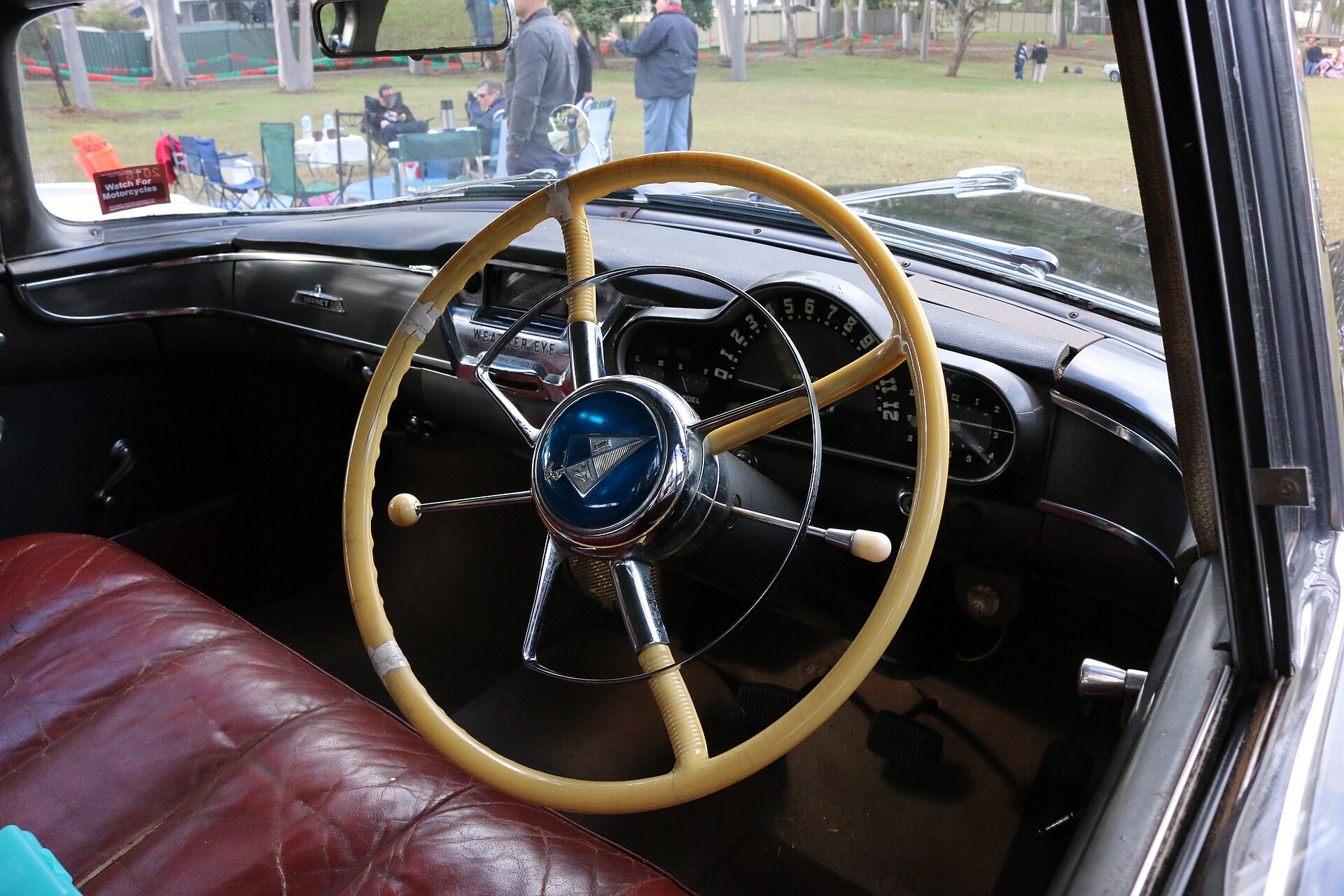
The cabin was huge for its time. The rear bench was among the widest in the industry: officially for three, but able to take four. The very rigid body structure had hidden advantages too: few American cars of the day were safer, especially in a rollover, or more stable at high speed. The driver faced a three-spoke steering wheel and a large instrument panel with a semicircular speedometer. The door panels were trimmed in pleasant fabric, plenty of metal details added to the car's status, and the gear lever was mounted on the steering column in classic American style.
Engine
Under the bonnet was a 5.0-litre (308 cubic inch) side-valve straight-six with 12 valves, fed by a Carter carburettor. At launch it produced 108 kW (145 hp) and about 373 Nm, enough to reach 100 km/h in around 13 seconds. Its strong performance and good handling quickly caught the attention of amateur racers, and the Hornet's racing career began.
Hudson's Twin H-Power, a dual-carburettor set-up, was a dealer option in 1951 and became standard in 1952. By 1954 output had risen to 127 kW (170 hp), and the "7-X" racing option pushed it beyond 155 kW (210 hp). Top speed reached about 180 km/h - an excellent figure for the time.
Transmission and chassis
Buyers could choose a three-speed manual gearbox, a manual with overdrive or a Hydra-Matic automatic; Hudson also offered semi-automatic Drive-Master transmissions. The suspension was independent at the front with coil springs and a rigid rear axle on leaf springs, and all four wheels had hydraulic drum brakes. The handling was the Hornet's great strength.
Racing success
Hornets raced frequently and won many times in the stock-car racing of the early 1950s. Hudson won 27 of 34 NASCAR Grand National races in 1952, 22 of 37 in 1953 and 17 of 37 in 1954. Drivers included Herb Thomas, Dick Rathmann, Al Keller, Frank Mundy and Tim Flock. In the 1952 AAA season, Marshall Teague won 12 of 13 scheduled events in a stock Hornet nicknamed the "Fabulous Hudson Hornet", which made the model famous around the world. The restored original car is now displayed at the Ypsilanti Automotive Heritage Museum in Michigan.
Second generation (1955–1957)
After Hudson merged with Nash to form American Motors, production moved to Nash's plant in Kenosha, Wisconsin. The 1955–1957 Hornets were built on Nash's platform as saloons and hardtops, with a 3,080 mm wheelbase. Besides the straight-six, they offered a Packard-built 5.2-litre V8 with 155 kW (208 hp) in 1955 and, in the 1956 Hornet Special, AMC's own 4.1-litre V8. Production of the Hornet ended in 1957.
Legacy
The Hornet was relatively affordable when new, and fully equipped cars still cost far less than luxury models of the time. Today it is a sought-after classic, especially in the United States, and some owners still drive their cars. Beyond NASCAR history, it lives on in video games and in "Cars", where Doc Hudson - voiced by Paul Newman - is a former champion who raced as the Fabulous Hudson Hornet.
Hudson Hornet: first vs latest generation
| Spec | Hornet I | Hornet II | Change |
|---|---|---|---|
| Years | 1951–1954 | 1955–1957 | 4 years apart |
| Most powerful version | 127 kW (173 PS) | 190 kW (258 PS) | +63 kW (+50%) |
Oldest and newest generation in the 1cars catalog. Power is the strongest version of each; other rows are shown only when both generations have the figure.
Image credits · Photos from Wikimedia Commons under free licences
- Hudson Hornet I · Photo: Greg Gjerdingen from Willmar, USA / Wikimedia Commons, CC BY 2.0
- Hudson Hornet II · Photo: Jeremy from Sydney, Australia / Wikimedia Commons, CC BY 2.0
Hudson Hornet in our rankings
- No. 6 of 86 · Longest sedans (5,309 mm)
- No. 13 of 420 · Longest cars (5,309 mm · top 4%)
- No. 24 of 131 · Biggest engines: sedans (5,400 cc · top 19%)
- No. 119 of 557 · Biggest engines: cars (5,400 cc · top 22%)
- No. 64 of 149 · Most powerful sedans (190 kW · top 44%)
- No. 33 of 68 · Most torque: sedans (373 Nm · top 49%)
Longer than 96% of ranked cars in the 1CARS catalog (No. 13 of 420).
FAQ
When was the Hudson Hornet built?
From 1951 to 1954 in Detroit and from 1955 to 1957 by American Motors in Kenosha, Wisconsin.
What engine did the Hudson Hornet have?
A 5.0-litre (308 cu in) side-valve straight-six with 108 kW (145 hp) at launch and up to 127 kW (170 hp) by 1954.
Why was the Hudson Hornet so successful in NASCAR?
Its step-down design gave it a low centre of gravity and excellent handling, and its powerful straight-six with Twin H-Power made it fast.
Is Doc Hudson in Cars a Hudson Hornet?
Yes. Doc Hudson is a 1951 Hudson Hornet who raced as the Fabulous Hudson Hornet.
Data sources
Data checked by an editor against the sources below.