The Story of the Moskvich 400 and 402 in Detail
The Moskvich 402 was the first Moskvich car designed in the Soviet Union rather than copied from a foreign model. It replaced the Opel Kadett-based Moskvich-400/401 in April 1956 and was built until 1958, when the 407 with an overhead-valve engine took over. The factory made around 90,000, and roughly one in five went abroad.

Key takeaways
- 1946–1956: the Moskvich-400 and 401 were built on the design of the pre-war Opel Kadett K38; 247,439 were made.
- 1956: the 402 brought a new body, a 1.2-litre 26 kW (35 PS) engine and a much roomier cabin.
- Variants included the 423 estate, the 410 four-wheel-drive saloon and versions for taxi, medical and disabled drivers.
- The 402 led directly to the 407 and 403, the first Soviet cars sold in larger numbers in Western Europe.

The first Moskvich at a glance
| Model | Years | Engine | Power | Built |
|---|---|---|---|---|
| KIM-10-50 (predecessor) | 1940–1941 | side-valve four | not confirmed | about 500 |
| Moskvich-400 | 1946–1954 | 1,074 cc side-valve four | 17 kW (23 hp) | 400 and 401 together: 247,439 |
| Moskvich-401 | 1954–1956 | 1,074 cc side-valve four | 19 kW (26 hp) | (included above) |
| Moskvich-402 | 1956–1958 | 1,220 cc side-valve four | 26 kW (35 PS) | 87,658–94,080 (sources differ) |
| Moskvich-407 | 1958–1963 | 1,358 cc OHV four | 34 kW (45 hp) | 359,980 |
| Moskvich-403 | 1962–1965 | 1,358 cc OHV four | about 37 kW (50 hp) | 133,523 |
Each model has its own catalogue page: the Moskvich-400, the Moskvich-407 and the Moskvich-403. The wider story of the factory, from the KIM works to AZLK, is told in the history of Moskvich and AZLK.

Before the 402: the KIM-10 and the Opel decision
The small-car plant that later built every Moskvich started life as the KIM works. Its first car, the KIM-10-50, appeared in 1940 and took clear inspiration from the British Ford Prefect. About 500 were made before production stopped in 1941. The factory also planned a four-door KIM-10-52 but never built it.

When work on a post-war people's car resumed, the decision fell on the German Opel Kadett K38. According to the usual account, the Soviet leadership, reportedly Stalin personally, chose the four-door Kadett in June 1945. The Soviet side claimed drawings and tooling from Opel's Rüsselsheim works as war reparations, and German engineers helped to reconstruct the missing plans. Some historians doubt how much of the tooling actually survived, and the old 1cars article added that four Kadetts were bought and taken apart to make master models.
In August 1945 the KIM works became MZMA, the small-car plant. Official papers date the start of the project to 10 October 1945, and the team finished the master models in August 1946. Workers assembled the first Moskvich-400-420 on 9 December 1946, and the government approved mass production on 28 April 1947.
Moskvich-400 and 401: a pre-war design for a new start
The 400-420 saloon used a unitary steel body, hydraulic brakes and independent front suspension, all modern features for a small car of the 1940s. Its 1,074 cc side-valve four produced 17 kW (23 hp) with a compression ratio of just 5.6:1, so performance was gentle: 0–80 km/h took 55 seconds. Fuel use of about 9 l/100 km was the best of any Soviet car of its time.
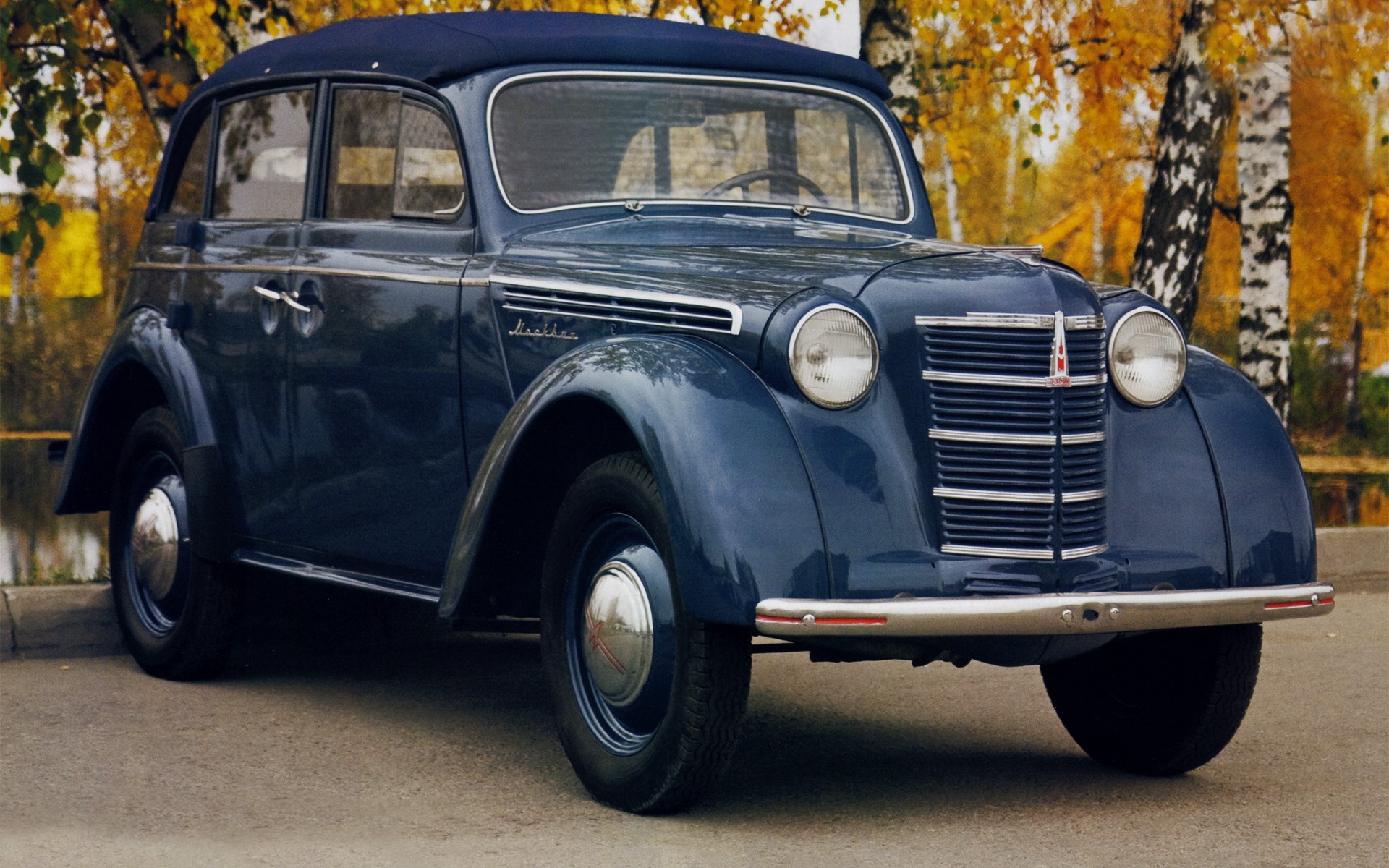
Output grew quickly, from 1,501 cars in 1947 to 4,808 in 1948 and 19,906 in 1949. The 100,000th car left the line in October 1952. A cabriolet (400-420A) arrived in 1949, and a wood-framed van (400-422) in 1948. In 1951 the three-speed gearbox gained synchromesh on the top two gears, and the lever moved to the steering column.
| Specification | Moskvich-400 |
|---|---|
| Length × width × height | 3,855 × 1,400 × 1,550 mm |
| Wheelbase | 2,340 mm |
| Ground clearance | 200 mm |
| Engine | 1,074 cc side-valve four, 17 kW (23 hp) |
| Gearbox | 3-speed manual |
| 0–80 km/h | 55 s |
The 401 of 1954 looked the same but had a reworked engine. Compression rose to 6.2:1 and power to 19 kW (26 hp), and the car gained a new starter, dynamo, wheel bearings and handbrake. The 401 weighed 885 kg and reached 90 km/h. The saloon was built until 20 April 1956, and the 400 and 401 together reached 247,439 cars.
The early cars also went abroad. The Moskvich-400 went on sale in Belgium in October 1950, priced below the Ford Prefect and the Morris Minor. Further cars went to East Germany and to Norway, which reportedly paid for some of them with fish.
Prototypes and the naming system
Between 1948 and 1951 the factory tried several upgrades. In 1949 it built six prototypes, the 401E-424E with 19 kW (26 hp) and the 403E-424E with about 24 kW (33 hp). A 403-424A coupé followed in 1951 with a 35 hp four. In 1954 the 404 Sport roadster appeared with a 58 hp overhead-valve engine, and the factory's racing story continues on the page about Moskvich racing cars.
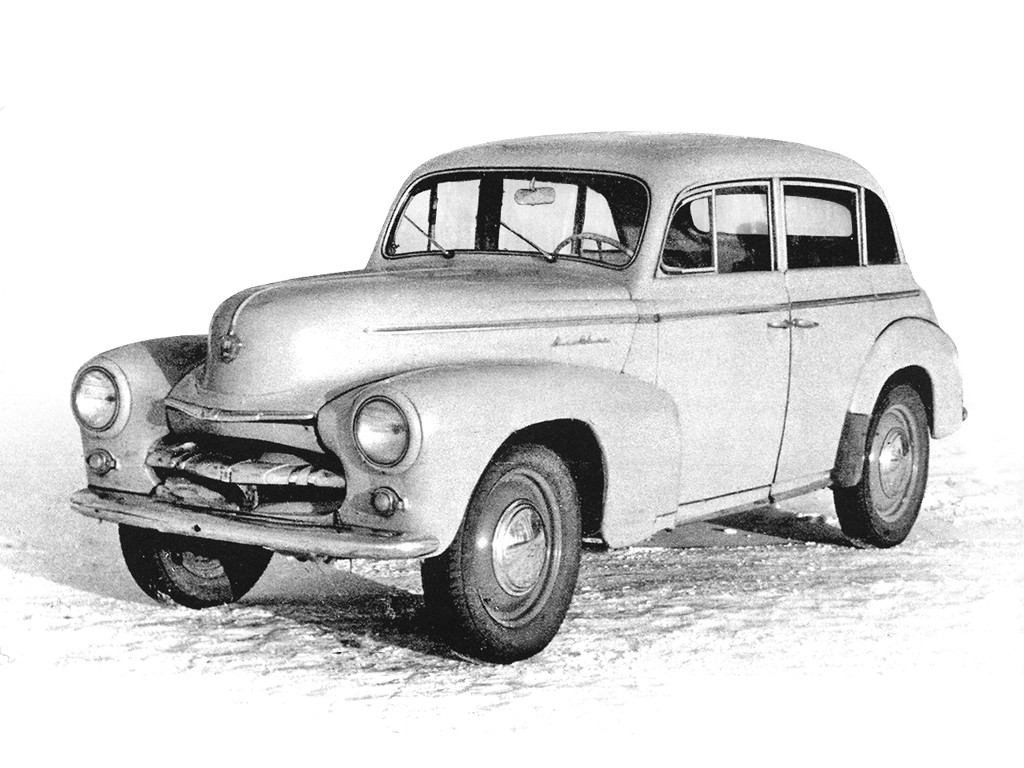
The names followed a simple code. The first number stood for the engine and the second for the body: in "402-425", 402 is the engine type and 425 the body style. That is why the old text called the car "Moskvich-402-405". Over time the first number became the model name.
Designing the 402: the first home-grown Moskvich
By the early 1950s the Kadett design was outdated, and facelifts could not hide its 1930s shape. Development of a new car began in 1950. The first prototype, the 402-425, ran in mid-1951, and seven prototypes with different body styles were built. With no test track available, engineers tried the cars on public roads. Engineers from GAZ, who were working on the larger GAZ-21 Volga at the same time, took part in the styling.
A prototype was shown to the public in February 1955. The factory completed the first series car on 20 April 1956, the same day the last 401 saloon left the line. Compared with the 401, the 402 was 200 mm longer, much wider and had a boot of about 340 litres.
| Parameter | Moskvich 402 |
|---|---|
| Body | four-door saloon (estate 423 from 1957) |
| Length × width × height | 4,055 × 1,540 × 1,560 mm |
| Wheelbase | 2,370 mm |
| Track | 1,220 mm |
| Tyres | 5.60–15 |
| Kerb weight | 910–980 kg (sources differ) |
| Engine | 1,220 cc side-valve four, 26 kW (35 PS) at 4,200 rpm |
| Fuel | petrol, minimum 72 octane |
| Gearbox | 3-speed manual, column shift |
| Top speed | about 90–105 km/h (sources differ) |
| 0–80 km/h | 28.5 s |
| Fuel use | about 9 l/100 km |
| Boot | about 340 l |
The engine was a bored-out development of the old side-valve unit, and the rear axle and gearbox came from the 401. Compared with the 401, the 402 had about a third more power but almost halved the 0–80 km/h time, from 55 to 28.5 seconds. 1cars calculated that gain from the factory figures in the table above.
Estate, 4x4 and special versions
The 402 family grew quickly:
- 402B, 402M and 402T: versions with hand controls for disabled drivers, a medical car and a taxi.
- 423 estate (1957–1958): a four-door estate with folding rear seats and a 250 kg payload.
- 410 (1957–1958): a four-wheel-drive saloon using parts from the GAZ-69, with 220 mm of ground clearance.
- 410N and 411 (1958–1961): the 4x4 saloon and estate with the stronger 407 engine.
- A9 and 429: a minibus and a closed van that remained prototypes.

By January 1961 the factory had built 11,890 four-wheel-drive Moskvich cars. A 4x4 family saloon of this size was rare anywhere in the world at the time.
From 402 to 407 and 403
In 1958 the 402 body received the new 1,358 cc overhead-valve engine with 34 kW (45 hp), and the car became the Moskvich-407. Top speed rose to about 115 km/h, and a four-speed synchromesh gearbox arrived at the end of 1959. The 407 was built until October 1963, with 359,980 made and 120,903 exported. The transitional 403 followed, then the 408 and the Moskvich-412.
Exports became important. In some years about half of all 407s went abroad, mainly to Eastern Europe, Norway, Finland and France. In Western Europe the cars were sometimes sold as the "Elite", and the Belgian importer Scaldia began assembling them in Seneffe in 1962. A 407 finished third in its class at the 1957 Thousand Lakes Rally in Finland.
Which early Moskvich to choose today
The old 1cars article compared the early cars with army ranks: the 400 and 401 were privates and sergeants, while the 402 became the first "officer". The comparison works. The 402 was the first Moskvich that its own engineers designed from scratch, and it set the layout of every Moskvich until the late 1960s.
For collectors the choice depends on what they want from the car. The 400 and 401 are the historic Opel-derived cars. The 402 is the rarest of the 402-407-403 family, because it was built for only about two years. The 407 is the most practical to own, thanks to its stronger OHV engine and four-speed gearbox, and it suits owners who want to drive their classic regularly, because parts are easier to find. The 407 and 412 are set side by side in the Moskvich-407 vs Moskvich-412 comparison, and more cars of the period appear among the best Soviet classic cars.
FAQ
Was the first post-war Moskvich based on the Opel Kadett?
Yes. The Moskvich-400 used the design of the four-door Opel Kadett K38 of 1938. The factory worked from drawings and tooling from Opel's Rüsselsheim works after 1945, and German engineers helped to reconstruct the missing plans.
When was the Moskvich 402 made?
The factory completed the first series Moskvich 402 on 20 April 1956. It was built until 1958, when the same body received a new overhead-valve engine and became the Moskvich-407.
How many Moskvich 402 cars were built?
Sources differ: German references give 87,658 cars, while English sources give 94,080, of which 18,019 were exported. The gap may come from counting estates and 4x4 versions separately.
What engine did the Moskvich 402 have?
It had a 1,220 cc side-valve four-cylinder petrol engine with 26 kW (35 PS) at 4,200 rpm. It ran on low-octane fuel and drove the rear wheels through a three-speed column-shift gearbox.
Was there a four-wheel-drive Moskvich 402?
Yes. The Moskvich-410 of 1957 was a 402 saloon with four-wheel drive and parts from the GAZ-69. The 410N and the 411 estate followed with the 407 engine, and 11,890 were built by 1961.