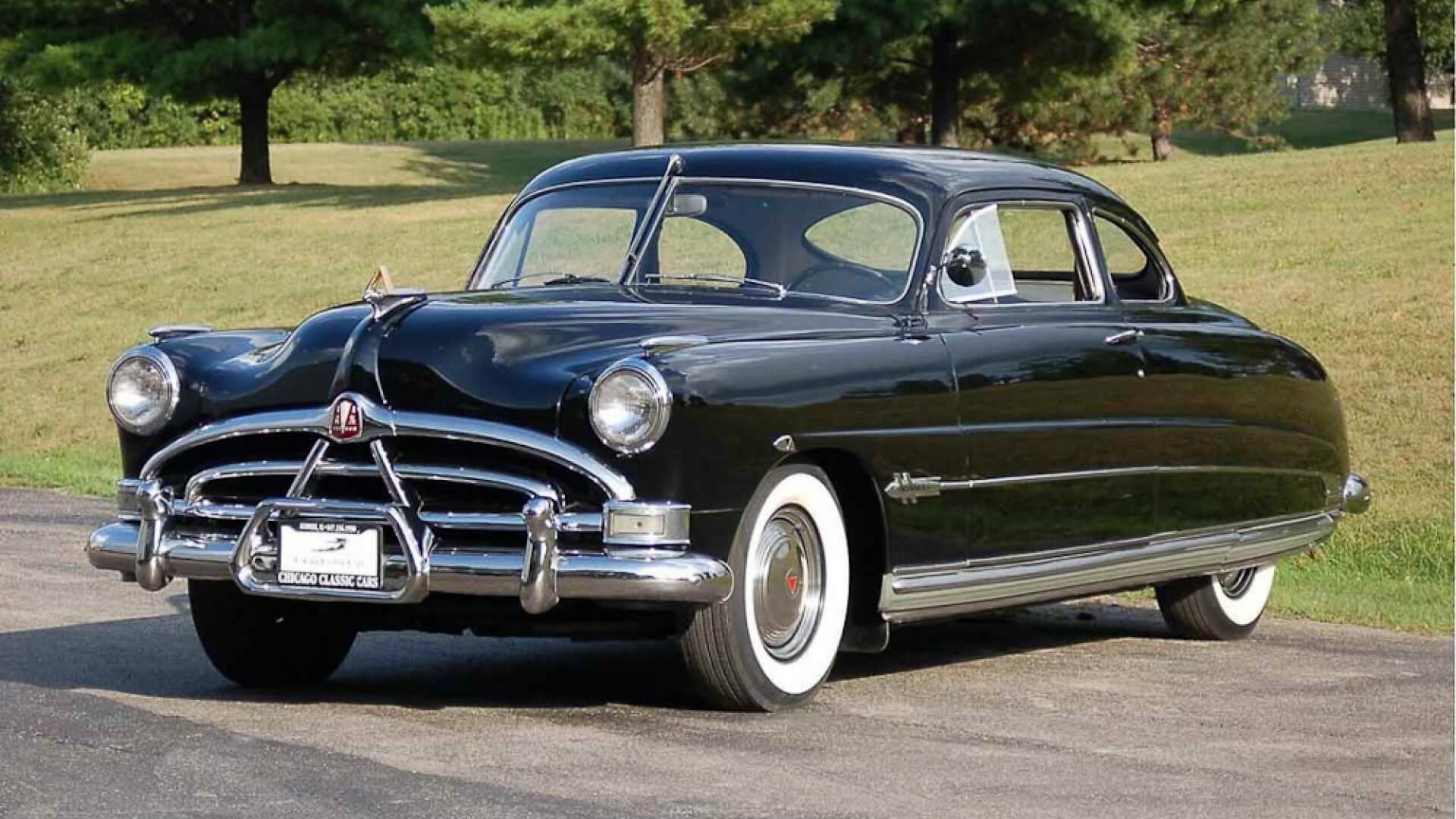
Hudson — Detroit's step-down cars and the Hornet, 1909 to 1957
Hudson was a Detroit car maker that built cars from 1909 to 1957. It was financed by the department-store owner Joseph L. Hudson and led by Roy D. Chapin, and in 1929 it was the third-largest car maker in the United States. Its cheaper Essex brand offered the first closed coach at a price close to an open car, and its "step-down" Hudsons of 1948 had a low floor and a low centre of gravity. On that base the Hornet dominated stock car racing from 1951 to 1954. In 1954 Hudson merged with Nash-Kelvinator to form American Motors, and the last Hudson left the Kenosha line on 25 June 1957.
Key takeaways
- The Hudson Motor Car Company was incorporated in Detroit on 20 February 1909; the first car, the Hudson "Twenty", sold 4,508 in its first year.
- Hudson and Essex together built about 300,000 cars in 1929, making Hudson the number three US car maker that year.
- The Hornet won 27 of 34 NASCAR Grand National races in 1952, 22 of 37 in 1953 and 17 of 37 in 1954.
- Hudson merged with Nash-Kelvinator on 1 May 1954 to form American Motors Corporation (AMC).
Hudson at a glance
| Fact | Value |
|---|---|
| Founded | 20 February 1909, Detroit, Michigan |
| Founders | Roy D. Chapin, Howard E. Coffin and other Detroit businessmen; capital from Joseph L. Hudson |
| Plant | Jefferson Avenue, Detroit (from 1910); Kenosha, Wisconsin (1955–1957) |
| Brands | Hudson, Essex (from 1919), Terraplane (from 1932) |
| Best year | About 300,000 Hudson and Essex cars in 1929 |
| Best-known models | Super Six, Essex coach, Terraplane, Commodore, Hornet, Jet |
| Racing | NASCAR and AAA stock car titles in the early 1950s |
| End | Merged into AMC 1954; last Hudson 25 June 1957 |
Chapin, Coffin and Joseph L. Hudson
Roy Dikeman Chapin was born in Lansing, Michigan, on 23 February 1880. In 1901 Chapin left the University of Michigan to work for Olds Motor Works in Detroit. Chapin later led the group of businessmen and engineers that founded Hudson, together with the engineer Howard E. Coffin. The money came from Joseph L. Hudson, owner of the Detroit department store, who put in about US$90,000 and gave the company his name.
The company was incorporated on 20 February 1909 by eight Detroit businessmen. The first car left the small factory on 3 July 1909. The Hudson "Twenty" sold 4,508 cars in its first year, a strong start for a new maker. A new plant on Jefferson Avenue opened on 29 October 1910, and production reached 6,486 in 1911.
Chapin also worked for the wider motor industry. With Henry B. Joy of Packard, Chapin led the drive to build the Lincoln Highway. In 1927 Chapin became head of the National Automobile Chamber of Commerce, and from 8 August 1932 to 3 March 1933 served as US Secretary of Commerce under President Herbert Hoover. Chapin died in Detroit on 16 February 1936.

Super Six, Essex and the closed car
Hudson's first own engine was the Super Six straight-six of 1916. The company then added a second, cheaper brand. The Essex was introduced in 1919 and was an immediate success.
Its big idea came in 1922. Essex offered the first closed coach priced close to an open car: the coach cost US$1,495 in 1922, only US$300 more than the touring car. By 1925 the coach was cheaper than the touring model. More than 1.13 million Essex cars were sold before the name was retired.
The combined sales of Hudson and Essex peaked in 1929, when the two brands built about 300,000 cars. That made Hudson the third-largest car maker in the United States that year.

Terraplane and the Depression years
For 1932 a redesigned Essex appeared as the Essex-Terraplane. It was launched on 21 July 1932, and the aviator Amelia Earhart christened it. From 1934 the Essex name was dropped and the car was sold simply as the Terraplane.
Hudson kept adding technical features in the 1930s: "radial safety control" suspension in 1936 and coil-spring independent front suspension in 1940. In 1939 the company hired Elizabeth Ann Thatcher as a designer. From 1942 to 1945 Hudson stopped making cars and turned to war production.

The step-down Hudsons and the Hornet
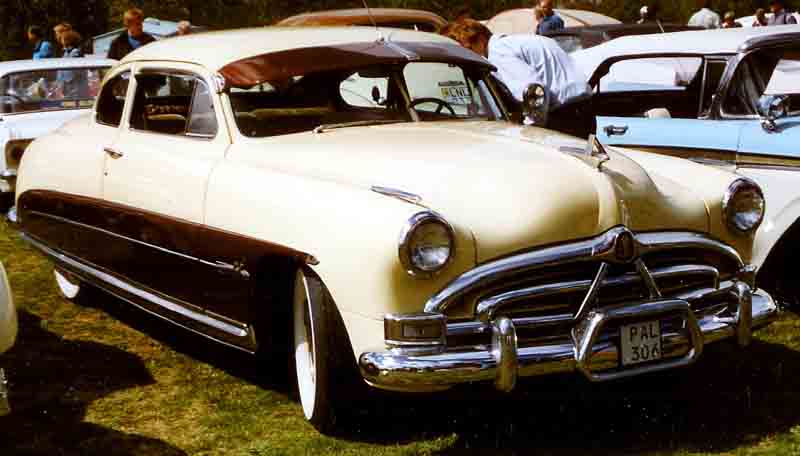
Hudson's best-known design arrived in 1948. In the "step-down" body, first used on the 1948 Commodore, the floor sat between the frame rails. Passengers stepped down into the car, the roof line was low and the centre of gravity was lower than on rival cars. The design was used until the 1954 model year.
The Hornet of 1951 combined this body with a new 308 cu in (5.0-litre) straight-six. With the dual-carburettor "Twin H-Power" option it produced 108 kW (145 hp) at 3,800 rpm. Twin H-Power was a dealer-installed option in mid-1951 and became standard in 1952. By 1954 output had risen to 127 kW (170 hp), and the "7-X" racing option gave more than 157 kW (210 hp).
On the track the Hornet was hard to beat:
| Year | NASCAR Grand National | Hornet production |
|---|---|---|
| 1951 | Start of Hudson's winning run | 43,666 |
| 1952 | 27 wins in 34 races | 35,921 |
| 1953 | 22 wins in 37 races | 27,208 |
| 1954 | 17 wins in 37 races | 24,833 |
Herb Thomas was one of the drivers who won NASCAR races in a Hornet in 1952. In the AAA series that year, Marshall Teague won 12 of 13 scheduled events and the title by 1,000 points. The "Fabulous Hudson Hornet" later inspired Doc Hudson, a 1951 Hornet voiced by Paul Newman in the Pixar film "Cars".

The Jet, the merger and the end
Racing success did not fix the finances. Hudson's compact Jet arrived for 1953 with a 202 cu in (3.3-litre) six of 78 kW (104 hp). Its 1953 base price was US$1,858, more than a full-size Ford (US$1,734) or Chevrolet (US$1,613). Development and tooling cost an estimated US$10 to 16 million, and compact car sales fell sharply from 1952 to 1954. Only 35,367 Jets were built in two years, and one historian called it "the car that torpedoed Hudson".
On 14 January 1954 Hudson agreed to merge with Nash-Kelvinator, and on 1 May 1954 the two formed American Motors Corporation. The Jet was the first Hudson model dropped. From 1955 Hudsons moved to the Nash platform and were built in Kenosha, Wisconsin. The straight-six remained, and a Packard-built V8 was offered in 1955 and 1956. Hornet production fell to 8,152 in 1956 and 4,108 in 1957. The last Hudson left the Kenosha assembly line on 25 June 1957, and AMC retired the name.
The Hudson models listed on 1cars are in the Hudson catalogue, and the racing car has its own page on the Hudson Hornet of 1951–1957 and its NASCAR record. The merger partner is in the Nash catalogue and the company they formed in the AMC catalogue. For the early luxury rival of Detroit, see the Packard catalogue; more cars of the era are in the classic cars section.

Hudson timeline
| Year | Event |
|---|---|
| 1909 | Company incorporated (20 February); first car (3 July) |
| 1910 | Jefferson Avenue plant opens (29 October) |
| 1916 | Super Six engine |
| 1919 | Essex brand introduced |
| 1922 | Essex closed coach priced close to the open car |
| 1929 | About 300,000 Hudson and Essex cars; third in the US |
| 1932 | Essex-Terraplane launched (21 July) |
| 1934 | Essex name dropped; Terraplane sold on its own |
| 1942 | Car production stops for the war |
| 1948 | Step-down bodies |
| 1951 | Hornet launched; start of the NASCAR run |
| 1953 | Compact Jet |
| 1954 | Merger with Nash-Kelvinator into AMC (1 May) |
| 1957 | Last Hudson built in Kenosha (25 June) |
Landmark Hudson models
| Model | Years | Why it matters |
|---|---|---|
| Hudson Twenty | 1909 | First Hudson; 4,508 sold in the first year |
| Super Six | From 1916 | First engine built by Hudson |
| Essex coach | From 1922 | Closed car at an open-car price |
| Terraplane | From 1932 | Depression-era car christened by Amelia Earhart |
| Commodore | From 1948 | First step-down Hudson |
| Hornet | 1951–1957 | Dominated NASCAR in 1952–1954 |
Photo gallery

FAQ
Who founded Hudson?
Roy D. Chapin and Howard E. Coffin with other Detroit businessmen. The department-store owner Joseph L. Hudson provided the capital and the name.
What was the Hudson step-down design?
From 1948 the floor of Hudson cars sat between the frame rails. Passengers stepped down into the car, which gave a lower roof and a lower centre of gravity.
Why was the Hudson Hornet so successful in racing?
The low step-down body and the 5.0-litre Twin H-Power straight-six. Hudson won 27 of 34 NASCAR Grand National races in 1952.
When did Hudson stop making cars?
Hudson merged with Nash-Kelvinator in 1954 to form AMC. The last Hudson was built in Kenosha on 25 June 1957.
What was the Essex?
Hudson's cheaper brand from 1919. Its closed coach of 1922 cost little more than an open car, and more than 1.13 million Essex cars were sold.
Sources
- Wikipedia — Hudson Motor Car Company (accessed 24 Oct 2026)
- Wikipedia — Hudson Hornet (accessed 24 Oct 2026)
- Wikipedia — Roy D. Chapin (accessed 24 Oct 2026)
- Wikipedia — Essex (automobile) (accessed 24 Oct 2026)
- Wikipedia — Hudson Jet (accessed 24 Oct 2026)
Found a mistake? Report an error