 Kia K5
Specs, engines and history
Published Sources (6) Report an error
By Sarah Whitmore, Senior Automotive Writer
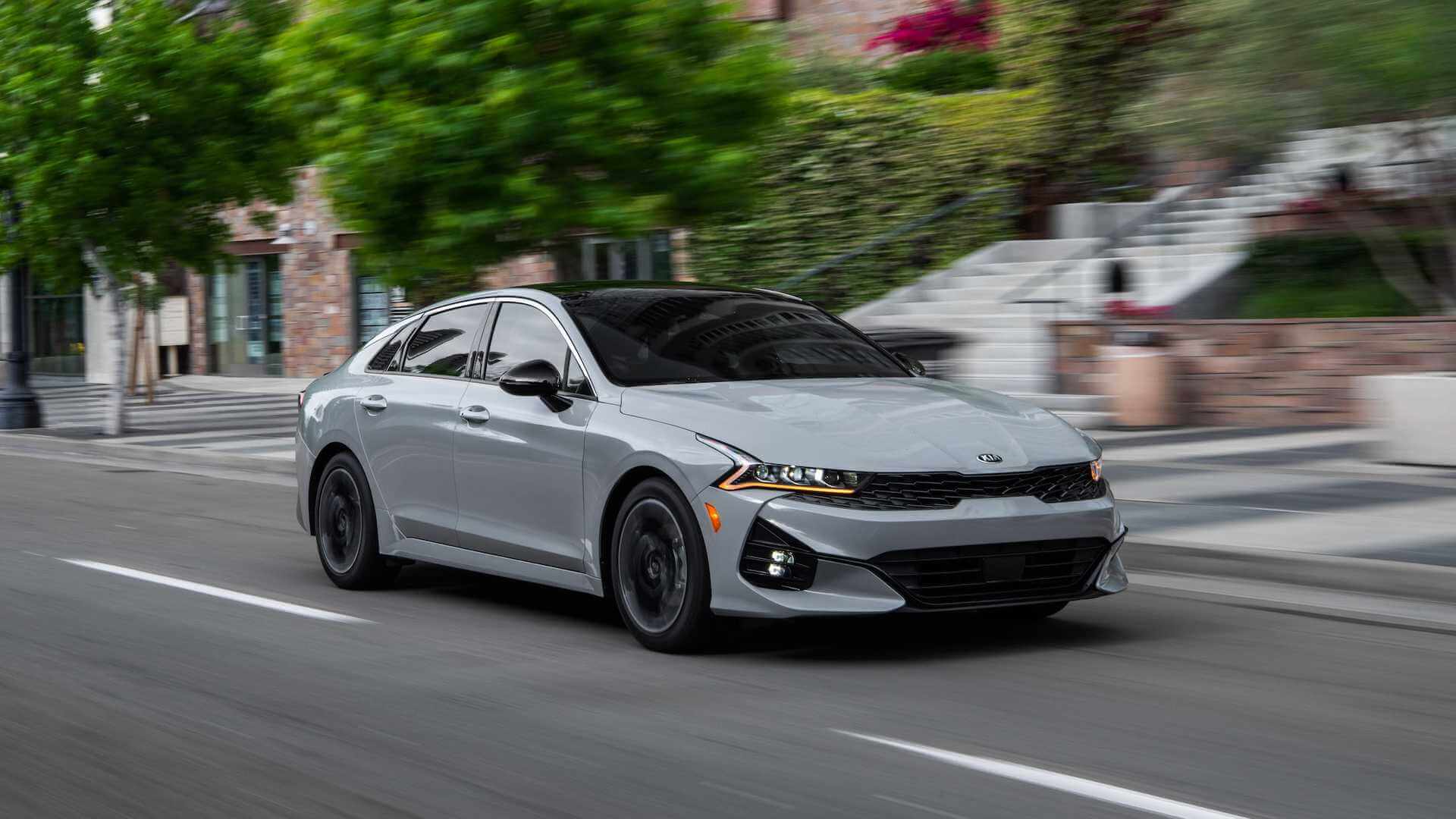
The Kia K5 is a front-wheel-drive mid-size sedan - by its dimensions close to the E-segment in European terms. It is the car previously sold in most countries as the Kia Optima (and in some markets as the Magentis); with the DL3 generation, the K5 name, already used in South Korea, China and Indonesia, became global. The first Optima of 2001 shared much of its engineering and some body panels with the Hyundai Sonata, but later generations moved away from that badge-engineering approach. The new K5 was unveiled at a special event in Seoul on 21 November 2019 and went on sale in South Korea on 12 December 2019.
In short
- DL3 generation, revealed in Seoul in November 2019; the successor to the Optima.
- Petrol engines: 2.0 MPI with 110 kW (150 PS) and 2.5 GDI with 143 kW (194 PS); six- and eight-speed automatics and front-wheel drive in the versions covered here.
- 510-litre boot with a full-size spare.
- Five stars in NHTSA crash testing; a 12.3-inch digital cluster, 10.25-inch screen and head-up display on higher trims.
Specs by version
Engines
| Version | Engine | Gearbox | Drive | Production years |
|---|---|---|---|---|
| 1.6 L 4 cyl Automatic (S8) · 2024 (EPA) | 1.6 l · 4 cyl 1,600 cc | 8-sp Automatic | Front-wheel drive | 2024 |
| 1.6 L 4 cyl Automatic (S8) · 2023 (EPA) | 1.6 l · 4 cyl 1,600 cc | 8-sp Automatic | Front-wheel drive | 2023 |
| 1.6 L 4 cyl Automatic (S8) · 2022 (EPA) | 1.6 l · 4 cyl 1,600 cc | 8-sp Automatic | Front-wheel drive | 2022 |
| 1.6 L 4 cyl Automatic (S8) · 2022 (EPA) | 1.6 l · 4 cyl 1,600 cc | 8-sp Automatic | Front-wheel drive | 2022 |
| 1.6 L 4 cyl Automatic (S8) · 2021 (EPA) | 1.6 l · 4 cyl 1,600 cc | 8-sp Automatic | Front-wheel drive | 2021 |
| 1.6 L 4 cyl Automatic (S8) · 2021 (EPA) | 1.6 l · 4 cyl 1,600 cc | 8-sp Automatic | Front-wheel drive | 2021 |
| 2.5 L 4 cyl Automatic (AM-S8) · 2026 (EPA) | 2.5 l · 4 cyl 2,500 cc | 8-sp Dual-clutch | Front-wheel drive | 2026 |
| 2.5 L 4 cyl Automatic (S8) · 2026 (EPA) | 2.5 l · 4 cyl 2,500 cc | 8-sp Automatic | Front-wheel drive | 2026 |
| 2.5 L 4 cyl Automatic (AM-S8) · 2025 (EPA) | 2.5 l · 4 cyl 2,500 cc | 8-sp Dual-clutch | Front-wheel drive | 2025 |
| 2.5 L 4 cyl Automatic (S8) · 2025 (EPA) | 2.5 l · 4 cyl 2,500 cc | 8-sp Automatic | Front-wheel drive | 2025 |
| 2.5 L 4 cyl Automatic (S8) · 2025 (EPA) | 2.5 l · 4 cyl 2,500 cc | 8-sp Automatic | Front-wheel drive | 2025 |
| 2.5 L 4 cyl Automatic (AM-S8) · 2024 (EPA) | 2.5 l · 4 cyl 2,500 cc | 8-sp Dual-clutch | Front-wheel drive | 2024 |
| 2.5 L 4 cyl Automatic (AM-S8) · 2023 (EPA) | 2.5 l · 4 cyl 2,500 cc | 8-sp Dual-clutch | Front-wheel drive | 2023 |
| 2.5 L 4 cyl Automatic (AM-S8) · 2022 (EPA) | 2.5 l · 4 cyl 2,500 cc | 8-sp Dual-clutch | Front-wheel drive | 2022 |
| 2.5 L 4 cyl Automatic (AM-S8) · 2021 (EPA) | 2.5 l · 4 cyl 2,500 cc | 8-sp Dual-clutch | Front-wheel drive | 2021 |
Performance
Show all 15 versions
| Version | Fuel consumption |
|---|---|
| 1.6 L 4 cyl Automatic (S8) · 2024 (EPA) | 7.6 l/100 km30.9 mpg US · 37.2 mpg UK |
| 1.6 L 4 cyl Automatic (S8) · 2023 (EPA) | 7.6 l/100 km30.9 mpg US · 37.2 mpg UK |
| 1.6 L 4 cyl Automatic (S8) · 2022 (EPA) | 7.4 l/100 km31.8 mpg US · 38.2 mpg UK |
| 1.6 L 4 cyl Automatic (S8) · 2022 (EPA) | 7.6 l/100 km30.9 mpg US · 37.2 mpg UK |
| 1.6 L 4 cyl Automatic (S8) · 2021 (EPA) | 7.4 l/100 km31.8 mpg US · 38.2 mpg UK |
| 1.6 L 4 cyl Automatic (S8) · 2021 (EPA) | 7.6 l/100 km30.9 mpg US · 37.2 mpg UK |
| 2.5 L 4 cyl Automatic (AM-S8) · 2026 (EPA) | 8.7 l/100 km27.0 mpg US · 32.5 mpg UK |
| 2.5 L 4 cyl Automatic (S8) · 2026 (EPA) | 8.1 l/100 km29.0 mpg US · 34.9 mpg UK |
| 2.5 L 4 cyl Automatic (AM-S8) · 2025 (EPA) | 8.7 l/100 km27.0 mpg US · 32.5 mpg UK |
| 2.5 L 4 cyl Automatic (S8) · 2025 (EPA) | 8.1 l/100 km29.0 mpg US · 34.9 mpg UK |
| 2.5 L 4 cyl Automatic (S8) · 2025 (EPA) | 7.8 l/100 km30.2 mpg US · 36.2 mpg UK |
| 2.5 L 4 cyl Automatic (AM-S8) · 2024 (EPA) | 8.7 l/100 km27.0 mpg US · 32.5 mpg UK |
| 2.5 L 4 cyl Automatic (AM-S8) · 2023 (EPA) | 8.7 l/100 km27.0 mpg US · 32.5 mpg UK |
| 2.5 L 4 cyl Automatic (AM-S8) · 2022 (EPA) | 8.7 l/100 km27.0 mpg US · 32.5 mpg UK |
| 2.5 L 4 cyl Automatic (AM-S8) · 2021 (EPA) | 8.7 l/100 km27.0 mpg US · 32.5 mpg UK |
Verified Manufacturer and type-approval data from our catalog · Sources and methodology
Safety
-
NHTSA 2025
US NCAP (NHTSA)
Stars from different years and organisations are not directly comparable: test protocols change every few years.
Kia K5 overview: years, platform, name
The K5 is built on a front-wheel-drive platform with a transverse engine and a monocoque body made largely of high-strength steel. Compared with the Optima it is bigger, bolder and more technologically advanced. Other Kia models are listed in our Kia catalogue, and its close relative is covered in the Hyundai catalogue.
Design and body
A steeply raked windscreen and a sculpted bonnet with aircraft-wing-like contours give the K5 a dynamic front end. The LED headlights are shaped like comets with tails and edged by intricate LED signatures; the "tiger nose" grille is slimmer than before but keeps its large pattern, and the bumper is cut with intakes and aerodynamic elements. In profile, the low, fastback-style roof and teardrop-shaped side glass make the car look futuristic. Wheels range from 16-inch alloys to optional 18-inch, while the GT-Line version has more aggressive bumpers and 19-inch wheels. At the rear, a steeply raked window, a short boot lid with a lip spoiler and distinctive LED tail lights complete the design. Ground clearance is 155 mm.
Interior, equipment and technology
The cabin feels more expensive than the car's price, with black or beige leather, wood-effect trim and a striking decorative panel across the dashboard; some savings are visible only in less obvious places. Ambient lighting offers 64 colours. The front seats are electrically adjustable, heated and ventilated, with good side support, though even higher trims lack lumbar adjustment; a dedicated button reclines the seat into a relaxation position.
The redesigned three-spoke steering wheel has eight buttons and four mini-joysticks. Base cars have analogue dials with a 4.2-inch display; higher trims have a 12.3-inch digital Supervision cluster that can show the blind-spot camera image when an indicator is used, plus an 8-inch head-up display. The infotainment system ranges from a conventional radio to an 8-inch screen and a 10.25-inch touchscreen, with touch-sensitive climate controls and relaxing ambient sound modes such as a crackling fireplace. The rear seat has recessed outer places, its own air vents, two USB ports and an armrest; the front passenger seat can be moved and folded from the back to give rear passengers more room. A 12-speaker Bose system is available.
The boot holds 510 litres, with a full-size spare and tools under the floor; the rear seats fold for longer items.
Engines and transmissions
| Engine | Power (kW / PS) | Torque | Gearbox |
|---|---|---|---|
| 2.0 MPI (G4NA), DOHC 16 valves, variable valve timing | 110 kW / 150 PS | 192 Nm | 6-speed automatic |
| 2.5 GDI (G4KN), direct injection, dual variable valve timing | 143 kW / 194 PS | 246 Nm | 8-speed automatic |
Combined consumption is about 7.1–7.2 l/100 km, 0–100 km/h takes 8.6–10.6 seconds and top speed is 200–210 km/h. These two versions have no manual gearbox and are front-wheel drive. Depending on the market, the DL3 range also included a 1.6 T-GDi turbo (offered with all-wheel drive in North America), a 2.0 hybrid and the K5 GT with a 2.5 T-GDi producing 216 kW (290 hp). Five driving modes are available: Smart, Eco, Comfort, Sport and Custom.
Chassis
Suspension is independent, with steel springs, passive dampers and anti-roll bars at both ends: MacPherson struts at the front and a multi-link rear axle. Rack-and-pinion steering has electric assistance, and the brakes are discs all round (ventilated at the front) with ABS, EBD and brake assist.
Safety
The K5 earned five stars out of five in NHTSA crash tests. Equipment includes stability control, active steering intervention, hill-start assist, emergency stop signal, tyre-pressure monitoring, rear cross-traffic alert and collision avoidance, blind-spot cameras shown in the instrument cluster, safe exit assist, driver attention warning, automatic high beam, front and side airbags, curtain airbags and ISOFIX. Entry versions already have a rear camera, cruise control, climate control, front and rear parking sensors, LED headlights, a heated steering wheel and six airbags; higher trims add a panoramic roof, surround view, a power boot lid, remote start, leather, ventilated seats, 18-inch wheels, full-LED lights and the digital cluster.
Strengths and weaknesses
Owners like the K5's design, sound system, technology, comfort, many features, high safety, roomy cabin, decent boot and full-size spare, and report no concerns about engine reliability. Criticisms include modest power from the base engine, a low front bumper, thin paint, limited ground clearance, average sound insulation and electronics, no heated washer jets or wiper area, and a bonnet that flutters at around 110 km/h. Rivals include the Toyota Camry, Hyundai Sonata, Mazda 6, Honda Accord, Volkswagen Passat, Skoda Superb, Ford Mondeo and Subaru Legacy.
Kia K5 in our rankings
- No. 110 of 256 · Most economical cars (7.4 l/100 km · top 44%)
- No. 66 of 131 · Biggest engines: sedans (2,500 cc · top 52%)
- No. 24 of 49 · Most economical sedans (7.4 l/100 km · top 52%)
- No. 314 of 557 · Biggest engines: cars (2,500 cc · top 58%)
- No. 533 of 912 · Longest-running car nameplates (7 years · top 60%)
- No. 195 of 305 · Oldest car models still on sale (7 years · top 67%)
More economical than 56% of ranked cars in the 1CARS catalog (No. 110 of 256).
FAQ
Is the Kia K5 the same as the Kia Optima?
Yes. The K5 name was used in South Korea, China and Indonesia, and with the DL3 generation it replaced the Optima name worldwide.
When was the Kia K5 DL3 launched?
It was unveiled in Seoul on 21 November 2019 and went on sale in South Korea on 12 December 2019.
What engines does the Kia K5 have?
A 2.0 MPI with 110 kW (150 PS) and a 2.5 GDI with 143 kW (194 PS), both with automatic gearboxes and front-wheel drive; other markets also received 1.6 turbo, hybrid and 2.5 turbo GT versions.
How safe is the Kia K5?
It scored five stars out of five in NHTSA crash testing.
Data sources
Data checked by an editor against the sources below.
- Wikipedia - Kia K5
- US EPA fueleconomy.gov - 49326.shtml
- US EPA fueleconomy.gov - 49324.shtml
- US EPA fueleconomy.gov - 47720.shtml
- US EPA fueleconomy.gov - 47718.shtml
- NHTSA 5-Star Safety Ratings (US NCAP) — U.S. Government work, public domain