 SEAT Ateca
Specs, engines and history
Published Sources (1) Report an error
By Felix Hartmann, Automotive Technology & EV Contributor
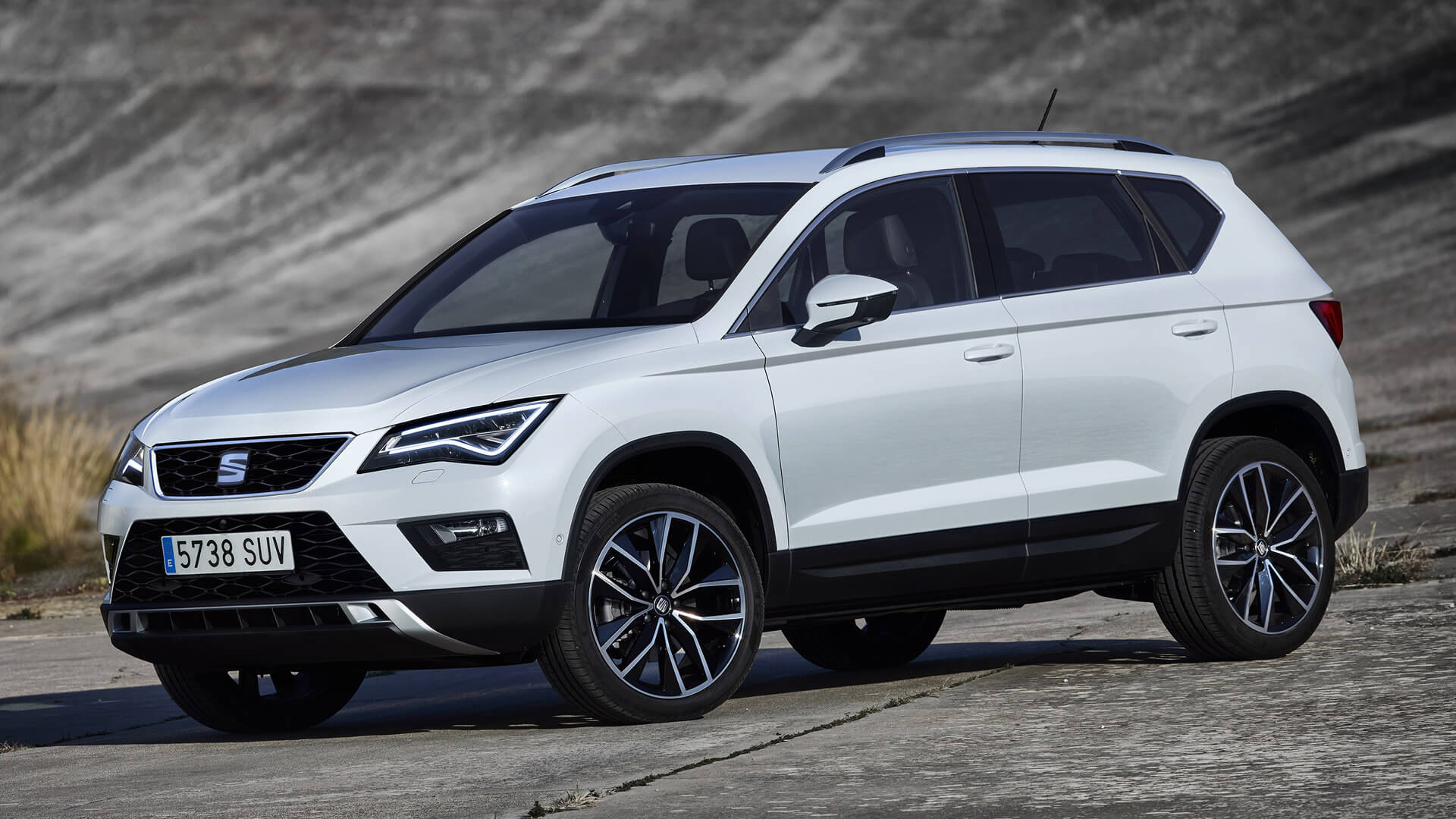
The SEAT Ateca is the first crossover in the history of the Spanish Volkswagen Group brand. It was officially presented at the Geneva motor show in March 2016 as the production version of the striking 20V20 concept shown a year earlier. On 15 June 2020 it received a facelift that refreshed the styling, raised comfort and improved its already good equipment. More than 300,000 Ateca had been sold in the first four years.
In short
- Revealed in Geneva in March 2016; facelifted on 15 June 2020.
- Built on the Volkswagen Group MQB platform, with MacPherson front and four-link rear suspension.
- Petrol engines with 85 and 110 kW (115 and 150 PS); TDI diesels with 85, 110 and 140 kW (115, 150 and 190 PS).
- Optional 4Drive all-wheel drive with a fifth-generation Haldex clutch and six driving modes.
SEAT Ateca at a glance
The Ateca is a five-seat compact SUV with a transverse engine, front-wheel drive as standard and optional 4Drive all-wheel drive. Like Skoda, SEAT is part of the Volkswagen Group, and the Ateca shares its MQB underpinnings with related models. More SEAT models are listed in our SEAT catalogue, and the brand's long-running family car is covered in our SEAT Toledo section.
The 2020 facelift
SEAT's management aimed for targeted rather than wholesale changes, improving safety, comfort and functionality. The body keeps its compact dimensions but looks bolder, combining SEAT's signature cues with details unique to the Ateca.
Exterior
The facelifted Ateca has aggressive headlights, distinctive air intakes, stepped and wave-shaped surfacing and plenty of chrome. The front is set low and slightly inclined to improve the driver's view. The bonnet has wave-like changes in height at its sides, leading to SEAT's polygonal grille with a wide chrome frame, a fine chrome mesh and a large SEAT badge. Triangular headlights at either side use LED technology on every version, including the base car. The bumper has a central trapezoidal intake with a coarse mesh and number-plate mount, two side recesses that channel air to the brakes and house fog lamps, and protective metal and plastic inserts.
At the side, a thin chrome line frames the window graphic, the pillars are gloss black, and triangular mirrors carry indicators. Chrome door handles, square wheel arches and sills with unpainted plastic cladding complete the profile, and wheels range from 17 to 19 inches depending on version. The slightly inclined rear has a sloping roof spoiler, a large rear window, triangular lights matching the front, chrome badges, a slightly protruding bumper with metal protective elements, fog lamps and two exhaust outlets.
Interior
The interior has been thoroughly digitised. The top FR Sport and Xperience Lux versions have a 10.25-inch digital instrument panel, and the infotainment system now offers voice recognition, wireless Apple CarPlay and Android Auto, online navigation and remote connectivity, with a screen of 8.25 to 9.2 inches depending on version. Other new features include a redesigned multifunction steering wheel, a heated windscreen and an eight-way electrically adjustable driver's seat with memory. Leather upholstery joins fabric, and matt grey inserts can frame the air vents, infotainment screen and console switch panels. Between the front seats are a control panel, cupholders and a tall armrest with a cooled storage box. The cabin is about as roomy as related Skoda models.
The Ateca seats five. Before the facelift, front-wheel-drive versions had a 510-litre boot and all-wheel-drive versions 485 litres, and the rear seats fold in sections to create a flat floor.
Engines and transmissions
| Engine | Fuel | Power (kW / PS) |
|---|---|---|
| 1.0 three-cylinder turbo | Petrol | 85 kW / 115 PS |
| 1.4 TSI, later 1.5 TSI four-cylinder turbo | Petrol | 110 kW / 150 PS |
| 1.6 TDI turbo | Diesel | 85 kW / 115 PS |
| 2.0 TDI turbo | Diesel | 110 kW / 150 PS |
| 2.0 TDI turbo | Diesel | 140 kW / 190 PS |
Petrol engines use about 5.3–6.2 l/100 km and diesels 4.3–5.0 l/100 km on the combined cycle. Gearboxes are a six-speed manual or a seven-speed DSG dual-clutch automatic. Drive goes to the front wheels as standard; the optional 4Drive system uses a fifth-generation Haldex multi-plate clutch that can send up to 90% of the torque to either axle depending on conditions. After the facelift there are six driving modes instead of four: Eco, Normal, Offroad, Sport, Snow and Individual.
Chassis
The Ateca is built on the modular MQB platform with MacPherson struts at the front and a four-link rear axle, with anti-roll bars at both ends. Rack-and-pinion steering has electric assistance, and the brakes are discs all round (ventilated at the front) with ABS, EBD and other electronic aids. High-quality aluminium and steel grades in the body reduce weight while improving crash safety.
Safety and equipment
The Ateca offers stability control, remote central locking, ABS, an anti-theft system, adaptive cruise control, lane keeping, tyre-pressure monitoring, driver fatigue detection, Front Assist with city emergency braking, front airbags, rear parking sensors, a surround-view camera, ISOFIX anchorages, LED interior lighting, an immobiliser, light and rain sensors, an auto-dimming rear-view mirror, power heated mirrors and blind-spot monitoring.
After the facelift, four trim levels are offered: Reference, Style, Xperience and FR. Equipment can include adaptive cruise control, light and rain sensors, heated power mirrors, a heated rear window, push-button start, a height-adjustable steering column, a heated steering wheel, heated and ventilated front seats, six airbags and curtain airbags, front and rear parking sensors, and ABS, ESP, brake assist, EBD, traction control, hill-start assist and adaptive headlights.
Key specifications
| Parameter | Value |
|---|---|
| Presented | March 2016, Geneva |
| Facelift | 15 June 2020 |
| Platform | MQB |
| Power (kW / PS) | 85–140 kW / 115–190 PS |
| Gearboxes | 6-speed manual, 7-speed DSG |
| Drive | Front or 4Drive all-wheel drive |
| Seats | 5 |
| Boot (pre-facelift) | 510 l (FWD), 485 l (AWD) |
| Wheels | 17–19 in |
Strengths and weaknesses
Owners praise the Ateca's good seats, sound ergonomics, decent infotainment system, attractive looks and good value for money, as well as the availability of all-wheel drive and a wide choice of engines. Good ground clearance and suspension help on poor roads. Some complain about sound insulation and a cabin that is slow to warm up in winter. Rivals include the Nissan Qashqai, Volkswagen Tiguan, Skoda Karoq, Kia Sportage, Hyundai Tucson, Peugeot 3008 and Ford Kuga.
SEAT Ateca in our rankings
In production longer than 57% of ranked nameplates in the 1CARS catalog (No. 387 of 912).
FAQ
When was the SEAT Ateca launched?
It was unveiled at the Geneva motor show in March 2016 and facelifted on 15 June 2020.
What concept car previewed the SEAT Ateca?
The 20V20 concept, shown a year before the production model.
Does the SEAT Ateca have all-wheel drive?
Yes, as an option: 4Drive uses a fifth-generation Haldex clutch that can send up to 90% of torque to either axle.
How big is the SEAT Ateca boot?
510 litres with front-wheel drive and 485 litres with all-wheel drive (pre-facelift figures).
Data sources
Data checked by an editor against the sources below.