
Moskvich-407 vs Moskvich-412: two eras of the Moskvich
Updated Report an error By Oleksandr Hnatiuk

Moskvich · 1958–1963
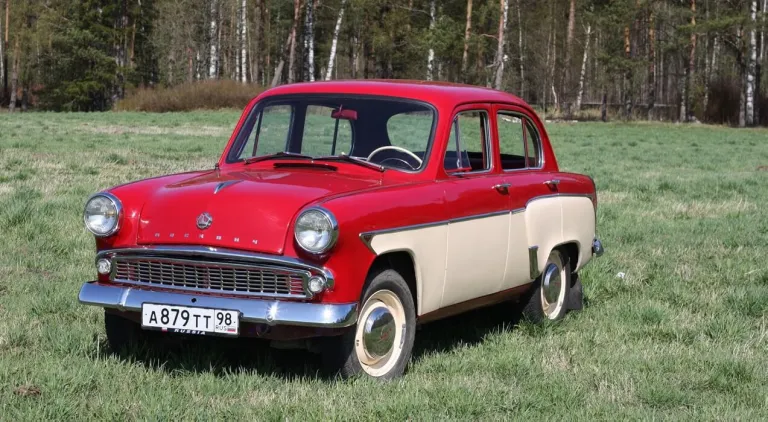
Moskvich-407
- Power
- 33 kW45 PS
- 0–100 km/h
- 23.0 s
- Top speed
- 115 km/h
- Kerb mass
- 910 kg

Moskvich · 1967–1975
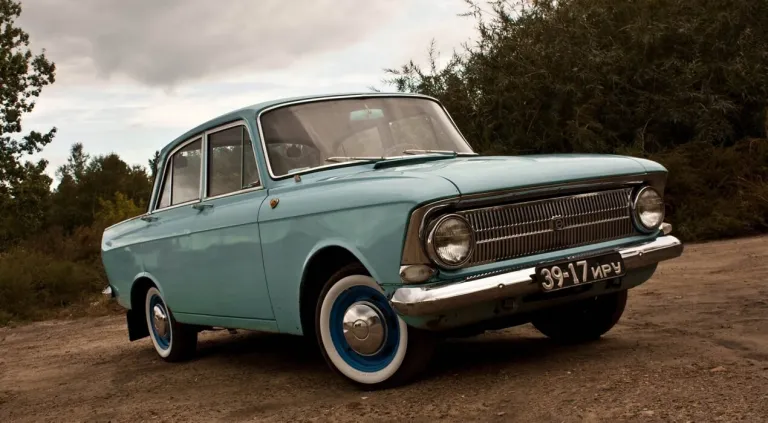
Moskvich-412
- Power
- 55 kW75 PS
- 0–100 km/h
- 19.0 s
- Top speed
- 140 km/h
- Kerb mass
- 1,045 kg
At a glance
Who suits what, worked out from the catalog figures of the versions above.
Categories won: Moskvich-407 0 Moskvich-412 1
- City Too close to call Length: 4,055 mm vs 4,115 mm
- Performance Moskvich-412 Power per tonne: 53 kW/t vs 36 kW/t; 0–100 km/h: 19.0 s vs 23.0 s
Verdict Opinion
The Moskvich-412 is the better car to drive by every measure: more power, a higher top speed, better brakes and a more modern aluminium overhead-camshaft engine. The Moskvich-407 is the more charming period piece, lighter and simpler, and it was described as the first Soviet car export to be truly successful in the West.
For regular use the 412 is the sensible choice; for 1950s character and export history the 407 is hard to beat.
— Oleksandr Hnatiuk
The Moskvich-407 and the Moskvich-412 are a decade apart, yet they belong to one continuous line of small MZMA saloons. The 407 appeared in 1958 as a development of the Moskvich-402 with a new overhead-valve engine. It was replaced by the 408 from 1964, and the 412 of 1967 was in turn derived from the 408 with a more powerful 1.5-litre engine.
Comparing the two shows how far the Moskvich moved in ten years: from a rounded 1950s saloon with drum brakes and 33 kW (45 PS) to a squarer, much quicker car with an aluminium overhead-camshaft engine and, from 1970, front disc brakes.
Engineering, design and everyday use
Engineering
The 407 uses a 1,358 cc overhead-valve inline-four with about 33 kW (45 PS) at 4,500 rpm and 88 Nm. It started with a three-speed gearbox; a four-speed synchromesh manual arrived in December 1959. The 412 has the UZAM-412 engine designed by Igor Okunev: 1,478 cc, an aluminium block and head, a chain-driven overhead camshaft and 55 kW (75 PS) at 5,800 rpm with 108 Nm, driving through a four-speed manual.
Both cars have independent front suspension and a rear live axle on leaf springs, and both drive the rear wheels. The 407 has drum brakes all round; the 412 has a dual-circuit system with servo and front discs from 1970.
Design and size
The 407 is 4,055 mm (159.6 in) long, 1,540 mm (60.6 in) wide and 1,560 mm (61.4 in) tall on a 2,370 mm (93.3 in) wheelbase, with a kerb weight of 910 kg (2,006 lb). The 412 is about 4.1 m long, 1,550 mm (61.0 in) wide and sits on a 2,400 mm (94.5 in) wheelbase, but it is heavier at 1,045 kg (2,304 lb).
Performance and use
The 407 tops out at 115 km/h (71 mph); the 412 reaches 140 km/h (87 mph) and 100 km/h in about 19 seconds. Both were exported in large numbers: 120,903 of the 359,980 Moskvich-407s built went abroad, and the 412 was sold in the UK from 1969 and proved itself in the 1968 London to Sydney Marathon and the 1970 London to Mexico World Cup Rally. Four-wheel-drive versions of the 407 were also built until 1961.
Race Stats side by side
Each figure is a 0–100 score from the catalog numbers, the same as on the 1CARS Race cards. PI is the overall performance index (100–999) and its class D–S.
| Stat | Moskvich-407 | Moskvich-412 |
|---|---|---|
| PI | D · 344 | C · 408 |
| Power | 18 | 30 |
| Grip | 40 | 43 |
| Handling | 73 | 80 |
| Top speed | 6 | 15 |
| Launch | 1 | 2 |
| Reliability | 46 | 53 |
Grip and handling are estimates from drive type, weight, height and body (hover a figure to see where it comes from). 1CARS Race
Who wins a race?
Quarter-mile (402 m) drag from a standing start, dry road, no reaction time — the 1CARS Race physics on the catalog figures of these versions.
- 1 Moskvich-4121.5 · petrol · 55 kW (75 PS) 20.57 sat 102 km/h
- 2 Moskvich-4071.4 · petrol · 33 kW (45 PS) 21.52 sat 97 km/h · +0.95 s
Size and weight
| Moskvich-407 | Moskvich-412 | |
|---|---|---|
| Length | 4,055 mm159.6 in | 4,115 mm162.0 in +60 mm +2.4 in +1.5% |
| Width | 1,540 mm60.6 in | 1,550 mm61.0 in +10 mm +0.4 in +0.6% |
| Wheelbase | 2,370 mm93.3 in | 2,400 mm94.5 in +30 mm +1.2 in +1.3% |
| Kerb weight | 910 kg2,006 lb | 1,045 kg2,304 lb +135 kg +298 lb +14.8% |
| Fits a standard garage? | Yes | Yes |
Difference vs Moskvich-407 (±). Garage check: a standard single garage takes a car up to about 5.0 m (16 ft 5 in) long and 1.9 m (6 ft 3 in) wide (width as listed in the catalog; some makers include the mirrors). Leave about 0.6 m (2 ft) to open the doors.
Full specifications
| Moskvich-407 | Moskvich-412 | |
|---|---|---|
| General | ||
| Version | 1.4 · petrol · 33 kW (45 PS) | 1.5 · petrol · 55 kW (75 PS) |
| Production years | 1958–1963 | 1967–1975 |
| Body | Sedan | Sedan |
| Country | Soviet Union (USSR) | Soviet Union (USSR) |
| Performance | ||
| Power Why it matters: More power means stronger acceleration and easier overtaking, especially with a full load. | 33 kW (45 PS) 44 hp | 55 kW (75 PS) 74 hp Better |
| Torque Why it matters: Torque is the pulling force you feel when accelerating from low revs, towing or climbing hills. | 88 Nm 65 lb-ft | No data |
| 0–100 km/h Why it matters: A shorter 0–100 km/h time means quicker getaways and safer merging onto fast roads. | 23.0 s | 19.0 s Better |
| Top speed Why it matters: Top speed hints at how relaxed the car is at motorway speeds, even if you never reach it. | 115 km/h 71 mph | 140 km/h 87 mph Better |
| Power per tonne | 36 kW/t 44 hp/ton calculated | 53 kW/t 64 hp/ton calculated Better |
| Engine and transmission | ||
| Fuel | Petrol | Petrol |
| Engine | 1,360 cc · 4 cyl 1.4 l | 1,500 cc 1.5 l |
| Gearbox | 3-speed manual | No data |
| Drive | No data | Rear-wheel drive |
| Dimensions and weight | ||
| Length | 4,055 mm 159.6 in | 4,115 mm 162.0 in |
| Width | 1,540 mm 60.6 in | 1,550 mm 61.0 in |
| Height | 1,560 mm 61.4 in | No data |
| Wheelbase | 2,370 mm 93.3 in | 2,400 mm 94.5 in |
| Kerb weight Why it matters: A lighter car is usually more agile and uses less energy. | 910 kg 2,006 lb Better | 1,045 kg 2,304 lb |
| Fuel tank Why it matters: A larger tank means more distance between fuel stops. | No data | 45 l 11.9 gal US |
| Economy and running costs | ||
| Fuel consumption Why it matters: Lower consumption cuts running costs and CO₂ emissions on every trip. | 6.5 l/100 km 36.2 mpg US | No data |
| Fuel cost per year | €1,710/year estimated | No data |
These cars do not differ in the data we have.
Equal rows hidden (3): Body, Country, Fuel.
Better marks the stronger figure — only for measurable specs (power, torque, 0–100 km/h, consumption, boot, weight).
Estimated at 15,000 km a year with fuel at €1.75/l petrol.
In plain words
Moskvich-412 is quicker: 0–100 km/h in 19.0 s against 23.0 s for Moskvich-407. Moskvich-412 is 60 mm longer than Moskvich-407 (4,115 mm vs 4,055 mm). Moskvich-407 is lighter by 135 kg (910 kg vs 1,045 kg). Moskvich-407 is the older design (from 1958); Moskvich-412 arrived in 1967. On the catalog figures, the Moskvich-412 is the pick for performance.
Which one to choose
Choose the Moskvich-407 if you want an authentic late-1950s saloon with simple overhead-valve mechanics and are happy with modest performance and drum brakes.
Choose the Moskvich-412 if you want a classic Moskvich that keeps up with modern traffic, with the 55 kW (75 PS) aluminium engine and, on cars from 1970, front disc brakes.
Frequently asked questions
Is the Moskvich-412 a development of the 407?
Indirectly. The 407 was followed by the 408 from 1964, and the 412 of 1967 was derived from the 408 with a new 1.5-litre engine.
How much more powerful is the 412?
Much more: 55 kW (75 PS) from 1,478 cc, against about 33 kW (45 PS) from 1,358 cc for the 407.
How many Moskvich-407s were built?
359,980, including 120,903 for export. No verified total is published for the Moskvich-412.