
Moskvich-412 vs Moskvich-2140: what changed in 1976
Updated Report an error By Oleksandr Hnatiuk

Moskvich · 1976–1988
Moskvich-2140
- Power
- 55 kW75 PS
- 0–100 km/h
- 19.0 s
- Top speed
- 142 km/h
- Kerb mass
- 1,080 kg

Moskvich · 1967–1975
Moskvich-412
- Power
- 55 kW75 PS
- 0–100 km/h
- 19.0 s
- Top speed
- 140 km/h
- Kerb mass
- 1,045 kg
At a glance
Who suits what, worked out from the catalog figures of the versions above.
Categories won: Moskvich-2140 0 Moskvich-412 1
- City Moskvich-412 Length: 4,115 mm vs 4,250 mm
- Off-road Too close to call Drive and body: Rear-wheel drive · Sedan vs Rear-wheel drive · Sedan
Verdict Opinion
Mechanically, the two are essentially the same car, so the decision is about era and character. The 412 is the purer late-1960s design, with rally history from the 1968 London to Sydney Marathon and the 1970 London to Mexico World Cup Rally. The 2140 is the better-equipped 1970s update and stayed in production until July 1988.
Neither is a clear upgrade in performance; the 2140 wins on equipment and comfort, the 412 on period charm.
— Oleksandr Hnatiuk
The Moskvich-2140 is the direct successor to the Moskvich-412, and the two cars are closely related. AZLK ended the 408 and 412 in December 1975 and started the 2140 in January 1976, keeping the same body structure, wheelbase, engine and rear-wheel-drive layout.
What changed was almost everything you can see and touch. The 2140 received new body panels everywhere except the roof, a new face and rear, and a modernised interior. This comparison explains how far the update went and what it means for anyone choosing between the two classics today.
Engineering, design and everyday use
Engineering
Both cars use the UZAM-412 engine: an aluminium-block inline-four of 1,478 cc with an overhead camshaft, rated at 55 kW (75 PS) at 5,800 rpm. Both have a four-speed manual gearbox, independent front suspension and a rear live axle on leaf springs; front disc brakes appeared on the 412 from 1970 and are standard on the 2140. The 2140 range also included the 2138, which used the older 1,358 cc 408 engine with 37 kW (50 PS) until 1982, because engine supply could not at first meet demand.
Design and equipment
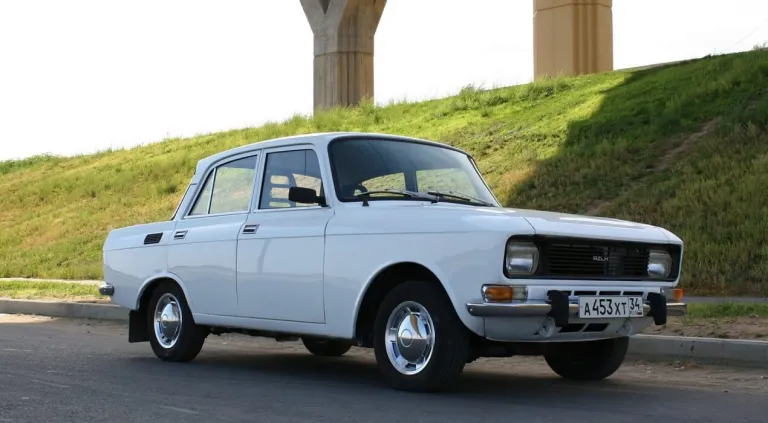
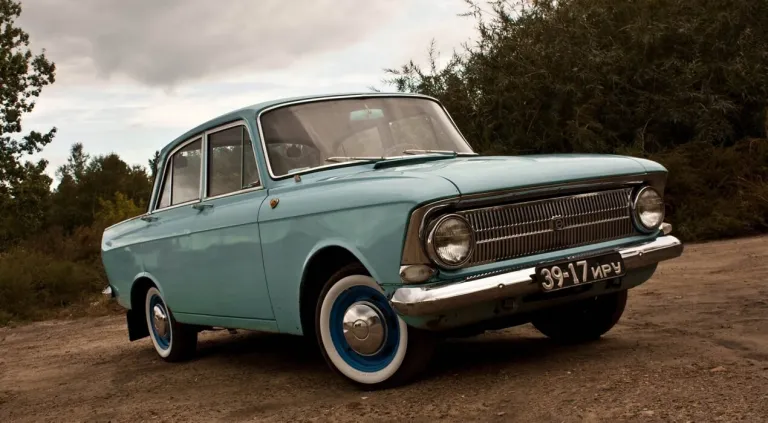
The 412 has twin round headlamps and a chrome grille. The 2140 switched to rectangular headlamps, a black plastic grille, new bumpers and tail lights, flush door handles and a fuel filler above the centre of the rear bumper. Inside it gained hazard warning lights, an electric windscreen washer, a heated rear window, a new steering wheel, round gauges and front headrests. Plastic bumpers arrived on the SL luxury version from 1981.
Size and use
Both cars are 1,550 mm (61.0 in) wide on a 2,400 mm (94.5 in) wheelbase. The 2140 is quoted at 4,250 mm (167.3 in) long, while figures for the 412 are around 4.1 m. Performance is similar: about 140 km/h (87 mph) and 0 to 100 km/h in about 19 to 20 seconds. The 412 was also built by IZh until 1982 and spawned estates, vans and the IZh-2125 hatchback.
Race Stats side by side
Each figure is a 0–100 score from the catalog numbers, the same as on the 1CARS Race cards. PI is the overall performance index (100–999) and its class D–S.
| Stat | Moskvich-2140 | Moskvich-412 |
|---|---|---|
| PI | D · 357 | C · 408 |
| Power | 14 | 30 |
| Grip | 43 | 43 |
| Handling | 76 | 80 |
| Top speed | 16 | 15 |
| Launch | 2 | 2 |
| Reliability | 63 | 53 |
Grip and handling are estimates from drive type, weight, height and body (hover a figure to see where it comes from). 1CARS Race
Who wins a race?
Quarter-mile (402 m) drag from a standing start, dry road, no reaction time — the 1CARS Race physics on the catalog figures of these versions.
- 1 Moskvich-4121.5 · petrol · 55 kW (75 PS) 20.57 sat 102 km/h
- 2 Moskvich-21401.5 · petrol 20.60 sat 102 km/h · +0.03 s
Size and weight
| Moskvich-2140 | Moskvich-412 | |
|---|---|---|
| Length | 4,250 mm167.3 in | 4,115 mm162.0 in −135 mm −5.3 in −3.2% |
| Width | 1,550 mm61.0 in | 1,550 mm61.0 in |
| Wheelbase | 2,400 mm94.5 in | 2,400 mm94.5 in |
| Kerb weight | 1,080 kg2,381 lb | 1,045 kg2,304 lb −35 kg −77 lb −3.2% |
| Fuel tank | 46 l12.2 gal US | 45 l11.9 gal US −1 l −0.3 gal US −2.2% |
| Fits a standard garage? | Yes | Yes |
Difference vs Moskvich-2140 (±). Garage check: a standard single garage takes a car up to about 5.0 m (16 ft 5 in) long and 1.9 m (6 ft 3 in) wide (width as listed in the catalog; some makers include the mirrors). Leave about 0.6 m (2 ft) to open the doors.
Full specifications
| Moskvich-2140 | Moskvich-412 | |
|---|---|---|
| General | ||
| Version | 1.5 · petrol | 1.5 · petrol · 55 kW (75 PS) |
| Production years | 1976–1988 | 1967–1975 |
| Body | Sedan | Sedan |
| Country | Soviet Union (USSR) | Soviet Union (USSR) |
| Performance | ||
| Power Why it matters: More power means stronger acceleration and easier overtaking, especially with a full load. | 55 kW (75 PS) 74 hp | 55 kW (75 PS) 74 hp |
| 0–100 km/h Why it matters: A shorter 0–100 km/h time means quicker getaways and safer merging onto fast roads. | 19.0 s | 19.0 s |
| Top speed Why it matters: Top speed hints at how relaxed the car is at motorway speeds, even if you never reach it. | 142 km/h 88 mph | 140 km/h 87 mph |
| Power per tonne | No data | 53 kW/t 64 hp/ton calculated |
| Engine and transmission | ||
| Fuel | Petrol | Petrol |
| Engine | 1,478 cc · 4 cyl 1.5 l | 1,500 cc 1.5 l |
| Drive | Rear-wheel drive | Rear-wheel drive |
| Dimensions and weight | ||
| Length | 4,250 mm 167.3 in | 4,115 mm 162.0 in |
| Width | 1,550 mm 61.0 in | 1,550 mm 61.0 in |
| Height | 1,480 mm 58.3 in | No data |
| Wheelbase | 2,400 mm 94.5 in | 2,400 mm 94.5 in |
| Kerb weight Why it matters: A lighter car is usually more agile and uses less energy. | 1,080 kg 2,381 lb | 1,045 kg 2,304 lb Better |
| Boot Why it matters: A bigger boot fits more luggage, shopping or a pram. | 520 l 18.4 cu ft | No data |
| Fuel tank Why it matters: A larger tank means more distance between fuel stops. | 46 l 12.2 gal US | 45 l 11.9 gal US |
| Economy and running costs | ||
| Fuel consumption Why it matters: Lower consumption cuts running costs and CO₂ emissions on every trip. | 10.2 l/100 km 23.1 mpg US | No data |
| Fuel cost per year | €2,680/year estimated | No data |
| Range on a full tank | 451 km 280 mi estimated | No data |
These cars do not differ in the data we have.
Equal rows hidden (8): Body, Country, Power, 0–100 km/h, Fuel, Drive, Width, Wheelbase.
Better marks the stronger figure — only for measurable specs (power, torque, 0–100 km/h, consumption, boot, weight).
Estimated at 15,000 km a year with fuel at €1.75/l petrol.
In plain words
Moskvich-2140 is 135 mm longer than Moskvich-412 (4,250 mm vs 4,115 mm). Moskvich-412 is lighter by 35 kg (1,045 kg vs 1,080 kg). Moskvich-412 is the older design (from 1967); Moskvich-2140 arrived in 1976. On the catalog figures, the Moskvich-412 is the pick for city.
Which one to choose
Choose the Moskvich-412 if you want the original round-headlamp shape, its motorsport story and the wider family of IZh derivatives.
Choose the Moskvich-2140 if you want more standard equipment, the later 1970s look and a car that was built for longer. Make sure it has the 1.5-litre engine, not the 2138 with the old 1.36-litre unit.
Frequently asked questions
Do the Moskvich-412 and 2140 have the same engine?
Yes. Both use the 1,478 cc UZAM-412 four-cylinder with 55 kW (75 PS). Only the cheaper 2138 variant of the 2140 used the older 1,358 cc engine.
When did the 2140 replace the 412?
AZLK ended the 412 in December 1975 and started the 2140 in January 1976. IZh continued its own 412 until 1982.
How can you tell them apart?
The 412 has twin round headlamps and a chrome grille; the 2140 has rectangular headlamps, a black plastic grille, new bumpers and flush door handles.