
Mazda RX-7 vs Toyota Supra A80: JDM rivals compared
Updated Report an error By Felix Hartmann
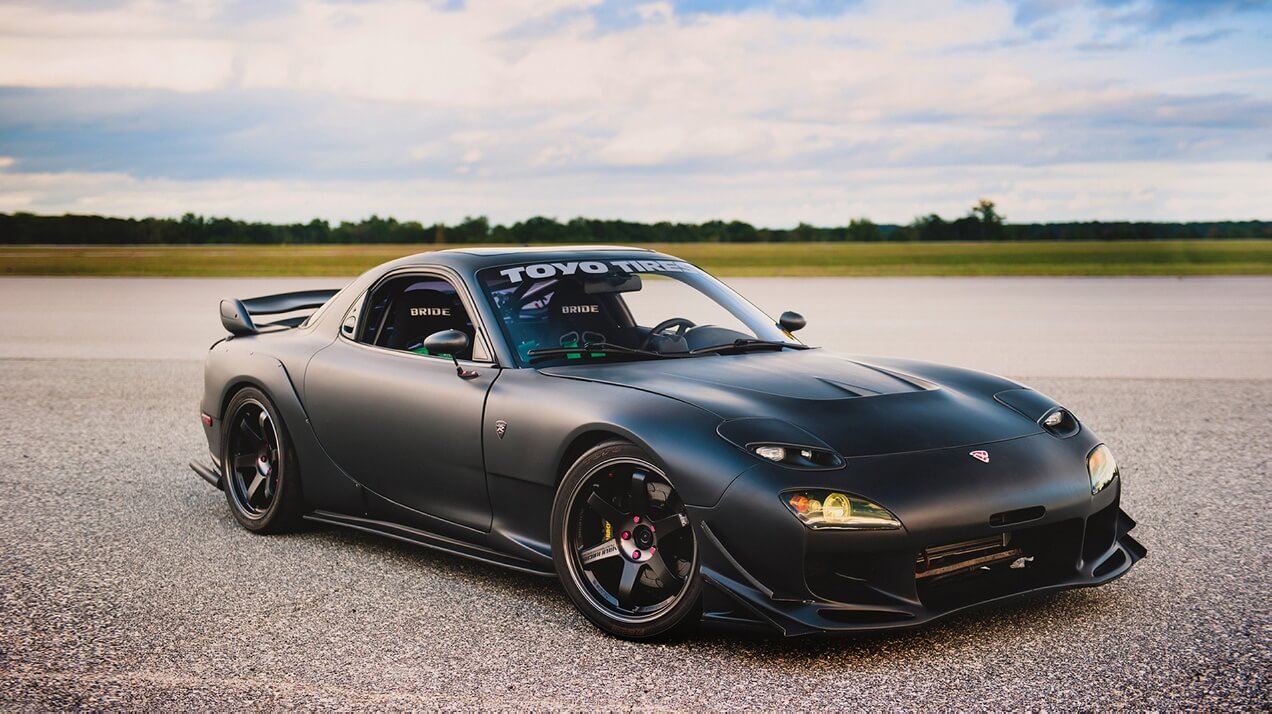
Mazda · 1991–2002
RX-7 FD
- Power
- 195 kW265 PS
- Kerb mass
- 1,310 kg

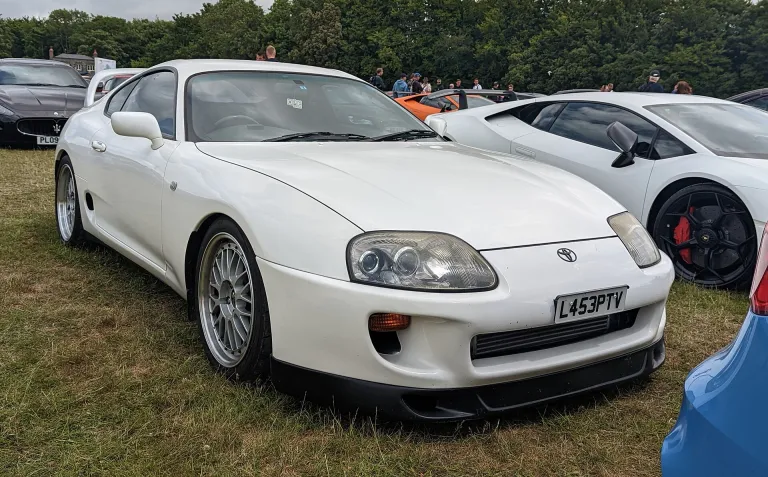
Toyota · 1993–2002
Supra A80
Price from €55,935 (1993)
- Power
- 239 kW325 PS
- Kerb mass
- 1,565 kg
Photo: Calreyn88 / Wikimedia Commons, CC BY-SA 4.0
At a glance
Who suits what, worked out from the catalog figures of the versions above.
- Performance Too close to call Power per tonne: 149 kW/t vs 153 kW/t
Verdict Opinion
The RX-7 is the purer sports car: compact, light and balanced, with a high-revving rotary engine that gives it a character no piston engine can copy. The Supra is the stronger, heavier grand tourer, whose 2JZ-GTE engine and robust six-speed drivetrain made it the favourite base for big power upgrades.
The engine is also the main ownership question. A rotary engine needs more careful maintenance and use than a conventional six, so a documented service history matters even more on an RX-7 than on a Supra.
- Felix Hartmann
The Mazda RX-7 and the Toyota Supra share a surprising timeline. Both nameplates appeared in 1978, the Supra as a longer, six-cylinder Celica Supra built after North American dealers asked for a rival to the Datsun 280Z, and both ended Japanese production in 2002. Their best-known meeting came in the 1990s, between the third-generation FD RX-7 and the fourth-generation A80 Supra.
Mazda built the RX-7 in three generations, more than 800,000 cars in all. The SA22C and FB ran from 1978 to 1985 (471,018 cars), the FC from 1985 to 1992 (272,027) and the FD from late 1991 to 2002 (68,589). The A80 Supra was made from April 1993 to August 2002. The Supra name returned in 2019 with the A90, developed together with BMW and sharing its platform with the Z4; the RX-7 was followed by the four-door RX-8.
Mazda RX-7 vs Toyota Supra: key differences
Rotary against straight-six
Every RX-7 uses a Wankel rotary engine. The FD's 13B-REW is a 1,308 cc twin-rotor unit with sequential twin turbochargers. It launched in Japan with 188 kW (255 PS) in 1992 and, in the final Type RS, reached 206 kW (280 PS) and 314 Nm. Toyota's A80 used a 2,997 cc inline-six. The naturally aspirated 2JZ-GE gave 165 kW (225 PS) in Japan. The 2JZ-GTE also used sequential twin turbos, with the second turbocharger joining at 4,000 rpm. Toyota rated it at 206 kW (280 PS) and 431 Nm in Japan. North American cars had 239 kW (324 PS) and 427 Nm, European ones 243 kW (330 PS) and 441 Nm.
Weight and gearboxes
The FD is the much lighter car. Japanese versions weigh between 1,220 kg (A-Spec) and 1,340 kg depending on trim, with the late Type RS at 1,280 kg. A manual Supra Turbo weighs 1,565 kg, nearly 300 kg more than an FD Type RS. The Mazda therefore carries 6.2 kg per kW, against 6.5 kg for a North American Supra Turbo. Turbo Supras have a six-speed manual developed with Getrag, the V160, or a four-speed automatic; the naturally aspirated car used a five-speed manual.
Markets and availability
Both cars left the United States early: the FD RX-7 was sold there only from 1993 to 1995, and US Supra sales ended in 1998, so most later cars are Japanese-market imports. In Japan the Supra was limited to 180 km/h; in other markets it was limited to 250 km/h. The last RX-7 special edition, the 2002 Spirit R, was limited to about 1,500 cars.
Race Stats side by side
Each figure is a 0–100 score from the catalog numbers, the same as on the 1CARS Race cards. PI is the overall performance index (100–999) and its class D–S.
| Stat | RX-7 FD | Supra A80 |
|---|---|---|
| PI | A · 688 | A · 686 |
| Power | 62 | 63 |
| Grip | 60 | 56 |
| Handling | 83 | 78 |
| Top speed | 63 | 70 |
| Launch | 61 | 61 |
| Reliability | 80 | 82 |
Grip and handling are estimates from drive type, weight, height and body (hover a figure to see where it comes from). 1CARS Race
Who wins a race?
Quarter-mile (402 m) drag from a standing start, dry road, no reaction time - the 1CARS Race physics on the catalog figures of these versions.
- 1 Supra A802JZ-GTE (North America) · petrol · 239 kW (325 PS) 13.58 sat 172 km/h
- 2 RX-7 FDRX-7 FD · FD Type RB · 195 kW (265 PS) 13.63 sat 172 km/h · +0.05 s
Size and weight
| RX-7 FD | Supra A80 | |
|---|---|---|
| Kerb weight | 1,310 kg2,888 lb | 1,565 kg3,450 lb +255 kg +562 lb +19.5% |
Difference vs RX-7 FD (±).
Full specifications
| Mazda RX-7 | Toyota Supra A80 | |
|---|---|---|
| General | ||
| Version | RX-7 FD · FD Type RB · 195 kW (265 PS) | 2JZ-GTE (North America) · petrol · 239 kW (325 PS) |
| Production years | 1991–2002 | 1993–2002 |
| Body | Coupe | Coupe |
| Class | Sports car | Sports car |
| Country | Japan | Japan |
| Performance | ||
| Power Why it matters: More power means stronger acceleration and easier overtaking, especially with a full load. | 195 kW (265 PS) 261 hp | 239 kW (325 PS) 321 hp Better |
| Power, all versions | 75–206 kW (102–280 PS) 101–276 hp | 165–243 kW (224–330 PS) 221–326 hp |
| Torque Why it matters: Torque is the pulling force you feel when accelerating from low revs, towing or climbing hills. | 294 Nm 217 lb-ft | 427 Nm 315 lb-ft Better |
| Power per tonne | 149 kW/t 181 hp/ton calculated | 153 kW/t 186 hp/ton calculated |
| Engine and transmission | ||
| Fuel | Petrol | Petrol |
| Engine | 1,308 cc 1.3 l | 2,997 cc · 6 cyl 3.0 l |
| Engine code | 13B-REW | 2JZ-GTE |
| Gearbox | 5-speed manual | 6-speed manual |
| Drive | Rear-wheel drive | Rear-wheel drive |
| Dimensions and weight | ||
| Kerb weight Why it matters: A lighter car is usually more agile and uses less energy. | 1,310 kg 2,888 lb Better | 1,565 kg 3,450 lb |
| Boot Why it matters: A bigger boot fits more luggage, shopping or a pram. | 160 l 5.7 cu ft | No data |
| Price | ||
| Price | No data | from €55,935 (1993) |
These cars do not differ in the data we have.
Equal rows hidden (5): Body, Class, Country, Fuel, Drive.
Better marks the stronger figure - only for measurable specs (power, torque, 0–100 km/h, consumption, boot, weight).
In plain words
Toyota Supra A80 has more power: 239 kW (325 PS) against 195 kW (265 PS) for Mazda RX-7. Mazda RX-7 is lighter by 255 kg (1,310 kg vs 1,565 kg). Mazda RX-7 is the older design (from 1978); Toyota Supra A80 arrived in 1993.
Which one to choose
Choose the Mazda RX-7 (FD) if you want a light, agile sports car for winding roads and the unique sound and response of a twin-rotor turbo engine.
Choose the Toyota Supra (A80) if you want a more comfortable long-distance coupé, a choice of naturally aspirated or turbocharged six-cylinder engines and the greatest potential for tuning.
Frequently asked questions
Which is more powerful, the RX-7 or the Supra?
In Japan both were capped at 206 kW (280 PS) in their strongest form. Export Supra Turbos had more: 239 kW (324 PS) in North America and 243 kW (330 PS) in Europe.
Which is lighter?
The RX-7. A late FD Type RS weighs 1,280 kg; a manual Supra Turbo weighs 1,565 kg.
When were they sold new?
The FD RX-7 from late 1991 to 2002 (in the US only 1993 to 1995) and the A80 Supra from 1993 to 2002 (in the US until 1998).
Is there a new Supra or RX-7?
The Supra returned in 2019 as the A90, developed with BMW alongside the Z4. Mazda replaced the RX-7 with the RX-8 and has not revived the name.