
Hyundai Tucson vs Nissan Qashqai: Europe's SUV favourites
Updated Report an error By Felix Hartmann

Hyundai · 2004–2009
Tucson JM
- Power
- 129 kW175 PS
- 0–100 km/h
- 10.5 s
- Top speed
- 180 km/h
- Kerb mass
- 1,668 kg

Nissan · 2021–present
Qashqai III
- Power
- 103 kW140 PS
- 0–100 km/h
- 10.2 s
- Top speed
- 196 km/h
- Kerb mass
- 1,405 kg
At a glance
Who suits what, worked out from the catalog figures of the versions above.
Categories won: Tucson JM 3 Qashqai III 2
- Family Tucson JM Boot: 540 l vs 504 l
- City Tucson JM Length: 4,325 mm vs 4,425 mm; Width: 1,795 mm vs 1,835 mm
- Long trips Qashqai III Range: 873 km vs 650 km (estimated)
- Performance Tucson JM Power per tonne: 77 kW/t vs 73 kW/t
- Running costs Qashqai III Fuel per year: €1,650 vs €2,630 (estimated)
- Off-road Too close to call Drive and body: All-wheel drive · SUV vs All-wheel drive · SUV
Verdict Opinion
The Tucson is the more versatile choice. It offers every type of drivetrain from a simple petrol to a 195 kW plug-in hybrid, and the plug-in makes sense for buyers who can charge at home.
The Qashqai is a smart compact alternative. Its e-Power system feels like an electric car in town without needing a charging cable, and its 2021 safety assist score was clearly higher than the Tucson's. For people who never plug in, it is a simple and efficient choice.
- Felix Hartmann
The Nissan Qashqai is often credited with starting Europe's crossover boom. It was presented at the 2006 Paris Motor Show, production began at Sunderland in England in December 2006, and the first generation sold more than 1.24 million units in Europe. The Hyundai Tucson is a little older – it was launched in 2004 on a platform shared with the second Kia Sportage – and its European cars come from Nošovice in the Czech Republic.
Today the two meet in their newest forms: the fourth Tucson, revealed on 15 September 2020, and the third Qashqai, announced on 18 February 2021.
Hyundai Tucson vs Nissan Qashqai: hybrids, e-Power, size
A wider choice of hybrids at Hyundai
The fourth Tucson is offered in Europe with a 1.6 T-GDi petrol engine of 110 kW (149 PS) or, as a 48-volt mild hybrid, up to 132 kW (179 PS); a 1.6 CRDi diesel was also offered. Hyundai rates the full hybrid at 169 kW (230 PS) combined; the plug-in version reaches 195 kW (265 PS) and stores 13.8 kWh in its battery. Nissan has no plug-in Qashqai.
Nissan's own approach
The current Qashqai has no diesel in its engine list. Its 1.3 DIG-T mild hybrid makes 103 kW (140 PS) or 117 kW (159 PS). The e-Power version is a series hybrid: a 1.5-litre variable-compression petrol engine with 115 kW only generates electricity, and the wheels are always driven by a 139 kW (190 PS) electric motor. That means the plug-in Tucson has 56 kW more than the strongest Qashqai.
Size and platforms
Europe gets the short-wheelbase Tucson with 2,680 mm between the axles; a 2,755 mm version is sold in most other regions. The third Qashqai uses the CMF-CD platform shared with the Nissan X-Trail and the Renault Austral. It is 35 mm longer, 32 mm wider and 25 mm taller than its predecessor, with a 20 mm longer wheelbase and 50 litres more boot space.
Earlier generations
On the used market, the second Qashqai (J11, launched in London in November 2013) offers a 1.2 DIG-T with 85 kW, a 1.3 DIG-T with 117 kW from 2018 and 1.5 and 1.6 dCi diesels. The third Tucson, unveiled in Geneva in March 2015, grew to 513 litres of luggage space and later gained an N Line version for Europe.
Safety results
In Euro NCAP's 2021 test the Qashqai scored 91% for adult occupants and 95% for safety assistance; the 2021 Tucson scored 86% and 70%. A 2025 test of a Qashqai under the newer protocol gave 78% for adult protection.
Race Stats side by side
Each figure is a 0–100 score from the catalog numbers, the same as on the 1CARS Race cards. PI is the overall performance index (100–999) and its class D–S.
| Stat | Tucson JM | Qashqai III |
|---|---|---|
| PI | C · 463 | C · 459 |
| Power | 42 | 40 |
| Grip | 47 | 34 |
| Handling | 48 | 57 |
| Top speed | 31 | 37 |
| Launch | 30 | 31 |
Grip and handling are estimates from drive type, weight, height and body (hover a figure to see where it comes from). 1CARS Race
Who wins a race?
Quarter-mile (402 m) drag from a standing start, dry road, no reaction time - the 1CARS Race physics on the catalog figures of these versions.
- 1 Qashqai IIIQashqai III · 1.3 DIG-T mild hybrid 140 · petrol · 103 kW (140 PS) 17.19 sat 127 km/h
- 2 Tucson JMTucson JM · 2.7 · petrol · 129 kW (175 PS) 17.23 sat 123 km/h · +0.04 s
Size and weight
Side view to scale, all cars from the front bumper.
| Tucson JM | Qashqai III | |
|---|---|---|
| Length | 4,325 mm170.3 in † | 4,425 mm174.2 in +100 mm +3.9 in +2.3% |
| Width | 1,795 mm70.7 in † | 1,835 mm72.2 in +40 mm +1.6 in +2.2% |
| Height | 1,730 mm68.1 in † | 1,625 mm64.0 in −105 mm −4.1 in −6.1% |
| Wheelbase | 2,630 mm103.5 in † | 2,665 mm104.9 in +35 mm +1.4 in +1.3% |
| Kerb weight | 1,668 kg3,677 lb | 1,405 kg3,097 lb −263 kg −580 lb −15.8% |
| Boot | 540 l19.1 cu ft | 504 l17.8 cu ft −36 l −1.3 cu ft −6.7% |
| Fuel tank | 65 l17.2 gal US | 55 l14.5 gal US −10 l −2.6 gal US −15.4% |
| Fits a standard garage? | Yes | Yes |
Difference vs Tucson JM (±). Garage check: a standard single garage takes a car up to about 5.0 m (16 ft 5 in) long and 1.9 m (6 ft 3 in) wide (width as listed in the catalog; some makers include the mirrors). Leave about 0.6 m (2 ft) to open the doors. † from another version of this generation.
Full specifications
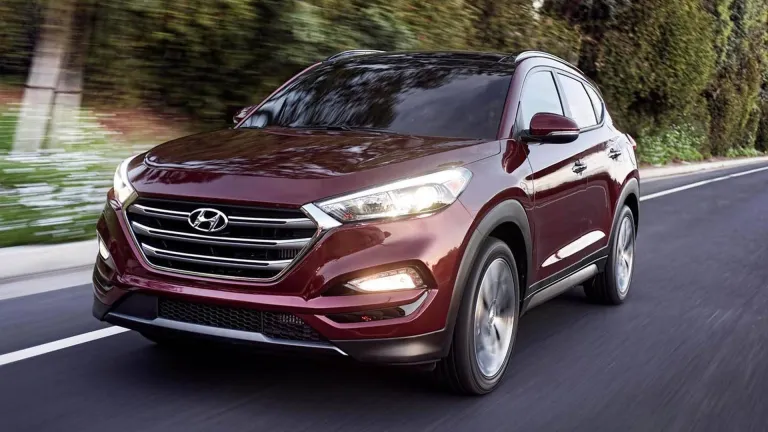
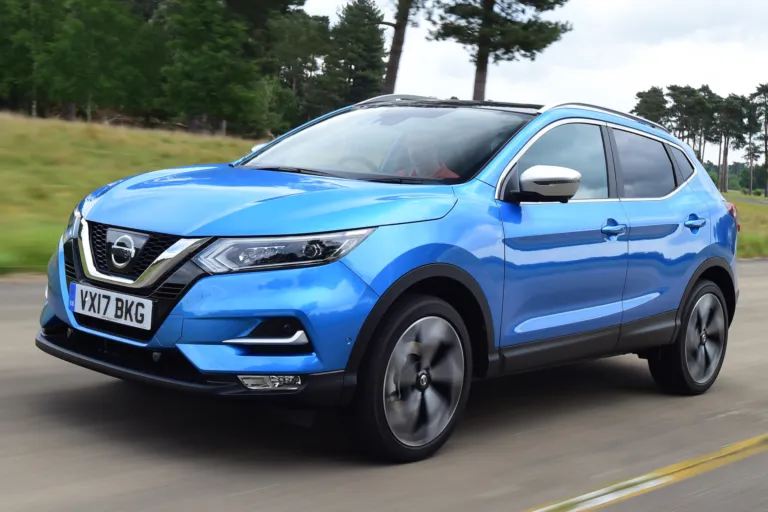
| Hyundai Tucson | Nissan Qashqai | |
|---|---|---|
| General | ||
| Version | Tucson JM · 2.7 · petrol · 129 kW (175 PS) | Qashqai III · 1.3 DIG-T mild hybrid 140 · petrol · 103 kW (140 PS) |
| Production years | 2004–2009 | 2021–present |
| Body | SUV | SUV |
| Class | SUV / crossover | SUV / crossover |
| Country | South Korea | Japan |
| Performance | ||
| Power Why it matters: More power means stronger acceleration and easier overtaking, especially with a full load. | 129 kW (175 PS) 173 hp Better | 103 kW (140 PS) 138 hp |
| Power, all versions | 100–136 kW (136–185 PS) 134–182 hp | 81–139 kW (110–189 PS) 109–186 hp |
| 0–100 km/h Why it matters: A shorter 0–100 km/h time means quicker getaways and safer merging onto fast roads. | 10.5 s | 10.2 s |
| Top speed Why it matters: Top speed hints at how relaxed the car is at motorway speeds, even if you never reach it. | 180 km/h 112 mph | 196 km/h 122 mph Better |
| Power per tonne | 77 kW/t 94 hp/ton calculated Better | 73 kW/t 89 hp/ton calculated |
| Engine and transmission | ||
| Fuel | Petrol | Petrol |
| Engine | 2,700 cc · 6 cyl 2.7 l | 4 cyl |
| Drive | All-wheel drive | All-wheel drive |
| Dimensions and weight | ||
| Length | 4,325 mm 170.3 in † | 4,425 mm 174.2 in |
| Width | 1,795 mm 70.7 in † | 1,835 mm 72.2 in |
| Height | 1,730 mm 68.1 in † | 1,625 mm 64.0 in |
| Wheelbase | 2,630 mm 103.5 in † | 2,665 mm 104.9 in |
| Kerb weight Why it matters: A lighter car is usually more agile and uses less energy. | 1,668 kg 3,677 lb | 1,405 kg 3,097 lb Better |
| Boot Why it matters: A bigger boot fits more luggage, shopping or a pram. | 540 l 19.1 cu ft Better | 504 l 17.8 cu ft |
| Fuel tank Why it matters: A larger tank means more distance between fuel stops. | 65 l 17.2 gal US Better | 55 l 14.5 gal US |
| Economy and running costs | ||
| Fuel consumption Why it matters: Lower consumption cuts running costs and CO₂ emissions on every trip. | 10.0 l/100 km 23.5 mpg US | 6.3 l/100 km 37.3 mpg US Better |
| CO₂ | 237 g/km | 142 g/km Better |
| Fuel cost per year | €2,630/year estimated | €1,650/year estimated Better |
| Range on a full tank | 650 km 404 mi estimated | 873 km 542 mi estimated Better |
| Safety | ||
| Euro NCAP | ★★★★☆ (2006) | ★★★★☆ (2025) |
These cars do not differ in the data we have.
Equal rows hidden (4): Body, Class, Fuel, Drive.
Better marks the stronger figure - only for measurable specs (power, torque, 0–100 km/h, consumption, boot, weight).
Estimated at 15,000 km a year with fuel at €1.75/l petrol. † from another version of this generation.
In plain words
Nissan Qashqai is quicker: 0–100 km/h in 10.2 s against 10.5 s for Hyundai Tucson. Nissan Qashqai is 100 mm longer than Hyundai Tucson (4,425 mm vs 4,325 mm). Nissan Qashqai is lighter by 263 kg (1,405 kg vs 1,668 kg). Hyundai Tucson has the bigger boot: 540 l against 504 l. At 15,000 km a year, fuel would cost about €2,630 (Hyundai Tucson), €1,650 (Nissan Qashqai) (estimated). Hyundai Tucson is the older design (from 2004); Nissan Qashqai arrived in 2006. On the catalog figures, the Hyundai Tucson is the pick for family, city and performance; the Nissan Qashqai is the pick for long trips and running costs.
Which one to choose
Choose the Hyundai Tucson if you want a plug-in hybrid, the most power in this pair, or a diesel.
Choose the Nissan Qashqai if you drive mostly in town and want electric-motor drive without charging, or if you value a compact footprint.
Used choice: a J11 Qashqai with the 1.3 DIG-T or a third-generation Tucson are both sensible buys; check the service history of the dual-clutch or CVT automatics.
Frequently asked questions
Is there a plug-in hybrid Qashqai?
No. The third Qashqai is offered as a mild hybrid and as the e-Power series hybrid, which cannot be charged from a socket. The Tucson is available as a plug-in hybrid with a 13.8 kWh battery.
How does Nissan e-Power work?
A 1.5-litre petrol engine runs only as a generator. A 139 kW (190 PS) electric motor always drives the wheels, so the car accelerates like an EV but is refuelled with petrol.
Which is bigger, the Tucson or the Qashqai?
The European Tucson rides on a 2,680 mm wheelbase. Nissan describes the third Qashqai relative to the J11: 35 mm longer, 32 mm wider and with a 20 mm longer wheelbase; our catalogue lists the J11 at 4,377 mm long.
Where are they built?
European Qashqais are built in Sunderland, England. Tucsons for Europe are built in Nošovice, Czech Republic, and the car is also produced in Ulsan, South Korea.