
Honda Accord vs Toyota Camry: mid-size saloons compared
Updated Report an error By Oleksandr Hnatiuk
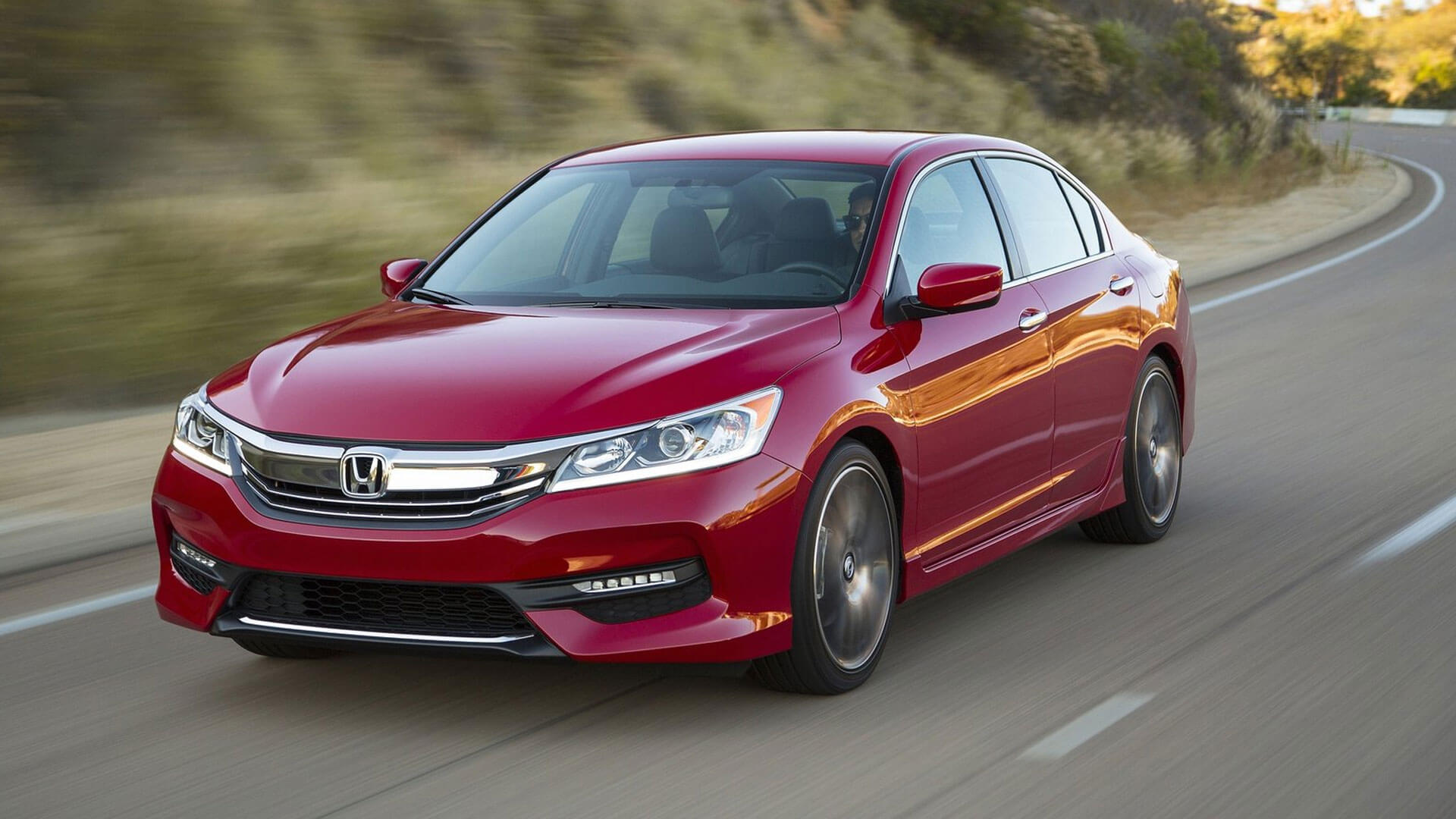
Honda · 2022–present
Accord XI
- Power
- 143 kW194 PS
- Kerb mass
- 1,493 kg

Toyota · 2023–present
Camry XV80
- Power
- 168 kW228 PS
- Kerb mass
- —
At a glance
Who suits what, worked out from the catalog figures of the versions above.
- City Too close to call Length: 4,971 mm vs 4,885 mm
- Off-road Too close to call Drive and body: Front-wheel drive · Sedan vs Front-wheel drive · Sedan
Verdict Opinion
The Camry is the more rational buy today: hybrid as standard in its main markets, the option of all-wheel drive and, in parts of Europe, official sales and service. Its long history as a taxi and fleet car in many countries also speaks for its durability.
The Accord appeals to drivers who want a larger cabin and a livelier character. The current car is longer than the Camry, and its turbo petrol gives a choice the hybrid-only Camry no longer offers in North America. In Europe, however, the Accord is a grey import, which complicates servicing and resale.
— Oleksandr Hnatiuk
In North America, the Middle East and much of Asia, the Honda Accord and the Toyota Camry play the role the Golf and the Focus played in Europe. They are the default answer for anyone who needs a comfortable, durable family saloon. Honda launched the Accord in 1976, six years before the first Camry of 1982, and the two have been compared generation by generation ever since.
European buyers know them less well. Honda stopped selling the Accord in Europe in 2015, after the eighth generation. Toyota brought the Camry back to Western Europe in April 2019 as a hybrid-only replacement for the Avensis. The current Camry is sold only in selected European countries, including Czechia, Slovakia, Poland, Hungary and the Baltic states. That makes both cars interesting mainly as imports and used purchases, where knowing the generations matters.
Honda Accord vs Toyota Camry: generations and powertrains
Current generations
The eleventh-generation Accord was revealed on 10 November 2022 and is built in Marysville, Ohio, among other plants. It offers a 1.5-litre turbo petrol with 143 kW (192 hp) and a 2.0-litre e:HEV hybrid, and at 4,971 mm long it is the bigger car. The ninth-generation Camry (XV80), unveiled on 14 November 2023, is 4,885–4,920 mm long on a 2,825 mm wheelbase. In North America every XV80 is a hybrid: the 2.5-litre system gives 168 kW (228 PS) with front-wheel drive and 173 kW (235 PS) with all-wheel drive. The Accord remains front-wheel drive only.
The previous cars
The XV70 Camry (2017–2024) introduced Toyota's TNGA platform to the model and measures 4,880–4,910 mm on a 2,820 mm wheelbase. Its range ran from four-cylinder petrols to a 3.5-litre V6 with 224 kW (301 hp) and a 2.5-litre hybrid; Europe received the hybrid only. The tenth Accord (2017–2022) switched to turbocharged engines: our catalogue lists a 1.5 with 141 kW and a 2.0 with 185 kW. The ninth generation (2012–2017) was the last with a V6, a 3.5-litre unit producing 207 kW.
Accord and Camry character
Over the decades the Accord has usually been the sportier of the two, with turbo engines and a manual gearbox available in some generations. The Camry has concentrated on comfort, a quiet cabin and hybrid economy. With the XV80 Toyota has also gone further in electrification: there is no non-hybrid Camry in North America any more, and all-wheel drive is available.
Size and weight
Side view to scale, all cars from the front bumper.
| Accord XI | Camry XV80 | |
|---|---|---|
| Length | 4,971 mm195.7 in | 4,885 mm192.3 in −86 mm −3.4 in −1.7% |
| Height | 1,449 mm57.0 in | 1,445 mm56.9 in −4 mm −0.2 in −0.3% |
| Wheelbase | 2,830 mm111.4 in | 2,825 mm111.2 in −5 mm −0.2 in −0.2% |
| Fits a standard garage? | No data | Tight |
Difference vs Accord XI (±). Garage check: a standard single garage takes a car up to about 5.0 m (16 ft 5 in) long and 1.9 m (6 ft 3 in) wide (width as listed in the catalog; some makers include the mirrors). Leave about 0.6 m (2 ft) to open the doors.
Full specifications
| Honda Accord | Toyota Camry | |
|---|---|---|
| General | ||
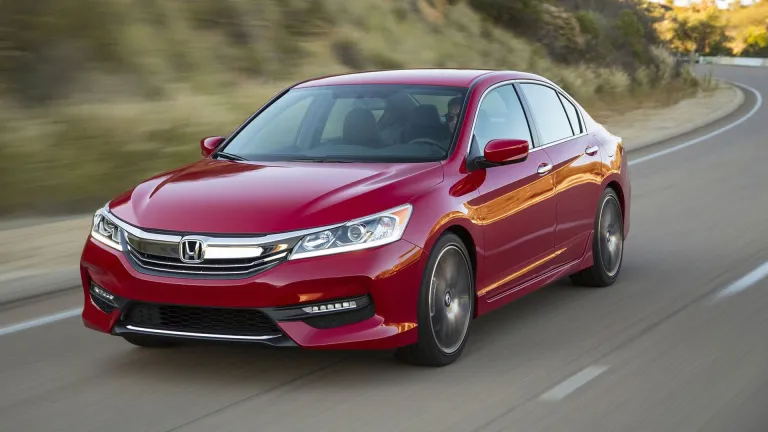
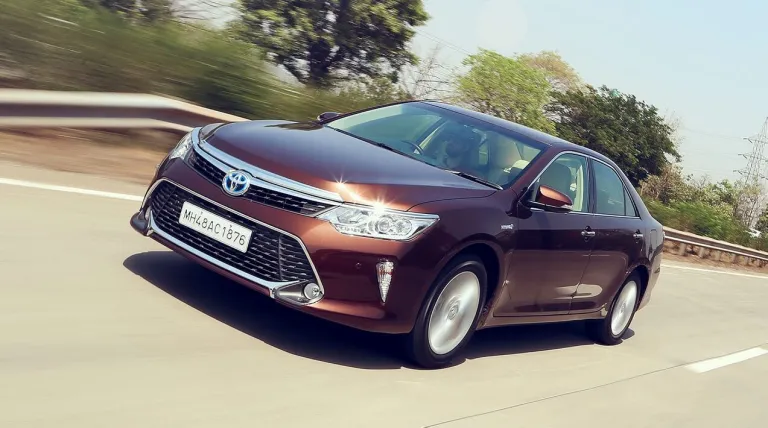
| Version | Accord XI · 1.5 VTEC Turbo CVT · petrol · 143 kW (194 PS) | Camry XV80 · 2.5 Hybrid FWD · 168 kW (228 PS) |
| Production years | 2022–present | 2023–present |
| Body | Sedan | Sedan |
| Country | Japan | Japan |
| Performance | ||
| Power Why it matters: More power means stronger acceleration and easier overtaking, especially with a full load. | 143 kW (194 PS) 192 hp | 168 kW (228 PS) 225 hp Better |
| Power, all versions | 50–207 kW (68–281 PS) 67–278 hp | 107–224 kW (145–305 PS) 143–300 hp |
| Torque Why it matters: Torque is the pulling force you feel when accelerating from low revs, towing or climbing hills. | 260 Nm 192 lb-ft | No data |
| Power per tonne | 96 kW/t 117 hp/ton calculated | No data |
| Engine and transmission | ||
| Fuel | Petrol | Hybrid |
| Engine | 1,498 cc · 4 cyl 1.5 l | 2,487 cc · 4 cyl 2.5 l |
| Gearbox | CVT | CVT |
| Drive | Front-wheel drive | Front-wheel drive |
| Dimensions and weight | ||
| Length | 4,971 mm 195.7 in | 4,885 mm 192.3 in |
| Width | No data | 1,840 mm 72.4 in |
| Height | 1,449 mm 57.0 in | 1,445 mm 56.9 in |
| Wheelbase | 2,830 mm 111.4 in | 2,825 mm 111.2 in |
| Kerb weight Why it matters: A lighter car is usually more agile and uses less energy. | 1,493 kg 3,292 lb | No data |
| Boot Why it matters: A bigger boot fits more luggage, shopping or a pram. | 473 l 16.7 cu ft | No data |
| Fuel tank Why it matters: A larger tank means more distance between fuel stops. | 56 l 14.8 gal US | No data |
| Economy and running costs | ||
| Fuel consumption Why it matters: Lower consumption cuts running costs and CO₂ emissions on every trip. | 7.3 l/100 km 32.2 mpg US | No data |
| Fuel cost per year | €1,920/year estimated | No data |
| Range on a full tank | 767 km 477 mi estimated | No data |
These cars do not differ in the data we have.
Equal rows hidden (4): Body, Country, Gearbox, Drive.
Better marks the stronger figure — only for measurable specs (power, torque, 0–100 km/h, consumption, boot, weight).
Estimated at 15,000 km a year with fuel at €1.75/l petrol.
In plain words
Toyota Camry has more power: 168 kW (228 PS) against 143 kW (194 PS) for Honda Accord. Honda Accord is 86 mm longer than Toyota Camry (4,971 mm vs 4,885 mm). Honda Accord is the older design (from 1976); Toyota Camry arrived in 1982. Our catalog has no kerb mass for the Toyota Camry yet, so some checks above leave it out.
Which one to choose
Choose the Honda Accord if you live in a market where it is sold officially, want the larger saloon or prefer a turbocharged petrol to a hybrid. A used ninth-generation 3.5 V6 is a rare fast family saloon.
Choose the Toyota Camry if you want a hybrid with low running costs or need all-wheel drive. It is also the practical choice in Europe, where the Camry has been sold officially in recent years and the Accord has not.
Frequently asked questions
Is the Honda Accord sold in Europe?
No. Honda ended Accord sales in Europe in 2015. The current eleventh generation is sold in North America, Asia and the Middle East.
Is the Toyota Camry available in Europe?
The XV70 Camry Hybrid was sold in Western Europe from April 2019. The current XV80 is offered only in selected countries such as Czechia, Slovakia, Poland, Hungary and the Baltic states.
Which is bigger, the Accord or the Camry?
The current Accord, at 4,971 mm long. The XV80 Camry measures 4,885–4,920 mm.
Does the Camry still have a V6?
No. The 3.5-litre V6 ended with the XV70 generation; in North America every XV80 Camry is a hybrid. The Accord dropped its V6 after the ninth generation.
Which one has all-wheel drive?
Only the Camry: the XV80 hybrid is available with all-wheel drive and 173 kW (235 PS). The Accord is front-wheel drive.