
BMW X3 vs Volvo XC60: German dynamics or Swedish calm?
Updated Report an error By Sarah Whitmore

BMW · 2024–present
X3 G45
- Power
- 293 kW398 PS
- 0–100 km/h
- —
- Top speed
- —
- Kerb mass
- 2,055 kg

Volvo · 2017–present
XC60 II
- Power
- 140 kW190 PS
- 0–100 km/h
- 8.8 s
- Top speed
- 205 km/h
- Kerb mass
- 1,764 kg
At a glance
Who suits what, worked out from the catalog figures of the versions above.
Categories won: X3 G45 2 XC60 II 2
- City XC60 II Consumption: 6.3 l/100 km vs 7.9 l/100 km
- Performance X3 G45 Power per tonne: 143 kW/t vs 79 kW/t
- Running costs XC60 II Fuel per year: €1,560 vs €2,070 (estimated)
- Off-road X3 G45 Drive and body: All-wheel drive · SUV vs All-wheel drive · SUV
Verdict Opinion
The X3 is the better car for keen drivers. The straight-six in the M50 and the fast X3 M of the previous generation give it a sporting character that the Volvo does not try to match.
The XC60 is the more relaxing choice. Its safety record is outstanding, its interior design is calm, and the T8 Recharge is one of the most powerful plug-in hybrids in the class. For a family car that is mostly driven at sensible speeds, many buyers will prefer the Volvo.
— Sarah Whitmore
The BMW X3 premiered at the Frankfurt show in September 2003. Its first generation (E83) was built entirely by Magna Steyr in Graz, Austria; from September 2010 production of the second generation moved to Spartanburg in South Carolina. The fourth X3 (G45) was unveiled on 19 June 2024.
Volvo entered the class five years later. The Volvo XC60 was previewed as a concept at Detroit in 2007 and shown in production form at Geneva in 2008, with European sales from the third quarter of that year. It introduced Volvo's City Safety system. The second XC60, presented at Geneva in 2017, moved to the Scalable Product Architecture shared with the larger XC90.
BMW X3 vs Volvo XC60: engines, plug-in range and safety
Engine choice
BMW still offers six cylinders. The G45 X3 M50 xDrive uses a 3.0-litre straight-six, while the four-cylinder versions include the 20 xDrive petrol, rated at 153 kW (208 PS), and a diesel, the 20d xDrive with 145 kW (197 PS). In the previous generation the X3 M reached 353 kW (480 PS), and the Competition version 375 kW (510 PS).
Every second-generation XC60 has a 2.0-litre four-cylinder. The T5 delivered 184 kW (250 PS) and the T6 AWD 235 kW (320 PS); the diesels were the D4 AWD with 140 kW (190 PS) and the D5 AWD with 173 kW (235 PS). The update shown in August 2025 brought a 48-volt mild-hybrid petrol with about 186 kW (250 hp) and 360 N·m.
Plug-in hybrids
This is the XC60's strong point. The T8 Recharge with the larger 18.7 kWh battery (14.8 kWh usable) produces 339 kW (461 PS) and covers up to 77 km on electricity. BMW's 30e plug-in answers with 220 kW (299 PS) and a claimed 90 km. So BMW drives 13 km further on a charge, while Volvo has 119 kW more power.
Size
At 4,755 mm, the G45 X3 is long for its class; it is 1,920 mm wide and has a 2,865 mm wheelbase. The XC60 is 1,902 mm wide without mirrors, 18 mm narrower than the BMW, and 2,117 mm with them.
Safety
The first XC60 received five stars for adult occupant protection from Euro NCAP in 2008, with the maximum 37 points. The second scored 98% for adult occupants in its 2017 ANCAP test, which was aligned with Euro NCAP, and in the USA it has been an IIHS Top Safety Pick every year from 2018 to 2024, with the Plus award in 2021 and 2022.
Race Stats side by side
Each figure is a 0–100 score from the catalog numbers, the same as on the 1CARS Race cards. PI is the overall performance index (100–999) and its class D–S.
| Stat | X3 G45 | XC60 II |
|---|---|---|
| PI | A · 632 | C · 488 |
| Power | 61 | 43 |
| Grip | 58 | 45 |
| Handling | 43 | 49 |
| Top speed | 63 | 40 |
| Launch | 70 | 38 |
Grip and handling are estimates from drive type, weight, height and body (hover a figure to see where it comes from). 1CARS Race
Who wins a race?
Quarter-mile (402 m) drag from a standing start, dry road, no reaction time — the 1CARS Race physics on the catalog figures of these versions.
- 1 X3 G45X3 G45 · M50 xDrive · petrol · 293 kW (398 PS) 12.95 sat 171 km/h
- 2 XC60 IIXC60 II · D4 AWD · diesel · 140 kW (190 PS) 16.22 sat 132 km/h · +3.27 s
Size and weight
Side view to scale, all cars from the front bumper.
| X3 G45 | XC60 II | |
|---|---|---|
| Length | 4,755 mm187.2 in | 4,688 mm184.6 in −67 mm −2.6 in −1.4% |
| Width | 1,920 mm75.6 in | 1,902 mm74.9 in −18 mm −0.7 in −0.9% |
| Height | 1,660 mm65.4 in | 1,658 mm65.3 in −2 mm −0.1 in −0.1% |
| Wheelbase | 2,865 mm112.8 in | 2,865 mm112.8 in |
| Kerb weight | 2,055 kg4,531 lb | 1,764 kg3,889 lb −291 kg −642 lb −14.2% |
| Fits a standard garage? | Too wide | Too wide |
Difference vs X3 G45 (±). Garage check: a standard single garage takes a car up to about 5.0 m (16 ft 5 in) long and 1.9 m (6 ft 3 in) wide (width as listed in the catalog; some makers include the mirrors). Leave about 0.6 m (2 ft) to open the doors.
Full specifications
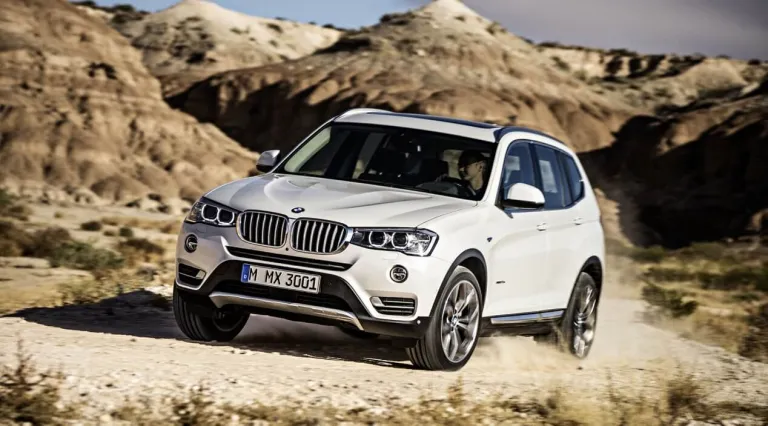
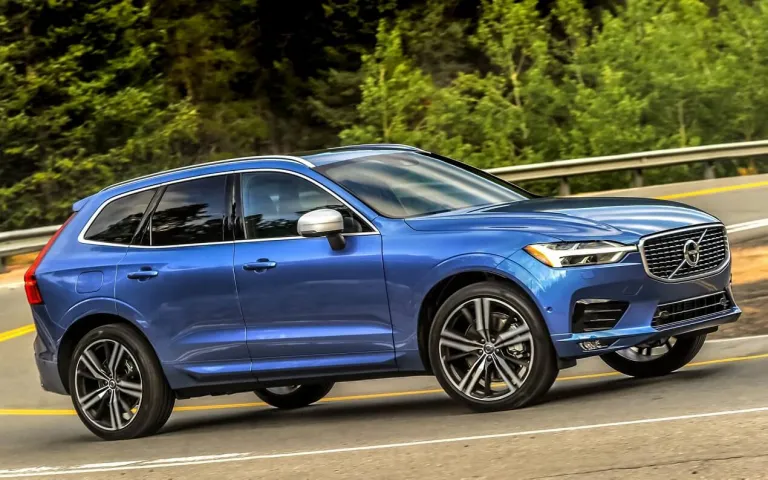
| BMW X3 | Volvo XC60 | |
|---|---|---|
| General | ||
| Version | X3 G45 · M50 xDrive · petrol · 293 kW (398 PS) | XC60 II · D4 AWD · diesel · 140 kW (190 PS) |
| Production years | 2024–present | 2017–present |
| Body | SUV | SUV |
| Class | SUV / crossover | SUV / crossover |
| Country | Germany | Sweden |
| Performance | ||
| Power Why it matters: More power means stronger acceleration and easier overtaking, especially with a full load. | 293 kW (398 PS) 393 hp Better | 140 kW (190 PS) 188 hp |
| Power, all versions | 105–293 kW (143–398 PS) 141–393 hp | 120–339 kW (163–461 PS) 161–455 hp |
| 0–100 km/h Why it matters: A shorter 0–100 km/h time means quicker getaways and safer merging onto fast roads. | No data | 8.8 s |
| Top speed Why it matters: Top speed hints at how relaxed the car is at motorway speeds, even if you never reach it. | No data | 205 km/h 127 mph |
| Power per tonne | 143 kW/t 173 hp/ton calculated Better | 79 kW/t 97 hp/ton calculated |
| Engine and transmission | ||
| Fuel | Petrol | Diesel |
| Engine | 2,998 cc · 6 cyl 3.0 l | 4 cyl |
| Drive | All-wheel drive | All-wheel drive |
| Dimensions and weight | ||
| Length | 4,755 mm 187.2 in | 4,688 mm 184.6 in |
| Width | 1,920 mm 75.6 in | 1,902 mm 74.9 in |
| Height | 1,660 mm 65.4 in | 1,658 mm 65.3 in |
| Wheelbase | 2,865 mm 112.8 in | 2,865 mm 112.8 in |
| Kerb weight Why it matters: A lighter car is usually more agile and uses less energy. | 2,055 kg 4,531 lb | 1,764 kg 3,889 lb Better |
| Boot Why it matters: A bigger boot fits more luggage, shopping or a pram. | No data | 483 l 17.1 cu ft |
| Fuel tank Why it matters: A larger tank means more distance between fuel stops. | No data | 71 l 18.8 gal US |
| Economy and running costs | ||
| Fuel consumption Why it matters: Lower consumption cuts running costs and CO₂ emissions on every trip. | 7.9 l/100 km 29.8 mpg US | 6.3 l/100 km 37.3 mpg US Better |
| CO₂ | 311 g/km | 164 g/km Better |
| Fuel cost per year | €2,070/year estimated | €1,560/year estimated Better |
| Range on a full tank | No data | 1,127 km 700 mi estimated |
| Safety | ||
| Euro NCAP | ★★★★★ (2025) | ★★★★★ (2017) |
These cars do not differ in the data we have.
Equal rows hidden (4): Body, Class, Drive, Wheelbase.
Better marks the stronger figure — only for measurable specs (power, torque, 0–100 km/h, consumption, boot, weight).
Estimated at 15,000 km a year with fuel at €1.75/l petrol, €1.65/l diesel.
In plain words
BMW X3 has more power: 293 kW (398 PS) against 140 kW (190 PS) for Volvo XC60. BMW X3 is 67 mm longer than Volvo XC60 (4,755 mm vs 4,688 mm). Volvo XC60 is lighter by 291 kg (1,764 kg vs 2,055 kg). At 15,000 km a year, fuel would cost about €2,070 (BMW X3), €1,560 (Volvo XC60) (estimated). BMW X3 is the older design (from 2003); Volvo XC60 arrived in 2008. On the catalog figures, the Volvo XC60 is the pick for city and running costs; the BMW X3 is the pick for performance and off-road. Our catalog has no 0–100 km/h for the BMW X3 yet, so some checks above leave it out.
Which one to choose
Choose the BMW X3 if driving pleasure, a six-cylinder engine or the longest electric range in this pair (90 km) matters most.
Choose the Volvo XC60 if safety, comfort and a quiet cabin are your priorities, or if you want a plug-in hybrid with 339 kW.
Used buyers will find plenty of F25 X3s (2010–2017) with xDrive and first-generation XC60s; check the service history of the automatic gearbox on high-mileage cars.
Frequently asked questions
Does the Volvo XC60 have a six-cylinder engine?
The first generation had six-cylinder petrol engines. Since the second generation arrived in 2017, all XC60 engines are 2.0-litre four-cylinders, including the plug-in hybrids.
Which plug-in hybrid goes further, the X3 30e or the XC60 T8?
BMW quotes up to 90 km for the X3 30e and Volvo up to 77 km for the XC60 T8 Recharge with the larger battery. The Volvo is more powerful: 339 kW against 220 kW.
Where are the X3 and XC60 built?
Most X3s since 2010 have come from Spartanburg in the USA, with additional production in Rosslyn, South Africa. The XC60 comes from Torslanda in Sweden and Chengdu in China, among other plants.
Is there an electric X3 or XC60?
BMW built the electric iX3 (G08) on the previous X3 from 2020, with 210 kW and an 80 kWh battery. The XC60 is offered as a plug-in hybrid rather than as a pure EV.