 Volvo XC60
All generations, specs and history
Updated Published Sources (7) Report an error
By Felix Hartmann, Automotive Technology & EV Contributor Reviewed by Oleksandr Hnatiuk

- Built
- 2008–present
- Generations
- 2
- Top power
- 339 kW (461 PS)
Timeline
XC60 generations
Click a generation for its own page


- XC60 I 2008–2017 · SUV · 120–242 kW (163–329 PS)
- XC60 II Current 2017–now · SUV · 140–339 kW (190–461 PS)
Newest first · 2 generations since 2008
-
2017

-
2008

All generations by year: XC60 II (2017–now) · XC60 I (2008–2017)
Which one is mine?
Pick the year of first registration to see which generation it is.
Check by VINWhich Volvo XC60 to buy
Our verdict · Felix Hartmann
A facelifted first-generation XC60 (2013–2017) with the D4 diesel is good value used. The second generation with a mild-hybrid petrol engine or a T8 Recharge with the larger battery suits buyers who want modern safety and low running costs. Check the service history of the automatic gearbox, the condition of the air suspension where fitted and, on plug-in hybrids, the battery and charging equipment.
The Volvo XC60 is a mid-size premium SUV launched at the 2008 Geneva Motor Show and Volvo's best-selling car since 2009. The first generation (2008–2017) was built in Ghent, Belgium, on the P3 platform and introduced the City Safety automatic braking system. The second generation, revealed at Geneva in 2017, uses the SPA platform and offers mild-hybrid and T8 plug-in hybrid versions with up to 77 km of electric range.
In short
- First generation: Euro NCAP five stars with 37 of 37 points in the 2008 side and frontal tests; engines from 120 to 242 kW.
- Second generation: T8 Recharge with 233 kW petrol engine plus a 106 kW electric motor and an 18.7 kWh battery.
- Built in Sweden, China, India and Malaysia; US production planned from late 2026.
- Global sales of 230,853 in 2024, a record for the model.

Size at a glance
Volvo XC60 I
The Volvo XC60 II is 61 mm longer, 218 mm narrower and 57 mm lower than the Volvo XC60 I.
| Dimensions | Volvo XC60 II | Volvo XC60 I | Difference |
|---|---|---|---|
| Length | 4,688 mm184.6 in | 4,627 mm182.2 in | +61 mm+2.4 in |
| Width | 1,902 mm74.9 in | 2,120 mm83.5 in | −218 mm−8.6 in |
| Height | 1,658 mm65.3 in | 1,715 mm67.5 in | −57 mm−2.2 in |
| Wheelbase | 2,865 mm112.8 in | 2,774 mm109.2 in | +91 mm+3.6 in |
| Boot | 483 L17.1 cu ft | 495 L17.5 cu ft | −12 L−0.4 cu ft |
Running cost
Fuel · XC60 D4 AWD
about 1,550 EUR fuel a year at 15,000 km
6.3 l/100 km · diesel at 1.65 EUR/l · change mileage, fuel price or version
Specs by version
Engines
| Version | Engine | Power | Torque | Drive | Production years |
|---|---|---|---|---|---|
| Plug-in hybrid · 1 version | |||||
| XC60 II · T8 Recharge AWD (extended range) | 4 cyl · Plug-in hybrid | 339 kW 461 PS455 hp | - | All-wheel drive | 2021 |
| Diesel · 2 versions | |||||
| XC60 II · D4 AWD | 4 cyl · Diesel | 140 kW 190 PS188 hp | - | All-wheel drive | 2017 |
| XC60 II · D5 AWD | 4 cyl · Diesel | 173 kW 235 PS232 hp | - | All-wheel drive | 2017 |
| Petrol · 3 versions | |||||
| XC60 I · 3.0 224 kW (305 PS) SUV | 3.0 l · 6 cyl · Petrol 3,000 cc | 224 kW 305 PS300 hp | - | - | - |
| XC60 II · T5 | 4 cyl · Petrol | 184 kW 250 PS247 hp | - | - | 2017–2021 |
| XC60 II · T6 AWD | 4 cyl · Petrol | 235 kW 320 PS315 hp | - | All-wheel drive | 2017–2021 |
| Other · 6 versions | |||||
| XC60 I · 2.4 D4 133 kW (181 PS) SUV | 2.4 l D4 | 133 kW 181 PS178 hp | - | - | - |
| XC60 I · 140 kW (190 PS) SUV | - | 140 kW 190 PS188 hp | 400 Nm295 lb-ft | - | - |
| XC60 I · 173 kW (235 PS) SUV | - | 173 kW 235 PS232 hp | 480 Nm354 lb-ft | - | - |
| XC60 I · 2.0 180 kW (245 PS) SUV | 2.0 l · 4 cyl 2,000 cc | 180 kW 245 PS241 hp | - | - | - |
| XC60 I · 187 kW (254 PS) SUV | - | 187 kW 254 PS251 hp | 350 Nm258 lb-ft | - | - |
| XC60 I · 235 kW (320 PS) SUV | - | 235 kW 320 PS315 hp | 400 Nm295 lb-ft | - | - |
Performance
Show all 6 versions
| Version | 0–100 km/h | Top speed | Fuel consumption | CO₂ |
|---|---|---|---|---|
| Plug-in hybrid · 1 version | ||||
| XC60 II · T8 Recharge AWD (extended range) | - | - | - | - |
| Diesel · 2 versions | ||||
| XC60 II · D4 AWD | 8.8 s 0–62 mph | 205 km/h127 mph | 6.3 l/100 km37.3 mpg US · 44.8 mpg UK | 164 g/km |
| XC60 II · D5 AWD | 7.2 s 0–62 mph | 220 km/h137 mph | 5.5 l/100 km42.8 mpg US · 51.4 mpg UK | 144 g/km |
| Petrol · 2 versions | ||||
| XC60 II · T5 | 6.9 s 0–62 mph | 210 km/h130 mph | 8.3 l/100 km28.3 mpg US · 34.0 mpg UK | 190 g/km |
| XC60 II · T6 AWD | 5.9 s 0–62 mph | 230 km/h143 mph | 7.7 l/100 km30.5 mpg US · 36.7 mpg UK | 176 g/km |
| Other · 1 version | ||||
| XC60 I · 235 kW (320 PS) SUV | 5.9 s 0–62 mph | 230 km/h143 mph | - | - |
Dimensions and weight
Show all 12 versions
| Version | Length | Width | Wheelbase | Kerb weight | Boot | Fuel tank |
|---|---|---|---|---|---|---|
| Plug-in hybrid · 1 version | ||||||
| XC60 II · T8 Recharge AWD (extended range) | - | 1,902 mm74.9 in | - | - | - | - |
| Diesel · 2 versions | ||||||
| XC60 II · D4 AWD | 4,688 mm184.6 in | 1,902 mm74.9 in | 2,865 mm112.8 in | 1,764 kg3,889 lb | 483 l17.1 cu ft | 71 l18.8 gal US |
| XC60 II · D5 AWD | - | 1,902 mm74.9 in | - | 2,149 kg4,738 lb | 483 l17.1 cu ft | 71 l18.8 gal US |
| Petrol · 3 versions | ||||||
| XC60 I · 3.0 224 kW (305 PS) SUV | 4,627 mm182.2 in | 2,120 mm83.5 in | 2,774 mm109.2 in | - | - | - |
| XC60 II · T5 | - | 1,902 mm74.9 in | - | 1,771 kg3,904 lb | 483 l17.1 cu ft | 71 l18.8 gal US |
| XC60 II · T6 AWD | - | 1,902 mm74.9 in | - | 2,162 kg4,766 lb | 483 l17.1 cu ft | 71 l18.8 gal US |
| Other · 6 versions | ||||||
| XC60 I · 2.4 D4 133 kW (181 PS) SUV | 4,627 mm182.2 in | 2,120 mm83.5 in | 2,774 mm109.2 in | 1,847 kg4,072 lb | 495 l17.5 cu ft | - |
| XC60 I · 140 kW (190 PS) SUV | 4,627 mm182.2 in | 2,120 mm83.5 in | 2,774 mm109.2 in | - | - | - |
| XC60 I · 173 kW (235 PS) SUV | 4,627 mm182.2 in | 2,120 mm83.5 in | 2,774 mm109.2 in | - | - | - |
| XC60 I · 2.0 180 kW (245 PS) SUV | 4,627 mm182.2 in | 2,120 mm83.5 in | 2,774 mm109.2 in | - | - | - |
| XC60 I · 187 kW (254 PS) SUV | 4,627 mm182.2 in | 2,120 mm83.5 in | 2,774 mm109.2 in | - | - | - |
| XC60 I · 235 kW (320 PS) SUV | 4,627 mm182.2 in | 2,120 mm83.5 in | 2,774 mm109.2 in | - | - | - |
Verified Manufacturer and type-approval data from our catalog · Sources and methodology
Safety
-
XC60 I · NHTSA 2016
US NCAP (NHTSA)
Stars from different years and organisations are not directly comparable: test protocols change every few years.
Volvo XC60 at a glance
The XC60 sits between the smaller XC40 and the larger Volvo XC90 and competes with the BMW X3, Audi Q5 and Mercedes-Benz GLC. It combines a raised driving position, available all-wheel drive and Volvo's focus on safety. The brand's story is told in the history of Volvo, and related estates such as the Volvo V60 Cross Country are in the Volvo catalogue.

| Generation | Years | Platform | Main plant | Main engines |
|---|---|---|---|---|
| XC60 I | 2008–2017 | P3 (Ford EUCD family) | Ghent, Belgium | T5, T6, D3, D4, D5 |
| XC60 II | 2017– | SPA | Torslanda, Sweden; Chengdu, China | T4–T6, mild hybrids, T8 plug-in hybrid, D4, D5 |
First-generation Volvo XC60 (2008–2017)
Design and launch
A concept with a glass roof, a new grille, an electric tailgate and 20-inch wheels previewed the XC60 at the 2007 Detroit Auto Show. The production model debuted at Geneva in 2008, European sales began in the third quarter of that year, and North American sales followed in early 2009. It shared the P3 platform with the 2007 Land Rover Freelander and was built at Volvo Car Gent in Belgium.

Interior and practicality
The front seats offer a wide range of adjustment, and the rear bench seats three adults. Boot space is 495 litres, rising to about 1,450 litres with the rear seats folded; each section of the rear seat can be folded separately. The 2013 facelift added a revised grille and lights, new interior materials and a 7-inch display.
First-generation engines
| Engine | Years | Power | Torque |
|---|---|---|---|
| DRIVe / D3 2.0 diesel | 2012–2015 | 120 kW (163 PS) | 400 Nm |
| D4 diesel | 2014–2017 | 140 kW (190 PS) | 400 Nm |
| D5 AWD twin-turbo diesel | 2010–2011 | 151 kW (205 PS) | 420 Nm |
| T5 2.0 turbo petrol | 2012–2013 | 177 kW (240 PS) | 320 Nm |
| T5 2.0 turbo petrol | 2014–2017 | 180 kW (245 PS) | 350 Nm |
| T6 AWD 3.0 turbo six | 2009–2010 | 210 kW (285 PS) | 400 Nm |
| T6 turbo + supercharged four | 2014–2017 | 225 kW (306 PS) | 400 Nm |
| T6 AWD R-Design | 2011–2016 | 242 kW (329 PS) | 487 Nm |
Engines were paired with a six-speed manual or the six-speed Geartronic automatic. According to the old 1cars text, the 3.0-litre T6 reaches 100 km/h in 6.9 seconds and uses up to 10.7 L/100 km combined. A plug-in hybrid concept of 2012 never reached production.
Dimensions
| Parameter | Metric | Imperial |
|---|---|---|
| Length | 4,627 mm | 182.2 in |
| Width (with mirrors) | 2,120 mm | 83.5 in |
| Height | 1,713 mm | 67.4 in |
| Wheelbase | 2,774 mm | 109.2 in |
| Kerb weight | 1,777–1,872 kg | 3,918–4,127 lb |
| Boot | 495–1,450 L | 17.5–51.2 cu ft |
| Towing capacity | 1,600–2,000 kg | 3,530–4,410 lb |
Safety and City Safety
The XC60 was the first Volvo with City Safety. A laser sensor near the rear-view mirror scans the road ahead. If the car approaches a vehicle at a speed difference of less than about 20 km/h and the driver does not react, the system prepares and applies the brakes. In Euro NCAP's 2008 test the XC60 scored 37 of 37 points in the frontal and side tests and received five stars, and the IIHS named it a Top Safety Pick+.
Second-generation Volvo XC60 (2017 to today)
Design, interior and platform
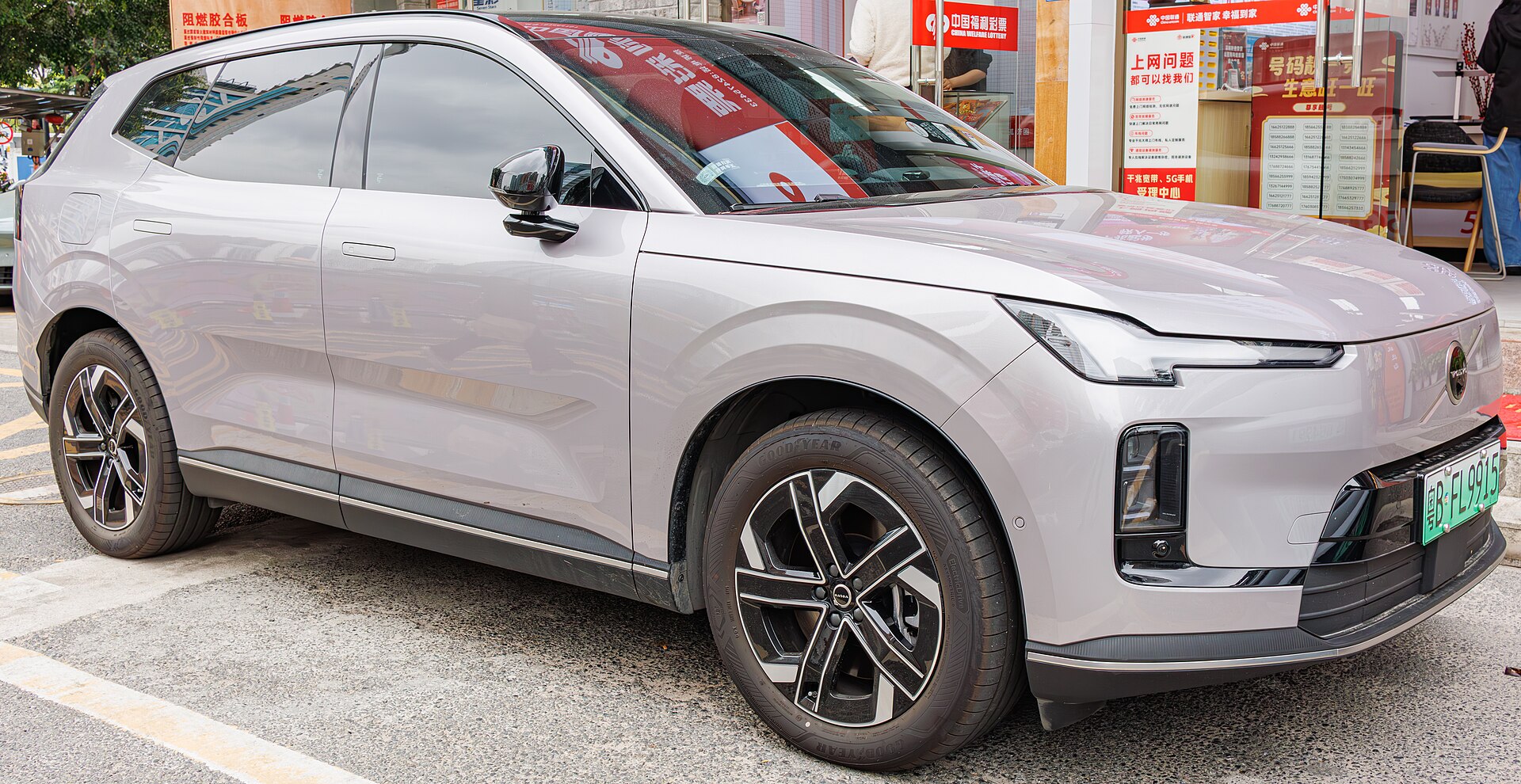
Revealed at Geneva in 2017, the second XC60 was the first 60 Series model developed after Geely bought Volvo. It moved to the Scalable Product Architecture shared with the XC90, S90 and V90, and a cabin with higher-quality materials and more legroom. Ground clearance is 216 mm, and air suspension with adjustable ride height was offered. It won Car of the Year Japan for 2017–2018.

Second-generation engines and plug-in hybrids
| Engine | Years | Power | Torque |
|---|---|---|---|
| T4 petrol | 2018–2021 | 140 kW (190 PS) | 350 Nm |
| T5 petrol | 2017–2021 | 184 kW (250 PS) | 350 Nm |
| T6 AWD petrol | 2017–2021 | 235 kW (320 PS) | 400 Nm |
| D4 AWD diesel | 2017– | 140 kW (190 PS) | 400 Nm |
| D5 AWD twin-turbo diesel | 2017– | 173 kW (235 PS) | 480 Nm |
| T8 plug-in hybrid | 2017–2021 | 234 kW (318 PS) petrol + 64 kW (87 PS) electric | – |
| T8 Recharge | 2022– | 233 kW (317 PS) petrol + 106 kW (144 PS) electric | 400 + 240 Nm |
The first plug-in hybrid used a 10.4 kWh battery, increased to 11.6 kWh in 2020 for about 31 km of electric range. From 2022 the Recharge models have an 18.7 kWh battery (14.8 kWh usable) for about 77 km of electric range and a total output of 339 kW (461 PS). The 2021 update introduced Google-based Android infotainment, and the August 2025 facelift brought a criss-cross grille, smoked LED tail lights, an 11.2-inch touchscreen and a digital instrument display.
Second-generation safety
In the 2017 test aligned with Euro NCAP, the XC60 scored 98% for adult occupants, 85% for children, 76% for pedestrians and 95% for safety assist. The IIHS awarded it Top Safety Pick or Top Safety Pick+ in most years from 2018 to 2024.
Rivals: how the XC60 compares
Against the BMW X3, Audi Q5 and Mercedes-Benz GLC, the XC60 stands out for safety, a calm and comfortable cabin and strong plug-in hybrid versions. Its weaknesses are a less sporty drive than the BMW and, on first-generation cars, an older infotainment system. For larger SUVs see the XC90, and for estates the Volvo V90.


Volvo XC60: first vs latest generation
| Spec | XC60 I | XC60 II | Change |
|---|---|---|---|
| Years | 2008–2017 | 2017–present | 9 years apart |
| Most powerful version | 242 kW (329 PS) | 339 kW (461 PS) | +97 kW (+40%) |
| Length | 4,627 mm | 4,688 mm | +61 mm |
| Width | 2,120 mm | 1,902 mm | −218 mm |
| Wheelbase | 2,774 mm | 2,865 mm | +91 mm |
| Lightest kerb weight | 1,847 kg | 1,764 kg | −83 kg |
| Best 0–100 km/h | 5.9 s | 5.9 s | same |
| Top speed | 230 km/h | 230 km/h | same |
Oldest and newest generation in the 1cars catalog. Power is the strongest version of each; other rows are shown only when both generations have the figure.
Popular comparisons
Volvo XC60 in our rankings
- No. 5 of 144 · Widest SUVs and crossovers (2,120 mm)
- No. 6 of 403 · Widest cars (2,120 mm)
- No. 55 of 304 · Heaviest cars (2,162 kg · top 19%)
- No. 43 of 197 · Most powerful SUVs and crossovers (339 kW · top 22%)
- No. 203 of 912 · Longest-running car nameplates (18 years · top 23%)
- No. 20 of 86 · Fastest SUVs and crossovers (230 km/h · top 24%)
Wider than 98% of ranked cars in the 1CARS catalog (No. 6 of 403).
Volvo XC60 photos 48


Volvo XC60 videos 9

Volvo XC60 video 1

Volvo XC60 video 2

Volvo XC60 video 3

Volvo XC60 video 4

Volvo XC60 video 5

Volvo XC60 video 6

Volvo XC60 video 7

Volvo XC60 video 8

Volvo XC60 video 9
FAQ
How many generations of the Volvo XC60 are there?
There are two: the first from 2008 to 2017, built in Ghent on the P3 platform, and the second from 2017 on the SPA platform, which received facelifts in 2021 and August 2025.
Is the Volvo XC60 a hybrid?
Yes. The second generation offers mild hybrids and the T8 plug-in hybrid; a fully electric SUV of similar size is the Volvo EX60. Since 2022 the T8 Recharge has an 18.7 kWh battery, about 77 km of electric range and 339 kW (461 PS) in total.
How big is the Volvo XC60 boot?
The first-generation XC60 has a 495-litre boot, which grows to about 1,450 litres with the rear seats folded. Each section of the rear seat can be folded separately.
How safe is the Volvo XC60?
Very safe. The first generation scored full marks in Euro NCAP's 2008 frontal and side tests, and the second generation scored 98% for adult protection in 2017. It was the first Volvo with City Safety.
Where is the Volvo XC60 built?
The first generation came from Ghent, Belgium. The second is built at Torslanda in Sweden and in China, India and Malaysia, with US production planned from late 2026.
Data sources
Data checked by an editor against the sources below.
- The text of this article (1cars archive)
- Wikipedia - Volvo XC60
- Latribuneauto - 2625 Retrouvez Tous Les Resultats Et Les Classements Des Crashs Tests Euro Ncap 2009 2
- Euro NCAP - Xceedingly Good
- Carsized - Volvo Xc60 2008 Suv
- EEA CO₂ monitoring (European Environment Agency, CC BY 4.0)
- NHTSA 5-Star Safety Ratings (US NCAP) — U.S. Government work, public domain