
 Isuzu 117 Coupe
All generations, specs and history
Published Sources (4) Report an error
By Sarah Whitmore, Senior Automotive Writer
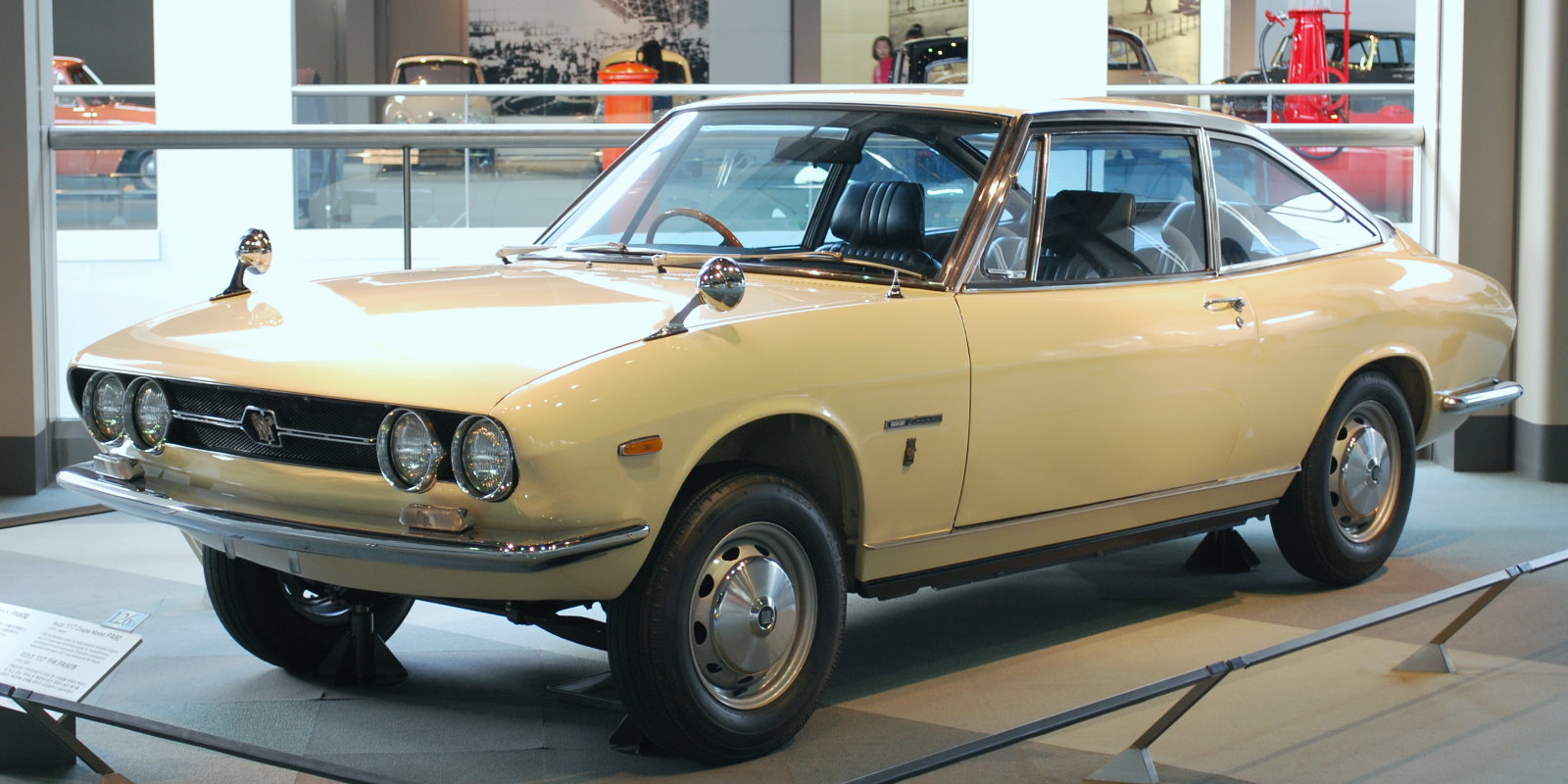
- Built
- 1968–1981
- Generations
- 2 · PA90 to PA95
- Top power
- 104 kW (141 PS)
Timeline
117 Coupe generations
Click a generation for its own page
- 117 Coupe PA90 1968–1972 · Coupe · 88 kW (120 PS)
- 117 Coupe PA95 1973–1981 · Coupe · 54–104 kW (73–141 PS)
Newest first · 2 generations since 1968
All generations by year: 117 Coupe PA95 (1973–1981) · 117 Coupe PA90 (1968–1972)
Which one is mine?
Pick the year of first registration to see which generation it is.
The Isuzu 117 Coupé is the four-seat grand touring coupé that Isuzu built from December 1968 to 1981 to a design by Giorgetto Giugiaro at Ghia. The first cars were largely made by hand at about 50 a month, with a 1.6-litre twin-cam engine of 88 kW (120 PS). Once General Motors invested, the 117 moved to series production with 1.8, 1.95 and 2.2-litre diesel engines.
In short
- Prototype shown at the Geneva Motor Show in March 1966, where it won a concours d'elegance; sales began in December 1968 at JPY 1,720,000.
- Three phases: hand-built cars (2,458 from December 1968 to late 1972), series production from March 1973, and the square-headlamp facelift of November 1977.
- Engines from the 1,584 cc G161W twin-cam to Bosch-injected 1.8 and 1.95-litre units and, from 1979, a 2,238 cc diesel.
- 86,192 built at Kawasaki, Kanagawa, according to Wikipedia; replaced in 1981 by the Giugiaro-designed Piazza.
Size at a glance
| Dimensions | Isuzu 117 Coupe PA90 |
|---|---|
| Length | 4,280 mm168.5 in |
| Width | 1,600 mm63.0 in |
| Height | 1,320 mm52.0 in |
| Wheelbase | 2,500 mm98.4 in |
Specs by version
Engines
| Version | Engine | Power | Gearbox | Drive | Production years |
|---|---|---|---|---|---|
| Diesel · 1 version | |||||
| PA95 · XD 2.2 Diesel | 2.2 l · 4 cyl · Diesel C223 | 54 kW 73 PS72 hp | - | Rear-wheel drive | 1979–1981 |
| Petrol · 3 versions | |||||
| PA90 · 1600 DOHC | 1.6 l · 4 cyl · Petrol G161W | 88 kW 120 PS118 hp | 4-sp Manual | Rear-wheel drive | 1968–1972 |
| PA95 · 2000 XE | 1.9 l · 4 cyl · Petrol G200W | 99 kW 135 PS133 hp | - | Rear-wheel drive | 1978–1981 |
| PA95 · 1800 XE | 1.8 l · 4 cyl · Petrol G180W | 104 kW 141 PS139 hp | Manual | Rear-wheel drive | 1973–1978 |
Performance
Show all 3 versions
| Version | Top speed |
|---|---|
| Diesel · 1 version | |
| PA95 · XD 2.2 Diesel | 130 km/h81 mph |
| Petrol · 2 versions | |
| PA90 · 1600 DOHC | 190 km/h118 mph |
| PA95 · 1800 XE | 193 km/h120 mph |
Dimensions and weight
Show all 4 versions
| Version | Length | Wheelbase |
|---|---|---|
| Diesel · 1 version | ||
| PA95 · XD 2.2 Diesel | - | 2,500 mm98.4 in |
| Petrol · 3 versions | ||
| PA90 · 1600 DOHC | 4,280 mm168.5 in | 2,500 mm98.4 in |
| PA95 · 2000 XE | 4,320 mm170.1 in | 2,500 mm98.4 in |
| PA95 · 1800 XE | - | 2,500 mm98.4 in |
Verified Manufacturer and type-approval data from our catalog · Sources and methodology
Isuzu 117 Coupé at a glance
| Specification | Isuzu 117 Coupé |
|---|---|
| Years | December 1968 to 1981 |
| Production total | 86,192 (Wikipedia); about 89,000 (Below The Radar) |
| Plant | Kawasaki, Kanagawa, Japan |
| Body style | two-door, four-seat coupé |
| Designer | Giorgetto Giugiaro at Carrozzeria Ghia |
| Layout | front engine, rear-wheel drive; Florian-based chassis, wishbones at the front, leaf-sprung live axle at the rear |
| Engines | 1,584 cc DOHC; 1,817 cc SOHC and DOHC; 1,949 cc SOHC and DOHC; 2,238 cc diesel |
| Power | 54 kW (72 bhp) diesel to 88 kW (120 PS) for the 1.6 twin-cam, more for the injected twin-cams |
| Kerb weight | 1,050-1,190 kg depending on engine |
| Top speed | 190 km/h (1.6 twin-cam, Japanese Nostalgic Car); 130 km/h (81 mph) diesel |
| Wheelbase and length | 2,500 mm; 4,280-4,320 mm |
| Price new | JPY 1,720,000 in 1968; JPY 2,022,000 in 1978 |
Project 117 and a Ghia commission
In the mid-1960s Isuzu was best known for trucks and the small Bellett, and it was the only large Japanese maker without a kei car. Project 117 was the code name for a mid-size range: a saloon and estate that became the Florian of 1967, and a coupé on the same rear-wheel-drive chassis. For the coupé Isuzu went to Carrozzeria Ghia in Turin, where Giorgetto Giugiaro had arrived in December 1965 after his years at Bertone.
The prototype, called Isuzu 117 Sport, was shown at the Geneva Motor Show in March 1966 and won a concours d'elegance there, according to the Japan Automotive Hall of Fame. It reached the Tokyo Motor Show in October 1966. Below The Radar notes that the shape was said to resemble the 1966 Fiat Dino coupé, also a Giugiaro design, and Giugiaro left Ghia in February 1967 to found Italdesign. Isuzu's own story, from licence-built Wolseleys to diesel pickups, is told in the history of Isuzu.
Built by hand at 50 a month
Isuzu's presses could not reproduce Giugiaro's curves in volume, so the early cars were largely made by hand. Small-scale production began in December 1968, 63 cars were sold that year, and output rarely exceeded about 50 a month. Wikipedia counts 2,458 coupés built between December 1968 and late 1972.
These cars were expensive. At JPY 1,720,000 in 1968 the 117 cost more than the Nissan Skyline 2000 GT-R at about JPY 1.5 million, though less than the Toyota 2000GT at about JPY 2.4 million, according to Japanese Nostalgic Car. Standard equipment included leather seats, headrests, a wooden dashboard with camphor laurel trim and a wood-rimmed steering wheel. Japanese Nostalgic Car gives the 1.6 twin-cam car a top speed of 190 km/h and a quarter-mile time of 16.8 seconds.
Isuzu 117 Coupé engines: twin cams, injection and a diesel
The launch engine was the 1,584 cc G161W twin-cam four, shared with the Bellett GT-R, with twin carburettors and 88 kW (120 PS) at 6,400 rpm. In 1970 the EC version brought Bosch D-Jetronic electronic fuel injection, early for a Japanese car. A twin-carburettor 1.8-litre SOHC engine followed in November 1970, and a single-carburettor 1800N in 1971.
| Engine | Capacity | Type | Years | Power quoted |
|---|---|---|---|---|
| G161W | 1,584 cc | DOHC, twin carburettors | 1968-1972 | 88 kW (120 PS) at 6,400 rpm |
| G180 (N, SS, Z) | 1,817 cc | SOHC, carburettors or injection | 1970-1981 | 85-93 kW (115-125 bhp) twin-carb |
| G180W | 1,817 cc | DOHC, injection (XE) | 1973-1978 | 104 kW (140 bhp) at 6,800 rpm |
| G200Z and G200W | 1,949 cc | SOHC and DOHC | 1978-1981 | up to 99 kW (135 PS) injected DOHC |
| C223 diesel | 2,238 cc | OHV four | 1979-1981 | 54 kW (72 bhp) |
Power ratings for the later engines come from Below The Radar and Japanese Nostalgic Car and are Japanese gross figures of the period; figures vary between sources. Gearboxes were a four-speed manual, a five-speed manual from May 1976 and a three-speed automatic from 1975.
GM money and the series-built 117
General Motors bought a 34 percent stake in Isuzu in 1971, and the investment paid for new presses. Series production began in March 1973, and output reached about 1,000 cars a month by the spring of that year. The 1.8-litre engine became standard, in versions such as the XT and SC with a single overhead camshaft, the twin-carburettor XG and the injected twin-cam XE. Domestic sales rose from 965 in 1972 to 9,506 in 1974, and Japanese Nostalgic Car puts the peak in 1975. Cheaper versions lost some of the wood and leather.
Stricter Japanese emissions rules from October 1975 cut outputs. The November 1977 facelift replaced the four round headlamps with rectangular units, added black bumpers and a front air dam, and used more plastic inside to cut costs. The 1.95-litre engines arrived in 1978, a Giugiaro Edition followed in 1979, and the XD diesel of the same year made the 117 one of the first sporting coupés offered with a diesel engine.

Never exported to Europe
Isuzu sold the 117 mainly in Japan. Below The Radar records that it was not exported to Europe, although Autocar tested one in Japan in early 1971 and a few cars reached Australia. Inside Japan the coupé stayed close to Giugiaro's original drawing for about 12 years, and the Japan Automotive Hall of Fame listed it as a Historic Car of Japan in 2014, citing the Japanese-Italian collaboration and the long life of the basic design.
From the 117 to the Piazza
By 1981 the 117 had been on sale for 13 years with its leaf-sprung live axle and a body designed in 1965-1966. Isuzu replaced it that year with the Piazza, again styled by Giugiaro, now at his own Italdesign studio. More Isuzu models are listed in the Isuzu catalogue.
Isuzu 117 Coupé today: what to check when buying
Most survivors are in Japan, so buying a 117 usually means importing one. The hand-built cars of 1968-1972 are the most sought after and have their own trim: the wooden dashboard, period gauges and wood-rimmed wheel are hard to replace if missing. Check the chassis code against the engine: PA90 for the 1.6-litre cars, PA95 for the 1.8 and PA96 for the 1.95 and the diesel.
On the body, look at the sills, the floors, the wheel arches, the bottoms of the doors and the area around the front and rear screens, and ask for underside photos before paying for shipping from Japan. Bosch D-Jetronic injection on EC and XE cars needs a specialist if it has been neglected. Many mechanical parts are shared with the Florian and other Isuzus of the time, while body panels and trim for the early round-headlamp cars are scarcer. The 117 Coupé is one of the cars in our best Japanese classic cars list.
Video

Isuzu 117 Coupe: first vs latest generation
| Spec | 117 Coupe PA90 | 117 Coupe PA95 | Change |
|---|---|---|---|
| Years | 1968–1972 | 1973–1981 | 5 years apart |
| Most powerful version | 88 kW (120 PS) | 104 kW (141 PS) | +16 kW (+18%) |
| Length | 4,280 mm | 4,320 mm | +40 mm |
| Wheelbase | 2,500 mm | 2,500 mm | same |
| Top speed | 190 km/h | 193 km/h | +3 km/h |
Oldest and newest generation in the 1cars catalog. Power is the strongest version of each; other rows are shown only when both generations have the figure.
Isuzu 117 Coupe in our rankings
- No. 28 of 121 · Smallest coupes (4,280 mm · top 24%)
- No. 14 of 50 · Fastest cars of the 1960s (190 km/h · top 28%)
- No. 181 of 650 · Smallest cars (4,280 mm · top 28%)
- No. 353 of 1242 · Longest-running car nameplates (13 years · top 30%)
- No. 20 of 50 · Fastest cars of the 1970s (193 km/h · top 42%)
- No. 34 of 73 · Fastest Japanese cars (193 km/h · top 50%)
Shorter than 76% of ranked coupes in the 1CARS catalog (No. 28 of 121).
FAQ
Who designed the Isuzu 117 Coupé?
Giorgetto Giugiaro, working at Carrozzeria Ghia in Turin. The prototype was shown at the Geneva Motor Show in March 1966 and won a concours d'elegance; Giugiaro later styled its successor, the Piazza, at Italdesign.
Why were early Isuzu 117 Coupés built by hand?
Isuzu's tooling could not press Giugiaro's body shape in volume, so from December 1968 the cars were largely hand-built at about 50 a month. Series production started in March 1973 after General Motors invested in Isuzu.
How many Isuzu 117 Coupés were made?
Wikipedia gives 86,192 between 1968 and 1981, Below The Radar about 89,000, so figures vary between sources. Only 2,458 of them are the hand-built cars made before series production.
Was there a diesel Isuzu 117 Coupé?
Yes. From 1979 the XD had a 2,238 cc four-cylinder diesel of 54 kW (72 bhp), with a top speed of 130 km/h (81 mph). It was one of the first sporting coupés sold with a diesel engine.
Data sources
Data checked by an editor against the sources below.
- Wikipedia - Isuzu 117 Coupé
- Below-the-radar
- Jahfa
- Japanesenostalgiccar - Isuzu 117 Coupe Jdm Italian Supermodel


