
 Datsun Sports
All generations, specs and history
Published Sources (4) Report an error
By Sarah Whitmore, Senior Automotive Writer
- Built
- 1959–1970
- Generations
- 3 · SPL212 to SR311
- Top power
- 112 kW (152 PS)
Timeline
Sports generations
Click a generation for its own page
SP310 and SR311 overlapped in 1967–1970, so SR311 sits on a second lane
- S211, SPL212, SPL213 1959–1962 · Roadster · 27–44 kW (37–60 PS)
- Fairlady 1500 and 1600 SP310/SP311 1962–1970 · Roadster · 57–71 kW (77–97 PS)
- 2000 SR311 1967–1970 · Roadster · 92–112 kW (125–152 PS)
Newest first · 3 generations since 1959
- 1967 SR311 1967–1970 · Roadster · 92–112 kW (125–152 PS) SP310 and SR311 overlapped in 1967–1970
- 1962 SP310 1962–1970 · Roadster · 57–71 kW (77–97 PS)
- 1959 SPL212 1959–1962 · Roadster · 27–44 kW (37–60 PS)
All generations by year: 2000 SR311 (1967–1970) · Fairlady 1500 and 1600 SP310/SP311 (1962–1970) · S211, SPL212, SPL213 (1959–1962)
Which one is mine?
Pick the year of first registration to see which generation it is.
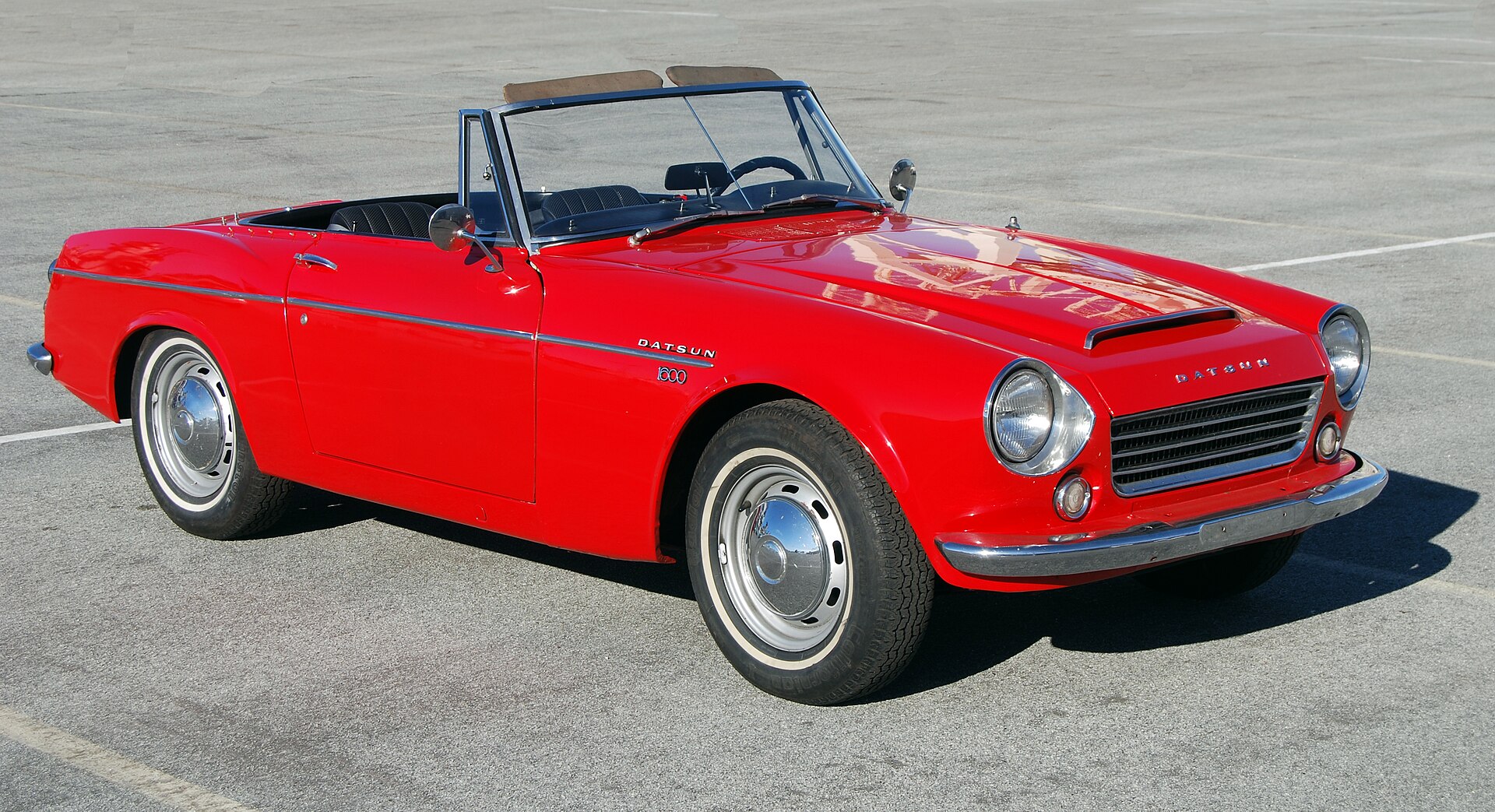
The Datsun Sports, sold in Japan as the Fairlady, is the family of open two-seaters that Nissan built from 1959 to 1970, before the Z car. It grew from 20 fibreglass S211s with a 988 cc engine into the SR311 2000, whose 1,982 cc overhead-cam four and five-speed gearbox made it the first Japanese car to exceed 200 km/h.
In short
- Five main series: S211 (1959), SPL212 and SPL213 (1960-1962), SP310 Fairlady 1500 (1962-1965), SP311 1600 (1965-1970) and SR311 2000 (1967-1970).
- About 40,000 roadsters were built in total, roughly 15,000 of them two-litre cars.
- The 2000 had 92 kW (125 PS) in Nissan's export specification, 101 kW (135 hp) SAE gross in US literature and a quoted top speed of 205 km/h.
- The 1600 and 2000 won ten SCCA national championships in the US.
Size at a glance
Datsun Fairlady 1500 and 1600 SP310/SP311
The Datsun 2000 SR311 is 25 mm taller than the Datsun Fairlady 1500 and 1600 SP310/SP311.
| Dimensions | Datsun 2000 SR311 | Datsun Fairlady 1500 and 1600 SP310/SP311 | Difference |
|---|---|---|---|
| Length | 3,910 mm153.9 in | 3,910 mm153.9 in | Same |
| Width | 1,495 mm58.9 in | 1,495 mm58.9 in | Same |
| Height | 1,300 mm51.2 in | 1,275 mm50.2 in | +25 mm+1.0 in |
| Wheelbase | 2,280 mm89.8 in | 2,280 mm89.8 in | Same |
Specs by version
Engines
| Version | Engine | Power | Torque | Gearbox | Drive | Production years |
|---|---|---|---|---|---|---|
| SPL212 · 1959–1962 | ||||||
| SPL212 · S211 | 1.0 l · 4 cyl · Petrol 988 cc | 27 kW 37 PS36 hp | - | - | Rear-wheel drive | 1959 |
| SPL212 · SPL213 | 1.2 l · 4 cyl · Petrol E-1 | 44 kW 60 PS59 hp | - | 4-sp Manual | Rear-wheel drive | 1961–1962 |
| Fairlady 1500 SP310 | 1.5 l · 4 cyl · Petrol G | 59 kW 80 PS79 hp | 118 Nm87 lb-ft | 4-sp Manual | Rear-wheel drive | 1962–1965 |
| SP310 · 1962–1970 | ||||||
| SP310 · Sports 1600 SPL311 | 1.6 l · 4 cyl · Petrol R16 | 66 kW 90 PS89 hp | 132 Nm97 lb-ft | 4-sp Manual | Rear-wheel drive | 1965–1970 |
| SR311 · 1967–1970 | ||||||
| SR311 · 2000 SRL311 | 2.0 l · 4 cyl · Petrol U20 | 92 kW 125 PS123 hp | 167 Nm123 lb-ft | 5-sp Manual | Rear-wheel drive | 1967–1970 |
Performance
Show all 1 versions
| Version | Top speed |
|---|---|
| SR311 · 1967–1970 | |
| SR311 · 2000 SRL311 | 205 km/h127 mph |
Dimensions and weight
Show all 3 versions
| Version | Length | Width | Height | Wheelbase | Kerb weight |
|---|---|---|---|---|---|
| Fairlady 1500 SP310 | 3,910 mm153.9 in | 1,495 mm58.9 in | 1,275 mm50.2 in | 2,280 mm89.8 in | 870 kg1,918 lb |
| SP310 · 1962–1970 | |||||
| SP310 · Sports 1600 SPL311 | 3,955 mm155.7 in | 1,495 mm58.9 in | 1,325 mm52.2 in | 2,280 mm89.8 in | - |
| SR311 · 1967–1970 | |||||
| SR311 · 2000 SRL311 | 3,910 mm153.9 in | 1,495 mm58.9 in | 1,300 mm51.2 in | 2,280 mm89.8 in | - |
Verified Manufacturer and type-approval data from our catalog · Sources and methodology
Datsun Sports Fairlady at a glance
| Specification | Datsun Sports |
|---|---|
| Years | June 1959 (S211) to April 1970 (last 1600 and 2000) |
| Production total | about 40,000 (Wikipedia); about 15,000 SR311 2000s (Classic Register) |
| Plants | Yokohama until 1960, then Nissan Shatai, Hiratsuka |
| Body style | two-door roadster; the SP310 began with a sideways third seat |
| Design | S211 by Yuichi Ohta; 1600 and 2000 restyled partly by Albrecht Goertz |
| Layout | front engine, rear-wheel drive, ladder chassis from Datsun truck and Bluebird 310 parts |
| Engines | 988 cc to 1,982 cc four-cylinders, pushrod and (2000) overhead cam |
| Power | 27 kW (37 PS) S211 to 92 kW (125 PS) SR311 export specification |
| Kerb weight | 870 kg (SP310, Nissan heritage data) |
| Top speed | about 169 km/h (105 mph) for the 1600; 205 km/h claimed for the 2000 |
| Price new | USD 2,460 (1500, 1964), USD 2,550 (1600, 1967), USD 2,999 (2000, 1967) |
From the fibreglass S211 to the Fairlady name
The S211 of June 1959 used the running gear of the Datsun 211 saloon under a fibreglass body drawn by Yuichi Ohta, carried "Datsun 1000" side badges and had a 988 cc engine of 27 kW (37 PS). Only 20 were made.
The SPL212 of 1960 switched to a steel body on the frame of the Datsun 223 truck and a 1,189 cc E-series engine of 35 kW (48 PS). It was built for export only and became the first Datsun sports car sold in the United States. The SPL213 added twin carburettors for 44 kW (60 PS), and Wikipedia counts 288 SPL212s and 217 SPL213s. The Fairlady name came from former Nissan president Katsuji Kawamata, who had seen the musical My Fair Lady on a trip to the US. Nissan's heritage pages date the name to the SPL213 of 1961, Wikipedia already to the SPL212.
Bluebird underpinnings and a sideways rear seat
The Fairlady reached Japanese buyers in October 1962 as the SP310 Fairlady 1500, with a left-hand-drive SPL310 for export. Nissan built it on a modified frame of the 310 Bluebird, took the 1.5-litre G engine and the rear axle from the Cedric saloon and fitted a four-speed gearbox with an unsynchronised first gear. The first cars had a third seat placed sideways behind the driver; the 1965 revision removed it and brought a sportier dashboard.
Nissan's heritage data gives the SP310 as 3,910 mm long, 1,495 mm wide and 1,275 mm high on a 2,280 mm wheelbase, with a kerb weight of 870 kg. In May 1963 an SP310 driven by G. Tahara won the B-II race for production sports cars at the first Japanese Grand Prix at Suzuka, beating imported rivals in front of a home crowd.
Datsun Sports engines from 988 cc to the two-litre U20
| Series | Years | Engine | Capacity | Power | Gearbox |
|---|---|---|---|---|---|
| S211 | 1959 | C-series OHV | 988 cc | 27 kW (37 PS) | 4-speed |
| SPL212 | 1960-1961 | E-series OHV | 1,189 cc | 35 kW (48 PS) | 4-speed |
| SPL213 | 1961-1962 | E-1, twin carburettors | 1,189 cc | 44 kW (60 PS) | 4-speed |
| SP310 1500 | 1962-1965 | G OHV, single SU | 1,488-1,497 cc | 57-59 kW (77-80 PS) | 4-speed |
| SP310 1500, twin SU | 1964-1965 | G OHV | 1,488-1,497 cc | 63 kW (85 PS) | 4-speed |
| SP311 1600 | 1965-1970 | R16 OHV, twin SU | 1,595 cc | 66 kW (90 PS) export; 71 kW (96 PS) in Japan | 4-speed, full synchromesh |
| SR311 2000 | 1967-1970 | U20 SOHC, twin SU | 1,982 cc | 92 kW (125 PS) export | 5-speed |
| SR311 Competition | 1967-1970 | U20, Mikuni-Solex | 1,982 cc | 112 kW (150 hp SAE gross) | 5-speed |
Figures vary between sources. Nissan lists the SP310 engine at 1,488 cc and 59 kW (80 PS), Wikipedia at 1,497 cc and 57 kW (77 PS). For the 2000, Nissan's export table shows 92 kW (125 PS) while its own text mentions 107 kW (145 PS), and US sources quote 101 kW (135 hp) SAE gross. The torque of the export 2000 is 167 Nm at 4,400 rpm and of the 1600 132 Nm at 4,000 rpm, both from Nissan.
Fairlady 1600 and 2000: the export roadsters
The SP311 appeared at the 1964 Tokyo Motor Show and went on sale in spring 1965 as the Fairlady 1600, or Datsun Sports 1600 abroad. It took the 1,595 cc R engine of the first Silvia, a Porsche-type synchromesh gearbox, front disc brakes and 14-inch wheels, and US West Coast dealers simply called it the Roadster. Top speed was about 169 km/h (105 mph).
The SR311 2000 followed in March 1967, and fewer than 1,000 of these early "half-year" 1967 cars were made. Its U20 engine had an aluminium cylinder head and a single overhead camshaft, and a factory Competition package with Mikuni-Solex carburettors and a hotter camshaft lifted output to 112 kW (150 hp) SAE gross; Australian two-litre cars had it as standard. The 1968 model year, shown at the Tokyo Motor Show in October 1967, brought a taller windscreen, a padded dashboard, built-in headrests and lifting door handles to meet US safety rules. In Japan the two-litre car carried a high annual road tax.
| Model year (US price new, conceptcarz) | Datsun 1600 | Datsun 2000 |
|---|---|---|
| 1964 | USD 2,460 (1500) | - |
| 1967 | USD 2,550 | USD 2,999 |
| 1968 | - | USD 3,000 |
| 1969 | - | USD 3,100 |
| 1970 | - | USD 3,095 |

Suzuka 1963 and the SCCA production classes
In SCCA production racing the 1600 and 2000 won ten national championships, the two-litre cars in C Production with Mikuni-Solex carburettors and the 1600s in D Production on Hitachi-built SU carburettors. John Morton and Bob Sharp both raced them, and actor Paul Newman started his racing career in one. Peter Brock's BRE team also raced U20-engined roadsters alongside its better-known 510 saloons. At home, Nissan lists the 2000 among its entries at the 1967 Japanese Grand Prix and the 1968 Monte Carlo Rally.
Datsun 2000 vs MGB and Triumph Spitfire
Datsun aimed the roadster at the British and Italian two-seaters that led the US import market. The closest match in size and price was the MGB, launched in 1962 with a 1.8-litre engine, and the smaller Triumph Spitfire fought the 1500 and 1600 lower down the price list. Wikipedia also names Fiat and Alfa Romeo as competitors. The Datsun 2000 offered a five-speed gearbox and an overhead-cam engine at a time when the MGB still used a pushrod four and a four-speed gearbox.
Making way for the 240Z
Tightening US safety and emissions rules made the separate-chassis roadster harder to sell. Nissan announced the Fairlady Z in October 1969, developed as the successor to the Fairlady 2000, and the last 1600 and 2000 roadsters were built in April 1970. The closed coupé that replaced them is covered in the Datsun 240Z hub.
Datsun Sports today: what to check when buying
The 1600 and 2000 share chassis and body, which is why the Classic Register warns that cars are sometimes rebuilt or presented as something they are not. Check that the chassis plate prefix matches the claimed model (SP311 or SPL311 for a 1600, SR311 or SRL311 for a 2000) and that the engine is the matching R16 or U20. A car sold as an original Competition-package 2000 needs documentation, because the Solex kit was available separately.
Body rot is the main cost. Look at the sills, floors, the lower front wings, the boot floor and the frame rails where the body sits on the chassis. The early S211, SPL212 and SPL213 are very rare outside collections, and parts for them are scarce.
Values: CLASSIC.COM's market benchmark for the 1967-1970 Datsun 2000 roadster stood at USD 20,394 in November 2026, based on sales between June 2025 and April 2026; at 0.86 that is about EUR 17,500. More Datsun models are listed in the Datsun catalogue. The roadster also has a place in our list of the best Japanese classic cars.
Photo gallery

Datsun Sports evolution in numbers
Did you know?
- The Datsun Sports ran for 11 years, from 1959 to 1970, over 3 generations in our catalog.
- The biggest jump in power came with the 2000 SR311: up to 112 kW (152 PS), 41 kW more than the Fairlady 1500 and 1600 SP310/SP311.
Most powerful version, kW
Figures from the 1cars catalog: power is the strongest version of each generation; generations without the figure are left out.
Datsun Sports: first vs latest generation
| Spec | S211, SPL212, SPL213 | 2000 SR311 | Change |
|---|---|---|---|
| Years | 1959–1962 | 1967–1970 | 8 years apart |
| Most powerful version | 44 kW (60 PS) | 112 kW (152 PS) | +68 kW (+155%) |
Oldest and newest generation in the 1cars catalog. Power is the strongest version of each; other rows are shown only when both generations have the figure.
Datsun Sports in our rankings
- No. 5 of 50 · Fastest cars of the 1960s (205 km/h)
- No. 9 of 36 · Lightest convertibles and roadsters (870 kg)
- No. 24 of 508 · Lightest cars (870 kg · top 5%)
- No. 53 of 650 · Smallest cars (3,910 mm · top 9%)
- No. 20 of 73 · Fastest Japanese cars (205 km/h · top 28%)
- No. 15 of 45 · Smallest convertibles and roadsters (3,910 mm · top 34%)
Lighter than 95% of ranked cars in the 1CARS catalog (No. 24 of 508).
FAQ
Is the Datsun Fairlady the same car as the Datsun Sports?
Yes. Nissan sold the roadsters as Fairlady in Japan and Australia and as Datsun Sports, Datsun 1500, 1600 or 2000 in export markets. The Fairlady Z coupé of 1969 later carried the name on.
How many Datsun roadsters were built?
About 40,000 between 1959 and 1970, according to Wikipedia. Around 15,000 of them were SR311 2000s, while the early S211 accounted for 20 cars and the SPL212 and SPL213 for about 500 between them.
How fast is the Datsun 2000 roadster?
Nissan quotes 205 km/h for the SR311 2000 and calls it the first Japanese car to pass 200 km/h. Conceptcarz gives a lower 120 mph (193 km/h).
What replaced the Datsun Fairlady roadster?
The Fairlady Z, sold abroad as the Datsun 240Z. Nissan announced it in October 1969 as the successor to the Fairlady 2000, and roadster production ended in April 1970.
Data sources
Data checked by an editor against the sources below.
- Wikipedia - Datsun Sports
- Nissan - Datsun Fairlady 1500
- Nissan - Datsun 1600 Sports
- Nissan - Datsun 2000 Roadster


