
 Datsun 510
Specs, engines and history
Published Sources (4) Report an error
By Sarah Whitmore, Senior Automotive Writer
- Built
- 1967–1973
- Top power
- 74 kW (101 PS)
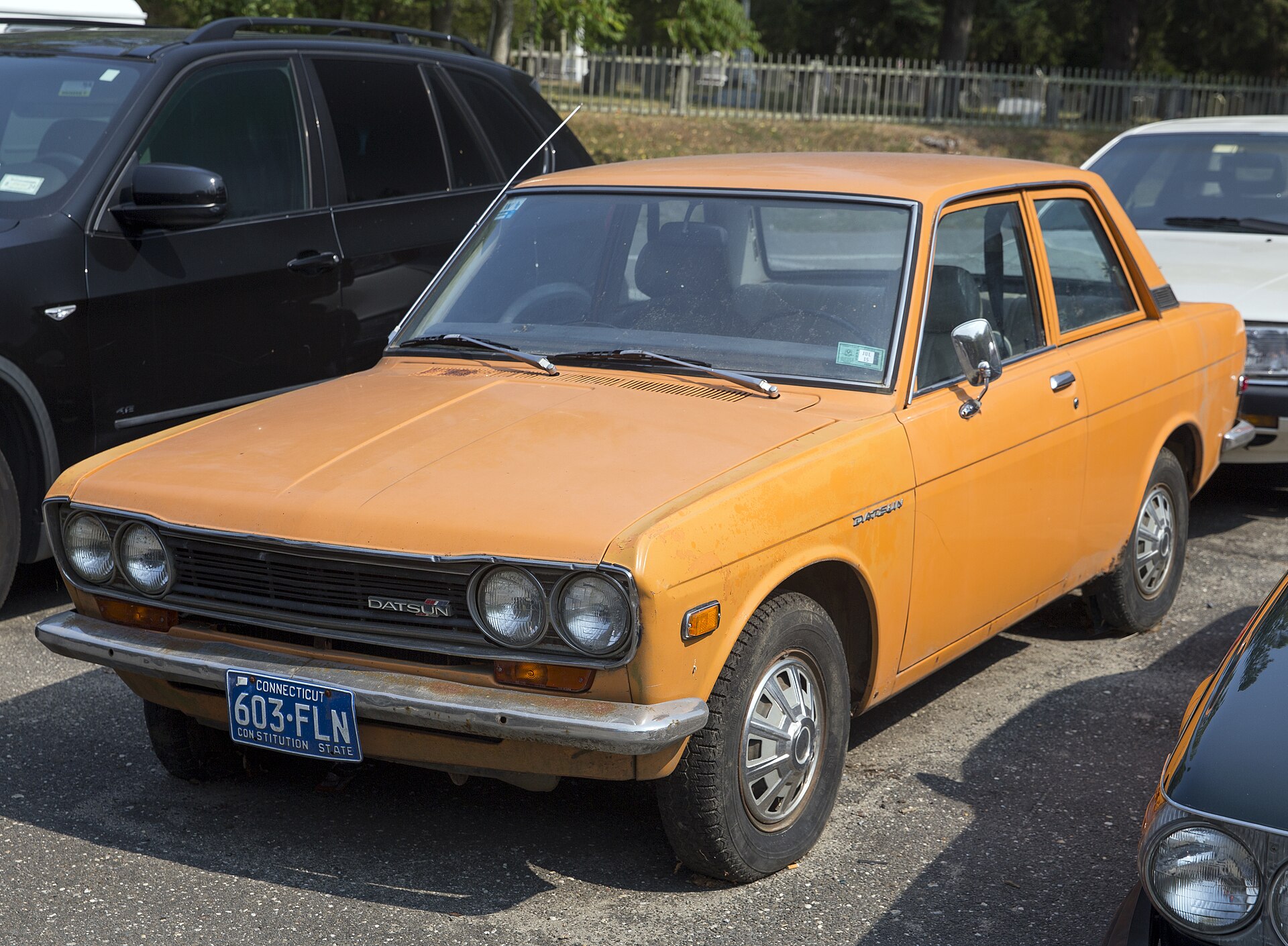
The Datsun 510 is the third-generation Nissan Bluebird, sold from August 1967 to 1973 as a two- and four-door saloon, a coupé and an estate. Its overhead-cam L16 engine, MacPherson struts and semi-trailing-arm rear axle copied the recipe of the BMW 1600-2 at a lower price, and the car won the 1970 Safari Rally and two Trans-Am 2.5 titles.
In short
- Launched in Japan on 15 August 1967 as the Bluebird 510; US sales began in October 1967 at about USD 1,996 for the four-door in 1968.
- Engines from 1.3 to 1.8 litres; the Japanese 1600 SSS coupé had 74 kW (100 PS), the US 1.6 was rated at 72 kW (96 hp SAE gross).
- First Japanese car to win the East African Safari Rally outright, in 1970, with Edgar Herrmann and Hans Schüller in a 1600 SSS.
- Nissan states global sales of more than 1.5 million in five years.
Size at a glance
| Dimensions | Datsun Bluebird 510 |
|---|---|
| Length | 4,120 mm162.2 in |
| Width | 1,560 mm61.4 in |
| Height | 1,410 mm55.5 in |
| Wheelbase | 2,420 mm95.3 in |
Specs by version
Engines
| Version | Engine | Power | Torque | Gearbox | Drive | Production years |
|---|---|---|---|---|---|---|
| 1300 | 4 cyl · Petrol L13 | 53 kW 72 PS71 hp | - | 3-sp Manual | Rear-wheel drive | 1967–1970 |
| 1600 Deluxe | 1.6 l · 4 cyl · Petrol L16 | 68 kW 92 PS91 hp | 129 Nm95 lb-ft | - | Rear-wheel drive | 1967–1973 |
| 510 1.6 (USA) | 1.6 l · 4 cyl · Petrol L16 | 72 kW 98 PS97 hp | - | 4-sp Manual | Rear-wheel drive | 1968–1973 |
| 1600 SSS Coupe | 1.6 l · 4 cyl · Petrol L16 | 74 kW 101 PS99 hp | 132 Nm97 lb-ft | - | Rear-wheel drive | 1968–1973 |
Performance
Show all 1 versions
| Version | Top speed |
|---|---|
| 510 1.6 (USA) | 160 km/h99 mph |
Dimensions and weight
Show all 3 versions
| Version | Length | Width | Height | Wheelbase | Kerb weight |
|---|---|---|---|---|---|
| 1600 Deluxe | 4,120 mm162.2 in | 1,560 mm61.4 in | 1,410 mm55.5 in | 2,420 mm95.3 in | 930 kg2,050 lb |
| 510 1.6 (USA) | - | - | - | - | 914 kg2,015 lb |
| 1600 SSS Coupe | 4,120 mm162.2 in | 1,560 mm61.4 in | 1,395 mm54.9 in | 2,420 mm95.3 in | 935 kg2,061 lb |
Verified Manufacturer and type-approval data from our catalog · Sources and methodology
Datsun 510 at a glance
| Specification | Datsun 510 |
|---|---|
| Years | August 1967 to 1973; replaced by the 610 Bluebird from September 1971 in Japan |
| Sales | more than 1.5 million worldwide in five years (Nissan heritage data) |
| Plants | Oppama, Japan; local assembly in Australia, New Zealand, Mexico, South Africa and Taiwan |
| Body styles | two-door and four-door saloon, two-door coupé (Japan), five-door estate |
| Design | usually credited to Teruo Uchino; the project began at Prince before the 1966 merger |
| Layout | front engine, rear-wheel drive; struts at the front, semi-trailing arms at the rear (estates: leaf-sprung live axle) |
| Engines | L13, L14, L16 and L18 overhead-cam fours; J13 and J15 pushrod fours in some export markets |
| Power | 53 kW (72 PS) for the Japanese 1.3 up to 74 kW (100 PS) for the 1600 SSS |
| Kerb weight | 930-965 kg (Nissan, Japanese models); about 914 kg (2,015 lb) for the US two-door |
| Top speed | about 160 km/h (100 mph), US 1.6 claim |
| Road test | quarter mile in 19.7 s (Road & Track, 1968) |
| Price new | USD 1,996 (1968); USD 2,300 two-door, USD 2,450 four-door and USD 2,650 estate in 1972 |
Why the Datsun 510 was built to rival the BMW 1600-2
Nissan had sold Datsuns in the United States since 1958, but the small saloons of that period were built for Japanese roads. Yutaka Katayama, head of Nissan's American operation, wanted a car that could hold its own on US freeways. Hagerty quotes his target as a car exactly like the BMW 1600-2 that was priced to sell, and he pushed Tokyo for a bigger overhead-cam engine than the home office had planned. The result arrived in Japan on 15 August 1967, and the four-door reached US showrooms in October of the same year.
Much of the groundwork came from Prince Motor Company, which merged with Nissan in 1966. The two-door saloon followed in the US in June 1968, and the estate and the two-door coupé came in 1968-1969. Naming changed by market: Bluebird in Japan, Datsun 510 in the US (510 being the internal series code), Datsun 1600 in Canada and New Zealand, and Datsun 1300, 1400, 1500, 1600 or 1800 elsewhere. The wider history of Datsun explains the brand, and the German benchmark grew into the BMW 2002.
Datsun 510 suspension, dimensions and weight
The engineering was the selling point. Saloons and coupés had MacPherson struts at the front and an independent rear end with semi-trailing arms, a layout then found mostly on German cars costing far more. Estates kept a live axle on leaf springs. In South America, Asia outside Japan and Africa the saloons were also built with a leaf-sprung solid axle, although South African 1600 models kept independent rear suspension.
Nissan's heritage collection gives the Japanese 1600 Deluxe saloon as 4,120 mm long, 1,560 mm wide and 1,410 mm high on a 2,420 mm wheelbase, with a kerb weight of 930 kg. The body had no front quarter-lights, unusual for 1967. The 1600 Deluxe in that collection has drum brakes all round, while the SSS coupé and US cars had front discs. Hagerty's valuation notes point out the price of the low cost: thinner steel and less sound insulation than a contemporary BMW.

Datsun 510 engines and power by market
Nissan's L-series four, a single overhead cam unit, powered most cars. The Japanese 1.3 used a three-speed manual; elsewhere a four-speed manual was standard and a three-speed automatic was optional. In September 1970 the L14 replaced the 1.3 and 1.5-litre engines in many markets, and the L18 was dropped in 1971.
| Version | Engine | Capacity | Power | Torque |
|---|---|---|---|---|
| Bluebird 1300 (Japan) | L13 OHC | 1.3 litres | 53 kW (72 PS) | - |
| Bluebird 1600 Deluxe (Japan) | L16, single carburettor | 1,595 cc | 68 kW (92 PS) at 6,000 rpm | 129 Nm |
| Bluebird 1600 SSS coupé | L16, twin SU carburettors | 1,595 cc | 74 kW (100 PS) at 6,000 rpm | 132 Nm |
| Datsun 510 (USA) | L16, Hitachi downdraught | 1,595 cc | 72 kW (96 hp SAE gross) | - |
| 1600 SSS (South Africa) | L16, twin carburettors | 1,595 cc | 81 kW (109 hp SAE) | - |
| 1970 Safari rally car | L16, two Solex 44 PHH | 1,595 cc | 96 kW (130 PS) at 6,800 rpm | 157 Nm |
Japanese figures come from Nissan's heritage collection, the US and South African ratings from Hagerty, conceptcarz and Wikipedia; Hagerty quotes 72 kW (97 hp) for the US engine, so the sources differ by one horsepower. In the UK, about 4,000 cars were imported, starting with the L16 and adding the L13 in 1969 and the L14 in 1970.
Datsun 510 price new and the 1968 Road & Track test
Road & Track tested a 510 in 1968. The car as tested cost USD 2,046, covered the quarter mile in 19.7 seconds and returned 25 mpg (9.4 l/100 km). The magazine liked the value but found that the soft suspension bottomed out easily, and it advised keen drivers to fit wider wheels and tyres.
Price was the core of the case. At USD 1,996 in 1968 the four-door cost roughly two-thirds of a BMW saloon, and Hagerty notes that it came to slightly under one dollar per pound of weight. By 1972 the two-door listed at USD 2,300, the four-door at USD 2,450 and the estate at USD 2,650, with the estate rising by about USD 500 in a year.
Datsun 510 in racing, from the 1970 Safari to BRE Trans-Am
Nissan had entered the East African Safari Rally since 1963. In 1970 the 1600 SSS of Edgar Herrmann and Hans Schüller won the 18th Safari outright, and Nissan also took the class and team prizes. It was the first overall win for a Japanese car. The rally car in Nissan's collection weighs 965 kg and runs a twin-Solex L16 of 96 kW (130 PS). In Australia the 1600 stayed competitive for more than a decade, and Wikipedia's results table still lists Datsun 1600 entries for Geoff Portman in 1982 and Ross Dunkerton in 1983.
In the US, Peter Brock's BRE team ran 510s in the Trans-Am 2.5 Challenge. John Morton won the drivers' title in 1971 and 1972, ending Alfa Romeo's run in the under-2.0-litre class; conceptcarz records that car number 46 started 19 races, took 16 pole positions and won 12. Bob Sharp won the SCCA B Sedan national title with a 510.
How the 610 Bluebird replaced the Datsun 510
The successor, the 610 Bluebird, appeared in Japan in September 1971, while the 510 continued in export markets. In the US the four-door saloon was dropped for 1974 in favour of the PL610. North American buyers later saw the 510 name again on a different car, the A10 Violet of 1978-1981, which shares nothing with the original beyond its badge. The same dealers soon had a more glamorous Katayama project to sell, the Datsun 240Z.
Datsun 510 today: what to check when buying
Hagerty puts it bluntly: rust has claimed most US examples, and repairs become expensive quickly. Look at the sills, floors, wheel arches, the bottoms of the doors and the strut tops, and check that the rear subframe mounts on independent-suspension cars are sound. Electrical faults are common, while the L-series engine and gearbox are simple and well supported.
Many surviving cars have been modified, from mild BRE-style road cars to full racers, and Hagerty notes that a tidy modified car can still sell well. A genuine unmodified two-door or coupé is the harder find. Japanese-market coupés and SSS models have their own trim and badges, so check the chassis plate prefix (KP510 for the 1600 SSS coupé, P510 for 1600 saloons) against the car's claimed identity.
Hagerty's US valuation tool showed USD 21,800 for a 1971 two-door saloon when checked in November 2026, about EUR 18,700 at an exchange rate of 0.86. The 510 sits among other models in the Datsun catalogue. The car the 510 was modelled on is compared directly in Datsun 510 vs BMW 2002, and the 510 also features in our best Japanese classic cars.
Photo gallery

Video

Popular comparisons
Datsun 510 in our rankings
- No. 35 of 508 · Lightest cars (914 kg · top 7%)
- No. 12 of 121 · Smallest coupes (4,120 mm · top 10%)
- No. 14 of 129 · Smallest sedans (4,120 mm · top 11%)
- No. 14 of 110 · Lightest coupes (935 kg · top 13%)
- No. 11 of 87 · Lightest sedans (914 kg · top 13%)
- No. 114 of 650 · Smallest cars (4,120 mm · top 18%)
Lighter than 93% of ranked cars in the 1CARS catalog (No. 35 of 508).
FAQ
When was the Datsun 510 built?
Nissan launched the Bluebird 510 in Japan on 15 August 1967 and built it until 1973. The 610 replaced it in Japan from September 1971, and the US four-door saloon was dropped for 1974.
Is the Datsun 510 the same as the Nissan Bluebird?
Yes, the 510 is the third-generation Bluebird; 510 is the internal series code that Datsun used as the model name in the US. Canada sold it as the Datsun 1600, and other markets used engine-size names such as 1400 or 1600.
How much power does a Datsun 510 have?
The US 1.6-litre L16 was rated at 72 kW (96 hp SAE gross). Japanese versions ranged from 53 kW (72 PS) for the 1300 to 74 kW (100 PS) for the twin-carburettor 1600 SSS, according to Nissan.
Did the Datsun 510 win the Safari Rally?
Yes, Edgar Herrmann and Hans Schüller won the 1970 East African Safari Rally outright in a 1600 SSS, the first overall win for a Japanese car. Nissan also took the class and team awards that year.
How much is a Datsun 510 worth today?
Hagerty's US valuation tool showed USD 21,800 for a 1971 two-door saloon in November 2026, about EUR 18,700. Rust-free original two-doors and Japanese coupés are the scarce cars; modified examples vary widely with the quality of the work.
Data sources
Data checked by an editor against the sources below.
- Wikipedia - Datsun 510
- Nissan - Datsun Bluebird 1600 Deluxe
- Nissan - Datsun Bluebird 1600sss Coupe
- Conceptcarz - Datsun 510


