
Datsun 510 vs BMW 2002: the copy and the original
Updated Report an error By Sarah Whitmore

BMW · 1968–1975
2002 (02 Series)
- Power
- 125 kW170 PS
- Top speed
- 211 km/h
- Kerb mass
- -

Datsun · 1967–1973
Bluebird 510
- Power
- 72 kW98 PS
- Top speed
- 160 km/h
- Kerb mass
- 914 kg
At a glance
Who suits what, worked out from the catalog figures of the versions above.
- Off-road Bluebird 510 Drive and body: Rear-wheel drive · Sedan vs Rear-wheel drive · Coupe
Verdict Opinion
New, the 510 was the better buy: it cost about a quarter less than a 2002 and offered the same chassis layout, four doors if needed and an estate. Today the gap has closed: Hagerty's November 2026 figures for the two cars differ by only USD 200.
The BMW is the stronger car to own as a classic. Its range runs up to the tii and Turbo, it has a convertible and a Touring, and its body uses heavier steel. The 510 wins on rarity, because rust has claimed most US examples, and on its Safari and Trans-Am record.
- Sarah Whitmore
The Datsun 510 was built to a brief that named its rival. Yutaka Katayama, who ran Nissan's American business, asked Tokyo for a car exactly like the BMW 1600-2 at a price that would sell, and the Bluebird 510 reached US showrooms in October 1967 with an overhead-cam four, MacPherson struts at the front and semi-trailing arms at the rear. A few months later BMW fitted its two-litre M10 to the same two-door body and created the BMW 2002.
So the two cars that US enthusiasts still argue about share a recipe and differ in price, engine size and build quality. The 510 sold more than 1.5 million worldwide in five years, according to Nissan. BMW built 339,092 of the standard 2002 between 1968 and 1975, plus the ti, tii and Turbo.
Datsun 510 vs BMW 2002: engines, chassis and prices
1.6 litres against 2.0 litres
The US 510 used the 1,595 cc L16 single-overhead-cam four with a Hitachi carburettor, rated at 72 kW (96 hp SAE gross). The 2002 has a 1,990 cc M10, also with one overhead camshaft, and 74 kW (100 PS) with a single carburettor. On paper the gap is only 2 kW, and the BMW gets there with 395 cc more displacement.
Faster BMW versions
Datsun's quickest road 510 was the Japanese 1600 SSS coupé with twin SU carburettors and 74 kW (100 PS). BMW went much further: the 2002 ti had 88 kW (120 PS), the fuel-injected 2002 tii of 1971-1975 96 kW (130 PS) and 185 km/h, and the 2002 Turbo of 1973-1975 125 kW (170 PS), 240 Nm and 211 km/h. Only 1,672 Turbos were built, against 38,703 tii.
Same layout, different size
Both are front-engined, rear-wheel-drive two-door saloons with struts at the front and independent rear suspension on the saloons. The Datsun 1600 Deluxe measures 4,120 mm on a 2,420 mm wheelbase and weighs 930 kg; the US two-door is about 914 kg. The 02 Series is 4,220-4,230 mm long on a 2,500 mm wheelbase and weighs 940-1,080 kg depending on version. Hagerty notes that Datsun saved money with thinner steel and less sound insulation than a contemporary BMW.
Body styles
The 510 came as a two-door and four-door saloon, a five-door estate and, in Japan, a two-door coupé. The 2002 was always a two-door, with the Touring hatchback of 1971-1974 and 2,517 Baur cabriolets as the alternatives.
Prices in 1968
The four-door 510 listed at USD 1,996 in 1968, and Road & Track's test car cost USD 2,046. Sports Car Market gives the 2002 a list price of USD 2,750 in 1968, so the Datsun undercut it by USD 754. Road & Track timed the 510 over the quarter mile in 19.7 seconds and recorded 25 mpg (9.4 L/100 km).
Racing records
A 510 1600 SSS driven by Edgar Herrmann and Hans Schüller won the 1970 East African Safari Rally outright, the first overall win for a Japanese car. In the US, John Morton's BRE 510 won the Trans-Am 2.5 drivers' title in 1971 and 1972.
Values in 2026
Hagerty's US valuation tool showed USD 21,800 for a 1971 Datsun 510 two-door in November 2026. The same tool gave about USD 22,000 for a 1974 BMW 2002 in good condition when checked in November 2026; 29 auction sales over three years ranged from USD 5,565 to USD 57,750.
Size and weight
| 2002 (02 Series) | Bluebird 510 | |
|---|---|---|
| Wheelbase | 2,500 mm98.4 in | 2,420 mm95.3 in † −80 mm −3.1 in −3.2% |
| Fits a standard garage? | No data | Yes |
Difference vs 2002 (02 Series) (±). Garage check: a standard single garage takes a car up to about 5.0 m (16 ft 5 in) long and 1.9 m (6 ft 3 in) wide (width as listed in the catalog; some makers include the mirrors). Leave about 0.6 m (2 ft) to open the doors. † from another version of this generation.
Full specifications
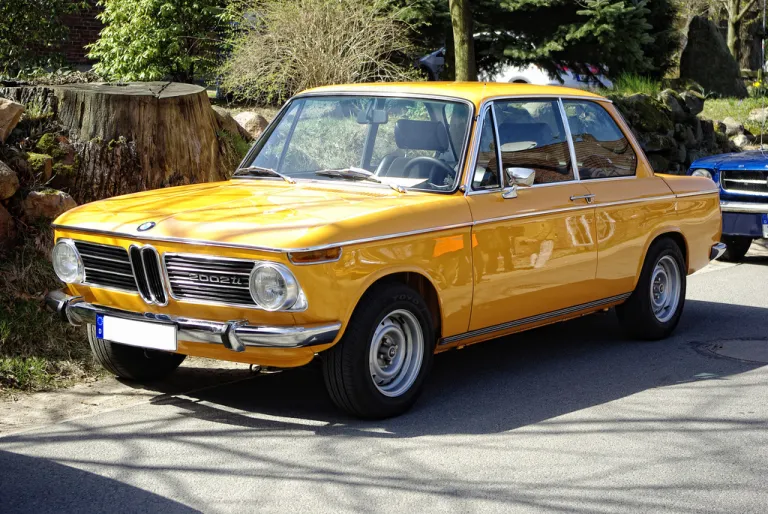
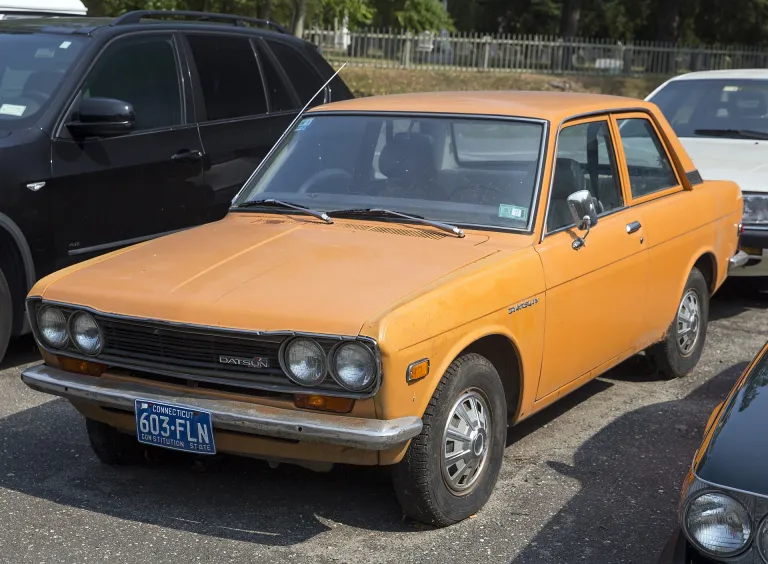
| BMW 2002 | Datsun 510 | |
|---|---|---|
| General | ||
| Version | Turbo (E20) · petrol · 125 kW (170 PS) | 1.6 (USA) · petrol · 72 kW (98 PS) |
| Production years | 1968–1975 | 1967–1973 |
| Body | Coupe | Sedan |
| Class | No data | C-segment (compact) |
| Country | Germany | Japan |
| Performance | ||
| Power Why it matters: More power means stronger acceleration and easier overtaking, especially with a full load. | 125 kW (170 PS) 168 hp Better | 72 kW (98 PS) 97 hp |
| Power, all versions | 74–125 kW (101–170 PS) 99–168 hp | 53–74 kW (72–101 PS) 71–99 hp |
| Torque Why it matters: Torque is the pulling force you feel when accelerating from low revs, towing or climbing hills. | 240 Nm 177 lb-ft | No data |
| Top speed Why it matters: Top speed hints at how relaxed the car is at motorway speeds, even if you never reach it. | 211 km/h 131 mph Better | 160 km/h 99 mph |
| Power per tonne | No data | 79 kW/t 96 hp/ton calculated |
| Engine and transmission | ||
| Fuel | Petrol | Petrol |
| Engine | 1,990 cc · 4 cyl 2.0 l | 1,595 cc · 4 cyl 1.6 l |
| Engine code | No data | L16 |
| Gearbox | manual | 4-speed manual |
| Drive | Rear-wheel drive | Rear-wheel drive |
| Dimensions and weight | ||
| Length | No data | 4,120 mm 162.2 in † |
| Width | No data | 1,560 mm 61.4 in † |
| Height | No data | 1,410 mm 55.5 in † |
| Wheelbase | 2,500 mm 98.4 in | 2,420 mm 95.3 in † |
| Kerb weight Why it matters: A lighter car is usually more agile and uses less energy. | No data | 914 kg 2,015 lb |
These cars do not differ in the data we have.
Equal rows hidden (2): Fuel, Drive.
Better marks the stronger figure - only for measurable specs (power, torque, 0–100 km/h, consumption, boot, weight).
† from another version of this generation.
In plain words
BMW 2002 has more power: 125 kW (170 PS) against 72 kW (98 PS) for Datsun 510. Datsun 510 is the older design (from 1967); BMW 2002 arrived in 1968. On the catalog figures, the Datsun 510 is the pick for off-road. Our catalog has no kerb mass for the BMW 2002 yet, so some checks above leave it out.
Which one to choose
Choose the Datsun 510 if you want a light, simple car with a racing history, a four-door or estate body, or a base for a BRE-style road car with the L-series engine.
Choose the BMW 2002 if you want more torque, a fuel-injected tii or Turbo, a Baur cabriolet or Touring, and a better-built shell. Both makers' other classics are in the Datsun catalogue and the BMW catalogue.
Frequently asked questions
Was the Datsun 510 a copy of the BMW 2002?
It was modelled on the BMW 1600-2, the smaller-engined sister of the 2002. Yutaka Katayama asked for a car like the 1600-2 at a lower price, and the 510 copied its overhead-cam engine, strut front suspension and semi-trailing-arm rear.
Which is faster, the Datsun 510 or the BMW 2002?
The standard cars are close: 72 kW (96 hp SAE gross) for the US 510 against 74 kW (100 PS) for the 2002. The 2002 tii with 96 kW and the 2002 Turbo with 125 kW are clearly faster than any road 510.
How much did a Datsun 510 and a BMW 2002 cost new?
The 510 four-door listed at USD 1,996 in the US in 1968. Sports Car Market gives the 2002 a 1968 list price of USD 2,750, so the Datsun cost USD 754 less.
Which is worth more today?
In November 2026 Hagerty's US valuation tool showed USD 21,800 for a 1971 510 two-door and about USD 22,000 for a 1974 2002 in good condition. Tii and Turbo models cost considerably more than a standard 2002.