
 Austin-Healey Sprite
All generations, specs and history
Published Sources (3) Report an error
By Sarah Whitmore, Senior Automotive Writer
- Built
- 1958–1971
- Generations
- 2
- Top power
- 48 kW (65 PS)
Timeline
Sprite generations
Click a generation for its own page
- Sprite Mk I Frogeye 1958–1961 · Roadster · 32 kW (44 PS)
- Sprite Mk II-Mk IV 1961–1971 · Roadster · 35–48 kW (48–65 PS)
Newest first · 2 generations since 1958
- 1961 Mk II-Mk IV 1961–1971 · Roadster · 35–48 kW (48–65 PS)
- 1958 Mk I Frogeye 1958–1961 · Roadster · 32 kW (44 PS)
All generations by year: Sprite Mk II-Mk IV (1961–1971) · Sprite Mk I Frogeye (1958–1961)
Which one is mine?
Pick the year of first registration to see which generation it is.
- Sprite Mk II-Mk IV 1961–1971
- Sprite Mk I Frogeye 1958–1961
The Austin-Healey Sprite is a two-seat roadster that BMC built at the MG works in Abingdon from 1958 to 1971. Designed by the Donald Healey Motor Company around Austin A35 and Morris Minor parts, it started with a 948 cc A-series engine of 32 kW (43 bhp) and a launch price of GBP 669 in 1958. Four Marks added up to 129,347 cars.
In short
- Built 1958-1971 in four Marks: Mk I "Frogeye" (48,987), Mk II (31,665), Mk III (25,905) and Mk IV (22,790).
- Engines grew from 948 cc and 32 kW (43 bhp) to 1,275 cc and 48 kW (65 bhp).
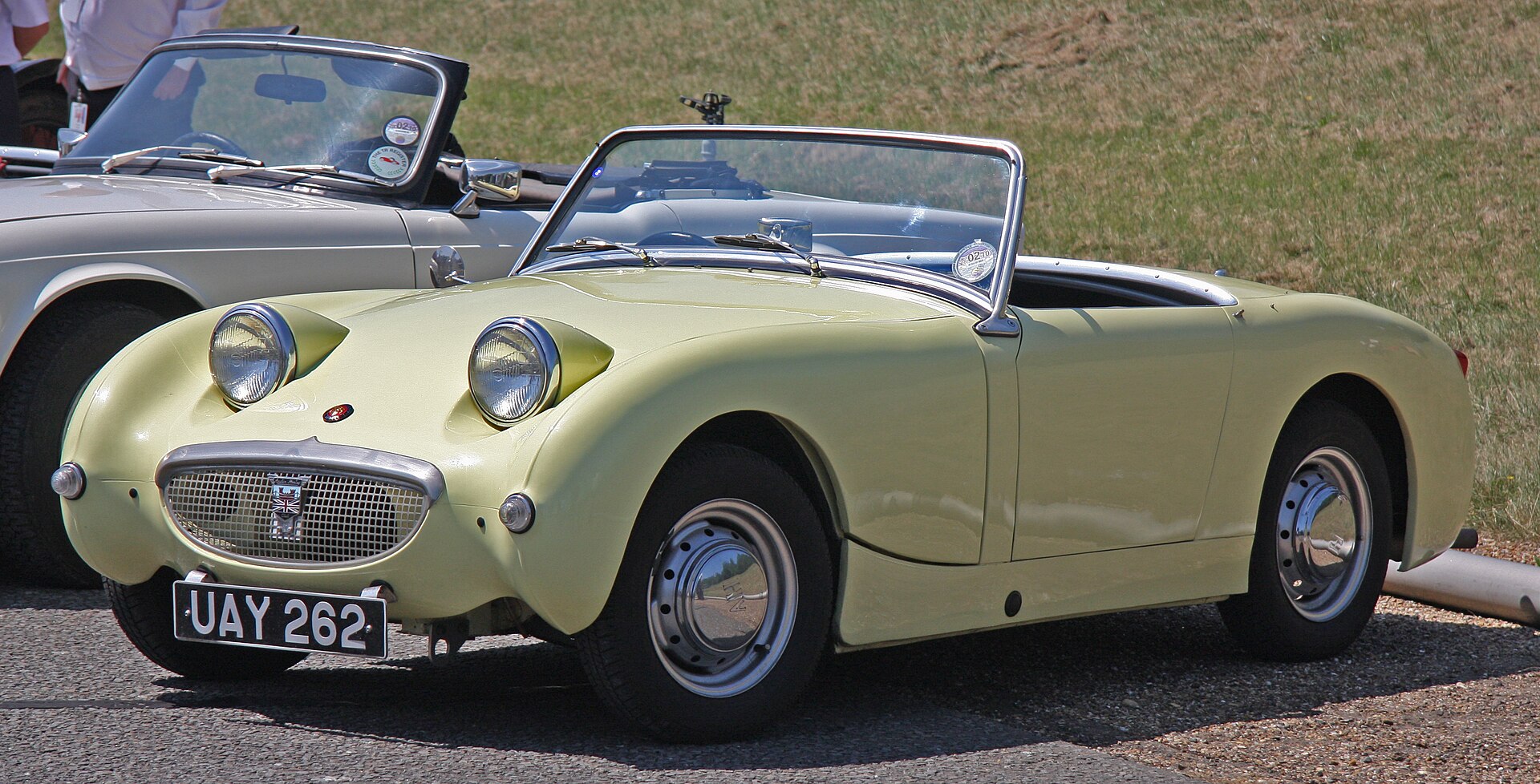
- The Mk I has no boot lid and no outside door handles; its headlamps sit on top of the bonnet.
- From 1961 it had an MG twin, the Midget, and the last 1,022 cars of 1971 were sold simply as Austin Sprites.
Size at a glance
| Dimensions | Austin-Healey Sprite Mk I Frogeye |
|---|---|
| Length | 3,493 mm137.5 in |
| Width | 1,346 mm53.0 in |
| Height | 1,264 mm49.8 in |
| Wheelbase | 2,032 mm80.0 in |
Specs by version
Engines
| Version | Engine | Power | Torque | Gearbox | Drive | Production years |
|---|---|---|---|---|---|---|
| Sprite Mk I Frogeye · 948 Mk I | 0.9 l · 4 cyl · Petrol 9CC | 32 kW 44 PS43 hp | 70 Nm52 lb-ft | 4-sp Manual | Rear-wheel drive | 1958–1961 |
| Sprite Mk II-Mk IV · 1098 Mk II | 1.1 l · 4 cyl · Petrol 10CG | 42 kW 57 PS56 hp | - | 4-sp Manual | Rear-wheel drive | 1962–1964 |
| Sprite Mk II-Mk IV · 1098 Mk III | 1.1 l · 4 cyl · Petrol 10CC | 44 kW 60 PS59 hp | 88 Nm65 lb-ft | 4-sp Manual | Rear-wheel drive | 1964–1966 |
| Sprite Mk II-Mk IV · 1275 Mk IV | 1.3 l · 4 cyl · Petrol 1,275 cc | 48 kW 65 PS64 hp | 98 Nm72 lb-ft | 4-sp Manual | Rear-wheel drive | 1966–1971 |
Performance
Show all 1 versions
| Version | Top speed |
|---|---|
| Sprite Mk I Frogeye · 948 Mk I | 133 km/h83 mph |
Dimensions and weight
Show all 1 versions
| Version | Length | Width | Height | Wheelbase | Kerb weight |
|---|---|---|---|---|---|
| Sprite Mk I Frogeye · 948 Mk I | 3,493 mm137.5 in | 1,346 mm53.0 in | 1,264 mm49.8 in | 2,032 mm80.0 in | 664 kg1,464 lb |
Verified Manufacturer and type-approval data from our catalog · Sources and methodology
Austin-Healey Sprite at a glance
| Specification | Austin-Healey Sprite |
|---|---|
| Years | May 1958 to 1971 |
| Production | 129,347 (sum of the four Mark totals) |
| Plants | BMC Abingdon, England; CKD assembly at Enfield, New South Wales |
| Body style | two-seat roadster, factory hardtop available |
| Design | Donald Healey Motor Company; styling Gerry Coker, chassis Barry Bilbie |
| Layout | front engine, rear-wheel drive, unitary body with front chassis legs |
| Engines | BMC A-series four: 948 cc, 1,098 cc, 1,275 cc |
| Power | 32 kW (43 bhp) to 48 kW (65 bhp) |
| Weight | 664 kg (Mk I, Auto Express) |
| Top speed | 133.4 km/h (82.9 mph), Mk I, The Motor 1958 |
| 0-60 mph | 20.5 s, Mk I, The Motor 1958 |
| Price new | GBP 669 in 1958 |
Why BMC built the Sprite from A35 and Minor parts
The Donald Healey Motor Company built the Sprite largely from the BMC parts bin. The engine and front suspension came from the Austin A35, the rack-and-pinion steering from the Morris Minor 1000. Production went to the MG factory at Abingdon, and the car was shown to the press in Monte Carlo on 20 May 1958.
The price was the point. GBP 669 in 1958 bought a sports car that topped 130 km/h, and the A-series kept running costs low. The Motor recorded 43 mpg (6.6 L/100 km) in its 1958 test. Classics World quotes GBP 679 including purchase tax for the launch car, so figures vary slightly between sources.
Frogeye body and quarter-elliptic chassis
Gerry Coker styled a one-piece front end that hinges forward, opening up the engine bay and front wheels. The headlamps were meant to fold back into the bonnet when not in use. The mechanism was dropped to save money, so the lamps stand upright on the panel. Hence the British nickname "Frogeye" and the American "Bugeye".
Underneath, Barry Bilbie designed a unitary structure with two chassis legs running forward to carry the engine and suspension. Wikipedia describes the Sprite as the first volume-production sports car built with unitary construction, though the front legs mean it is not a pure monocoque. The rear axle hangs on quarter-elliptic leaf springs with lever-arm dampers and top links. There was no boot lid, so luggage and the spare wheel are reached by tilting the seat backs forward, and no exterior door handles either.
Auto Express lists a 2,032 mm (80 in) wheelbase, 3,493 mm (137.5 in) length, 1,346 mm width and a kerb weight of 664 kg (1,464 lb). The 948 cc engine got twin 1 1/8 in SU carburettors and stronger valve springs, and output rose from the A35 saloon's 25 kW (34 bhp) to 32 kW (43 bhp) at 5,200 rpm.

Sprite Mk II, Mk III and Mk IV and the MG Midget twin
In May 1961 the Mk II replaced the Frogeye with a conventional body: headlamps in the wings, a full-width grille, an opening boot lid and squared-off rear wheel arches. In the same month BMC launched the MG Midget, the same car with MG badges and trim, and enthusiasts have called the pair "Spridgets" ever since. The MG Midget hub follows that branch, which outlived the Austin-Healey name by eight years.
| Mark | Years | Engine | Power | Built |
|---|---|---|---|---|
| Mk I | 1958-1961 | 948 cc | 32 kW (43 bhp) | 48,987 |
| Mk II | 1961-1964 | 948 cc, 1,098 cc from Oct 1962 | 35 kW (46.5 bhp), 42 kW (56 bhp) | 31,665 |
| Mk III | 1964-1966 | 1,098 cc | 44 kW (59 bhp) | 25,905 |
| Mk IV | 1966-1971 | 1,275 cc | 48 kW (65 bhp) | 22,790 |
The October 1962 update brought the 1,098 cc engine, a stronger gearbox with baulk-ring synchromesh, front disc brakes and optional wire wheels. The Mk III of March 1964 gained a curved windscreen, wind-up side windows, outside door handles and semi-elliptic rear springs in place of the quarter-elliptics. The Mk IV arrived at the London Motor Show in October 1966 with the 1,275 cc engine and a hood that stayed attached to the car and folded away. After the British Leyland takeover a 1970 facelift made Sprite and Midget almost identical.
Power figures for the 1,098 cc and 1,275 cc cars come from the Midget, which shared the engines: 44 kW (59 bhp) at 5,750 rpm for the later 1,098 cc unit and 48 kW (65 bhp) at 6,000 rpm with 98 Nm (72 lb-ft) for the 1,275 cc engine.
In Italy, Innocenti built its own version with a Ghia body by Tom Tjaarda. The Spider sold 4,790 cars with the 950 cc engine and 2,074 with the 1100 between 1961 and 1968, and a coupé on a longer wheelbase added 794 more.
Sprite road tests, Sebring and Le Mans
The Motor tested a Mk I in 1958 and recorded 133.4 km/h (82.9 mph) and 0-60 mph in 20.5 seconds; the test car cost GBP 678 including GBP 223 of tax. Its 1961 test of a Mk II hardtop gave 138.1 km/h (85.8 mph) and 20.0 seconds at a price of GBP 705. The appeal lay in the steering, the low weight and the price rather than in outright pace.
Competition came quickly. John Sprinzel and Willy Cave won their class on the 1958 Alpine Rally, and in 1959 a Sprite took a class win in the 12 Hours of Sebring, which introduced the car to American buyers. Stirling Moss, Bruce McLaren and Steve McQueen all raced Sprites at Sebring in the early 1960s, and a streamlined Sprite finished 12th overall at Le Mans in 1965.

Why the Sprite name ended in 1971
The Healey link ended in 1971. Wikipedia attributes the decision to Donald Stokes at British Leyland, who wanted to stop paying royalties to the Donald Healey Motor Company, and the last 1,022 cars left Abingdon badged only as Austin Sprites. US exports had already stopped after 1969, when emission equipment was also costing the A-series performance. British Leyland saw no need for a direct replacement because it still sold the identical MG Midget and the similar Triumph Spitfire. Buyers who wanted more power had always been pointed to the six-cylinder Austin-Healey 3000, the big Healey from the same factory.
Austin-Healey Sprite today: what to check when buying
Nearly every Frogeye has been restored at least once, so judge the quality of that work as much as the car. Rust starts in the outer and inner sills and spreads to the floors and the box sections between the rear sills, especially around the rear spring mounts; Auto Express warns that the rear spring holder is hard to repair. Check the front bulkhead around the heater box, battery tray and master cylinder, and the radiator crossmember and inner wings under the bonnet. A heavy clamshell strains its hinges, and a glassfibre bonnet usually lowers the value against an original steel one.
The A-series is simple and parts are cheap. Listen for bottom-end rumble, look for blue smoke from worn valve-stem seals, and check the dipstick for the "mayonnaise" of a failing head gasket. Test the synchromesh and make sure the gearbox does not jump out of gear under load. Quarter-elliptic springs and tired lever-arm dampers make the Mk I go light at the rear, and the front suspension has four grease points per side that need regular attention. Many cars carry period upgrades such as the 1,275 cc engine or front disc brakes, which most buyers accept.
Classics World quoted a Classic.com average sale price of about GBP 14,600 for a Mk I in spring 2026, roughly EUR 16,800 at about 1.15 euros to the pound. Body panels, hoods and trim are reproduced, and the Midget and Sprite Club and the Austin-Healey Club support owners in the UK. Every other model from Donald Healey's partnership with BMC is in the Austin-Healey catalogue. How the Sprite and its badge twin differ is set out in Austin-Healey Sprite vs MG Midget, and the Sprite also appears among the best British classic sports cars.
Photo gallery

Austin-Healey Sprite: first vs latest generation
| Spec | Sprite Mk I Frogeye | Sprite Mk II-Mk IV | Change |
|---|---|---|---|
| Years | 1958–1961 | 1961–1971 | 3 years apart |
| Most powerful version | 32 kW (44 PS) | 48 kW (65 PS) | +16 kW (+50%) |
Oldest and newest generation in the 1cars catalog. Power is the strongest version of each; other rows are shown only when both generations have the figure.
Popular comparisons
Austin-Healey Sprite in our rankings
- No. 4 of 45 · Smallest convertibles and roadsters (3,493 mm)
- No. 4 of 36 · Lightest convertibles and roadsters (664 kg)
- No. 6 of 509 · Lightest cars (664 kg)
- No. 11 of 651 · Smallest cars (3,493 mm · top 2%)
- No. 348 of 1243 · Longest-running car nameplates (13 years · top 30%)
- No. 135 of 157 · Most powerful cars of the 1960s (48 kW · top 89%)
Lighter than 98% of ranked cars in the 1CARS catalog (No. 6 of 509).
FAQ
Why is the Austin-Healey Sprite called the Frogeye?
Because its headlamps stand on top of the bonnet. They were designed to retract, but BMC deleted the mechanism to save cost, so the lamps stayed permanently upright and looked like a frog's eyes. American owners call the same car the Bugeye.
How many Austin-Healey Sprites were built?
About 129,347 across four Marks between 1958 and 1971: 48,987 Mk I, 31,665 Mk II, 25,905 Mk III and 22,790 Mk IV. Sources differ on whether the final 1,022 Austin-badged cars are included in the Mk IV figure.
What is the difference between a Sprite and an MG Midget?
From 1961 the two were the same car with different badges, grilles and trim, built side by side at Abingdon. The Midget was the better seller and continued until 1979, while the Sprite ended in 1971.
How much is a Frogeye Sprite worth today?
About GBP 14,600 on average for a Mk I, according to Classic.com sales data quoted by Classics World in spring 2026. That is roughly EUR 16,800 in 2026. Restoration quality decides the price, and a glassfibre bonnet in place of the steel original usually lowers it.
Data sources
Data checked by an editor against the sources below.
- Wikipedia - Austin Healey Sprite
- Co - Austin Healey Frogeye Sprite Buying Guide 1958 1961
- Wikipedia - MG Midget


