
Austin-Healey Sprite vs MG Midget: the Spridget twins
Updated Report an error By Sarah Whitmore

Austin-Healey · 1958–1961
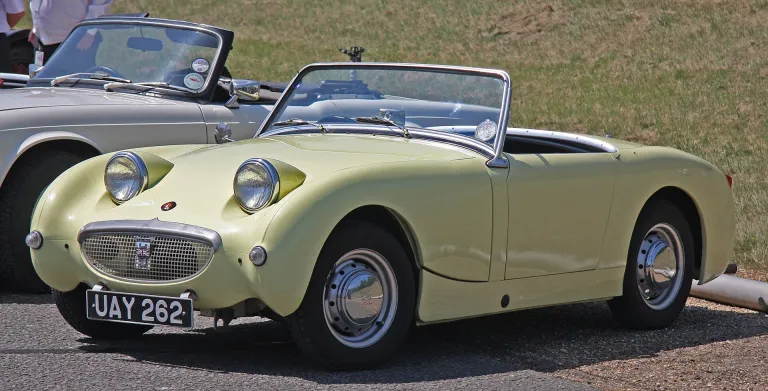
Sprite Mk I Frogeye
- Power
- 32 kW44 PS
- Top speed
- 133 km/h
- Kerb mass
- 664 kg

MG · 1961–1974
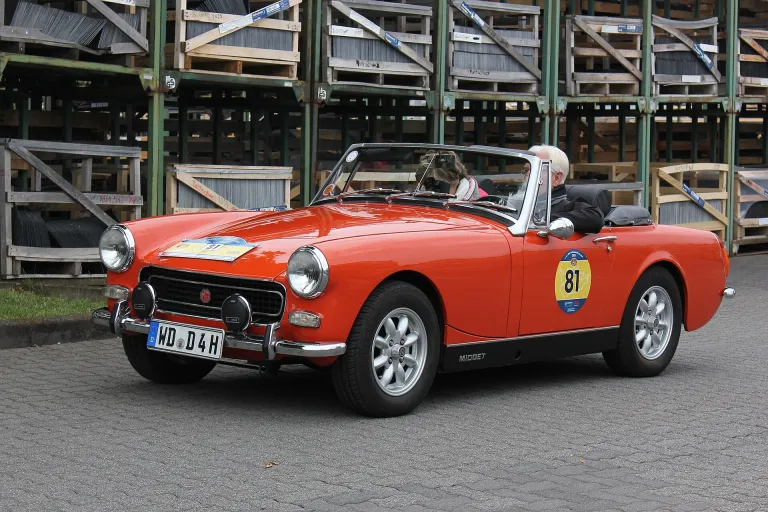
Midget Mk I-Mk III
- Power
- 48 kW65 PS
- Top speed
- -
- Kerb mass
- -
At a glance
Who suits what, worked out from the catalog figures of the versions above.
Categories won: Sprite Mk I Frogeye 0 Midget Mk I-Mk III 1
- City Too close to call Length: 3,493 mm vs 3,480 mm
- Off-road Midget Mk I-Mk III Drive and body: Rear-wheel drive · Roadster vs Rear-wheel drive · Roadster
Verdict Opinion
For the 1961-1971 cars the choice is mostly about badge, grille and trim, since the engines, gearboxes and bodies were shared. The Midget is easier to find because more were built, and its 1,275 cc Mk III is the strongest chrome-bumper car of either name.
The Frogeye is a separate case. It is slower, lighter and simpler than any Midget, and the market pays for its one-piece bonnet: the 2026 Frogeye average is more than twice the median Midget Mk I.
- Sarah Whitmore
The Austin-Healey Sprite came first. The Donald Healey Motor Company built it from Austin A35 and Morris Minor parts, BMC assembled it at Abingdon, and the press saw it in Monte Carlo on 20 May 1958 at a price of GBP 669. In 1961 the Sprite lost its upright Frogeye headlamps and gained a conventional body, and BMC launched the MG Midget as the same car with MG badges and trim. Enthusiasts have called the pair Spridgets ever since.
From 1961 to 1971 the real choice was between two grilles on one car. The differences that matter today lie elsewhere: the Frogeye has no twin, the Midget continued for eight years after the Sprite name ended, and the two use different Mark numbers for the same engines. This comparison sets the 948 cc Frogeye against the 1,275 cc Midget Mk III, the two versions buyers most often weigh up.
Austin-Healey Sprite vs MG Midget: what really differs
Mark numbers do not line up
Because the Sprite started three years earlier, its Mark numbers run one ahead. The Sprite Mk II of 1961 is the Midget Mk I, the Sprite Mk III of 1964 is the Midget Mk II, and the 1,275 cc Sprite Mk IV of 1966 matches the Midget Mk III.
Engines and power
The Frogeye's 948 cc A-series with twin SU carburettors gives 32 kW (43 bhp) at 5,200 rpm. The first Midget of 1961 had 34 kW (46 bhp) from the same capacity, and both cars moved to 1,098 cc and 42 kW (56 bhp) in October 1962, when front disc brakes also arrived. The 1,275 cc engine of the Sprite Mk IV and Midget Mk III makes 48 kW (65 bhp) at 6,000 rpm and 98 Nm. Only the Midget got the 1,493 cc Triumph engine of 1974-1979, rated at 48 kW (65 bhp) in the UK and 37 kW (50 bhp) in US form.
Body and chassis
The Frogeye's bonnet and wings lift as one piece, its headlamps sit on top, and it has no boot lid or exterior door handles. It is 3,493 mm long on a 2,032 mm wheelbase and weighs 664 kg, with quarter-elliptic rear springs. The Midget shares the wheelbase and measures 3,480 mm; early cars weigh about 735 kg. Wind-up windows and semi-elliptic rear springs came in 1964, and the 1500 gained large plastic-covered bumpers and a higher ride height for US impact rules.
Performance in period tests
The Motor recorded 133.4 km/h and 0-60 mph in 20.5 seconds for a Frogeye in 1958, with 43 mpg (6.6 L/100 km). Its 1962 test of a 948 cc Midget gave 141.5 km/h and 18.3 seconds. The 1,275 cc cars reach 60 mph in about 13 seconds and the Midget 1500 in about 12 seconds, with 161 km/h.
Production
BMC built 129,347 Sprites in four Marks, including 48,987 Frogeyes, and the last 1,022 of 1971 were badged simply Austin Sprite. Midget output reached about 226,400 by 7 December 1979, with 100,246 of the 1,275 cc Mk III alone. From 1961 the Midget outsold its twin: 152,528 Midgets to 1974 against 80,360 Sprites of Mk II to Mk IV.
Prices new and values in 2026
The Frogeye cost GBP 669 in 1958; The Motor's 948 cc Midget cost GBP 689 including taxes in 1962. Classics World quoted a Classic.com average of about GBP 14,600 for a Frogeye in spring 2026. British Classic Cars, using auction results to August 2026, gave medians of GBP 5,850 for a Midget Mk I, GBP 5,124 for a Mk III and GBP 3,656 for a 1500.
Size and weight
| Sprite Mk I Frogeye | Midget Mk I-Mk III | |
|---|---|---|
| Length | 3,493 mm137.5 in | 3,480 mm137.0 in † −13 mm −0.5 in −0.4% |
| Wheelbase | 2,032 mm80.0 in | 2,032 mm80.0 in † |
| Fits a standard garage? | Yes | No data |
Difference vs Sprite Mk I Frogeye (±). Garage check: a standard single garage takes a car up to about 5.0 m (16 ft 5 in) long and 1.9 m (6 ft 3 in) wide (width as listed in the catalog; some makers include the mirrors). Leave about 0.6 m (2 ft) to open the doors. † from another version of this generation.
Full specifications
| Austin-Healey Sprite | MG Midget | |
|---|---|---|
| General | ||
| Version | Sprite Mk I Frogeye · 948 Mk I · petrol · 32 kW (44 PS) | Midget Mk I-Mk III · Mk III 1275 (65 bhp) · petrol · 48 kW (65 PS) |
| Production years | 1958–1961 | 1961–1974 |
| Body | Roadster | Roadster |
| Class | Sports car | Sports car |
| Country | United Kingdom | United Kingdom |
| Performance | ||
| Power Why it matters: More power means stronger acceleration and easier overtaking, especially with a full load. | 32 kW (44 PS) 43 hp | 48 kW (65 PS) 64 hp Better |
| Power, all versions | 32–48 kW (44–65 PS) 43–64 hp | 34–48 kW (46–65 PS) 46–64 hp |
| Torque Why it matters: Torque is the pulling force you feel when accelerating from low revs, towing or climbing hills. | 70 Nm 52 lb-ft | 98 Nm 72 lb-ft Better |
| Top speed Why it matters: Top speed hints at how relaxed the car is at motorway speeds, even if you never reach it. | 133 km/h 83 mph | No data |
| Power per tonne | 48 kW/t 59 hp/ton calculated | No data |
| Engine and transmission | ||
| Fuel | Petrol | Petrol |
| Engine | 948 cc · 4 cyl 0.9 l | 1,275 cc · 4 cyl 1.3 l |
| Engine code | 9CC | No data |
| Gearbox | 4-speed manual | 4-speed manual |
| Drive | Rear-wheel drive | Rear-wheel drive |
| Dimensions and weight | ||
| Length | 3,493 mm 137.5 in | 3,480 mm 137.0 in † |
| Width | 1,346 mm 53.0 in | No data |
| Height | 1,264 mm 49.8 in | No data |
| Wheelbase | 2,032 mm 80.0 in | 2,032 mm 80.0 in † |
| Kerb weight Why it matters: A lighter car is usually more agile and uses less energy. | 664 kg 1,464 lb | No data |
These cars do not differ in the data we have.
Equal rows hidden (7): Body, Class, Country, Fuel, Gearbox, Drive, Wheelbase.
Better marks the stronger figure - only for measurable specs (power, torque, 0–100 km/h, consumption, boot, weight).
† from another version of this generation.
In plain words
MG Midget has more power: 48 kW (65 PS) against 32 kW (44 PS) for Austin-Healey Sprite. Austin-Healey Sprite is 13 mm longer than MG Midget (3,493 mm vs 3,480 mm). Austin-Healey Sprite is the older design (from 1958); MG Midget arrived in 1961. On the catalog figures, the MG Midget is the pick for off-road. Our catalog has no kerb mass for the MG Midget yet, so some checks above leave it out.
Which one to choose
Choose the Austin-Healey Sprite if you want the 1958 Frogeye shape, the lightest car of the family, or the Healey name on a 1961-1971 car.
Choose the MG Midget if you want the widest choice of cars and parts, the 1,275 cc Mk III at a lower price, or the later 1500 with more top speed. The Austin-Healey catalogue lists the big Healeys from the same factory.
Frequently asked questions
Is an Austin-Healey Sprite the same as an MG Midget?
From 1961 to 1971, yes in all but badges, grille and trim; both were built side by side at Abingdon. The 1958-1961 Frogeye Sprite has no Midget version, and the Midget 1500 of 1974-1979 has no Sprite version.
Which Sprite matches which Midget?
The Sprite Mk II matches the Midget Mk I, the Sprite Mk III the Midget Mk II and the 1,275 cc Sprite Mk IV the Midget Mk III. The Frogeye Mk I came three years before the first Midget.
Why did the Sprite end before the Midget?
British Leyland stopped paying royalties to the Donald Healey Motor Company in 1971. The last 1,022 cars were sold as Austin Sprites, while the MG Midget continued until December 1979.
Which is worth more today?
The Frogeye. Classics World quoted a Classic.com average of about GBP 14,600 in spring 2026, while British Classic Cars gave a median of GBP 5,850 for a Midget Mk I and GBP 5,124 for a Mk III in September 2026.