
 Honda Fit
Specs, engines and history
Published Sources (5) Report an error
By Sarah Whitmore, Senior Automotive Writer
- Built
- 2001–present
- Top power
- 90 kW (122 PS)
- Euro NCAP
- 5 stars · 2020
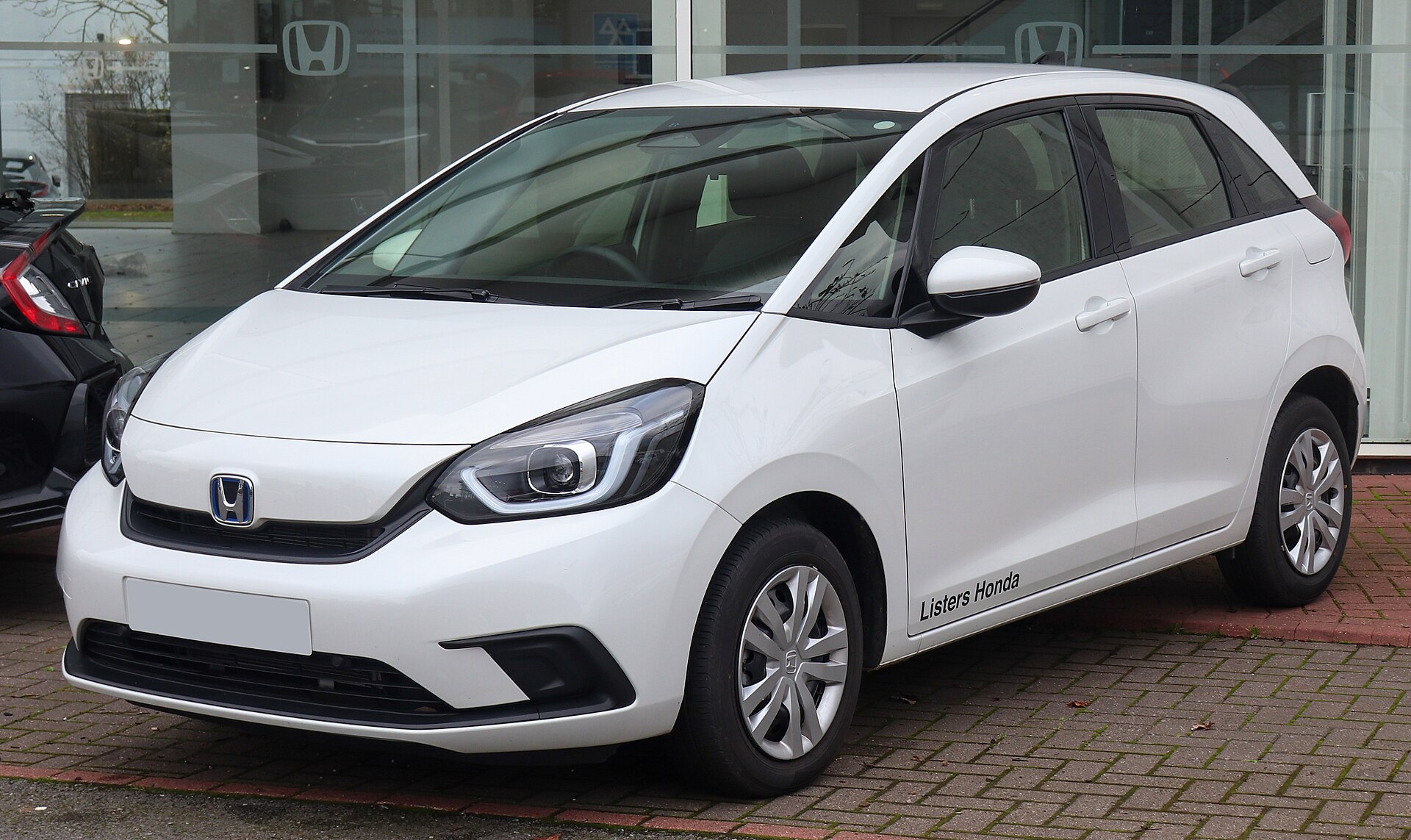
The Honda Jazz, sold as the Fit in Japan and the Americas, is a small five-door hatchback that Honda has built since 2001. The fourth generation was unveiled on 23 October 2019 and reached European showrooms in June 2020. In Europe it is sold only as the 1.5-litre e:HEV full hybrid, in hatchback and raised Crosstar form, and it gained 10 kW in a 2023 update.
In short
- Four generations since 2001; the current one (codes GR and GS) went on sale in Japan on 13 February 2020.
- European Jazz e:HEV since 2023: 90 kW (122 PS) electric motor, 253 Nm, 1.5 petrol engine with 79 kW (107 PS).
- 4,089 mm long with a 304-litre boot and 1,205 litres with the rear seats folded.
- German list price from EUR 29,300 for the Jazz Advance (ADAC, March 2023); five Euro NCAP stars in 2020.
Size at a glance
| Dimensions | Honda Fit / Jazz GR |
|---|---|
| Length | 4,089 mm161.0 in |
| Width | 1,694 mm66.7 in |
| Height | 1,526 mm60.1 in |
| Wheelbase | 2,517 mm99.1 in |
| Boot | 304 L10.7 cu ft |
Running cost
Fuel · Fit GR Jazz 1.5 e:HEV (2023)
about 1,200 EUR fuel a year at 15,000 km
4.6 l/100 km · petrol at 1.75 EUR/l · change mileage, fuel price or version
Specs by version
Engines
| Version | Engine | Power | Torque | Gearbox | Drive | Production years |
|---|---|---|---|---|---|---|
| Jazz 1.5 e:HEV (2020) | 1.5 l · 4 cyl · Hybrid 1,498 cc | 80 kW 109 PS107 hp | 253 Nm187 lb-ft | Single-speed | Front-wheel drive | 2020–2023 |
| Jazz 1.5 e:HEV (2023) | 1.5 l · 4 cyl · Hybrid 1,498 cc | 90 kW 122 PS121 hp | 253 Nm187 lb-ft | Single-speed | Front-wheel drive | 2023 |
| Jazz Crosstar 1.5 e:HEV (2023) | 1.5 l · 4 cyl · Hybrid 1,498 cc | 90 kW 122 PS121 hp | 253 Nm187 lb-ft | Single-speed | Front-wheel drive | 2023 |
Performance
Show all 3 versions
| Version | 0–100 km/h | Top speed | Fuel consumption | CO₂ |
|---|---|---|---|---|
| Jazz 1.5 e:HEV (2020) | - | - | 4.5 l/100 km52.3 mpg US · 62.8 mpg UK | 102 g/km |
| Jazz 1.5 e:HEV (2023) | 9.6 s 0–62 mph | 175 km/h109 mph | 4.6 l/100 km51.1 mpg US · 61.4 mpg UK | 104 g/km |
| Jazz Crosstar 1.5 e:HEV (2023) | 9.7 s 0–62 mph | 175 km/h109 mph | 4.8 l/100 km49.0 mpg US · 58.9 mpg UK | 108 g/km |
Dimensions and weight
Show all 2 versions
| Version | Length | Width | Height | Wheelbase | Kerb weight | Boot | Fuel tank |
|---|---|---|---|---|---|---|---|
| Jazz 1.5 e:HEV (2023) | 4,089 mm161.0 in | 1,694 mm66.7 in | 1,526 mm60.1 in | 2,517 mm99.1 in | 1,230 kg2,712 lb | 304 l10.7 cu ft | 40 l10.6 gal US |
| Jazz Crosstar 1.5 e:HEV (2023) | 4,105 mm161.6 in | - | 1,556 mm61.3 in | 2,520 mm99.2 in | - | 304 l10.7 cu ft | 40 l10.6 gal US |
Verified Manufacturer and type-approval data from our catalog · Sources and methodology
Safety
-
Euro NCAP 2020
Full Euro NCAP result
Stars from different years and organisations are not directly comparable: test protocols change every few years.
Honda Jazz e:HEV at a glance
| Specification | Honda Jazz e:HEV (fourth generation) |
|---|---|
| Body and segment | five-door supermini (B segment); Crosstar with raised styling |
| Production start | Japan February 2020; Europe from June 2020; built at Suzuka, Japan, and in China |
| Name | Jazz in Europe, Fit in Japan and China |
| Drive | front-wheel drive, e:HEV two-motor hybrid with fixed gear |
| Power (Europe, 2023) | 90 kW (122 PS) motor, 253 Nm; petrol engine 79 kW (107 PS), 131 Nm |
| Consumption (WLTP) | 4.5 l/100 km (2020); 4.6 l/100 km Advance, 4.8 l/100 km Crosstar (2023) |
| Top speed | 175 km/h |
| Length / wheelbase | 4,089 / 2,517 mm (Crosstar 4,105 / 2,520 mm) |
| Boot | 304 l, 1,205 l with rear seats folded |
| Fuel tank / towing | 40 l / 500 kg |
| Euro NCAP | five stars (2020) |
| Price from | EUR 29,300 in Germany in 2023 (Advance) |
Jazz or Fit: one car, four generations
Honda showed the first Fit in Japan in June 2001, and the car arrived in Europe as the Jazz in 2002. Its trick was the fuel tank under the front seats, which left room for rear seats that fold flat or flip their cushions up. The second generation (GE) followed in October 2007, the third (GK) went on sale in Japan on 5 September 2013, and the fourth was revealed at the 2019 Tokyo Motor Show.
| Generation | Codes | Years | Europe |
|---|---|---|---|
| First | GD | 2001-2007 | Jazz from 2002 |
| Second | GE | 2007-2013 | Jazz |
| Third | GK, GP | 2013-2020 | Jazz, petrol only |
| Fourth | GR, GS | since 2019 | Jazz e:HEV and Jazz Crosstar, hybrid only |
The catalogue keeps the car under its Japanese name, Fit, while this page uses Jazz because that is the badge on every European car. The Fit's main rival at home, the Toyota Vitz, was sold in Europe as the Yaris, and the two have competed for two decades.

How the e:HEV hybrid works
The fourth Jazz replaced the i-DCD hybrid of the Japanese Fit with the i-MMD system, which Honda calls e:HEV. A 1.5-litre Atkinson-cycle petrol engine mostly drives a generator, while a separate electric motor turns the front wheels. At higher speeds a clutch can link the engine directly to the wheels. There is no conventional gearbox.
In the 2020 launch version the motor gave 80 kW (109 PS) and 253 Nm. Honda raised it to 90 kW (122 PS) for the 2023 model year, and the petrol engine went up by 7 kW to 79 kW (107 PS) with 131 Nm. Torque at the wheels stayed at 253 Nm. The claimed WLTP figure for the 2020 car was 4.5 l/100 km and 102 g/km of CO2.
Japan also offers the Fit with a 1.3-litre petrol engine of 72 kW (98 PS), and the e:HEV accounted for 72% of Japanese orders by March 2020. In Europe the Jazz has been hybrid-only since the fourth generation.
Versions in Europe
| Version | Engine | Power | WLTP consumption | 0-100 km/h |
|---|---|---|---|---|
| Jazz e:HEV (2020-2023) | 1.5 i-MMD hybrid | 80 kW (109 PS) | 4.5 l/100 km | - |
| Jazz e:HEV Elegance (2023) | 1.5 i-MMD hybrid | 90 kW (122 PS) | 4.5 l/100 km (62.8 mpg UK) | 9.4 s |
| Jazz e:HEV Advance (2023) | 1.5 i-MMD hybrid | 90 kW (122 PS) | 4.6 l/100 km | 9.6 s |
| Jazz e:HEV Advance Sport (2023) | 1.5 i-MMD hybrid | 90 kW (122 PS) | 4.8 l/100 km (58.9 mpg UK) | 9.6 s |
| Jazz Crosstar Advance (2023) | 1.5 i-MMD hybrid | 90 kW (122 PS) | 4.8 l/100 km | 9.7 s |
The 0-100 km/h times are Honda UK's 0-62 mph figures. Advance Sport, new for 2023, is the only version with a Sport drive mode and has its own bumper, gloss black mirrors and 16-inch wheels. The 2023 update also changed the springs: 8% softer at the front and 20% firmer at the rear.
Jazz Crosstar: the raised version
The Crosstar is the Jazz with a honeycomb grille, side cladding and roof rails. Honda UK gives it 4,105 mm of length and a 2,520 mm wheelbase; ADAC lists 1,556 mm of height against 1,526 mm for the hatchback. The boot volume is the same 304 litres.
The extra height and wider tyres cost a little efficiency. The 2023 Crosstar Advance is rated at 4.8 l/100 km and 108 g/km, against 4.6 l/100 km for the Jazz Advance. In Germany ADAC listed the Crosstar Advance at EUR 30,500 in 2023, EUR 1,200 more than the equivalent hatchback. Its exclusive paint was Fjord Mist Blue.

Space, safety and test results
At 4,089 mm (161.0 in) the Jazz is a short car with a tall roof of 1,526 mm. Honda quotes 304 l of boot and 1,205 l to the roof with the rear seats folded. ADAC measured 260 l and 1,200 l, and the hinged rear cushions leave a tall load space behind the front seats. The fuel tank holds 40 l, which gave ADAC a range of 780 km in the earlier Executive test car. Since 2023 the Jazz may tow 500 kg.
Euro NCAP gave the Jazz five stars in November 2020: 87% for adult occupants, 83% for child occupants, 80% for vulnerable road users and 76% for safety assist. It has a front centre airbag that protects the driver and passenger from each other in far-side impacts. In 2023 Traffic Jam Assist was extended to work from standstill.
ADAC rated the Crosstar Advance 2.4 overall and the pre-facelift Executive 2.3. Its Ecotest gave the hybrid four of five stars with 5.1 l/100 km for the Jazz and 5.3 l/100 km for the Crosstar.
Prices and which Jazz to choose
In Germany the Jazz Advance cost from EUR 29,300 and the Crosstar Advance from EUR 30,500 in March 2023, according to ADAC. Honda UK lists the Jazz Elegance at GBP 28,475, the Advance at GBP 29,715, the Advance Sport at GBP 30,995 and the Crosstar Advance at GBP 30,795 in November 2026.
- Elegance: the lowest consumption and the quickest 0-62 mph time of the range, 9.4 seconds.
- Advance: more equipment for about GBP 1,240 more in the UK.
- Advance Sport: the version for drivers who want a Sport mode.
- Crosstar: for rough roads and a higher seating position, at a small cost in economy.
Small hybrid rivals include the MG3 Hybrid+, while buyers who need more height can step up to the Honda HR-V, which uses the same e:HEV principle. Every model is listed in the Honda catalogue.
Photo gallery

Honda Fit in our rankings
- No. 12 of 234 · Smallest SUVs and crossovers (4,105 mm · top 6%)
- No. 35 of 338 · Most economical cars (4.5 l/100 km · top 12%)
- No. 93 of 625 · Smallest cars (4,089 mm · top 15%)
- No. 17 of 117 · Most economical SUVs and crossovers (4.8 l/100 km · top 18%)
- No. 114 of 482 · Lightest cars (1,230 kg · top 24%)
- No. 22 of 62 · Most economical hatchbacks (4.5 l/100 km · top 39%)
Shorter than 94% of ranked SUVs and crossovers in the 1CARS catalog (No. 12 of 234).
FAQ
Is the Honda Jazz the same car as the Honda Fit?
Yes. Honda sells the same small hatchback as the Fit in Japan, China and the Americas and as the Jazz in Europe, Australia and parts of Asia. The current fourth generation was unveiled in October 2019 under both names.
Is the Honda Jazz a plug-in hybrid?
No. The Jazz e:HEV is a full hybrid that charges its battery while driving. A 1.5-litre petrol engine powers a generator, and a 90 kW (122 PS) electric motor drives the front wheels in the 2023 version.
How big is the Jazz boot?
Honda quotes 304 litres with the rear seats up and 1,205 litres to the roof with them folded. ADAC measured 260 litres. The Crosstar has the same boot.
What is the difference between the Jazz and the Jazz Crosstar?
The Crosstar has a raised body, honeycomb grille, side cladding and roof rails. It is 16 mm longer in Honda UK figures and uses 4.8 l/100 km against 4.6 l/100 km for the Jazz Advance.
How safe is the Honda Jazz?
Euro NCAP awarded five stars in 2020, with 87% for adult occupant protection. A front centre airbag between the front seats is standard.
Data sources
Data checked by an editor against the sources below.
- Wikipedia - Honda Fit
- 1cars
- Motor1 - Honda Jazz Facelift Hybrid 2023
- Co - Specifications
- ADAC - Honda Jazz


