
 Smart #3
Specs, engines and history
Published Sources (2) Report an error
By Felix Hartmann, Automotive Technology & EV Contributor
- Built
- 2023–present
- Top power
- 315 kW (428 PS)
Which Smart #3 to choose
Our verdict · Felix Hartmann
The Pro+ is the most balanced version: for EUR 5,000 more than the Pro in ADAC's 2026 list it adds 110 km of WLTP range, 150 kW DC charging and 22 kW AC charging. The Pro suits drivers with short daily distances who charge at home. The Brabus reaches 100 km/h in 3.7 seconds and adds all-wheel drive, but it gives up 40 km of range compared with the Premium and costs EUR 8,350 more than the Pro+ in ADAC's 2026 list. A facelift is planned for 2027; Smart's Europe chief said in September 2025 that it would be more extensive than the 2026 model-year update, without naming details. All current and earlier Smart models are listed in the Smart catalogue.
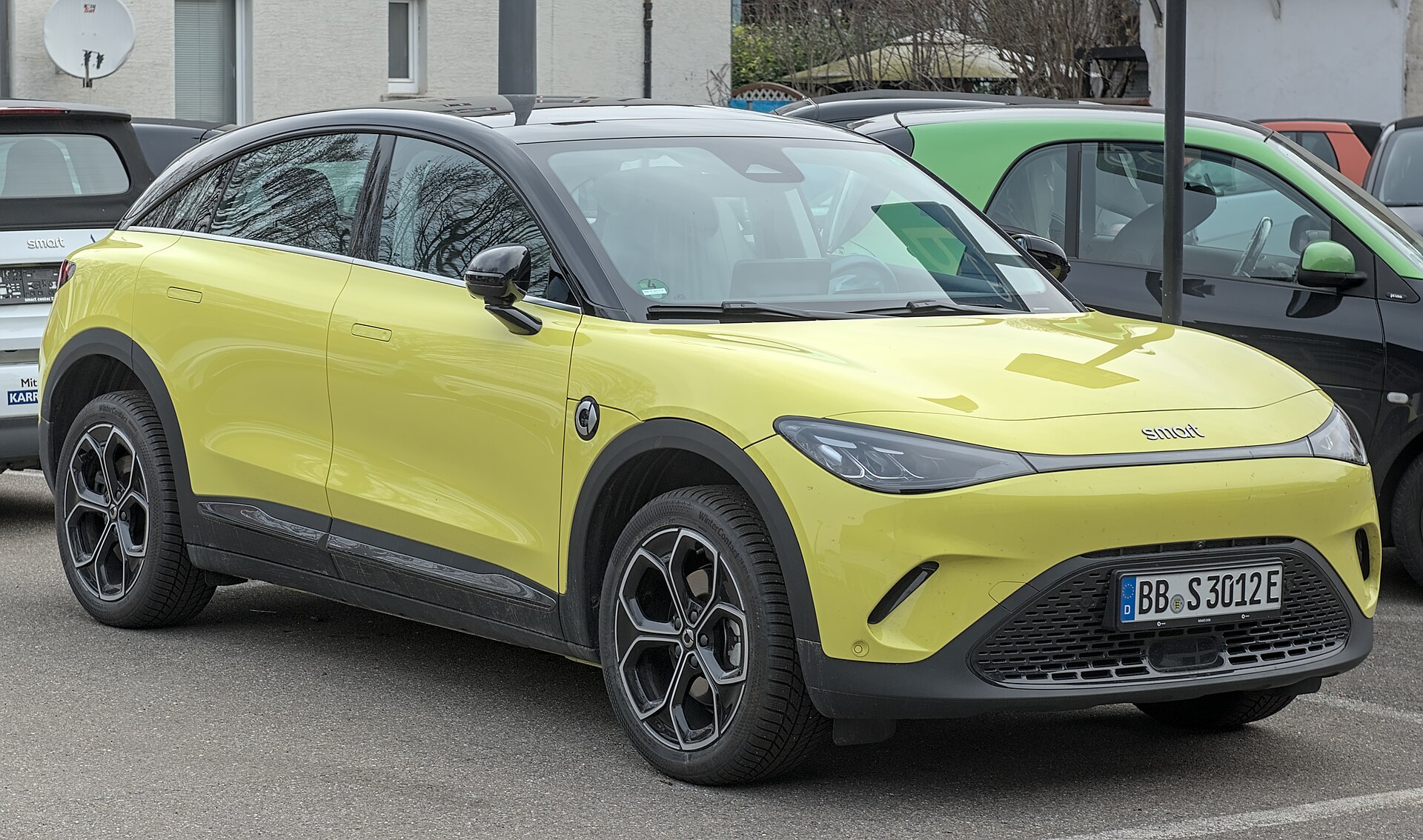
The Smart #3 is an electric coupé-styled compact crossover from Smart Automobile, the joint venture of Mercedes-Benz Group and Geely. Revealed at Auto Shanghai on 17 April 2023 and on sale in Germany since December 2023, it uses Geely's SEA platform and is closely related to the Smart #1. The #3 offers 200 kW (272 PS) as standard and 315 kW (428 PS) as a Brabus.
In short
- Revealed 17 April 2023 in Shanghai, European premiere at the IAA Munich in September 2023; built in Xi'an, China.
- Batteries of 49 kWh (LFP) or 66 kWh (NMC) gross; WLTP range 325-455 km (202-283 miles).
- Rear-wheel drive with 200 kW (272 PS), or all-wheel drive Brabus with 315 kW (428 PS) and 0-100 km/h in 3.7 seconds.
- Euro NCAP five stars (2023); ADAC lists German prices from EUR 41,140 for the #3 Pro.
Size at a glance
| Dimensions | Smart #3 I |
|---|---|
| Length | 4,400 mm173.2 in |
| Width | 1,844 mm72.6 in |
| Height | 1,556 mm61.3 in |
| Wheelbase | 2,785 mm109.6 in |
| Boot | 370 L13.1 cu ft |
Specs by version
Engines
| Version | Engine | Power | Torque | Gearbox | Drive | Production years |
|---|---|---|---|---|---|---|
| Pro | Electric | 200 kW 272 PS268 hp | 343 Nm253 lb-ft | 1-sp Single-speed | Rear-wheel drive | 2023 |
| Pro+ | Electric | 200 kW 272 PS268 hp | 343 Nm253 lb-ft | 1-sp Single-speed | Rear-wheel drive | 2023 |
| Premium | Electric | 200 kW 272 PS268 hp | 343 Nm253 lb-ft | 1-sp Single-speed | Rear-wheel drive | 2023 |
| Brabus | Electric | 315 kW 428 PS422 hp | 543 Nm400 lb-ft | 1-sp Single-speed | All-wheel drive | 2023 |
Performance
Show all 4 versions
| Version | 0–100 km/h | Top speed | Fuel consumption | Range |
|---|---|---|---|---|
| Pro | 5.8 s 0–62 mph | 180 km/h112 mph | 17.2 kWh/100 km27.7 kWh/100 mi | 325 km202 mi |
| Pro+ | 5.8 s 0–62 mph | 180 km/h112 mph | 16.8 kWh/100 km27.0 kWh/100 mi | 435 km270 mi |
| Premium | 5.8 s 0–62 mph | 180 km/h112 mph | 16.3 kWh/100 km26.2 kWh/100 mi | 455 km283 mi |
| Brabus | 3.7 s 0–62 mph | 180 km/h112 mph | 17.6 kWh/100 km28.3 kWh/100 mi | 415 km258 mi |
Dimensions and weight
Show all 4 versions
| Version | Length | Width | Height | Wheelbase | Kerb weight | Boot | Battery |
|---|---|---|---|---|---|---|---|
| Pro | 4,400 mm173.2 in | 1,844 mm72.6 in | 1,556 mm61.3 in | 2,785 mm109.6 in | 1,780 kg3,924 lb | 370 l13.1 cu ft | 47 kWh |
| Pro+ | 4,400 mm173.2 in | 1,844 mm72.6 in | 1,556 mm61.3 in | 2,785 mm109.6 in | 1,780 kg3,924 lb | 370 l13.1 cu ft | 62 kWh |
| Premium | 4,400 mm173.2 in | 1,844 mm72.6 in | 1,556 mm61.3 in | 2,785 mm109.6 in | - | 370 l13.1 cu ft | 62 kWh |
| Brabus | 4,400 mm173.2 in | 1,844 mm72.6 in | 1,556 mm61.3 in | 2,785 mm109.6 in | 1,910 kg4,211 lb | 370 l13.1 cu ft | 62 kWh |
Verified Manufacturer and type-approval data from our catalog · Sources and methodology
Smart #3 at a glance
| Specification | Smart #3 |
|---|---|
| Segment / body | compact crossover with coupé roofline, five doors |
| Production | since June 2023, Xi'an, China |
| Platform | Geely Sustainable Experience Architecture (SEA) |
| Drive | rear-wheel drive; Brabus all-wheel drive with two motors |
| Power | 200 kW (272 PS) or 315 kW (428 PS) |
| Battery | 49 kWh LFP (47 kWh usable) or 66 kWh NMC (62 kWh usable) |
| WLTP range | 325-455 km (202-283 miles) |
| Charging | 130 kW (LFP) or 150 kW (NMC) DC; 7.2 or 22 kW AC |
| Length / wheelbase | 4,400 mm (173.2 in) / 2,785 mm (109.6 in) |
| Boot | 370 l plus 15 l front compartment; 1,160 l maximum |
| Euro NCAP | five stars (2023) |
| Price from | EUR 41,140, #3 Pro, Germany (ADAC, November 2026) |
How the #3 differs from the Smart #1
Smart's model line has moved far from the two-seat city car described in the Smart ForTwo guide. Since 2020 the brand has been a joint venture of Mercedes-Benz Group and Geely, and its cars are developed and built in China on Geely's SEA architecture, as the history of Smart explains. The #1 was the first model; the #3 followed in April 2023 as a lower, longer version with a sloping roof.
The #3 is 4,400 mm (173.2 in) long, 1,844 mm wide and 1,556 mm tall, on a 2,785 mm wheelbase. Its drag coefficient of 0.27 helps the range: with the same 66 kWh battery the #3 Premium is rated at 455 km WLTP. The Chinese name is Smart Jingling #3, and Wikipedia lists the Xi'an plant in Shaanxi province as the place of assembly.
Versions, batteries and outputs
| Version | Battery (gross, chemistry) | Power / torque | WLTP range | 0-100 km/h | Weight (EU) |
|---|---|---|---|---|---|
| #3 Pro | 49 kWh, LFP | 200 kW (272 PS) / 343 Nm | 325 km | 5.8 s | 1,780 kg |
| #3 Pro+ | 66 kWh, NMC | 200 kW (272 PS) / 343 Nm | 435 km | 5.8 s | 1,780 kg |
| #3 Premium | 66 kWh, NMC | 200 kW (272 PS) / 343 Nm | 455 km | 5.8 s | about 1,800 kg |
| #3 Brabus | 66 kWh, NMC | 315 kW (428 PS) / 543 Nm | 415 km | 3.7 s | 1,910 kg |
All versions reach 180 km/h (112 mph). The single rear motor is a permanently excited synchronous unit; the Brabus adds a 115 kW (156 PS) front motor for all-wheel drive. A 25th Anniversary Edition with Premium equipment and Brabus styling was offered at the launch and listed by ADAC until April 2026; later special models included a Keith Haring Edition from September 2025 and a Pro+ Black Collection from August 2026.

Charging, consumption and real range
The LFP battery of the #3 Pro charges at up to 130 kW DC and 7.2 kW AC. The NMC versions accept 150 kW DC and, from the Pro+ upwards, 22 kW AC, which fills the battery in about 180 minutes. Smart and ADAC quote about 30 minutes from 10 to 80 percent for both batteries. WLTP consumption ranges from 16.8 kWh/100 km for the Pro+ to 17.6 kWh/100 km for the Brabus.
ADAC tested the #3 Premium in July 2025. It recorded 18.2 kWh/100 km in the Ecotest, including charging losses, and a real range of 410 km (255 miles) against the 455 km WLTP figure. On a fast charger the car briefly exceeded its 150 kW peak but fell below 100 kW at about 55 percent, and it added 250 km of range in 20 minutes. ADAC gave an overall grade of 1.9.
Boot space, towing and safety
The boot is the #3's weak point. Smart quotes 370 litres (13.1 cu ft) plus a 15-litre front compartment, and 1,160 litres (41.0 cu ft) with the rear seat folded. ADAC measured only 255 litres to the window line, 685 litres with the seat folded and 1,170 litres to the roof, and it called the boot small. The NMC versions may tow 1,600 kg (3,527 lb) braked.
Euro NCAP awarded the #3 five stars in 2023 after testing the Pro+: 90 percent for adult occupants, 86 percent for children, 84 percent for vulnerable road users and 85 percent for safety assist. Standard equipment from the Pro+ includes a highway assistant, a traffic-jam assistant and a 12.8-inch central display, according to the September 2023 launch information.
Prices and rivals
| Version | German list price at launch (Sept 2023) | ADAC catalogue (November 2026) |
|---|---|---|
| #3 Pro | not offered | EUR 41,140 |
| #3 Pro+ | EUR 43,490 | EUR 46,140 |
| #3 Premium | EUR 46,490 | not checked |
| #3 Brabus | EUR 50,990 | EUR 54,490 |
ADAC's July 2025 test quoted EUR 48,490 for the Premium and EUR 53,490 for the Brabus. The closest relative among rivals is the Volvo EX30, which uses the SEA2 development of the same Geely platform. It is shorter at 4,233 mm, offers 51 or 69 kWh batteries and up to 315 kW in its Twin Motor Performance version, and charges at up to 153 kW. A larger coupé-SUV built in China is the Cupra Tavascan: made in Hefei on Volkswagen's MEB platform, it is 4,644 mm long and carries an 82 kWh battery.
Photo gallery


Smart #3 in our rankings
- No. 13 of 150 · Quickest SUVs and crossovers, 0–100 (3.7 s · top 10%)
- No. 13 of 100 · Quickest electric cars, 0–100 (3.7 s · top 14%)
- No. 29 of 203 · Quickest cars of the 2020s, 0–100 (3.7 s · top 15%)
- No. 24 of 170 · Power-to-weight: SUVs and crossovers (165 kW/t · top 15%)
- No. 61 of 410 · Quickest cars, 0–100 (3.7 s · top 16%)
- No. 20 of 104 · Quickest German cars, 0–100 (3.7 s · top 20%)
Quicker from 0 to 100 km/h than 90% of ranked SUVs and crossovers in the 1CARS catalog (No. 13 of 150).
FAQ
What is the range of the Smart #3?
The Smart #3 Pro with the 49 kWh LFP battery has 325 km WLTP. With the 66 kWh NMC battery the Pro+ reaches 435 km, the Premium 455 km and the Brabus 415 km. ADAC measured 410 km in real driving with the Premium.
Is the Smart #3 bigger than the Smart #1?
Yes. The #3 is the longer and lower of the two, with a coupé roofline, a length of 4,400 mm and a 2,785 mm wheelbase. Both models share Geely's SEA platform and are built in China by the Mercedes-Benz and Geely joint venture.
How fast does the Smart #3 charge?
The NMC versions charge at up to 150 kW DC and the LFP-equipped Pro at 130 kW, with about 30 minutes from 10 to 80 percent. From the Pro+ upwards the #3 accepts 22 kW AC.
Who makes the Smart #3?
The #3 is made by Smart Automobile, a joint venture of Mercedes-Benz Group and Geely. It is built in Xi'an, China, on Geely's SEA platform, and European sales began in December 2023 in Germany and early 2024 elsewhere.
Data sources
Data checked by an editor against the sources below.
- Wikipedia - Smart 3
- ADAC


