
 Cupra Terramar
Specs, engines and history
Published Sources (3) Report an error
By Oleksandr Hnatiuk, Automotive Editor & Used Car Specialist
- Built
- 2024–present
- Top power
- 200 kW (272 PS)
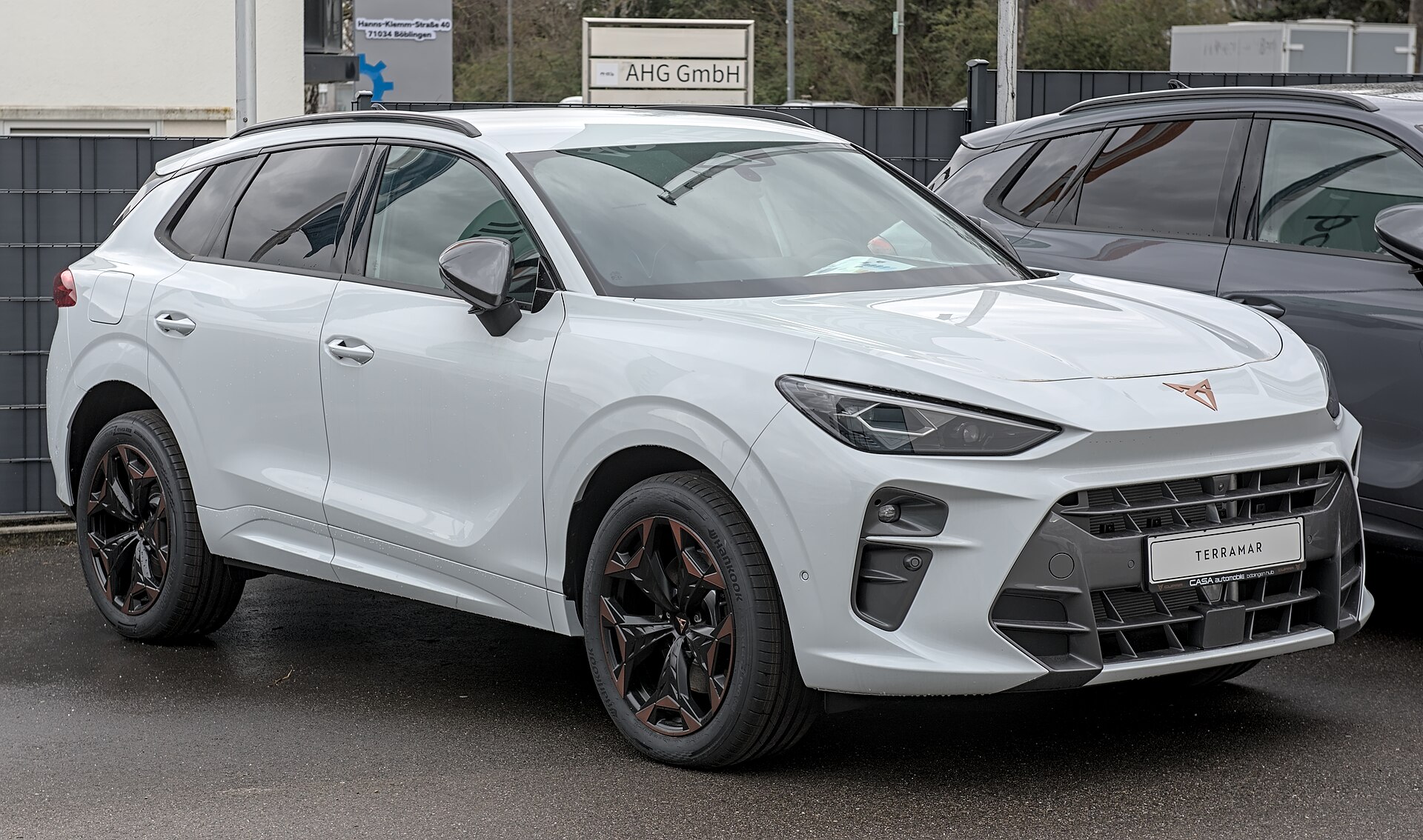
The Cupra Terramar is a 4.52-metre family SUV with petrol, mild-hybrid and plug-in hybrid engines, revealed in Barcelona in September 2024. It is the first Cupra built by Audi: production runs at Audi Hungaria in Győr alongside the Audi Q3, on the Volkswagen Group's MQB Evo platform. Outputs range from 110 kW (150 PS) to 200 kW (272 PS).
In short
- Compact SUV of 4,519 mm, built in Győr, Hungary, since September 2024; first customer cars in November 2024.
- Engines: 1.5 eTSI mild hybrid, 2.0 TSI with 4Drive all-wheel drive, and 1.5 e-Hybrid plug-in with 150 kW (204 PS) or 200 kW (272 PS).
- Plug-in versions carry a 19.7 kWh net battery for up to 118 km of WLTP electric range in ADAC's 2026 listings.
- Five Euro NCAP stars (2025); German prices from EUR 45,280 in 2026.
Size at a glance
| Dimensions | Cupra Terramar KP |
|---|---|
| Length | 4,519 mm177.9 in |
| Width | 1,869 mm73.6 in |
| Height | 1,586 mm62.4 in |
| Wheelbase | 2,681 mm105.6 in |
| Boot | 540 L19.1 cu ft |
Running cost
Fuel · Terramar KP 1.5 eTSI 150 DSG
about 1,600 EUR fuel a year at 15,000 km
6.1 l/100 km · petrol at 1.75 EUR/l · change mileage, fuel price or version
Specs by version
Engines
| Version | Engine | Power | Torque | Gearbox | Drive | Production years |
|---|---|---|---|---|---|---|
| Plug-in hybrid · 2 versions | ||||||
| 1.5 e-Hybrid 204 DSG | 1.5 l · 4 cyl · Plug-in hybrid 1,498 cc | 150 kW 204 PS201 hp | 350 Nm258 lb-ft | 6-sp Dual-clutch | Front-wheel drive | 2024 |
| 1.5 e-Hybrid VZ 272 DSG | 1.5 l · 4 cyl · Plug-in hybrid 1,498 cc | 200 kW 272 PS268 hp | 400 Nm295 lb-ft | 6-sp Dual-clutch | Front-wheel drive | 2024 |
| Petrol · 4 versions | ||||||
| 1.5 eTSI 150 DSG | 1.5 l · 4 cyl · Petrol 1,498 cc | 110 kW 150 PS148 hp | 250 Nm184 lb-ft | 7-sp Dual-clutch | Front-wheel drive | 2024–2026 |
| 1.5 eTSI 160 DSG | Petrol | 118 kW 160 PS158 hp | - | Dual-clutch | Front-wheel drive | 2026 |
| 2.0 TSI 4Drive DSG | 2.0 l · 4 cyl · Petrol 1,984 cc | 150 kW 204 PS201 hp | 320 Nm236 lb-ft | 7-sp Dual-clutch | All-wheel drive | 2024 |
| 2.0 TSI VZ 4Drive DSG | 2.0 l · 4 cyl · Petrol 1,984 cc | 195 kW 265 PS261 hp | 400 Nm295 lb-ft | 7-sp Dual-clutch | All-wheel drive | 2024 |
Performance
Show all 5 versions
| Version | 0–100 km/h | Top speed | Fuel consumption | Range | CO₂ |
|---|---|---|---|---|---|
| Plug-in hybrid · 2 versions | |||||
| 1.5 e-Hybrid 204 DSG | 8.3 s 0–62 mph | 205 km/h127 mph | 1.6 l/100 km147.0 mpg US · 176.6 mpg UK | 118 km73 mi | 36 g/km |
| 1.5 e-Hybrid VZ 272 DSG | 7.3 s 0–62 mph | 215 km/h134 mph | 1.6 l/100 km147.0 mpg US · 176.6 mpg UK | 118 km73 mi | 37 g/km |
| Petrol · 3 versions | |||||
| 1.5 eTSI 150 DSG | 9.3 s 0–62 mph | 205 km/h127 mph | 6.1 l/100 km38.6 mpg US · 46.3 mpg UK | - | 139 g/km |
| 2.0 TSI 4Drive DSG | 7.1 s 0–62 mph | 225 km/h140 mph | 7.5 l/100 km31.4 mpg US · 37.7 mpg UK | - | 171 g/km |
| 2.0 TSI VZ 4Drive DSG | 5.9 s 0–62 mph | 243 km/h151 mph | 8.4 l/100 km28.0 mpg US · 33.6 mpg UK | - | 191 g/km |
Dimensions and weight
Show all 5 versions
| Version | Length | Width | Height | Wheelbase | Kerb weight | Boot | Fuel tank | Battery |
|---|---|---|---|---|---|---|---|---|
| Plug-in hybrid · 2 versions | ||||||||
| 1.5 e-Hybrid 204 DSG | 4,519 mm177.9 in | 1,869 mm73.6 in | 1,586 mm62.4 in | 2,681 mm105.6 in | 1,898 kg4,184 lb | 450 l15.9 cu ft | 45 l11.9 gal US | 20 kWh |
| 1.5 e-Hybrid VZ 272 DSG | 4,519 mm177.9 in | 1,869 mm73.6 in | 1,586 mm62.4 in | 2,681 mm105.6 in | 1,904 kg4,198 lb | 450 l15.9 cu ft | 45 l11.9 gal US | 20 kWh |
| Petrol · 3 versions | ||||||||
| 1.5 eTSI 150 DSG | 4,519 mm177.9 in | 1,869 mm73.6 in | 1,586 mm62.4 in | 2,681 mm105.6 in | 1,638 kg3,611 lb | 540 l19.1 cu ft | 55 l14.5 gal US | - |
| 2.0 TSI 4Drive DSG | 4,519 mm177.9 in | 1,869 mm73.6 in | 1,586 mm62.4 in | 2,681 mm105.6 in | 1,740 kg3,836 lb | 540 l19.1 cu ft | 60 l15.9 gal US | - |
| 2.0 TSI VZ 4Drive DSG | 4,519 mm177.9 in | 1,869 mm73.6 in | 1,586 mm62.4 in | 2,681 mm105.6 in | 1,750 kg3,858 lb | 540 l19.1 cu ft | 60 l15.9 gal US | - |
Verified Manufacturer and type-approval data from our catalog · Sources and methodology
Cupra Terramar at a glance
| Specification | Cupra Terramar |
|---|---|
| Segment / body | compact SUV (C-SUV), five doors, five seats |
| Production | from September 2024, Audi Hungaria, Győr, Hungary |
| Platform | Volkswagen Group MQB Evo |
| Drive | front-wheel drive, or 4Drive all-wheel drive on the 2.0 TSI |
| Power | 110-200 kW (150-272 PS) |
| Engines | 1.5 eTSI, 2.0 TSI, 1.5 e-Hybrid plug-in |
| Consumption (WLTP) | 6.1 l/100 km (1.5 eTSI) to 8.4 l/100 km (2.0 TSI VZ) |
| Electric range (PHEV) | up to 118 km WLTP |
| Length / wheelbase | 4,519 mm (177.9 in) / 2,681 mm (105.6 in) |
| Boot | 540 l (petrol), 450 l (plug-in hybrid) |
| Euro NCAP | five stars (2025) |
| Price from | EUR 45,280 (Germany, 2026) |
A Cupra named after a race track, built by Audi
Cupra presented the Terramar in early September 2024 at the America's Cup in Barcelona's harbour, and production began at Győr the same month. The name comes from the Terramar circuit in Sitges, where Cupra was launched as a brand in 2018. In the range it replaces the Cupra Ateca as the brand's mid-size SUV and sits above the Cupra Formentor; all current models are in the Cupra catalogue.
Győr builds more than 1.6 million engines and over 170,000 vehicles a year, and the Terramar is the first car the plant builds for a sister brand of Audi. Cupra's design team in Barcelona styled the car under design director Jorge Díez. A limited America's Cup edition of 1,337 cars marked the launch.
Shared hardware: Q3, Tiguan and Kodiaq
Under the skin the Terramar uses the updated MQB Evo platform of the third-generation Audi Q3, which is built on the same line. The same platform carries the third-generation Volkswagen Tiguan, the second-generation Škoda Kodiaq and the Volkswagen Tayron, so engines, gearboxes and the plug-in hybrid system are shared with those models.
The e-Hybrid combines a 1.5 TSI petrol engine with an 85 kW (116 PS) electric motor and a six-speed DSG. Its battery holds 25.8 kWh gross and 19.7 kWh net, charges at 11 kW on AC and at up to 50 kW on DC, where 10 to 80% takes 26 minutes according to ADAC. The non-hybrid models use a seven-speed DSG.
Engines and performance
| Version | Engine | Power | Torque | 0-100 km/h | WLTP |
|---|---|---|---|---|---|
| 1.5 eTSI | 1.5 petrol, 48V mild hybrid, FWD | 110 kW (150 PS) | 250 Nm | 9.3 s | 6.1 l/100 km |
| 2.0 TSI 4Drive | 2.0 petrol, AWD | 150 kW (204 PS) | 320 Nm | 7.1 s | 7.5 l/100 km |
| 2.0 TSI VZ 4Drive | 2.0 petrol, AWD | 195 kW (265 PS) | 400 Nm | 5.9 s | 8.4 l/100 km |
| 1.5 e-Hybrid | 1.5 petrol + electric, FWD | 150 kW (204 PS) | 350 Nm | 8.3 s | 1.6 l/100 km, 118 km electric |
| 1.5 e-Hybrid VZ | 1.5 petrol + electric, FWD | 200 kW (272 PS) | 400 Nm | 7.3 s | 1.6 l/100 km, 118 km electric |
The 2.0 TSI VZ is the fastest Terramar, with a top speed of 243 km/h. ADAC lists a revised 1.5 eTSI from November 2026 with 118 kW (160 PS) at the same German price as the 110 kW version. ADAC also lists 118 km of electric range for the e-Hybrid models sold from October 2025; earlier figures, including Wikipedia's, quote up to 100 km. The plug-in models weigh around 1,900 kg, about 260 kg more than the 1.5 eTSI.
Boot, towing and rear space
The Terramar is 4,519 mm long, 1,869 mm wide and 1,586 mm high, on a 2,681 mm wheelbase. ADAC gives a 540-litre boot for the petrol models and 450 litres for the plug-in hybrids, whose battery takes space under the floor. What Car? measures up to 642 litres in the petrol car with the floor lowered and the 40/20/40 rear bench slid forward.
Towing capacity is a strength of the larger engines. ADAC lists 1,800 kg braked for the 1.5 eTSI, 2,000 kg for the e-Hybrid and 2,200 kg for the 2.0 TSI 4Drive models. Fuel tanks hold 55 litres in the 1.5 eTSI, 60 litres in the 2.0 TSI and 45 litres in the plug-ins.

Safety: five Euro NCAP stars
Euro NCAP tested the 1.5 e-Hybrid in 2025 and gave the Terramar five stars, with 89% for adult occupants, 87% for child occupants, 82% for vulnerable road users and 76% for safety assist. ANCAP adopted the same result for Australia. The cabin has a 12.9-inch central touchscreen and a 12-speaker Sennheiser sound system is available.
Prices in Germany and the UK
ADAC's November 2026 list shows German prices from EUR 45,280 for the 1.5 eTSI, EUR 49,980 for the 2.0 TSI 4Drive, EUR 52,000 for the 1.5 e-Hybrid, EUR 57,500 for the 2.0 TSI VZ and EUR 58,410 for the e-Hybrid VZ. Tribe Edition versions were listed between November 2025 and August 2026. In the UK, What Car? quoted list prices of GBP 38,015 to GBP 51,345 in 2026 across the V1, V2, VZ1, VZ2 and First Edition trims.
Rivals and which Terramar to buy
The Terramar's most direct rival comes from its own group. The Volkswagen Tiguan offers a 652-litre boot according to What Car?, slightly more than the Terramar's 642 litres in its most generous configuration, and it starts at a lower price. The Škoda Kodiaq is longer and available with seven seats. Among plug-in rivals, What Car? notes that the Terramar's electric range beats the plug-in versions of the Audi Q3, BMW X1, Range Rover Evoque and Volvo XC40.
For company-car drivers and short commutes, the 1.5 e-Hybrid with 150 kW (204 PS) is the sensible choice: it covers 118 km on electricity and costs EUR 6,410 less than the e-Hybrid VZ in Germany. Private buyers covering long distances may prefer the 1.5 eTSI, which uses 6.1 l/100 km and keeps the 540-litre boot. The 2.0 TSI VZ 4Drive is the pick for towing and performance, with 2,200 kg of towing capacity and 5.9 seconds to 100 km/h.
Photo gallery


Cupra Terramar in our rankings
- No. 24 of 175 · Fastest SUVs and crossovers (243 km/h · top 14%)
- No. 78 of 391 · Biggest boot: cars (540 l · top 21%)
- No. 53 of 240 · Fastest cars of the 2020s (243 km/h · top 23%)
- No. 143 of 527 · Fastest cars (243 km/h · top 28%)
- No. 164 of 545 · Heaviest cars (1,904 kg · top 31%)
- No. 59 of 187 · Biggest boot: SUVs and crossovers (540 l · top 33%)
Faster than 86% of ranked SUVs and crossovers in the 1CARS catalog (No. 24 of 175).
FAQ
Where is the Cupra Terramar built?
The Terramar is built by Audi Hungaria in Győr, Hungary, on the same line as the Audi Q3. Production started in September 2024, and it is the first model the Győr plant builds for a Volkswagen Group sister brand.
What is the electric range of the Cupra Terramar e-Hybrid?
ADAC lists 118 km of WLTP electric range for the 150 kW and 200 kW e-Hybrid versions sold from October 2025. They use a 25.8 kWh battery with 19.7 kWh usable and charge at up to 50 kW on DC.
How big is the Cupra Terramar's boot?
The petrol and mild-hybrid models have 540 litres, or up to 642 litres with the floor lowered and the sliding rear seat moved forward. The plug-in hybrids lose space to the battery: ADAC lists 450 litres.
Is the Cupra Terramar the same as the Audi Q3?
The two share the MQB Evo platform, engines and the Győr production line, but the Terramar has its own body, interior and chassis tuning. It also shares much of its technology with the Volkswagen Tiguan and Škoda Kodiaq.
Data sources
Data checked by an editor against the sources below.
- Wikipedia - Cupra Terramar
- ADAC
- ADAC - 1generation


