 Cupra Born
Specs, engines and history
Published Sources (2) Report an error
By Felix Hartmann, Automotive Technology & EV Contributor
- Built
- 2021–present
- Top power
- 240 kW (326 PS)
Which Cupra Born to buy: verdict
Our verdict · Felix Hartmann
- Best value: the 2026 facelift with 58 kWh and 140 kW, from EUR 39,990 in Germany.
- For long distances: the 77 or 79 kWh battery, with up to 560 km WLTP and faster DC charging.
- For performance: the Born VZ, with 240 kW, 545 Nm and 5.6 seconds to 100 km/h.
- Used: a 2022-2024 Born 58 e-Boost is the cheapest way into a 170 kW Born, but expect lower charging speeds than later cars.
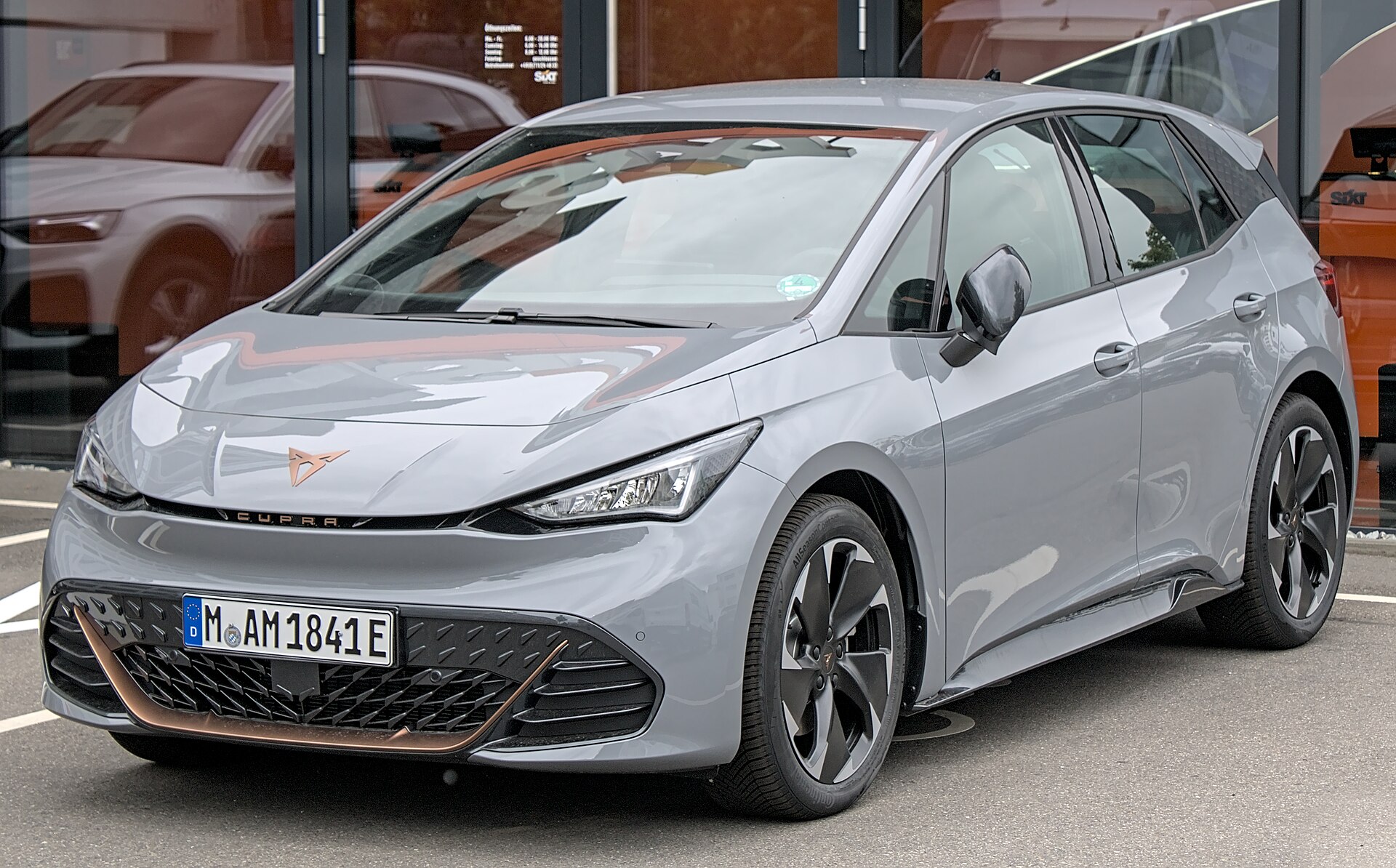
The Cupra Born is a C-segment electric hatchback that Cupra, SEAT's performance brand, has built at Volkswagen's Zwickau plant in Germany since September 2021. It uses the same MEB platform as the Volkswagen ID.3 but has sharper styling, sportier tuning and more power: 150 to 240 kW, the top figure coming from the Born VZ of 2024. A facelift with new lights, physical steering-wheel buttons and Android-based infotainment followed in 2026.
In short
- Cupra's first fully electric car: a five-door C-segment hatchback with rear-wheel drive, built in Zwickau, Germany.
- Net battery capacities of 58 to 79 kWh; power from 150 kW (204 PS) to 240 kW (326 PS) in the Born VZ, and 140 kW (190 PS) for the 2026 entry version.
- WLTP range up to 599 km for the VZ; ADAC lists 630 km for the facelifted VZ.
- 4,322 mm long with a 385-litre boot; five Euro NCAP stars in 2022; German prices from EUR 39,990 (2026).
Size at a glance
| Dimensions | Cupra Born K1 |
|---|---|
| Length | 4,324 mm170.2 in |
| Width | 1,809 mm71.2 in |
| Height | 1,540 mm60.6 in |
| Wheelbase | 2,766 mm108.9 in |
| Boot | 385 L13.6 cu ft |
Specs by version
Engines
| Version | Engine | Power | Torque | Gearbox | Drive | Production years |
|---|---|---|---|---|---|---|
| 77 kWh 170 kW | Electric | 170 kW 231 PS228 hp | 310 Nm229 lb-ft | 1-sp Single-speed | Rear-wheel drive | 2022–2025 |
| VZ 79 kWh | Electric | 240 kW 326 PS322 hp | 545 Nm402 lb-ft | 1-sp Single-speed | Rear-wheel drive | 2024 |
Performance
Show all 2 versions
| Version | 0–100 km/h | Top speed | Fuel consumption | Range |
|---|---|---|---|---|
| 77 kWh 170 kW | 7.1 s 0–62 mph | 160 km/h99 mph | 15.8 kWh/100 km25.4 kWh/100 mi | 556 km345 mi |
| VZ 79 kWh | 5.6 s 0–62 mph | 200 km/h124 mph | 14.2 kWh/100 km22.9 kWh/100 mi | 630 km391 mi |
Dimensions and weight
Show all 2 versions
| Version | Length | Width | Height | Wheelbase | Kerb weight | Boot | Battery |
|---|---|---|---|---|---|---|---|
| 77 kWh 170 kW | 4,324 mm170.2 in | 1,809 mm71.2 in | 1,540 mm60.6 in | 2,766 mm108.9 in | 1,969 kg4,341 lb | 385 l13.6 cu ft | 82 kWh |
| VZ 79 kWh | 4,336 mm170.7 in | 1,809 mm71.2 in | 1,543 mm60.7 in | 2,766 mm108.9 in | 2,004 kg4,418 lb | 385 l13.6 cu ft | 84 kWh |
Verified Manufacturer and type-approval data from our catalog · Sources and methodology
Cupra Born at a glance
| Specification | Cupra Born |
|---|---|
| Segment | C-segment hatchback, battery electric |
| Brand / maker | Cupra (SEAT, Volkswagen Group) |
| Production | from September 2021, Zwickau-Mosel plant, Germany |
| Platform | Volkswagen Group MEB |
| Body style | five-door hatchback |
| Drive | rear motor, rear-wheel drive |
| Length / wheelbase | 4,322 mm / 2,765 mm |
| Boot | 385 l, 1,267 l with the rear seats folded |
| Power range | 140-240 kW (190-326 PS) |
| Related models | Volkswagen ID.3, ID.4 and ID.5, Skoda Enyaq and Elroq, Audi Q4 e-tron |
Alberto Torrecillas designed the exterior and Tsanko Petrov the interior. The Born is Cupra's compact electric model, next to the larger Tavascan SUV and the Formentor; see our Cupra catalogue.
From SEAT el-Born to Cupra Born
The car was first shown as the SEAT el-Born concept at the Geneva Motor Show in March 2019. The study had a 62 kWh battery, 150 kW (204 PS), 0-100 km/h in 7.5 seconds and a claimed WLTP range of 420 km. Production in Zwickau was confirmed in July 2020. In February 2021 the car moved to the Cupra brand and dropped the "el-" from its name, and the production version premiered in May 2021. A 45 kWh entry version with 110 kW (150 PS) was announced but cancelled.

Generations and versions
The Born has had only one generation so far, with a facelift in 2026.
| Generation | Code | Years | Body styles | Engines | Power (kW / hp) |
|---|---|---|---|---|---|
| Born (pre-facelift) | K1 | 2021-2026 | 5-door hatchback | electric, 58-79 kWh net | 150-240 kW (201-322 hp) |
| Born (facelift) | K1 | 2026- | 5-door hatchback | electric, 58-79 kWh net | 140-240 kW (188-322 hp) |
The first cars of 2022 with the 77 kWh battery were four-seaters; ADAC lists five-seat versions from May 2022. In 2024 Cupra added the VZ and revised the batteries, and ADAC lists them as 60 kWh and 79 kWh from May 2025.
Batteries, power and performance
| Version | Battery, gross (net) | Power | Torque | 0-100 km/h | WLTP range | DC charging | Years |
|---|---|---|---|---|---|---|---|
| Born 58 | 62 (58) kWh | 150 kW (204 PS) | 310 Nm | 7.3 s | up to 426 km | 120 kW | 2021-2024 |
| Born 58 e-Boost | 62 (58) kWh | 170 kW (231 PS) | 310 Nm | 6.6 s | up to 422 km | 120 kW | 2021-2024 |
| Born 59 e-Boost | 63 (59) kWh | 170 kW (231 PS) | 310 Nm | 6.7 s | up to 428 km | 165 kW | 2024- |
| Born 77 | 82 (77) kWh | 170 kW (231 PS) | 310 Nm | 7.0-7.1 s | up to 560 km | 170-175 kW | 2021-2025 |
| Born VZ | 84 (79) kWh | 240 kW (326 PS) | 545 Nm | 5.6 s | up to 599 km | 185 kW | 2024- |
Every Born has a single permanent-magnet motor at the rear: the APP 310 in the regular versions and the APP 550 in the VZ. ADAC gives a top speed of 160 km/h for the 77 kWh car and 200 km/h for the facelifted VZ. On a fast charger the Born reaches 80% in 35 to 60 minutes, depending on the battery, and Cupra claims about 100 km of range in 7 minutes.

The Born VZ
The VZ arrived in 2024 as the fastest Born. Its larger APP 550 motor delivers 240 kW (326 PS) and 545 Nm, 75% more torque than the other versions, and cuts the 0-100 km/h time to 5.6 seconds. It uses the 79 kWh net battery, charges at up to 185 kW and has a WLTP range of up to 599 km. In Germany it cost EUR 52,870 in 2024; after the facelift ADAC lists it at EUR 50,990, with 630 km of WLTP range and 14.2 kWh/100 km.

The 2026 facelift
The facelift brought redesigned triangular headlights and tail lights, better interior materials, conventional buttons on the steering wheel and an Android-based infotainment system. ADAC lists three German versions from June 2026: 58 kWh with 140 kW (190 PS) for EUR 39,990, 79 kWh Endurance with 170 kW (231 PS) for EUR 45,990, and the VZ for EUR 50,990.
Dimensions, space and boot
| Parameter | Metric | Imperial |
|---|---|---|
| Length | 4,322-4,336 mm | 170.2-170.7 in |
| Width (without / with mirrors) | 1,809 / 2,070 mm | 71.2 / 81.5 in |
| Height | 1,537-1,543 mm | 60.5-60.7 in |
| Wheelbase | 2,765-2,766 mm | 108.9 in |
| Kerb weight (EU) | 1,969 kg (77 kWh), 2,004 kg (VZ, 2026) | 4,341 / 4,418 lb |
| Boot, seats up / folded | 385 / 1,267 l | 13.6 / 44.7 cu ft |
Like other MEB cars, the Born puts its wheels close to the corners: the wheelbase of 2,766 mm is 64% of the overall length. The 385-litre boot is a little bigger than the first-generation MG4's 363 litres but well short of the MG4 Urban's 470 litres.
Running costs and charging
ADAC lists WLTP consumption of 15.8 kWh/100 km for the 77 kWh Born and 14.2 kWh/100 km for the facelifted VZ, efficient figures for a car weighing around two tonnes. All versions charge at 11 kW on AC. The cost of ownership calculator helps compare it with a petrol hatchback, and the electric cars section lists alternatives.
Equipment
At launch the Born came with a 12-inch touchscreen, sports seats with integrated headrests, a head-up display, adaptive cruise control, Travel Assist, traffic sign recognition and automatic emergency braking. Dynamic Chassis Control Sport adaptive dampers were available. German launch prices in November 2021 were EUR 40,150 for the 150 kW Born with 58 kWh and EUR 47,250 for the 170 kW e-Boost with 77 kWh.
Safety: Euro NCAP
Euro NCAP tested the Born in 2022 and awarded five stars, with 93% for adult occupants, 89% for child occupants, 73% for pedestrians and 80% for safety assist. A 2025 retest of the 59 kWh e-Boost under newer rules gave 89% adult, 87% child, 76% vulnerable road users and 76% safety assist; ADAC lists the result as five stars. More results are in our safety ratings.
Reliability and production
Independent reliability data for the Born is still thin, and we have found no sourced pattern of faults, so we do not list any. It shares its platform and much of its electric hardware with the Volkswagen ID.3 and other MEB models. Production figures show steady demand: 4,801 cars in 2021, 36,153 in 2022, 45,300 in 2023, 42,593 in 2024 and 43,207 in 2025, about 172,000 in total.
Rivals
| Model | Engines | Power (hp) | Boot (l) | Price from (EUR) |
|---|---|---|---|---|
| Cupra Born (facelift) | electric, 58-79 kWh | 188-322 | 385 | 39,990 (Germany, 2026) |
| MG4 (I, facelift) | electric, 64-77 kWh | 188-429 | 363 | 42,990 (Germany, 2026) |
| MG4 Urban | electric, 43-54 kWh | 148-158 | 470 | 24,990 (Germany, 2026) |
| Jeep Avenger Electric | electric, 54 kWh | 154 | 355 | 38,500 (Germany, 2026) |
Its closest rival is its own technical twin, the Volkswagen ID.3. The MG4 offers rear-wheel drive and a four-wheel-drive XPower for similar money, while the MG4 Urban is far cheaper and more practical but slower. Compare them in our comparison tool.
Photo gallery


Cupra Born in our rankings
- No. 7 of 76 · Heaviest hatchbacks (2,004 kg)
- No. 9 of 91 · Most torque: hatchbacks (545 Nm)
- No. 14 of 141 · Most powerful hatchbacks (240 kW · top 11%)
- No. 13 of 88 · Longest-range electric cars (630 km · top 16%)
- No. 12 of 76 · Power-to-weight: hatchbacks (120 kW/t · top 16%)
- No. 18 of 91 · Widest hatchbacks (1,809 mm · top 21%)
Heavier than 90% of ranked hatchbacks in the 1CARS catalog (No. 7 of 76).
FAQ
Is the Cupra Born the same as the VW ID.3?
Both use the MEB platform and are built in Zwickau, but the Born has its own body, interior and chassis tuning and generally more power.
What is the range of the Cupra Born?
Depending on battery and year, WLTP ranges run from about 365 km to 599 km; ADAC lists 630 km for the facelifted Born VZ.
How fast does the Cupra Born charge?
DC charging peaks at 120 to 185 kW depending on the version; 80% takes 35 to 60 minutes. On AC all versions charge at 11 kW.
How powerful is the Cupra Born VZ?
The VZ produces 240 kW (326 PS) and 545 Nm and reaches 100 km/h in 5.6 seconds.
How safe is the Cupra Born?
It received five Euro NCAP stars in 2022, with 93% for adult occupant protection.
Data sources
Data checked by an editor against the sources below.