
 Tatra 603
All generations, specs and history
Published Sources (1) Report an error
By Oleksandr Hnatiuk, Automotive Editor & Used Car Specialist
- Built
- 1956–1975
- Generations
- 2 · 603-1 to 2-603
- Top power
- 77 kW (105 PS)
Timeline
603 generations
Click a generation for its own page
Newest first · 2 generations since 1956

All generations by year: 2-603 (1962–1975) · 603 603-1 (1956–1962)
Which one is mine?
Pick the year of first registration to see which generation it is.
Check by VINThe Tatra 603 is the large rear-engined saloon that Tatra built from 1956 to 1975 for Czechoslovak officials, state companies and export. An air-cooled 2.5-litre V8 sat behind the rear axle, under a streamlined six-seat body that changed from three headlamps to four in 1962. Only 20,422 were made, almost all by hand.
In short
- Production 1956-1975, mainly at Kopřivnice; 20,422 cars in total, with a peak of 1,671 in 1972.
- Air-cooled OHV V8 of 2,545 cc and later 2,474 cc, from 70 kW (95 PS) to 77 kW (105 PS).
- Sold only to senior political and industrial officials at home; about a third went abroad, including to Cuba and China.
- Replaced in 1974 by the Tatra 613 with a 3.5-litre engine and a body by Vignale.
Size at a glance
Tatra 603 603-1
The Tatra 2-603 is 90 mm shorter and 15 mm narrower than the Tatra 603 603-1.
| Dimensions | Tatra 2-603 | Tatra 603 603-1 | Difference |
|---|---|---|---|
| Length | 4,975 mm195.9 in | 5,065 mm199.4 in | −90 mm−3.5 in |
| Width | 1,895 mm74.6 in | 1,910 mm75.2 in | −15 mm−0.6 in |
| Height | 1,530 mm60.2 in | 1,529 mm60.2 in | +1 mm |
| Wheelbase | 2,750 mm108.3 in | 2,748 mm108.2 in | +2 mm+0.1 in |
Specs by version
Engines
| Version | Engine | Power | Torque | Gearbox | Drive | Production years |
|---|---|---|---|---|---|---|
| 603-1 · 1956–1962 | ||||||
| 603-1 · 2.5 V8 (95 PS) | 2.5 l · 8 cyl · Petrol 603F | 70 kW 95 PS94 hp | 157 Nm116 lb-ft | 4-sp Manual | Rear-wheel drive | 1956–1962 |
| 2-603 · 1962–1975 | ||||||
| 2-603 · 2.5 V8 603 H (105 PS) | 2.5 l · 8 cyl · Petrol 603H | 77 kW 105 PS103 hp | - | 4-sp Manual | Rear-wheel drive | 1968–1975 |
| 2-603 · 2.5 V8 (105 PS) | 2.5 l · 8 cyl · Petrol 603G | 77 kW 105 PS103 hp | 167 Nm123 lb-ft | 4-sp Manual | Rear-wheel drive | 1962–1968 |
Performance
Show all 2 versions
| Version | Top speed |
|---|---|
| 2-603 · 1962–1975 | |
| 2-603 · 2.5 V8 603 H (105 PS) | 170 km/h106 mph |
| 2-603 · 2.5 V8 (105 PS) | 170 km/h106 mph |
Dimensions and weight
Show all 2 versions
| Version | Length | Width | Height | Wheelbase | Kerb weight |
|---|---|---|---|---|---|
| 603-1 · 1956–1962 | |||||
| 603-1 · 2.5 V8 (95 PS) | 5,065 mm199.4 in | 1,910 mm75.2 in | 1,529 mm60.2 in | 2,748 mm108.2 in | 1,400 kg3,086 lb |
| 2-603 · 1962–1975 | |||||
| 2-603 · 2.5 V8 603 H (105 PS) | 4,975 mm195.9 in | 1,895 mm74.6 in | 1,530 mm60.2 in | 2,750 mm108.3 in | 1,470 kg3,241 lb |
Verified Manufacturer and type-approval data from our catalog · Sources and methodology
Tatra 603 at a glance
| Item | Tatra 603 |
|---|---|
| Years | 1956-1975 |
| Production | 20,422, about 6,000 of them first-series cars |
| Plants | Kopřivnice; Příbor from 1969 according to Wikipedia EN |
| Body style | 4-door saloon, six seats (five officially from 1968) |
| Designers | Julius Mackerle (engineering), František Kardaus (body) and team |
| Layout | rear-mounted V8, rear-wheel drive, monocoque body |
| Engines | 2,545 cc air-cooled V8 (to 1962); 2,474 cc (from 1962) |
| Power | 70 kW (95 PS); 77 kW (105 PS) at 4,800 rpm from 1962 |
| Kerb weight | 1,400 kg (Wikipedia EN); 1,470 kg for the 1969-1972 car (Wikipedia DE) |
| Length | 4,975-5,065 mm depending on series and source |
| Top speed | 160 km/h official; Tatra quoted up to 170 km/h, and a 1964 test measured 173 km/h |
| Price new | Kčs 98,000, about three times a Škoda Octavia (Lancaster Insurance); DM 15,050 in West Germany, later DM 16,000 |
A secret V8 project for the state elite
Tatra's car programme had been stopped in 1951, and the decision was reversed in 1952. Development began that year in secret under the name Valuta. In 1953 the government asked for a new luxury car with a 3.5-litre eight-cylinder engine. Julius Mackerle proposed using the 2.5-litre V8 of project 603 as an interim engine, and the first drivable car was ready in 1955. It was unveiled that year in Gottwaldov, now Zlín, and by 1957 output had reached about two cars a day.
The 603 succeeded the Tatraplan and kept the firm's streamlined tradition alive. It was the last Tatra with a streamlined body, and Wikipedia DE describes it as the last passenger car built in Kopřivnice before assembly moved. Ordinary citizens could not normally buy one. The cars went to ministries, party officials, state enterprises and diplomats, and the political limits went beyond Czechoslovakia: the Comecon trade bloc allowed the country only 300 luxury cars a year. Tatra built more, and in 1958 a comparison trial against East Germany's Sachsenring P240, a saloon from the Zwickau works that later built the Trabant, was decided in favour of the 603. The story of the company before and after the 603 is told in our Tatra history.
Air-cooled V8 behind the rear axle
The engine was an overhead-valve V8 with hemispherical combustion chambers and air cooling, weighing about 180 kg (173 kg for the later version, according to Wikipedia DE). With the engine in the tail and a full load, weight distribution was 47/53 front to rear. The four-speed gearbox had a column change to clear the front floor for a bench seat, and buyers could order "mountain" ratios. Front suspension used MacPherson struts, the rear had swing axles, and both ends ran on coil springs. The drag coefficient was 0.36, according to Classic Car Passion.
| Version | Years | Displacement | Power | Torque |
|---|---|---|---|---|
| 603 (603-1) | 1956-1962 | 2,545 cc | 70 kW (95 PS) | 157 Nm at 3,000 rpm |
| 2-603 (603 G engine) | 1962-1968 | 2,474 cc | 77 kW (105 PS) at 4,800 rpm | 167 Nm at 4,000 rpm |
| 2-603 from 1968 (603 H engine) | 1968-1975 | 2,472 cc | 77 kW (105 PS) at 4,800 rpm | not published |
Wikipedia EN uses the 603F, 603G and 603H engine designations, and the second-series engine had a smaller capacity but more power. Works consumption was 10-15 l/100 km, and a 1964 test recorded 13 l/100 km at a steady 140 km/h. In 1973 the 603 became the first Czechoslovak car with contactless thyristor ignition.

Three headlamps, then four: the 603 series by series
The first series of 1956-1962 had three headlamps behind a single curved glass cover, and the centre lamp turned with the steering. The T2-603 of 1962 brought four headlamps in a long oval grille, a new dashboard, a rear track 55 mm wider and a revised 2,474 cc engine that raised output from 70 kW (95 PS) to 77 kW (105 PS); our kW to PS and hp converter gives the same figures in hp. Power brakes followed in 1966, and the windscreen grew 66 mm taller in 1967.
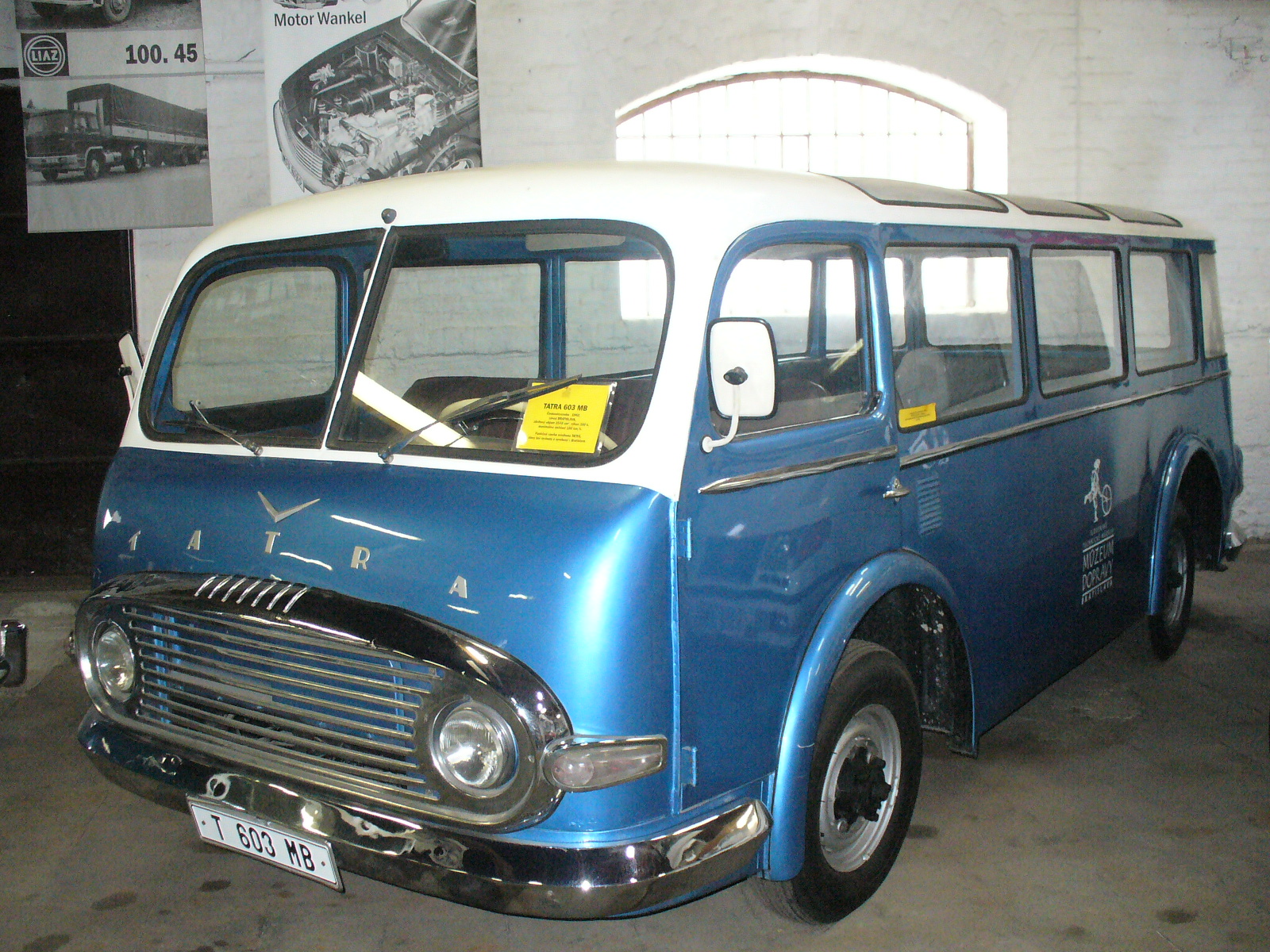
The 1968 car, unofficially called the 603-3 or 2-603 II, set the headlamps flush with the front, gained disc brakes on all four wheels and became an official five-seater with compulsory front seat belts. Wikipedia DE dates the four-wheel discs to 1970, so the year depends on the source. Prototypes never reached production: a front-engined, front-wheel-drive minibus called the 603 MB (1961), a notchback 603 A with an ambulance version (1964) and the 603 X (1966). Work on the successor began in 1968, and the Tatra 613 took over in 1974. Tatra's earlier and later cars appear in the Tatra catalogue.

Rallies, races and a car for Castro
The 603 raced far more than its role suggests. Between 1957 and 1967 it started 79 races, 24 of them international, and collected 60 wins, 56 second places and 49 thirds. At the 1959 Austrian Alpine Cup all three entries finished and Alois Mark won his class. In the 1,231 km Rallye Wiesbaden that year Mark was third overall and the best foreign driver. At the Marathon de la Route only 13 of 43 starters finished, and two 603s took third and fourth in their class. The later 603 B5 and B6 were the last racing versions.
About a third of production went abroad, mainly to Warsaw Pact countries, Cuba and China, and East Germany took about 3,000 from late 1959. Fidel Castro received a white 603 fitted with air conditioning, probably the only one so equipped, and is said to have sent Tatra a Chevrolet Corvair in return.
Tatra 603 today: what to check when buying
Most 603s led hard official lives and went back to the factory for repair several times. A first-series car sold in the UK, for example, carried a post-1964 four-headlamp body and had received six engines over its life, so check that the body, engine and documents match the claimed series. Ask for evidence of engine work, because the air-cooled V8 depends entirely on its fans and ducting for cooling. Classic Car Passion warns that the handling with the heavy V8 in the tail is unusual, and that parts are hard to source outside the Czech and Slovak Republics, so join a specialist register before buying.
The same UK car showed bubbles under its paint and needed recommissioning after five years without use, which is typical of a 603 that has stood for a long time. Check whether a car still has drum brakes or has been converted to discs, as that one had.
Values have risen with rarity. In December 2023 Forbes Czech Republic quoted CZK 2.5-3 million (about EUR 100,000-120,000) for a well restored first-series car, more than CZK 1 million (about EUR 40,000) for a restored third series and CZK 300,000-500,000 (about EUR 12,000-20,000) for one that needs restoration. In April 2024 Autiva Auctions in Prague sold an unrestored 1967 2-603 with diplomatic plates for EUR 36,000, above its EUR 20,000-30,000 estimate. Other cars of the same decade are in our classic cars section.
Tatra 603: first vs latest generation
| Spec | 603 603-1 | 2-603 | Change |
|---|---|---|---|
| Years | 1956–1962 | 1962–1975 | 6 years apart |
| Most powerful version | 70 kW (95 PS) | 77 kW (105 PS) | +7 kW (+10%) |
| Length | 5,065 mm | 4,975 mm | −90 mm |
| Width | 1,910 mm | 1,895 mm | −15 mm |
| Wheelbase | 2,748 mm | 2,750 mm | +2 mm |
| Lightest kerb weight | 1,400 kg | 1,470 kg | +70 kg |
Oldest and newest generation in the 1cars catalog. Power is the strongest version of each; other rows are shown only when both generations have the figure.
Tatra 603 in our rankings
- No. 10 of 20 · Fastest cars of the 1960s (170 km/h)
- No. 37 of 539 · Longest cars (5,065 mm · top 7%)
- No. 15 of 98 · Widest sedans (1,910 mm · top 16%)
- No. 17 of 105 · Longest sedans (5,065 mm · top 17%)
- No. 202 of 1118 · Longest-running car nameplates (19 years · top 20%)
- No. 137 of 516 · Widest cars (1,910 mm · top 27%)
Longer than 93% of ranked cars in the 1CARS catalog (No. 37 of 539).
FAQ
How many Tatra 603s were built?
20,422 between 1956 and 1975, almost all assembled by hand. About 6,000 were first-series cars with three headlamps, and the best single year was 1972 with 1,671 cars. Around a third were exported.
What engine does the Tatra 603 have?
An air-cooled overhead-valve V8 mounted behind the rear axle. The first series had 2,545 cc and 70 kW (95 PS); from 1962 a 2,474 cc version gave 77 kW (105 PS) at 4,800 rpm.
Could private buyers own a Tatra 603?
Normally not. The car was allocated to senior political and industrial officials, ministries and state enterprises, and private sales were the exception. After 1990 many cars were sold privately, often abroad.
What replaced the Tatra 603?
The Tatra 613, which entered production in 1974. It had a squarer body styled by Vignale and a 3.5-litre air-cooled V8 with overhead camshafts, still mounted at the rear.
Data sources
Data checked by an editor against the sources below.
- Wikipedia - Tatra 603


