
 Rover SD1
Specs, engines and history
Published Sources (3) Report an error
By Felix Hartmann, Automotive Technology & EV Contributor
- Built
- 1976–1986
- Top power
- 142 kW (193 PS)
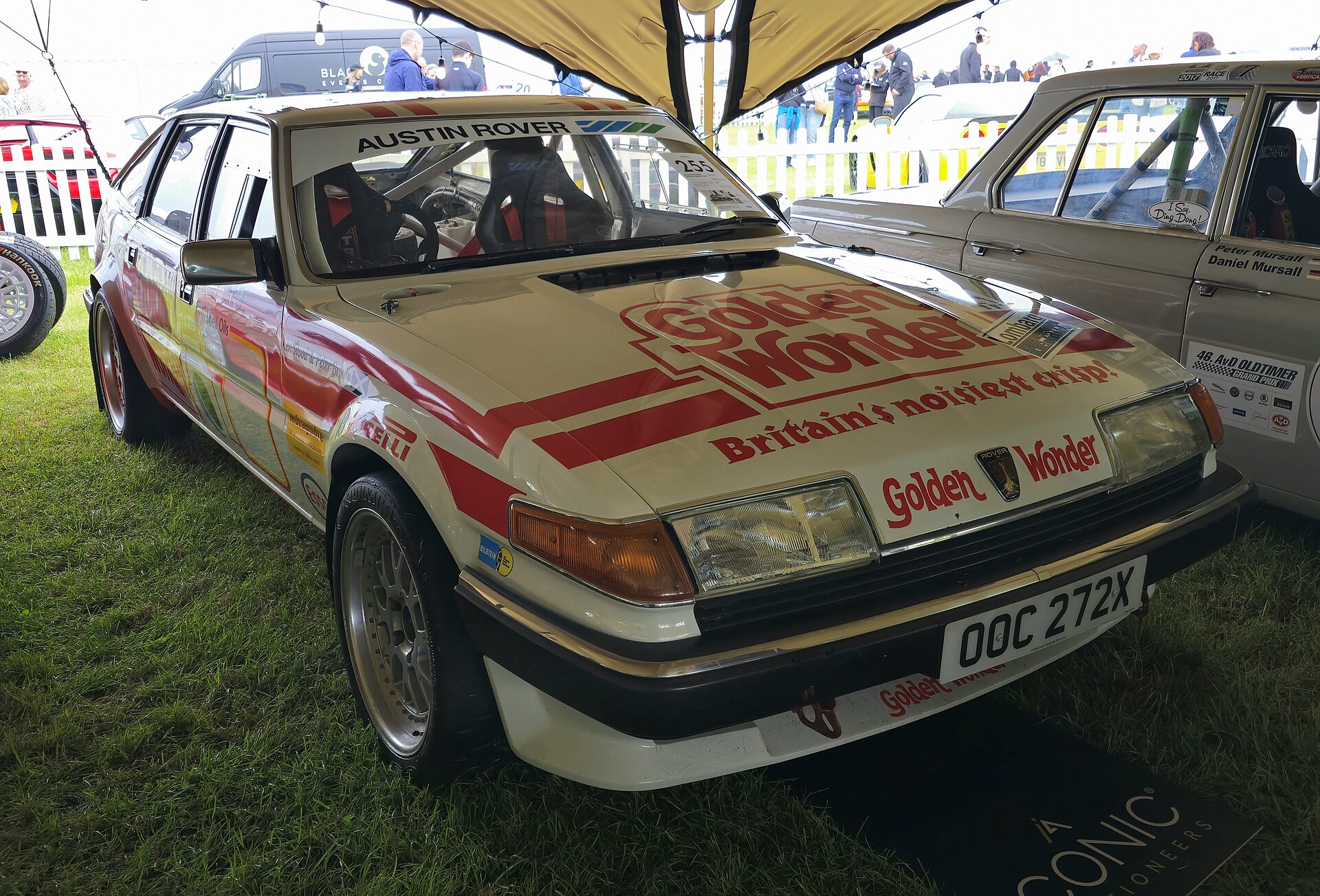
The Rover SD1 is the five-door executive hatchback that British Leyland launched on 30 June 1976 as the Rover 3500 and built until 1986. Styled by David Bache with an eye on the Ferrari Daytona, it was European Car of the Year 1977, used engines from a 2.0 four to the 3.5-litre aluminium V8, and the fuel-injected Vitesse won touring car titles. Production reached 303,345.
In short
- Built 1976-1986 at Solihull and, from 1981, at Cowley; 303,345 cars, plus the Standard 2000 built in India 1985-1988.
- Engines: 2.0 O-series, 2.3 and 2.6 six-cylinders, 2.4 VM turbodiesel and 3.5 V8 with up to 142 kW (190 bhp) in the Vitesse.
- European Car of the Year 1977, at GBP 4,750 for the 3500 in 1976.
- Tom Walkinshaw and Win Percy won six rounds of the 1985 European Touring Car Championship; replaced by the Rover 800 in 1986.
Size at a glance
| Dimensions | Rover SD1 I |
|---|---|
| Length | 4,699 mm185.0 in |
| Width | 1,768 mm69.6 in |
| Height | 1,372 mm54.0 in |
| Wheelbase | 2,814 mm110.8 in |
Specs by version
Engines
| Version | Engine | Power | Gearbox | Drive | Production years |
|---|---|---|---|---|---|
| Diesel · 1 version | |||||
| 2400 SD Turbo | 2.4 l · 4 cyl · Diesel 2,393 cc | 67 kW 91 PS90 hp | - | Rear-wheel drive | 1982 |
| Petrol · 5 versions | |||||
| 2300 | 2.4 l · 6 cyl · Petrol 2,350 cc | - | - | Rear-wheel drive | 1977 |
| 2600 | 2.6 l · 6 cyl · Petrol 2,597 cc | - | - | Rear-wheel drive | 1977 |
| 2000 O-series | 2.0 l · 4 cyl · Petrol 1,994 cc | 75 kW 102 PS101 hp | - | Rear-wheel drive | 1982 |
| 3500 V8 | 8 cyl · Petrol | 116 kW 158 PS156 hp | 5-sp Manual | Rear-wheel drive | 1976 |
| Vitesse 3.5 V8 injection | 8 cyl · Petrol | 142 kW 193 PS190 hp | 5-sp Manual | Rear-wheel drive | 1982–1986 |
Performance
Dimensions and weight
Verified Manufacturer and type-approval data from our catalog · Sources and methodology
Rover SD1 at a glance
| Item | Rover SD1 |
|---|---|
| Years | June 1976 to July 1986 (UK) |
| Production | 303,345 |
| Plants | Solihull; Cowley from 1981 |
| Body style | 5-door fastback hatchback |
| Designers | David Bache (styling), Spen King (engineering) |
| Layout | front V8, six or four, rear-wheel drive, live rear axle with Watts linkage |
| Engines | 1,994 cc four; 2,350 cc and 2,597 cc sixes; 2,393 cc turbodiesel; 3.5-litre V8 |
| Power | 67 kW (90 bhp) to 142 kW (190 bhp) |
| Length / wheelbase | 4,699 mm / 2,814 mm |
| Top speed | over 193 km/h (120 mph) for the 3500; 217 km/h (135 mph) for the Vitesse |
| 0-100 km/h | 0-60 mph in under 8.5 s (3500, Motor Sport 1976); 7.1 s (Vitesse) |
| Price new | GBP 4,750 for the 3500 in 1976 |
The SD1 belongs to the British Leyland chapter of the brand told in our history of Rover; the catalogue entries are in our Rover section, and other British saloons of the period are in our classic cars section.
Specialist Division car number one
The name says where it came from: SD1 stood for Specialist Division project number one inside British Leyland. The car was meant to replace the technically sophisticated but ageing Rover P6, and from the P6 it kept only the all-aluminium V8.
David Bache drew a long, low five-door fastback whose nose recalled the Ferrari Daytona and 365 GTC/4. Spen King's engineering was much simpler than the P6's: MacPherson struts at the front and a live rear axle with a Watts linkage. The jury of European Car of the Year chose the Rover 3500 for 1977, and the car and its design team were also named Midlander of the Year in 1976.

V8 launch, sixes and the four-cylinder 2000
The 3500 arrived first, with the V8 and, on Motor Sport's test car, a five-speed manual gearbox. Rover claimed 116 kW (155 bhp), although Wikipedia notes that cars as sold peaked at about 99 kW (133 bhp). Bill Boddy of Motor Sport, testing the car in November 1976, reported more than 120 mph (193 km/h), 0-60 mph in under 8.5 seconds and 23.2 mpg, and gave the price as GBP 4,750, or under GBP 4,850 with electric windows.
The six-cylinder 2300 and 2600, developed from the Triumph engine, followed in 1977 after production problems had delayed the full range. Lancaster Insurance's history quotes 104 mph (167 km/h) for the 2300 and 117 mph (188 km/h) for the 2600, at GBP 5,342 and GBP 5,800 new; the 2300 went without the 2600's rev counter, five-speed gearbox and central locking. The V8-S of 1979 became the 3500 SE in 1980, and the first Vanden Plas models appeared in late 1980.
| Engine | Displacement | Power | Introduced |
|---|---|---|---|
| 2000, O-series four | 1,994 cc | 75 kW (101 bhp) | 1982 |
| 2300, straight six | 2,350 cc | n/a in our sources | 1977 |
| 2600, straight six | 2,597 cc | n/a in our sources | 1977 |
| 2400 SD Turbo, VM diesel | 2,393 cc | 67 kW (90 bhp) | 1982 |
| 3500 V8, carburettors | 3.5 litres | 116 kW (155 bhp) claimed | 1976 |
| Vitesse V8, Lucas injection | 3.5 litres | 142 kW (190 bhp), 298 Nm | 1982 |
| Vitesse Twin Plenum | 3.5 litres | 142 kW (190 bhp) official; 157-164 kW (210-220 bhp) reported | 1985-1986 |
The 1982 Series 2 and the Vitesse
Early cars suffered from poor build quality, quick-wearing trim, flaking paint and ventilation problems that lasted until 1980. Production moved to Cowley in 1981, and the facelifted Series 2 of early 1982 brought flush headlamps, a deeper rear window with a wash-wipe and wood on the dashboard and door cards. The range widened downwards with the 2000 and the VM-engined 2400 SD Turbo, which returned about 30 mpg.
At the top sat the Vitesse. Its fuel-injected V8 gave 142 kW (190 bhp) and 220 lb ft (298 Nm), Hagerty UK quotes 135 mph (217 km/h) and 0-60 mph in 7.1 seconds, and the car rode on 15-inch alloy wheels. Hagerty counts 3,897 Vitesses, of which 363 were automatics, while Car & Classic gives 3,987. The Twin Plenum of 1985-1986, with intake changes engineered by Lotus, was built to homologate the racing car. Rover never announced a power increase, though the press reported 157-164 kW (210-220 bhp). How many were built is disputed: Octane and Car & Classic give 500, Wikipedia 200-250 against a planned 500.
Touring car wins and police patrols
British Leyland's motorsport department saw the car's racing potential in 1980, and Tom Walkinshaw Racing ran the works cars: Steve Soper and René Metge won the 1983 RAC Tourist Trophy, Andy Rouse took the 1984 British Saloon Car Championship, and Jeff Allam and Armin Hahne won the Group A class at the 1984 Bathurst 1000. In 1985 Walkinshaw and Win Percy won six rounds of the European Touring Car Championship, and Tony Pond won the Group A category of the British Rally Championship.
The same V8 made the SD1 a patrol car for many British forces, among them the Metropolitan Police, West Midlands Police and Grampian Police. Upmarket, it sat below the Jaguar XJ inside British Leyland and competed with the BMW 5 Series of the time, covered in our BMW 5 Series history.
The SD1 ended in July 1986, with the last Vitesse, registered D 537 PUK, leaving the factory that month. Its successor was the front-wheel-drive Rover 800.

Rover SD1 today: what to check when buying
Rust is the first check. Hagerty UK lists the wheelarches, door bottoms, floorpans, boot floor, bonnet, tailgate, lower grille surround, the area around the windscreen and the steel around any sunroof; the sills usually survive thanks to the pressure ventilation system. Octane adds the rear suspension mounts and front inner wings. On a Vitesse or Twin Plenum, check the chassis number, because a car that looks like a Vitesse may have started life as a standard 3500.
The V8 needs regular oil changes to protect the camshaft and tappets, and a neglected cooling system leads to blown head gaskets. Six-cylinder engines suffer from sludged oil feeds to the camshaft and rockers, so change the oil every 3,000 miles or yearly and replace the toothed timing belt soon after purchase. The 2000 and the turbodiesel are durable, and the gearboxes are reliable and easy to fix. Almost everything is available, including original body panels and trim, though model-year changes make ordering the right electrical part harder.
Values (GBP converted at about 1.17):
- Vitesse, Octane, October 2024: good early cars EUR 7,000-11,700 (GBP 6,000-10,000), great examples above EUR 17,500 (GBP 15,000), top original cars from EUR 23,400 (GBP 20,000).
- Other V8s, Hagerty UK, May 2022: smartest cars EUR 9,900-11,700 (GBP 8,500-10,000), projects from about EUR 3,500 (GBP 3,000); sixes about EUR 1,170 (GBP 1,000) less.
- 2000, Hagerty UK, May 2022: EUR 1,750 (GBP 1,500) for a runner to EUR 7,600 (GBP 6,500) for the best.
Rover SD1 in our rankings
- No. 9 of 94 · Longest hatchbacks (4,699 mm)
- No. 10 of 93 · Biggest engines: hatchbacks (2,597 cc)
- No. 10 of 22 · Fastest cars of the 1970s (193 km/h)
- No. 18 of 72 · Fastest hatchbacks (217 km/h · top 25%)
- No. 50 of 142 · Most powerful hatchbacks (142 kW · top 36%)
- No. 34 of 92 · Most torque: hatchbacks (298 Nm · top 37%)
Longer than 90% of ranked hatchbacks in the 1CARS catalog (No. 9 of 94).
FAQ
What does SD1 stand for?
SD1 means Specialist Division project number one, the internal British Leyland code for the car that replaced the Rover P6. It went on sale in 1976 as the Rover 3500, and the project code became the name enthusiasts still use.
How fast is the Rover SD1 Vitesse?
The Vitesse reaches 135 mph (217 km/h) and accelerates from 0 to 60 mph in 7.1 seconds, according to Hagerty UK. Its fuel-injected 3.5-litre V8 produces 142 kW (190 bhp) and 298 Nm.
How many Rover SD1s were made?
Rover built 303,345 SD1s between 1976 and 1986. About 3,900 were Vitesses, with sources giving 3,897 or 3,987, and the Standard 2000 built in India between 1985 and 1988 comes on top of that figure.
What replaced the Rover SD1?
The Rover 800 replaced the SD1 in 1986. It was a front-wheel-drive saloon, a clean break from the rear-drive layout of the SD1, and it took over the role of Rover's executive car.
Data sources
Data checked by an editor against the sources below.
- Wikipedia - Rover SD1
- Co - Rover 2600 Sd1
- Co - Buying Guide Rover Sd1 1976 1986


