
 Rover P6
Specs, engines and history
Published Sources (3) Report an error
By Sarah Whitmore, Senior Automotive Writer
- Built
- 1963–1977
- Top power
- 112 kW (152 PS)
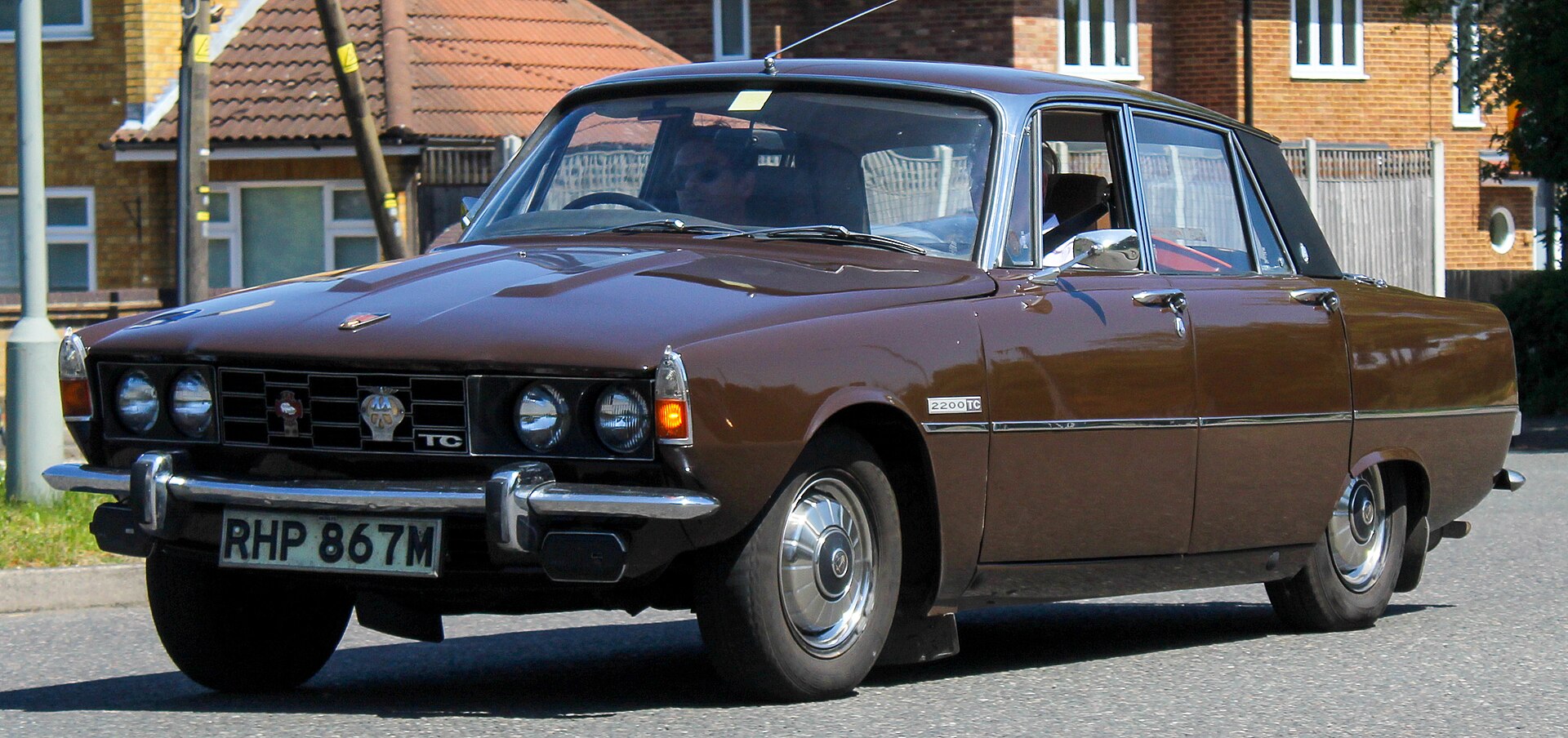
The Rover P6 is the four-door executive saloon that Rover built at Solihull from 1963 to 1977 and sold as the 2000, 2200 and 3500. It combined a steel base unit carrying bolt-on outer panels with a de Dion rear axle and disc brakes on all four wheels, won the first European Car of the Year award in 1964, and reached 322,302 cars according to Wikipedia.
In short
- Announced on 9 October 1963, a week before its rival, the Triumph 2000; the last P6 was built on 19 March 1977.
- 208,875 four-cylinder 2000s, 81,057 V8 3500s and 32,370 2200s; Classic & Sports Car gives a total of 329,066.
- Overhead-camshaft fours from 67 kW (90 bhp) and, from April 1968, the 3.5-litre V8 with up to 112 kW (150 bhp) in the manual 3500S.
- Replaced by the Rover SD1 hatchback, launched in June 1976.
Size at a glance
| Dimensions | Rover P6 |
|---|---|
| Length | 4,534 mm178.5 in |
| Width | 1,683 mm66.3 in |
| Height | 1,391 mm54.8 in |
| Wheelbase | 2,625 mm103.3 in |
Specs by version
Engines
| Version | Engine | Power | Gearbox | Drive | Production years |
|---|---|---|---|---|---|
| 2000 (SC) | 2.0 l · 4 cyl · Petrol 1,978 cc | 67 kW 91 PS90 hp | 4-sp Manual | Rear-wheel drive | 1963–1973 |
| 2200 SC | 2.2 l · 4 cyl · Petrol 2,205 cc | 73 kW 99 PS98 hp | - | Rear-wheel drive | 1973–1977 |
| 2000 TC | 2.0 l · 4 cyl · Petrol 1,978 cc | 85 kW 116 PS114 hp | 4-sp Manual | Rear-wheel drive | 1966–1973 |
| 2200 TC | 2.2 l · 4 cyl · Petrol 2,205 cc | 86 kW 117 PS115 hp | - | Rear-wheel drive | 1973–1977 |
| 3500 V8 automatic | 3.5 l · 8 cyl · Petrol 3,528 cc | 107 kW 145 PS143 hp | 3-sp Automatic | Rear-wheel drive | 1968–1977 |
| 3500S V8 manual | 3.5 l · 8 cyl · Petrol 3,528 cc | 112 kW 152 PS150 hp | 4-sp Manual | Rear-wheel drive | 1971–1977 |
Performance
Show all 2 versions
| Version | Top speed |
|---|---|
| 3500 V8 automatic | 183 km/h114 mph |
| 3500S V8 manual | 196 km/h122 mph |
Dimensions and weight
Show all 3 versions
| Version | Length | Width | Height | Wheelbase | Kerb weight | Fuel tank |
|---|---|---|---|---|---|---|
| 2000 (SC) | 4,534 mm178.5 in | 1,683 mm66.3 in | 1,391 mm54.8 in | 2,625 mm103.3 in | 1,255 kg2,767 lb | 55 l14.5 gal US |
| 2000 TC | - | - | - | - | 1,275 kg2,811 lb | - |
| 3500 V8 automatic | 4,572 mm180.0 in | 1,676 mm66.0 in | 1,422 mm56.0 in | 2,616 mm103.0 in | 1,298 kg2,862 lb | - |
Verified Manufacturer and type-approval data from our catalog · Sources and methodology
Rover P6 at a glance
| Item | Rover P6 |
|---|---|
| Years | October 1963 to March 1977 |
| Production | 322,302 (Wikipedia); 329,066 (Classic & Sports Car) |
| Plant | Lode Lane, Solihull, England |
| Designers | Spen King and Gordon Bashford (engineering), David Bache (styling) |
| Body styles | four-door saloon; about 150 FLM Panelcraft estates |
| Layout | front engine, rear-wheel drive, de Dion rear axle, inboard rear discs |
| Engines | 1,978 cc and 2,205 cc OHC four; 3,528 cc OHV V8 |
| Power | 67-112 kW (90-150 bhp) |
| Kerb weight | 1,275 kg (2000 TC) to 1,298 kg (3500) |
| Top speed | 196 km/h (122 mph), 3500S |
| 0-96 km/h (0-60 mph) | 9.1 s, 3500S, Hagerty UK |
| Price new (UK) | GBP 1,415 for a 2000 TC in 1967; GBP 1,723-2,104 in 1972 |
The P6 sits between the P5 and the SD1 in our Rover catalogue.
A clean-sheet Rover: base unit, de Dion and four discs
Rover had looked at base-unit construction as early as 1953. In the P6 the steel base unit took all the loads, and the outer panels, including wings, doors and sill covers, were bolted on unstressed, an idea inspired by the Citroën DS; the bonnet and boot lid were aluminium. Spen King and Gordon Bashford engineered the car, and David Bache styled it.
At the rear, a de Dion tube made in two telescoping parts located the wheels without sliding splines in the driveshafts, and a Watt linkage controlled sideways movement. The brakes were discs on all four wheels, mounted inboard at the rear, and the gearbox had synchromesh on all forward gears. To build it, Rover spent more than GBP 10 million doubling the size of its Solihull factory, including an electrostatic paint process that wasted 2% of paint against 60% for air spraying. The P6 won the AA Gold Medal for Safety in 1965. The history of Rover shows how far this design moved the company from its upright 1950s saloons.
2000 versus Triumph 2000: the 1963 launch
Rover announced the 2000 on 9 October 1963, just before the Earls Court Motor Show, and Triumph launched its 2000 one week later. The two cars fought for the same buyers for 14 years: Classic & Sports Car counts 316,653 Triumph 2000-family cars against the Rover's 329,066, and the Triumph history covers the other side of that rivalry.
The launch engine was a 1,978 cc overhead-camshaft four with an 85.7 mm bore and stroke and a single SU carburettor, giving 67 kW (90 bhp). The National Motor Museum lists a Rover 2000 at 167 km/h (104 mph) with 0-60 mph in 14.35 seconds. In August 1967 Motor Sport compared a 2000 TC with the Volvo 144S at the same GBP 1,415 and found the Rover better in ride, handling, gearchange, economy and refinement.
Engines and performance, from 2000 TC to 3500S
The twin-carburettor 2000 TC arrived in 1966 with two SU HD8s and 10:1 compression, together with an automatic 2000. In April 1968 the 3500 brought the all-aluminium 3.5-litre V8, derived from a Buick design, with a three-speed Borg-Warner automatic only, a larger radiator, bigger brakes and bigger wheels. A manual 3500S followed for Britain and Europe in 1971, after a US-market 3500S of which 2,043 were built from 1969 to 1971. In late 1973 the 2.2-litre 2200 replaced the 2000, with compression lowered to 9:1 so it ran on four-star petrol.
| Version | Years | Engine | Power |
|---|---|---|---|
| 2000 (SC) | 1963-1973 | 1,978 cc four, single SU | 67 kW (90 bhp) |
| 2000 TC | 1966-1973 | 1,978 cc four, twin SU | 85 kW (114 bhp) |
| 3500 | 1968-1977 | 3,528 cc V8, automatic | 107 kW (144 bhp) |
| 3500S | 1971-1977 | 3,528 cc V8, four-speed manual | 112 kW (150 bhp) |
| 2200 SC | 1973-1977 | 2,205 cc four, single SU | 73 kW (98 bhp) |
| 2200 TC | 1973-1977 | 2,205 cc four, twin SU | 86 kW (115 bhp) |
Torque ranged from 156 Nm on the 2000 to 277 Nm on the V8. Autocar quoted 183 km/h (114 mph) and 0-60 mph in 10.5 seconds for the 3500, while Motor measured 188 km/h (117 mph) and 9.5 seconds with an automatic car. The same V8 family later powered sports cars such as the TVR Griffith 500.

Series Two, estates and the end in 1977
The Series Two of 1970 brought a new grille, revised bonnet pressings, new rear lights and the battery moved to the boot, and the 3500 and 2000 TC gained new instruments. Alternators, inertia-reel seat belts, delay wipers and, from 1972, a stronger gear linkage followed. The coachbuilder FLM Panelcraft converted about 150 cars into estates between 1966 and 1976, and the last 150 V8s of 1976 were finished in Platinum paint.
The SD1 hatchback was launched in June 1976, and the 2200 and 3500 overlapped with it until the final P6 was built on 19 March 1977. Hagerty UK's buyer's guide calls the P6, even in late form, "very much a pre-Leyland Rover".

Rover P6 today: what to check when buying
The bolt-on panels hide the condition of the base unit, so tidy outer wings prove little. Check the undersides of the sills and the jacking points, floors and inner sills, rear seat wells, the three-layer wheel arches, D-posts, the boot floor, the rear scuttle and the Watt linkage mounts. Outer front and rear wings, door bottoms and the rear valance also rot. Even panel gaps are a good sign; uneven ones point to hidden rust or poor repairs.
Mechanically, look for split de Dion gaiters, since grit wears the tube quickly, and for seized inboard rear calipers and handbrakes. Early cars used Dunlop rear brakes up to 1966; later Girling parts are easier to find. V8 engines suffer sludge, camshaft wear and head-gasket failure from internal corrosion if antifreeze and oil were neglected. Four-cylinder engines can rattle their timing chains. The 3500S gearbox can baulk in second gear. Fuel lines should be updated for ethanol, and the 2000 TC and early V8s need super unleaded. The Rover P6 Club publishes its own buyer's guide for members and newcomers.
Octane's guide of September 2026 lists good examples at about EUR 5,200 (GBP 4,500) for a 2000 or 2200 SC, EUR 8,600 (GBP 7,500) for a 3500 automatic and EUR 12,700 (GBP 11,000) for a 3500S, rising to EUR 23,000 (GBP 20,000) for an excellent 3500S. A 2200 is worth about 20% less than an equivalent 2000. More British saloons of the period are in our classic cars section.
Rover P6 in our rankings
- No. 114 of 422 · Lightest cars (1,255 kg · top 28%)
- No. 318 of 1145 · Longest-running car nameplates (14 years · top 30%)
- No. 53 of 176 · Biggest engines: sedans (3,528 cc · top 31%)
- No. 37 of 120 · Smallest sedans (4,534 mm · top 31%)
- No. 14 of 41 · Fastest cars of the 1970s (196 km/h · top 35%)
- No. 13 of 37 · Fastest cars of the 1960s (183 km/h · top 36%)
Lighter than 72% of ranked cars in the 1CARS catalog (No. 114 of 422).
FAQ
How many Rover P6s were built?
Wikipedia gives 322,302: 208,875 of the 2000, 81,057 of the 3500 and 3500S, and 32,370 of the 2200. Classic & Sports Car quotes 329,066, so figures vary between sources. Production ran at Solihull from 1963 to March 1977.
Was the Rover P6 European Car of the Year?
Yes. The Rover 2000 was the first winner of the European Car of the Year award, for 1964. It also received the AA Gold Medal for Safety in 1965, two years after its announcement in October 1963.
Which Rover P6 is the fastest?
The 3500S with the 3.5-litre V8 and four-speed manual gearbox, sold from 1971 to 1977. It produced 112 kW (150 bhp), reached 196 km/h (122 mph) and covered 0-60 mph in 9.1 seconds according to Hagerty UK.
What replaced the Rover P6?
The Rover SD1, a five-door hatchback launched in June 1976 with the same 3.5-litre V8. P6 production overlapped with it for several months, and the last P6 left Solihull on 19 March 1977.
Data sources
Data checked by an editor against the sources below.
- Wikipedia - Rover P6
- Com - 1963 Rover 2000
- Co - Buying Guide Rover P6 1963 1977


