
 Rover 600 Series
Specs, engines and history
Published Report an error
By Felix Hartmann, Automotive Technology & EV Contributor
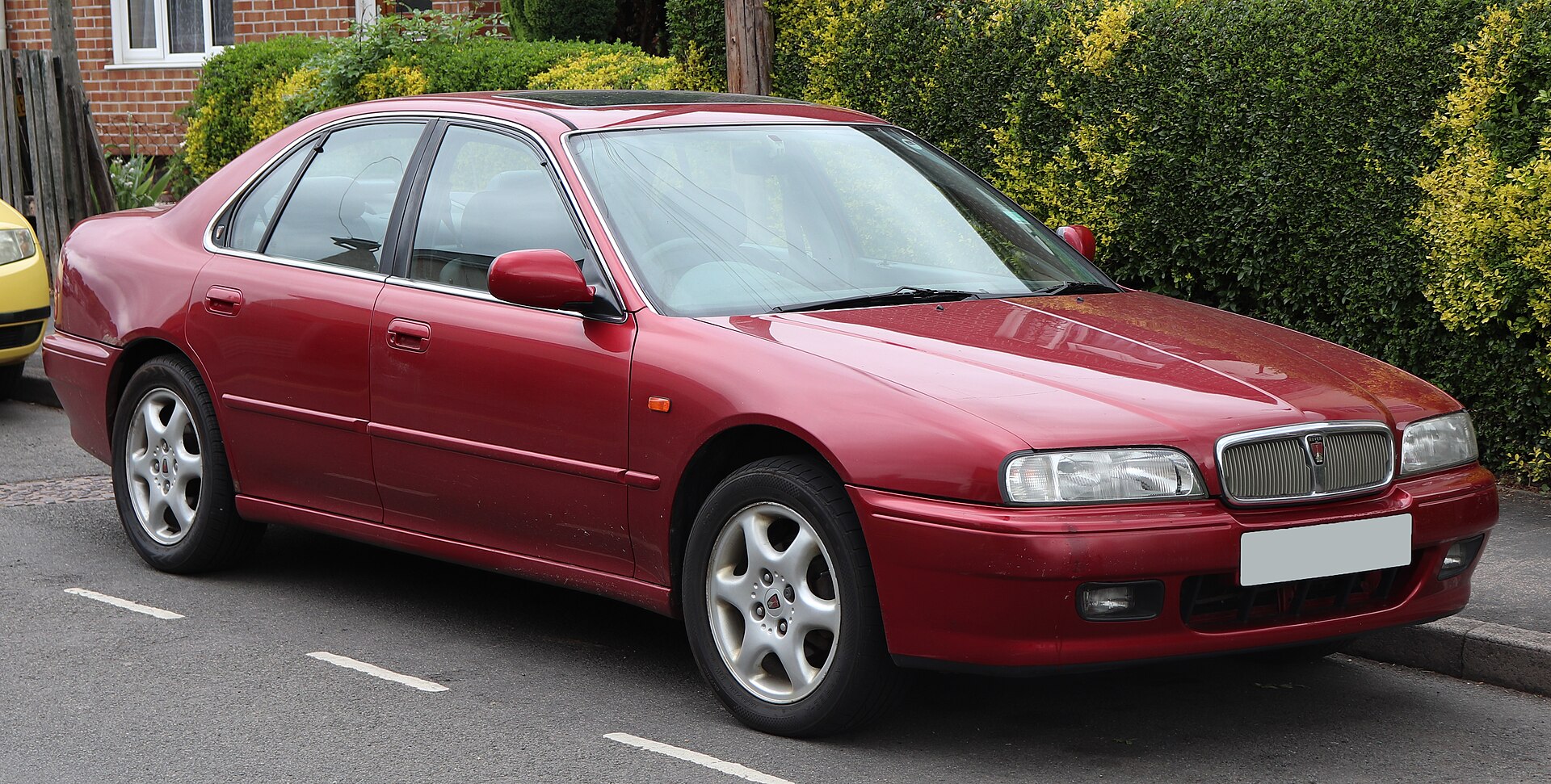
The Rover 600 Series was Rover's four-door executive saloon of 1993 to 1999, built in Britain on the platform of the fifth-generation Honda Accord. It was launched on 19 April 1993 to replace the Austin Montego saloon, used Honda petrol engines of 1.8 to 2.3 litres plus Rover's own diesel and turbo engines, and sold 272,512 cars. The 620ti of 1994, with a 147 kW (200 PS) turbo, was the fastest version. The Rover 75 replaced it.
In short
- Production April 1993 – early 1999; 272,512 cars, with 1995 the best year at 61,533.
- Honda body and chassis (Accord/Ascot Innova, CB platform) with Rover styling and interior trim.
- Engines from the 85 kW (115 PS) 1.8 to the 147 kW (200 PS) 2.0 turbo of the 620ti; 2.0 turbodiesel with 77 kW (105 PS).
- The RAC called it the most reliable Rover of its era; T-series head gaskets and rust in the rear inner wings are known weak points.
Rover 600 at a glance: body, platform and plant
| Item | Rover 600 Series |
|---|---|
| Production | April 1993 – early 1999 |
| Plant | Cowley, Oxford (Wikipedia infobox; the text also mentions Honda's Swindon plant) |
| Body | four-door saloon only |
| Platform | Honda CB (fifth-generation Accord / Ascot Innova) |
| Layout | front engine, front-wheel drive |
| Engines | Honda 1.8, 2.0, 2.3 petrol; Rover 2.0 T-series turbo; Rover 2.0 L-series turbodiesel |
| Gearboxes | five-speed manual, four-speed automatic |
| Wheelbase / length | 2,720 mm / 4,650 mm |
| Predecessor / successor | Austin Montego / Rover 75 |
The 600 is in our Rover catalogue. It was the last Rover before the BMW-developed Rover 75, and its Honda roots are covered in our Honda Accord generations guide.
One generation, 1993–1999
The 600 had a single generation. Its body and interior were based on the Honda Accord of the fifth generation, the chassis was developed by Honda, and Rover gave the car its own exterior and a wood-and-chrome interior. The Wikipedia infobox credits Richard Woolley with the 1989 design.
| Year | Change |
|---|---|
| 19 April 1993 | launch of the 600 Series |
| 1994 | 620ti turbo (summer); driver's airbag standard |
| December 1994 | 620 turbodiesel (Di/SDi) |
| spring 1996 | passenger airbag available; interior updates; transponder immobiliser; air conditioning from Si |
| March 1996 | 618i/Si with the Honda F18A3 listed; 620i dropped (Wikipedia DE) |
| 1997 | suspension lowered by about 10 mm, body-coloured trim |
| early 1999 | production ends; Rover 75 takes over |
| Year | Production |
|---|---|
| 1993 | 30,594 |
| 1994 | 54,604 |
| 1995 | 61,533 |
| 1996 | 43,701 |
| 1997 | 40,291 |
| 1998 | 40,815 |
| 1999 | 974 |
| Total | 272,512 |

Engines, transmissions and performance
| Model | Engine | Power | Torque | 0–100 km/h | Top speed | Years |
|---|---|---|---|---|---|---|
| 618i / Si | 1,850 cc Honda F18A3 | 85 kW (115 PS) | 150 Nm | 10.8 s | 195 km/h | 03/1996–02/1999 |
| 620i | 1,997 cc Honda F20Z2 | 85 kW (115 PS) | 173 Nm | 10.8 s | 198 km/h | 08/1993–03/1996 |
| 620Si | 1,997 cc Honda F20Z1 | 96 kW (131 PS) | 177 Nm | 10.2 s | 201 km/h | 08/1993–02/1999 |
| 623Si | 2,259 cc Honda H23A3 | 116 kW (158 PS) | 206 Nm | 10.0 s | 216 km/h | 08/1993–02/1999 |
| 620ti | 1,994 cc Rover T-series turbo | 147 kW (200 PS) | 240 Nm | 7.5 s | 230 km/h | 07/1994–02/1999 |
| 620Di / SDi | 1,994 cc Rover L-series turbodiesel | 77 kW (105 PS) | 210 Nm | 10.9 s | 188 km/h | 12/1994–02/1999 |
Figures from Wikipedia DE; the British launch dates are earlier than these German market dates. The badge shows the engine size: 618 for 1.8 litres, 620 for 2.0 and 623 for 2.3.
The 620ti used a Garrett turbocharger and intercooler and was the only 600 with sports suspension as standard. Wikipedia EN quotes 236 Nm and 0–60 mph in 7 seconds, and Autocar (8 February 1995) found it as quick in the mid-range as a Ford Sierra Sapphire RS Cosworth. The 1996 changes gave the T-series a wasted-spark ignition, a Klinger head gasket and a limited-slip differential.

Dimensions, weight and interior space
| Parameter | Metric | Imperial |
|---|---|---|
| Length | 4,650 mm | 183.1 in |
| Width | 1,727 mm | 68.0 in |
| Height | 1,380 mm | 54.3 in |
| Wheelbase | 2,720 mm | 107.1 in |
| Kerb weight, petrol (Wikipedia DE) | 1,255–1,335 kg | 2,767–2,943 lb |
| Kerb weight, diesel (Wikipedia DE) | 1,310–1,380 kg | 2,888–3,042 lb |
Rear legroom was the main criticism: Parkers and Wikipedia DE both describe it as tight. No estate was built; Rover's next large estate was the Rover 75 Tourer of 2001.
Running costs and trims
The range ran from 618i through 620 Si, SLi and GSi to the 623 SLi, GSi and iS, the 620ti and the diesel 620 SDi, SLDi and GSDi, with 618iL, 618iS, 620iSD and 620iLD run-out models. Wikipedia notes that a large share of cars went to fleets, and Wikipedia DE says prices were well below those of premium rivals. Our sources give no list prices or official fuel-consumption figures.
Safety, recalls and reliability
A driver's airbag was standard from 1994, a passenger airbag was available from spring 1996, and a transponder immobiliser came in 1996. In May 1996 Rover recalled 21,634 cars built between December 1994 and December 1995 to check a possible steering-rack fault. Our sources give no Euro NCAP result.
The RAC listed the 2.3-litre engine, the Accord basis and good reliability as strengths, calling the 600 the most reliable Rover of its era. The weak points it named were the ride and handling, rust in the rear inner wings and head-gasket trouble on the T-series turbo engine. The AA praised "the finest power units and sweetest gearchange" but criticised the price and the space.

Rivals and which Rover 600 to buy
The 600 was a British-built alternative to the large family saloons of its time and to its Honda twin. To compare it with the Accord or other large family cars of the 1990s, use our car comparison tool.
Verdict: the 620Si and 623 with Honda engines are the safest buys, with the reliability the RAC praised. The 620ti is the fastest version, but check the head gasket and, on post-1996 cars, the limited-slip differential. The diesel is the economical choice for high mileage. On every car, look at the rear inner wings for rust and check that the 1996 steering-rack recall work has been done where it applies.

Photo gallery


FAQ
Is the Rover 600 a Honda?
Partly. It uses the body structure, chassis and petrol engines of the fifth-generation Honda Accord, with Rover styling, interior and its own diesel and turbo engines.
How many Rover 600s were built?
272,512 between 1993 and 1999.
How fast is the Rover 620ti?
Its 147 kW (200 PS) turbo engine gives a top speed of 230 km/h and 0–100 km/h in 7.5 s (Wikipedia DE).
What are the common problems of the Rover 600?
Rust in the rear inner wings and head-gasket failure on the 620ti's T-series engine; the RAC rated the car itself as reliable.
What replaced the Rover 600?
The Rover 75, which also replaced the larger Rover 800.


