
 Buick GS 455 Stage 1
Specs, engines and history
Published Sources (5) Report an error
By Felix Hartmann, Automotive Technology & EV Contributor
- Built
- 1970–1972
- Top power
- 268 kW (364 PS)
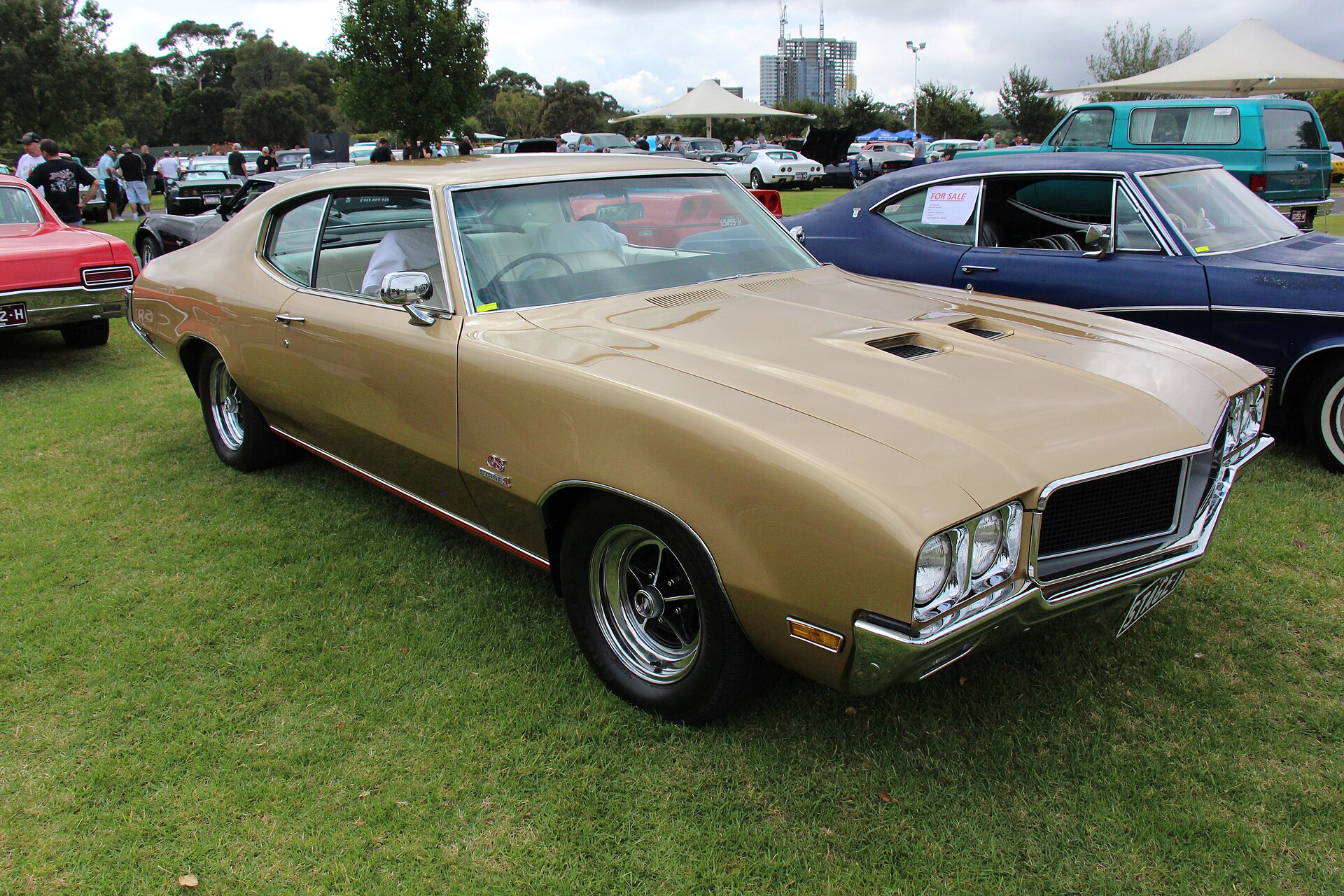
The Buick GS 455 Stage 1 was the high-output engine package for Buick's mid-size Gran Sport, built from 1970 to 1972. In 1970 its 7.5 L (455 cu in) V8 was rated at 268 kW (360 hp, SAE gross) and 691 Nm (510 lb-ft), the highest torque rating of the classic muscle-car years. Motor Trend timed a 1970 Stage 1 at 13.38 seconds over the quarter mile.
In short
- A factory option for the GS 455 coupé and convertible, and part of the GSX: larger valves, a hotter camshaft, more compression and a retuned Quadrajet.
- Ratings: 268 kW (360 hp) gross in 1970, 257 kW (345 hp) gross in 1971, 201 kW (270 hp) net in 1972.
- Production: 2,465 in 1970, 801 coupés in 1971 and 728 in 1972, according to the sources used.
- The NHRA classed the Stage 1 at 298 kW (400 hp) before the 1970 Winternationals, 30 kW (40 hp) above the factory figure.
Specs by version
| Version | Engine | Power | Torque | Drive | Production years |
|---|---|---|---|---|---|
| 455 Stage 1 V8 (SAE net) | 7.5 l · 8 cyl · Petrol 7,456 cc | 201 kW 273 PS270 hp | 529 Nm390 lb-ft | Rear-wheel drive | 1972 |
| 455 Stage 1 V8 (SAE gross), 1971 | 7.5 l · 8 cyl · Petrol 7,456 cc | 257 kW 349 PS345 hp | 624 Nm460 lb-ft | Rear-wheel drive | 1971 |
| 455 Stage 1 V8 (SAE gross) | 7.5 l · 8 cyl · Petrol 7,456 cc | 268 kW 364 PS359 hp | 691 Nm510 lb-ft | Rear-wheel drive | 1970 |
Verified Manufacturer and type-approval data from our catalog · Sources and methodology
Stage 1 at a glance
| Specification | Buick GS 455 Stage 1 |
|---|---|
| Model years | 1970-1972 |
| Built | 2,465 (1970), 801 coupés (1971), 728 (1972) |
| Bodies | two-door coupé, convertible |
| Platform | GM A-body (Skylark-based Gran Sport) |
| Engine | 7.5 L (455 cu in) V8, bore x stroke 109.5 x 99.1 mm (4.3125 x 3.90 in) |
| Power | 268 kW (360 hp, SAE gross) at 4,600 rpm (1970) |
| Torque | 691 Nm (510 lb-ft) at 2,800 rpm (1970) |
| Compression | 10.0:1 or 10.5:1 in 1970 (sources differ), lower from 1971 |
| Valves | 54.1 mm (2.13 in) intake, 44.6 mm (1.755 in) exhaust |
| Gearboxes | three-speed manual; Muncie close-ratio four-speed; Turbo Hydra-Matic 400 |
| Rear axle | 3.64:1 Positraction (3.42:1 with air conditioning) |
| Quarter mile | 13.38 s at 105.5 mph (Motor Trend, 1970, 1,728 kg (3,810 lb) car) |
| Price | GS from US$3,098 in 1970; Stage 1 package US$199 in 1970 (Street Muscle) |
Why Buick built a bigger Gran Sport engine
For 1970 General Motors dropped the 400 cu in limit on its mid-size cars, and Buick moved its new 455 into the Gran Sport. The GS 455 outsold the smaller GS 350 in its first year, with 10,148 two-doors against 9,948. The standard 455 already gave 261 kW (350 hp) and 691 Nm (510 lb-ft), and the Stage 1 package was the step above it for owners who drag raced.
For 1970 the package was built around the larger engine and offered on any GS 455, as a coupé or a convertible, with the three-speed, four-speed or automatic gearbox. It was also the engine of 400 of the 678 GSX cars built that year.
Inside the Stage 1 package
The Stage 1 used the same raw cylinder-head castings as other 1970 Buick 455s, machined for bigger valves and smaller combustion chambers, which raised the compression. The valves grew from 50.8 mm (2.00 in) intake and 41.1 mm (1.62 in) exhaust to 54.1 mm (2.13 in) and 44.6 mm (1.755 in). The rest of the package added parts in every system that mattered for sustained high speed:
| Component | Standard GS 455 (1970) | Stage 1 (1970) |
|---|---|---|
| Rating (SAE gross) | 261 kW (350 hp) | 268 kW (360 hp) at 4,600 rpm |
| Torque | 691 Nm (510 lb-ft) at 2,800 rpm | 691 Nm (510 lb-ft) at 2,800 rpm |
| Valves (intake / exhaust) | 50.8 / 41.1 mm | 54.1 / 44.6 mm |
| Camshaft | standard hydraulic | 0.490 in lift, 326/346 degrees duration |
| Carburettor | Rochester Quadrajet | Quadrajet with Stage 1 calibration, cold-air induction |
| Lubrication and cooling | standard | 5/8 in oil pickup, revised oil pump, heavy-duty radiator |
| Rear axle | 3.42:1 manual, 2.93:1 automatic | 3.64:1 Positraction |
Automatic cars got a strengthened Turbo Hydra-Matic 400 with a 2.48:1 first gear, and four-speed cars a larger clutch. One period account gives 348 degrees of exhaust duration instead of 346, so sources differ on this detail.
The 455 also had known limits. Wikipedia lists two-bolt main bearing caps, an oiling system marginal for sustained high revs and thin lifter-valley walls that can crack.

The 510 lb-ft figure and the ten horsepower
The Stage 1 and the standard 455 shared one torque figure, 691 Nm (510 lb-ft) at 2,800 rpm, and their power ratings were only 7 kW (10 hp) apart. Few people believed the gap. Buick engineer Dennis Manner later said that the weakest of 15 Stage 1 engines checked on the production-line dynamometer gave about 425 hp, and the NHRA classed the Stage 1 Skylark at 400 hp for Stock racing before the 1970 Winternationals. Street Muscle notes that no American production engine topped the 510 lb-ft rating until the V10 of the 2003 Dodge Viper.
| Model year | Standard 455 | Stage 1 | Stage 1 torque | Rating method |
|---|---|---|---|---|
| 1970 | 261 kW (350 hp) | 268 kW (360 hp) | 691 Nm (510 lb-ft) | SAE gross |
| 1971 | 235 kW (315 hp) | 257 kW (345 hp) | 624 Nm (460 lb-ft) | SAE gross |
| 1972 | 186 kW (250 hp) | 201 kW (270 hp) | 529 Nm (390 lb-ft) | SAE net |
For 1971 Buick lowered compression across the 455 range for low-lead fuel; the standard engine went from 10:1 to 8.5:1. In 1972 the industry switched to net ratings, which explains most of the drop on paper.
Road tests and drag-strip numbers
Motor Trend's 1970 run of 13.38 seconds at 105.5 mph in a 1,728 kg (3,810 lb) Stage 1 coupé was never matched by another magazine, according to Curbside Classic, and critics called the test car a ringer. Other period tests were slower but consistent:
| Test | Car | Result |
|---|---|---|
| Motor Trend, 1970 | GS 455 Stage 1 coupé | 13.38 s at 105.5 mph |
| Supercars '70 1/2 (June 1969 test) | pre-production Stage 1, automatic, 3.64:1 | 14.10 s at 102 mph |
| Hi-Performance Cars, October 1970 | GSX Stage 1 | 14.0 s at 103 mph, 0-60 mph in 6.2 s |
| Car Review, March 1985 | modified 1970 Stage 1 vs Hemi GTX | 12.30 s at 110.97 mph vs 13.03 s |
Car Craft summed up the stock cars in 1985 as low-14 and high-13-second performers straight from the showroom. The 1985 Car Review shootout at Gainesville pitted Richard Lasseter's Stage 1 against Roy Badie's Hemi GTX; the Buick won both runs, helped by a Holley carburettor and an Edelbrock intake that the Hemi did not have.
Stage 2, the GSX and the end
Beyond Stage 1, Buick developed a dealer-installed Stage 2 for the 455, with round-port heads, headers, a racing camshaft, forged high-compression pistons, an Edelbrock B4B intake and a Holley 850 cfm carburettor. The parts were not offered openly until 1972, and only about 75 sets of Stage 2 heads were made before porosity problems and emission rules ended them.
The Stage 1 itself lasted beyond the cars covered here: Wikipedia rates the 1973 Stage 1 at 270 hp net in the Century-based GS, and Buick dropped the Stage 1 and 455 options for 1975. The GSX, with 678, 124 and 44 cars in 1970, 1971 and 1972, was the rare dress-up version of the same drivetrain.
Stage 1 today: what to check
The cylinder heads are the quickest engine check. A Car Craft reference reprinted by TeamBuick lists Stage 1 head casting numbers 1240150 for 1970, 1240146 for 1971 and 1238530 for 1972, and the valves should measure 2.13 and 1.75 in. Original invoices, build sheets, the Protect-O-Plate and an entry in the Stage 1 Registry carry most of a car's value. Convertibles are scarce: Street Muscle cites 232 Stage 1 convertibles for 1970.
Two dated sales show the range: a 1970 Stage 1 four-speed coupé sold for US$110,000 at Barrett-Jackson on 24 October 2020, and a 1970 Stage 1 coupé with a four-speed made US$50,400 at RM Sotheby's Arizona sale in 2020. Rivals with the same idea were the Chevrolet Chevelle SS 454 and the Oldsmobile 4-4-2 W-30. All Gran Sport versions are listed in the Buick catalogue.

Buick GS 455 Stage 1 in our rankings
- No. 18 of 635 · Biggest engines: cars (7,456 cc · top 3%)
- No. 14 of 183 · Biggest engines: coupes (7,456 cc · top 8%)
- No. 95 of 486 · Most torque: cars (691 Nm · top 20%)
- No. 22 of 91 · Most powerful cars of the 1970s (268 kW · top 27%)
- No. 36 of 118 · Most torque: coupes (691 Nm · top 32%)
- No. 369 of 1012 · Most powerful cars (268 kW · top 37%)
Bigger engine than 97% of ranked cars in the 1CARS catalog (No. 18 of 635).
FAQ
How much torque did the Buick Stage 1 455 make?
691 Nm (510 lb-ft) at 2,800 rpm in 1970, the same rating as the standard GS 455. The figure fell to 624 Nm (460 lb-ft) in 1971 and 529 Nm (390 lb-ft, SAE net) in 1972.
How many GS 455 Stage 1 cars were built?
About 2,465 in 1970, including roughly 232 convertibles, 801 coupés in 1971 and 728 cars in 1972.
Was the Stage 1 really rated at only 360 hp?
Yes, officially 268 kW (360 hp, SAE gross) in 1970. Buick engineers measured about 425 hp on production engines, and the NHRA classed the car at 400 hp, so the rating is widely seen as understated.
What is the difference between Stage 1 and Stage 2?
Stage 1 was a factory-installed option with larger valves, a hotter cam and a retuned Quadrajet. Stage 2 was a dealer parts package with new heads, forged pistons and a Holley carburettor, made in very small numbers.
Data sources
Data checked by an editor against the sources below.
- Wikipedia - Buick Gran Sport
- Streetmusclemag
- Slashgear - Rarest Buick Muscle Car 1970s
- Rmsothebys
- Gmauthority - 1972 Buick Gs Stage 1 Heads To Auction


