 Buick Envision
All generations, specs and history
Published Sources (2) Report an error
By Sarah Whitmore, Senior Automotive Writer
- Built
- 2014–present
- Generations
- 2
Timeline
Envision generations
Click a generation for its own page


- Envision I 2014–2020 · SUV
- Envision II Current 2020–now · SUV
Newest first · 2 generations since 2014
All generations by year: Envision II (2020–now) · Envision I (2014–2020)
Which one is mine?
Pick the year of first registration to see which generation it is.
- Envision II 2020–present
- Envision I 2014–2020
Verdict
Our verdict · Sarah Whitmore
The second-generation Envision has an attractive, fresh and dynamic design, interesting equipment and an appealing price, and its cabin is more modern and comfortable. It offers features previously found only on Buick's more expensive models. Despite decent ground clearance and available all-wheel drive, it is not a car for frequent off-road use, and the single-engine line-up limits choice.
The Buick Envision is a compact premium SUV from Buick, a brand of General Motors. It was previewed by a concept car in 2011, introduced in China in August 2014 and shown in its North American version at the Detroit motor show in January 2016. The Envision is built by SAIC-GM at the Dongyue plant in Yantai, China, and was the first Chinese-built GM vehicle sold in the United States. Two generations have been built so far; the second was revealed in 2020. This article looks at the facelifted first generation and then at what changed with the second.
In short
- First generation: China 2014, North America 2016, facelifted for the 2019 model year; second generation from 2020 (Envision S in China).
- Engines: 1.5 turbo, 2.0 turbo and 2.5 naturally aspirated petrol units with 124–191 kW (169–260 PS), depending on market.
- Front-wheel drive or all-wheel drive; six-speed, seven-speed dual-clutch or nine-speed automatic gearboxes.
- 422 litres of boot space, rising to 1,555 litres with the rear seats folded.
Safety
-
Envision II · NHTSA 2025
US NCAP (NHTSA)
-
Envision I · NHTSA 2019
US NCAP (NHTSA)
Stars from different years and organisations are not directly comparable: test protocols change every few years.
Buick Envision at a glance
More Buick models are listed in our Buick catalogue.
| Generation | Debut | Plant | Engines |
|---|---|---|---|
| First | China, August 2014; North America, January 2016 | Yantai, China | 1.5T, 2.0T, 2.5 |
| Second | 2020 | Yantai, China | 2.0T |
Exterior of the facelifted first generation
The facelifted first-generation Envision looks very stylish. Buick knew the car needed a refresh in a crowded and competitive SUV market, but the changes are evolutionary rather than radical. The front has a revised grille and lights: the grille bulges less and has black vertical bars and the familiar chrome surround, and the badge now has a coloured centre. The headlights gained modern projector lenses and distinctive L-shaped LED daytime running lights, which give the car a more assertive look. Even the base version has xenon headlights with LED elements and a heated wiper park area, and higher trims get full LED headlights.
The front bumper is more massive, with a large lower grille in the centre and projector fog lamps with C-shaped chrome surrounds at the sides, finished by a compact black lip that the base car previously lacked. On some versions there are vents near the windscreen pillars that release air from under the bonnet.
The side changed little, and almost every detail shows that the Envision is designed mainly for tarmac. A curved line runs from the front wheel arches to the tail lights, and another wave-like line runs along the bottom. There is less chrome than before and more plastic trim, with body-coloured protective cladding around the base of the car. The door handles are chrome as standard or body-coloured as an option. The side glass is still divided into several sections — two at the front and three at the rear — despite buyers' comments. The large mirrors are now mounted on the doors on thicker stalks, with LED indicators and electric adjustment as standard and heating, side cameras and power folding as options. Ground clearance is a decent 200 mm. Standard wheels are 17 inches, with 18- and 19-inch wheels available, and a panoramic roof with a sliding section is optional.
At the rear, the tailgate, rear window and lights were revised. The window has a sportier shape with a small spoiler and side trims above it, and the tail lights now use LEDs for better brightness. The chrome strip is shorter and no longer divides the lights in two. The lower part of the tailgate has a horizontal line and chrome model and trim badges, and the two-part bumper carries twin exhaust tips, a diffuser and two wide LED rear fog lamps.
Interior
The cabin design is unconventional but modern. The driver has a slim three-spoke steering wheel with a few buttons, trimmed in leather and heated as standard, with height and reach adjustment. The colour instrument panel has three sections: analogue gauges at the sides and a large display in the centre that also shows the speed.
The dashboard is divided into three levels. The top has a wood-trim panel with an integrated clock, a few controls and an 8-inch infotainment screen that looks small against its surroundings. A row of air vents and a small recess separate it from the lower level, which flows like a continuation of the tunnel and houses the unusual climate controls with two small colour screens. This leads to the tunnel with two cupholders, the gear lever and the electric parking brake, plus controls for the drive modes and safety systems. The driver and front passenger each have their own armrest. There is a 12 V socket, and the facelifted car adds Qi wireless charging, Apple CarPlay and Android Auto, 4G LTE connectivity and a Wi-Fi hotspot.
Upholstery is quality fabric on standard versions and leather on more expensive ones. There is plenty of space, and both rows are comfortable. The driver's seat adjusts 12 ways and the passenger's eight ways, though side support is not pronounced. The rear bench seats three adults and has a centre armrest with two cupholders. The boot holds 422 litres and up to 1,555 litres with the rear seats folded.
Engines and transmissions
| Engine | Power | Torque | Gearbox | Notes |
|---|---|---|---|---|
| 1.5 turbo, direct injection | 124 kW (169 PS) | 250 Nm | 7-speed dual-clutch | Chinese market; about 7 l/100 km; 0–100 km/h 10.3 s |
| 2.0 turbo | 191 kW (260 PS) | 400 Nm | 9-speed automatic | Chinese-market rating; 0–100 km/h 8.2 s |
| 2.0 turbo (North America) | 188 kW (252 hp) | 353 Nm | 6-speed, then 9-speed automatic | Nine-speed from the 2019 model year |
| 2.5, naturally aspirated, direct injection | 147 kW (197 hp) | 260 Nm | 6-speed automatic | About 8.2 l/100 km; front-wheel drive |
The 1.5 turbo and 2.0 turbo versions can be front- or all-wheel drive; the 2.0 turbo uses about 8.7 l/100 km. Top speeds are 190–200 km/h.
Chassis
The suspension is conventional, with MacPherson struts at the front and a multi-link rear axle. All four wheels have disc brakes.
Safety and equipment
The facelifted Envision keeps all the safety systems of the earlier car and adds several new ones: front and side airbags, curtain airbags, a 360-degree camera, three-point belts, a rear camera with parking guidelines, lane departure warning, blind-spot monitoring, ISOFIX mounts, ABS and ESP, automatic emergency braking, start-stop, adaptive cruise control, adaptive headlights, rain and light sensors, a head-up display and remote control via smartphone.
In North America the Envision was offered in five trim levels. The base version already had ten airbags, a rear camera, parking sensors, rain and light sensors, tyre-pressure monitoring and stability control. The top-spec version added a premium sound system, ventilated seats and more parking assistants.
Second generation (2020 onwards)
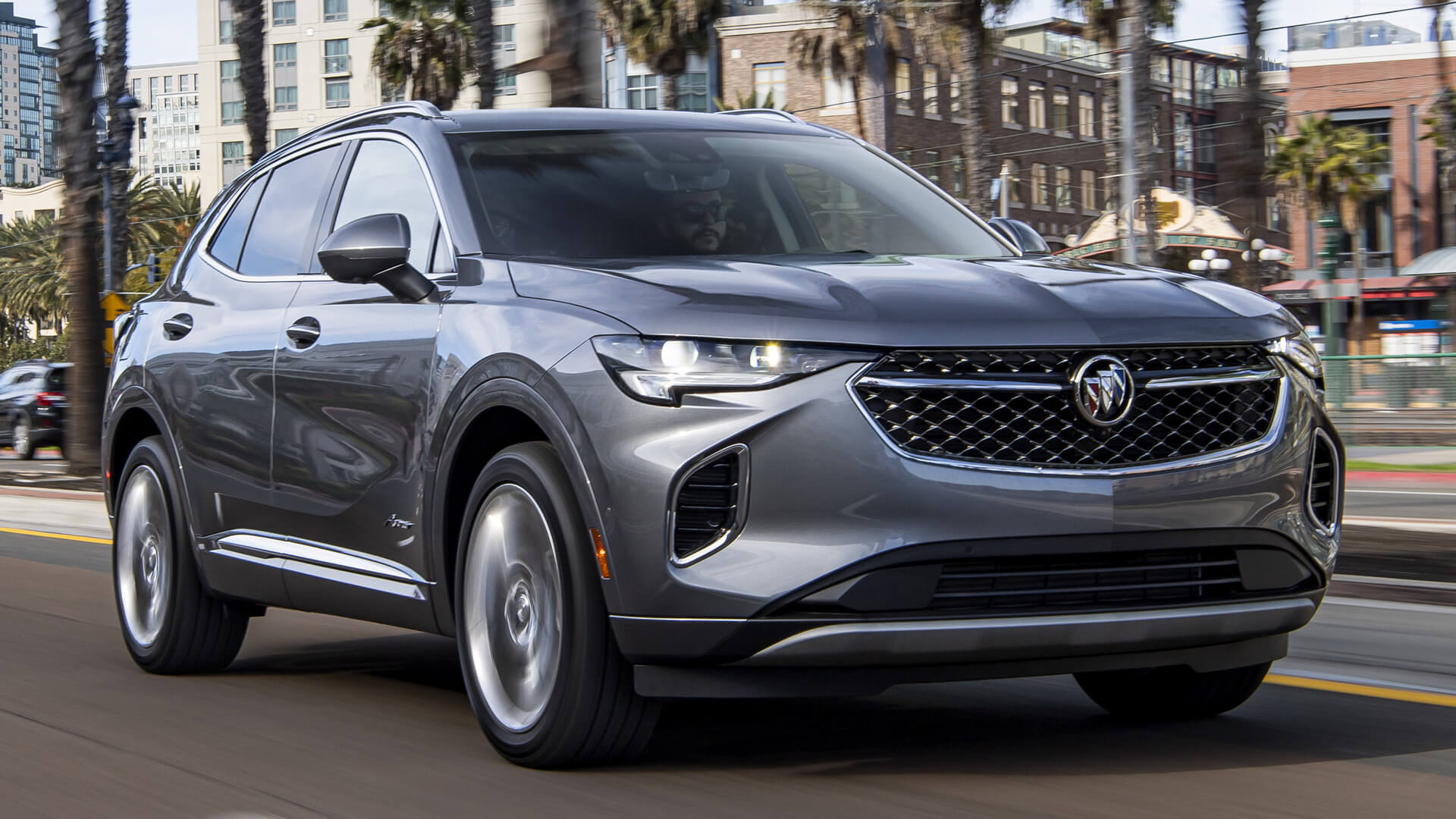
The second-generation Envision was revealed in 2020, for China — where it is called the Envision S — and North America. The design is stylish and modern, with LED headlights and tail lights, large 18- to 20-inch wheels and chrome trim around the body. Compared with the first generation it is 24 mm shorter, 44 mm wider and 55 mm lower, with a wheelbase 29 mm longer, which makes it look younger and more dynamic. For the first time there is a luxury Avenir version with its own grille and extra chrome.
The interior also improved, although it remains fairly traditional, with analogue instruments and a conventional multifunction steering wheel. A 10-inch colour touchscreen with Apple CarPlay and Android Auto takes centre stage, and the traditional clock on the console has gone. The dual-zone climate control keeps physical buttons, and the automatic gearbox is operated by buttons. The front seats have electric adjustment, heating and ventilation, and a head-up display and a Bose sound system are available.
The only engine is a 2.0-litre turbocharged four-cylinder, rated at 170 kW (228 hp) in the United States and 174 kW (237 PS) in China, paired with a nine-speed automatic and front- or all-wheel drive.
Rivals
The Envision competes with compact premium SUVs such as the Lexus NX, Infiniti QX50, Audi Q5, Acura RDX, Volvo XC60 and Lincoln Corsair.
Image credits · Photos from Wikimedia Commons under free licences
- Buick Envision I · Photo: Mr.choppers / Wikimedia Commons, CC BY-SA 3.0
- Buick Envision II · Photo: Elise240SX / Wikimedia Commons, CC BY-SA 4.0
Buick Envision in our rankings
- No. 315 of 912 · Longest-running car nameplates (12 years · top 35%)
- No. 148 of 305 · Oldest car models still on sale (12 years · top 50%)
- No. 314 of 345 · Cars with the most generations (2 generations)
In production longer than 65% of ranked nameplates in the 1CARS catalog (No. 315 of 912).
FAQ
Where is the Buick Envision made?
In China, by SAIC-GM at the Dongyue plant in Yantai. It was the first Chinese-built GM vehicle sold in the United States.
When was the Buick Envision launched?
In China in 2014 and in North America in 2016; the second generation followed in 2020.
What engine does the second-generation Buick Envision have?
A 2.0-litre turbo four-cylinder with 170 kW (228 hp) in the US, paired with a nine-speed automatic.
How big is the Buick Envision boot?
The first generation has 422 litres, or 1,555 litres with the rear seats folded.
Data sources
Data checked by an editor against the sources below.
- Wikipedia — Buick Envision
- NHTSA 5-Star Safety Ratings (US NCAP) — U.S. Government work, public domain