 Jeep Commander
Specs, engines and history
Published Sources (2) Report an error
By Felix Hartmann, Automotive Technology & EV Contributor
- Built
- 2005–2010
- Top power
- 268 kW (364 PS)
Which Commander to buy
Our verdict · Felix Hartmann
- For Europe: the 3.0 CRD diesel. It is the only engine ADAC lists for the whole 2006-2010 run, it has 510 Nm, tows 3,500 kg and uses far less fuel than the V8s.
- For towing and off-road work: a car with Quadra-Drive II and its electronic limited-slip differentials.
- For performance: the 2009-2010 5.7 Hemi with 268 kW (360 hp), mainly found in North America.
- For space: check the third row in person; with all seven seats up, only 212 litres of boot space remain.
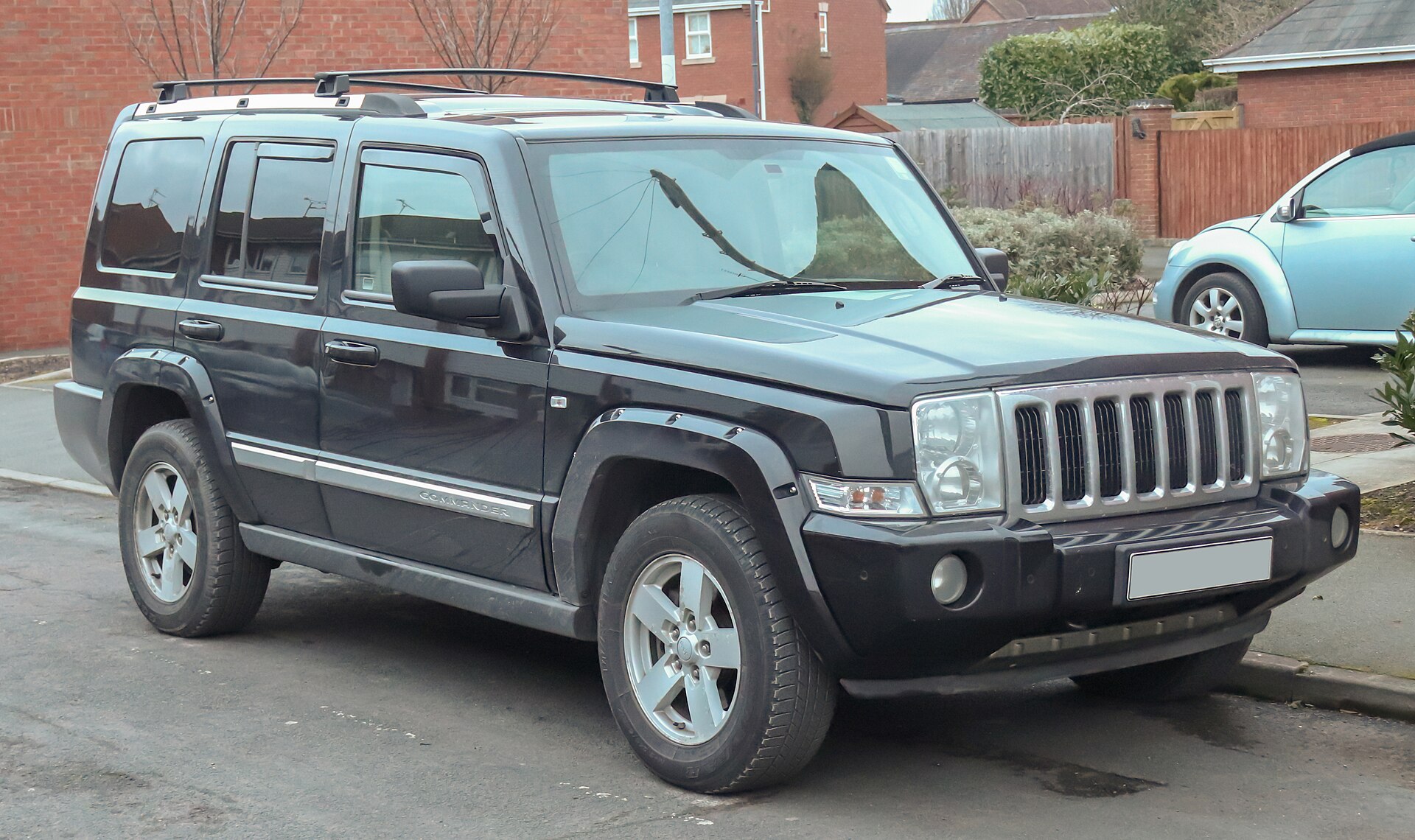
The Jeep Commander is a mid-size, seven-seat SUV that Jeep built from July 2005 to 2010, sold as the 2006 to 2010 model years. Under its square, upright body sat the WK platform and most of the hardware of the Grand Cherokee of the time, but with a stepped roof and three rows of seats. In Europe it was sold almost entirely as the 3.0 CRD diesel with 160 kW (218 PS), assembled by Magna Steyr in Graz, Austria.
In short
- Mid-size SUV with five or seven seats, one generation (XK, export version XH), 2005-2010.
- Built at Jefferson North Assembly in Detroit; the diesel export cars came from Magna Steyr in Graz.
- Engines from the 157 kW (210 hp) 3.7 V6 to the 268 kW (360 hp) 5.7 Hemi V8; in Germany the 3.0 CRD diesel, a 4.7 V8 and a 5.7 V8 were listed.
- Five-speed automatic throughout; German list prices from EUR 40,090 (4.7 V8, 2006) to EUR 66,290 (5.7 Overland, 2008).
Size at a glance
| Dimensions | Jeep Commander XK |
|---|---|
| Length | 4,787 mm188.5 in |
| Width | 1,899 mm74.8 in |
| Height | 1,826 mm71.9 in |
| Wheelbase | 2,780 mm109.4 in |
Specs by version
Engines
| Version | Engine | Power | Torque | Gearbox | Drive | Production years |
|---|---|---|---|---|---|---|
| Diesel · 1 version | ||||||
| 3.0 CRD | 3.0 l · 6 cyl · Diesel OM642 | 160 kW 218 PS215 hp | 510 Nm376 lb-ft | 5-sp Automatic | Four-wheel drive (4×4) | 2006–2010 |
| Petrol · 2 versions | ||||||
| 4.7 V8 | 4.7 l · 8 cyl · Petrol 4,701 cc | 170 kW 231 PS228 hp | 410 Nm302 lb-ft | 5-sp Automatic | Four-wheel drive (4×4) | 2006–2008 |
| 5.7 V8 | 5.7 l · 8 cyl · Petrol 5,654 cc | 240 kW 326 PS322 hp | 500 Nm369 lb-ft | 5-sp Automatic | Four-wheel drive (4×4) | 2006–2009 |
Performance
Show all 3 versions
| Version | 0–100 km/h | Top speed |
|---|---|---|
| Diesel · 1 version | ||
| 3.0 CRD | 9.0 s 0–62 mph | 191 km/h119 mph |
| Petrol · 2 versions | ||
| 4.7 V8 | 9.5 s 0–62 mph | 189 km/h117 mph |
| 5.7 V8 | 7.4 s 0–62 mph | 208 km/h129 mph |
Dimensions and weight
Verified Manufacturer and type-approval data from our catalog · Sources and methodology
Jeep Commander at a glance
| Specification | Jeep Commander (XK/XH) |
|---|---|
| Segment | Mid-size SUV, five or seven seats |
| Production | 18 July 2005 - 2010 (model years 2006-2010) |
| Plants | Jefferson North Assembly, Detroit, USA; Magna Steyr, Graz, Austria (XH diesel) |
| Platform | Chrysler WK, unibody, shared with the Jeep Grand Cherokee (WK) |
| Layout | Front engine, rear-wheel drive or four-wheel drive |
| Length / wheelbase | 4,788 mm / 2,781 mm |
| Kerb weight | 1,992-2,190 kg (US data); 2,305-2,425 kg (EU data, with driver) |
| Power range | 157-268 kW (210-360 hp) |
| Designer | Don Renkert (2002) |
The Commander is listed with the other models in our Jeep catalogue. It was designed in 2002 by Don Renkert and is easy to spot by its flat glass, exposed bolt heads on the bodywork and the roof rack that hides a step in the roofline. That step raises the second and third rows above the front seats, so rear passengers sit higher and see over the people in front.

Generations: one Commander, and a later namesake
The XK Commander had a single generation with no major facelift. Its export twin for diesel markets carried the code XH. Production ended after the 2010 model year, and the car was not directly replaced: Chrysler named the 2011 Dodge Durango as its successor in the USA, while Wikipedia's infobox also lists the later Grand Cherokee L as the three-row Jeep that took its place.
| Generation | Code | Years | Body styles | Engines | Power (kW / hp) |
|---|---|---|---|---|---|
| Commander | XK / XH | 2005-2010 | 5-door SUV, 5 or 7 seats | 3.7 V6, 4.7 V8, 5.7 Hemi V8, 3.0 V6 CRD diesel | 157-268 kW (210-360 hp) |
| Commander (Brazil, India as Meridian) | - | 2021- | 5-door SUV, 5 or 7 seats | 1.3 T270 turbo petrol, 2.0 Multijet II diesel | 125-136 kW (170-185 PS) |
The second row is a different car that only shares the name. Jeep revived the Commander badge in Brazil in August 2021 for a three-row SUV based on the Compass and its Small Wide platform, about 365 mm longer and with a 158 mm longer wheelbase. It is built in Goiana, Brazil, and in Pune, India, where it is sold as the Meridian; Japan has received it from India since October 2022. Brazil gets a 1.3-litre turbo petrol with 136 kW (185 PS) and 270 Nm, front-wheel drive and a six-speed automatic, or a 2.0 Multijet II diesel with 125 kW (170 PS), 380 Nm, a nine-speed automatic and four-wheel drive. Its boot holds 661 litres with five seats in use, 233 litres behind the third row and 1,760 litres with both rear rows folded. This later model has not been sold in the EU. China also had a separate Grand Commander from 2018, based on the Cherokee (KL).
Engines, transmissions and 4x4 systems
| Engine | Years | Power | Torque | Markets |
|---|---|---|---|---|
| 3.7 PowerTech V6 petrol | 2005-2010 | 157 kW (210 hp) | 319 Nm | North America and others |
| 4.7 PowerTech V8 petrol / E85 | 2005-2007 | 175 kW (235 hp) | 393 Nm | North America |
| 4.7 PowerTech V8 petrol / E85 | 2008-2009 | 227 kW (305 hp) | 453 Nm | North America |
| 5.7 Hemi V8 petrol | 2005-2008 | 246 kW (330 hp) | 502 Nm | North America |
| 5.7 Hemi V8 petrol | 2009-2010 | 268 kW (360 hp) | 529 Nm | North America |
| 3.0 CRD V6 diesel (Mercedes-Benz OM642) | 2006-2010 | 160 kW (218 PS) | 510 Nm | Europe and other export markets |
The German market was quoted slightly different petrol figures. ADAC lists the 4.7 V8 at 170 kW (231 PS) and 410 Nm, and the 5.7 V8 at 240 kW (326 PS) and 500 Nm, alongside the 3.0 CRD at 160 kW (218 PS) and 510 Nm.
| Version (Germany) | 0-100 km/h | Top speed | NEDC combined | CO2 |
|---|---|---|---|---|
| 3.0 CRD, 160 kW (218 PS) | 9.0 s | 191 km/h | 10.8 l/100 km | 284 g/km |
| 4.7 V8, 170 kW (231 PS) | 9.5 s | 189 km/h | 14.8 l/100 km | 352 g/km |
| 5.7 V8, 240 kW (326 PS) | 7.4 s | 208 km/h | 15.9 l/100 km | 377 g/km |
Every Commander used a five-speed automatic, either the W5A580 or the 545RFE. Base cars in the USA had rear-wheel drive. The four-wheel-drive systems came in three steps:
- Quadra-Trac I: full-time 4x4 without a low range, paired with the 3.7 V6.
- Quadra-Trac II: full-time 4x4 with a low range and a neutral position for flat towing, used with the V8s.
- Quadra-Drive II: adds electronic limited-slip differentials front and rear, plus skid plates for the fuel tank, front suspension and transfer case.
The front suspension uses short and long arms, the rear a five-link live axle. Ground clearance is 211 mm and the approach, departure and breakover angles are 34, 27 and 20 degrees, so the Commander is a genuine off-roader by mid-size SUV standards. The European diesel was approved to tow 3,500 kg braked.
Dimensions, seating and boot
| Parameter | Metric | Imperial |
|---|---|---|
| Length | 4,787-4,788 mm | 188.5 in |
| Width | 1,899-1,905 mm | 74.8-75.0 in |
| Height | 1,826-1,920 mm | 71.9-75.6 in |
| Wheelbase | 2,780-2,781 mm | 109.5 in |
| Kerb weight (EU, 3.0 CRD) | 2,355 kg | 5,192 lb |
| Boot, all seats in use | 212 l | 7.5 cu ft |
| Boot, rear seats folded (to window / to roof) | 1,028 / 1,940 l | 36.3 / 68.5 cu ft |
| Fuel tank | 77 l | 20.3 US gal |
| Braked towing (3.0 CRD) | 3,500 kg | 7,716 lb |
Base and Sport models seated five, with a third row optional; the Limited had seven seats as standard. With seven seats in place, the 212-litre boot is small for a car of this length, which is the price of fitting a third row into a body shorter than 4.8 m. At 1.9 m wide without mirrors, it is worth checking your parking space with our garage fit tool before buying.

Fuel economy and running costs
The Commander is a thirsty car. On the old NEDC cycle the 3.0 CRD was rated at 10.8 l/100 km combined (13.5 urban, 9.2 extra-urban) and 284 g/km of CO2, and it met the Euro 4 standard. The petrol V8s were rated at 14.8 l/100 km for the 4.7 and 15.9 l/100 km for the 5.7. With a 77-litre tank, the diesel covers roughly 700 km between fill-ups on the official figure. Our fuel cost calculator turns these numbers into a yearly bill for your own mileage.
Trims and equipment
| Trim | Years | Key equipment |
|---|---|---|
| Base / Sport | 2006-2010 | cloth seats, alloy wheels, six-speaker audio |
| Limited | 2006-2010 | leather, power front seats, six-disc CD changer, Boston Acoustics speakers |
| Overland | 2007-2009 | leather and suede seats, navigation, satellite radio, Command View sunroof |
| 65th Anniversary | 2006 | anniversary badges, dark 17-inch wheels, premium audio |
| Rocky Mountain | 2007-2009 | special badges, dark 17-inch wheels, premium audio |
In Germany, ADAC lists base, Sport, Limited and Overland versions, from EUR 40,090 for the 4.7 V8 (2006) and EUR 42,090 for the 3.0 CRD (2006) up to EUR 60,290 for the 3.0 CRD Overland and EUR 66,290 for the 5.7 Overland (2008). Options included Command View glass roof panels, a rear DVD screen with reversing camera, xenon headlights, hill descent control and a power tailgate.

Safety
Electronic stability control, traction control, roll mitigation, rear parking sensors, front dual-stage airbags, side curtain airbags, tyre pressure monitoring and a full-size spare wheel were standard. We found no Euro NCAP test of the Commander in the sources we used, so there is no European star rating to quote; our safety section covers models that Euro NCAP has rated.
Reliability and reception
We have no verified fault statistics for the Commander, and we do not repeat forum claims. What is on record is the reception. Car and Driver preferred the Commander to the Ford Explorer in a comparison test in November 2005, but Chrysler's later chief executive Sergio Marchionne criticised the car in strong terms. The market agreed with him: US sales fell from 88,497 cars in 2006 to 63,027 in 2007, 27,694 in 2008, 12,655 in 2009 and 8,115 in 2010. Over its life, about 217,000 Commanders were sold in the USA and about 2,000 in Mexico.
The diesel is the Mercedes-Benz OM642 V6. Ask for a complete service history, check the four-wheel-drive system and the automatic gearbox, and have the car inspected before you buy.
Rivals
| Model | Engines | Power (kW / hp) | Boot (l) | Price from (EUR) |
|---|---|---|---|---|
| Jeep Commander 3.0 CRD | 3.0 V6 diesel | 160 kW (218 PS) | 212-1,940 | 42,090 (Germany, 2006) |
| Jeep Commander 4.7 V8 | 4.7 V8 petrol | 170 kW (231 PS) | 212-1,940 | 40,090 (Germany, 2006) |
| Jeep Grand Cherokee (WK) | same engine family on the same platform | - | - | - |
| Ford Explorer (2006) | V6 and V8 petrol | - | - | not sold new in the EU |
The closest alternative is the Grand Cherokee (WK), which shares the platform, the engines and the 4x4 hardware but has two rows of seats. The comparison tool puts the Commander side by side with other seven-seat SUVs.
Jeep Commander in our rankings
- No. 35 of 391 · Heaviest cars (2,425 kg · top 9%)
- No. 14 of 155 · Biggest engines: SUVs and crossovers (5,654 cc · top 10%)
- No. 114 of 627 · Biggest engines: cars (5,654 cc · top 19%)
- No. 28 of 144 · Heaviest SUVs and crossovers (2,425 kg · top 20%)
- No. 44 of 175 · Most powerful diesel cars (160 kW · top 26%)
- No. 27 of 106 · Most torque: diesel cars (510 Nm · top 26%)
Heavier than 91% of ranked cars in the 1CARS catalog (No. 35 of 391).
FAQ
How many generations of the Jeep Commander are there?
One. The XK Commander was built from 2005 to 2010. The Commander sold in Brazil since 2021 (Meridian in India) is a different, Compass-based car.
Was the Jeep Commander sold in Europe?
Yes. Europe received the XH export version from 2006, built by Magna Steyr in Graz, mainly with the 3.0 CRD diesel. ADAC also lists 4.7 and 5.7 V8 petrol versions in Germany.
What is the fuel consumption of the Jeep Commander?
The 3.0 CRD diesel was rated at 10.8 l/100 km (NEDC). The 4.7 V8 was rated at 14.8 l/100 km and the 5.7 V8 at 15.9 l/100 km.
How big is the boot of the Jeep Commander?
212 litres with all seven seats in use, 1,028 litres to the window line with the rear seats folded and 1,940 litres to the roof.
Which engine does the Commander diesel use?
The 3.0-litre Mercedes-Benz OM642 V6 turbodiesel with 160 kW (218 PS) and 510 Nm.
Data sources
Data checked by an editor against the sources below.