Saleen — From Racing Mustangs to an American Supercar
Saleen is an American maker of high-performance cars from Southern California, founded in 1983 by the racing driver Steve Saleen. It made its name with modified Ford Mustangs, won SCCA championships with them and in 2000 launched the S7, a mid-engined supercar with a 7.0-litre V8. The company also assembled and painted the Ford GT for Ford. Its later history includes changes of ownership, a stock-market listing, a large joint venture in China that collapsed in 2020, and a current range that includes Mustang- and Bronco-based models.
Key takeaways
- Founded as Saleen Autosport in 1983 by Steve Saleen, a former Formula Atlantic driver; the first three Saleen Mustangs were built in 1984.
- Won the SCCA Drivers' Championship in 1987 and raced at Le Mans for the first time in 1997.
- The S7 of 2000 had 410 kW (550 hp); the twin-turbo version of 2005 had 559 kW (750 hp). The S7-R won its class at Le Mans in 2010.
- A Chinese joint venture, Jiangsu Saleen, was formed in 2017; its factory closed in February 2020 and a court seized its assets.
Saleen at a glance
| Fact | Value |
|---|---|
| Founded | 1983 as Saleen Autosport |
| Founder | Steve Saleen (born 1949, Inglewood, California) |
| Base | Southern California (Irvine from 2001) |
| First cars | Three Mustang hatchbacks, 1984 |
| Best-known models | S281 Mustang, SR, S7, S1, Sportruck |
| Racing | SCCA titles from 1987; Le Mans class win in 2010 (S7-R) |
| Contract work | Ford GT assembly and paint, Dodge Viper paint |
| China | Jiangsu Saleen Automotive Technology, 2017–2020 |
Origins: Steve Saleen and the first Mustangs
Stephen Mark Saleen was born in Inglewood, California, on 2 April 1949 and studied business at the University of Southern California. He raced in Formula Atlantic, finishing third in the series standings in 1980, and in 1982 moved to the SCCA Trans-Am series in a Ford Mustang. In 1983 he formed Saleen Autosport.
The first production run in 1984 was just three Mustang hatchbacks: one white, one copper and one black. A Saleen Mustang won its class in the Mosport 24-hour race that year. In 1985 a certified centrifugal supercharger was fitted to a production car for the first time, and in 1986 the company entered SCCA racing and won the 24 Hours of Mosport. In 1987 it took the SCCA Drivers' Championship along with the team, manufacturer and tyre titles, and in 1988 its cars finished first, second and third at Mosport.

The 1990s: S351, SR and Le Mans
Saleen Performance Parts was set up in 1990, the team entered the Trans-Am series, and in 1991 it won the SCCA Race Truck championship. In 1993 the company built a one-off S302 for the actor Tim Allen, and in 1995 the two men, with Bob Bondurant, formed the Saleen/Allen "RRR" Speedlab team. The S351 of 1994 had an engine of 351 cu in built by Saleen itself, and the SR Widebody won the SCCA Manufacturers' Championship in 1996. That year Steve Saleen was inducted into the Mustang Hall of Fame together with Carroll Shelby.
The S281 became the core product from 1996. Based mainly on the Mustang GT with its 4.6-litre V8, it began at 164 kW (220 hp) and, with superchargers and later Mustang generations, reached up to 410 kW (550 hp). Special editions included 300 H-281 Dan Gurney cars, 100 each in blue, red and white, named after Dan Gurney. In 1997 the team raced at Le Mans for the first time, Steve Saleen co-drove a Mustang SR there, the XP8 Explorer SUV was introduced, and the company was restructured as Saleen, Inc.

The S7 and the S7-R
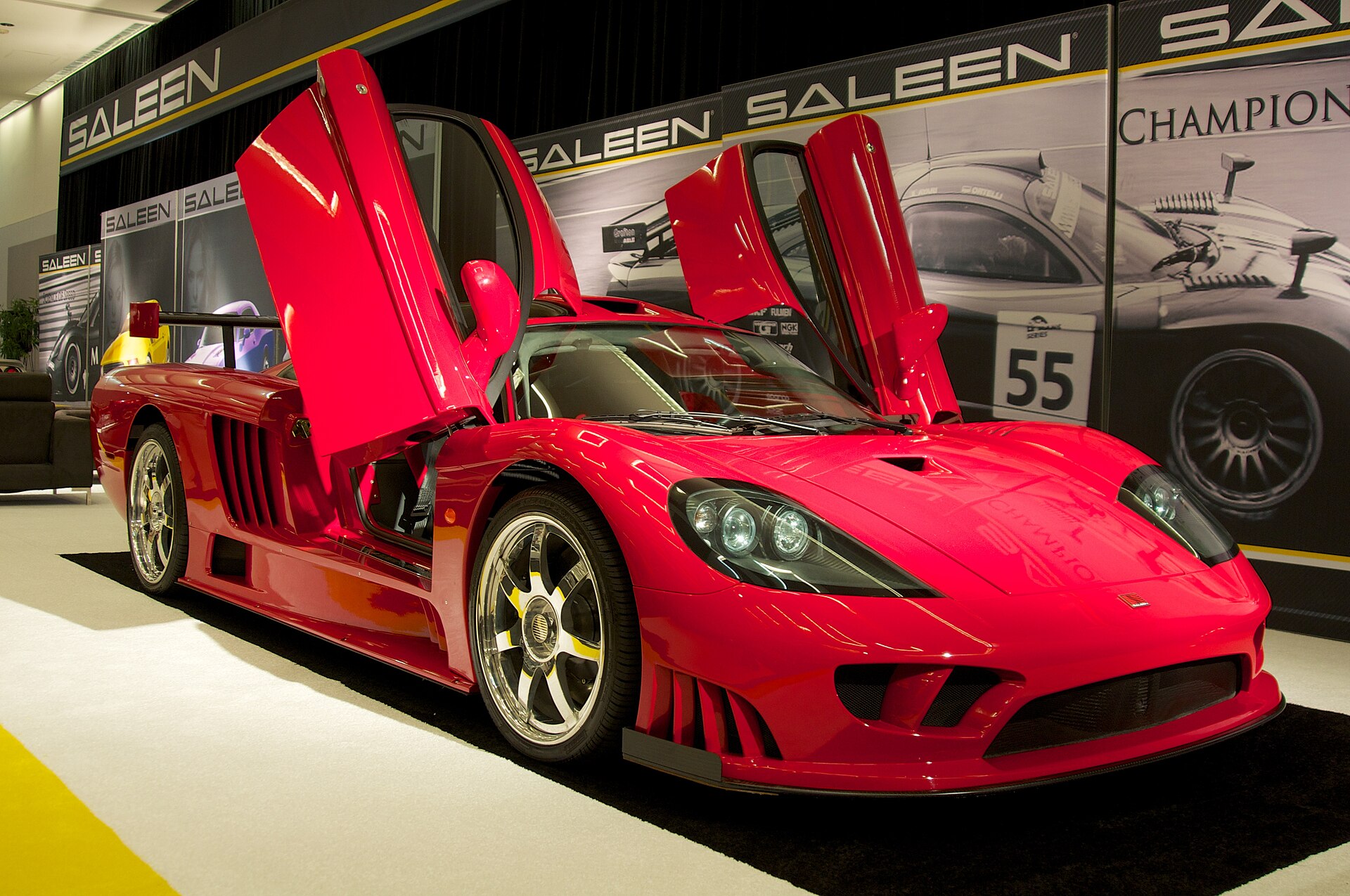
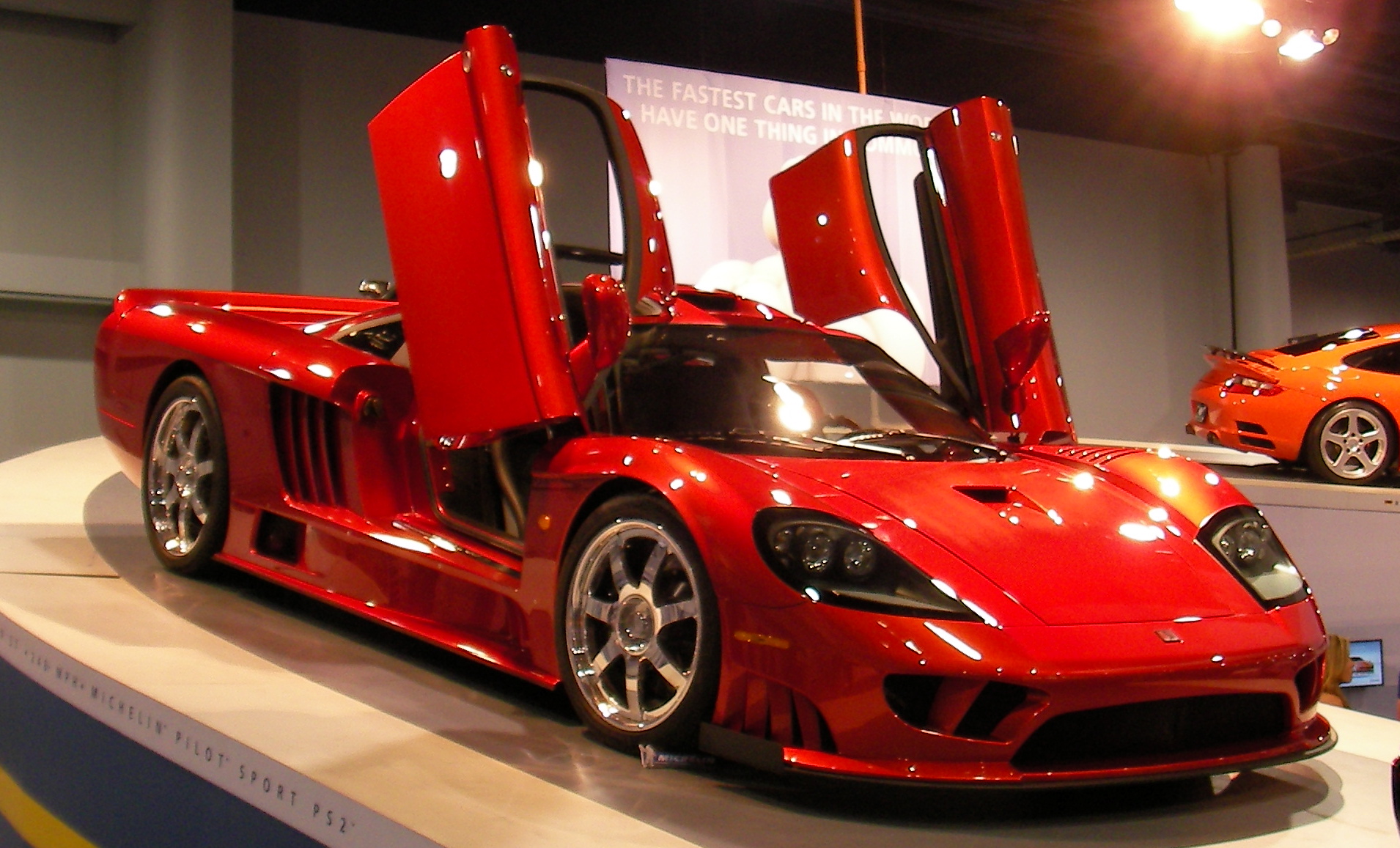
The S7 was presented on 19 August 2000 at the Monterey Historic Races, initially priced at just under US$400,000 in 2000. Steve Saleen led the concept and engine work, and Phil Frank was responsible for the aerodynamic, body and interior design. The mid-mounted 7.0-litre V8, a bored and stroked derivative of Ford's small-block engine, produced 410 kW (550 hp) at 6,400 rpm in a car with a kerb weight of 1,300 kg. That is about 315 W per kg, which the power-to-weight calculator can set against any other car. A top speed of 354 km/h was claimed but never confirmed in testing. The twin-turbo S7 of 2005 raised output to 559 kW (750 hp).
The S7-R racing version appeared in 2001; 14 were completed ready to race. In 2004 Vitaphone's S7-R won outright at Imola in the FIA GT Championship, ahead of Ferrari and Maserati, and took three wins that season. ACEMCO finished eleventh at Le Mans in 2006, and in 2010 an S7-R prepared by Oreca for Larbre Compétition won the LMGT1 class, the model's only class win at Le Mans. The Saleen S7 article covers the car's specifications and racing career.

Ford GT work and the 2000s
In the same years the company grew as a supplier. In 2001 it moved to a 100,000 sq ft plant in Irvine, and in 2002 it won the contract to assemble and paint the Ford GT, which made it a tier-1 Ford supplier. A 203,000 sq ft facility in Troy, Michigan, built the GT from 2004. In 2007 the company painted bodies for the Dodge Viper, showed the S5S Raptor concept and built the Bumblebee and Barricade cars for the film Transformers.
Steve Saleen himself resigned from Saleen, Inc. in March 2007. In March 2008 he announced SMS Supercars, and in 2009 it released the SMS570 Dodge Challenger. In 2010 and 2011 the owner of the name, Revstone, built 42 Saleen Mustangs in Detroit, while Steve Saleen sold his cars under the SMS badge.
New owners, the return and the China venture
By the end of 2011 an agreement allowed Steve Saleen to use the name again, and in April 2012 he announced his return to the brand. On 26 June 2013 the company went public through a reverse merger, with Steve Saleen as controlling shareholder. It unveiled the FOURSIXTEEN, a modified Tesla Model S, in August 2014, but ended that year with significant debt. On 12 October 2017 the US Securities and Exchange Commission revoked the registration of its shares, and the company became private again.
In 2017 Steve Saleen and Charlie Wang formed Jiangsu Saleen Automotive Technology in Rugao, China. The S1 sports car, unveiled at the 2017 Los Angeles show, had a 2.5-litre turbocharged four-cylinder of 336 kW (457 PS) and weighed 1,218 kg; plans for 1,500 cars a year did not materialise. The MaiMai electric microcar of 2019 sold only 27 units by April 2021. The Rugao factory closed in February 2020, a court in Nantong seized the venture's assets in June 2020, and the Chinese government accused Wang of embezzling state funds. The court put the company up for auction on 30 May 2022.
In the United States the range listed by the company includes the 302 Mustang (354–597 kW), the Sportruck pickups, the Bronco-based BIG OLY, the S1 and the GTX saloon. Saleen models are listed in the Saleen catalogue, and other fast American cars are in the supercars section.
Saleen timeline
| Year | Event |
|---|---|
| 1983 | Steve Saleen forms Saleen Autosport |
| 1984 | First three Saleen Mustangs |
| 1987 | SCCA Drivers' Championship |
| 1994 | S351 with a Saleen-built engine |
| 1996 | S281; SR Widebody wins SCCA Manufacturers' title |
| 1997 | First Le Mans entry; Saleen, Inc. |
| 2000 | S7 presented at Monterey (19 August) |
| 2002 | Ford GT assembly and paint contract |
| 2005 | Twin-turbo S7 with 559 kW |
| 2007 | Steve Saleen resigns (March) |
| 2010 | S7-R wins the LMGT1 class at Le Mans |
| 2013 | Public listing through a reverse merger (26 June) |
| 2017 | Jiangsu Saleen joint venture; S1 unveiled |
| 2020 | Rugao factory closes (February) |
Landmark Saleen models
| Model | Years | Why it matters |
|---|---|---|
| Saleen Mustang | 1984 onwards | The car that started the company |
| S351 | 1994 | First Saleen-built engine |
| S281 | 1996–2009 | Core Mustang model, 164–410 kW |
| S7 | 2000 onwards | Mid-engined 7.0-litre supercar |
| S7-R | 2001 onwards | FIA GT winner, Le Mans class winner 2010 |
| S1 | 2018–2019 | Turbo four-cylinder sports car of the China era |
Photo gallery


FAQ
Who founded Saleen?
Steve Saleen, a former Formula Atlantic and Trans-Am driver, who formed Saleen Autosport in 1983 and built the first Saleen Mustangs in 1984.
How powerful is the Saleen S7?
The naturally aspirated S7 of 2000 had 410 kW (550 hp); the twin-turbo version of 2005 had 559 kW (750 hp).
Did Saleen build the Ford GT?
Saleen won the contract to assemble and paint the Ford GT in 2002 and built it at a facility in Troy, Michigan, from 2004.
What happened to Saleen in China?
The Jiangsu Saleen joint venture formed in 2017 closed its Rugao factory in February 2020. A court seized its assets in June 2020 and put the company up for auction in May 2022.
Does Saleen still make cars?
The company still lists modified Mustangs, Sportruck pickups, the BIG OLY, the S1 and the GTX saloon in its range.
Sources
- Wikipedia — Saleen (accessed 24 Oct 2026)
- Wikipedia — Steve Saleen (accessed 24 Oct 2026)
- Wikipedia — Saleen S7 (accessed 24 Oct 2026)
- Wikipedia — Saleen S281 (accessed 24 Oct 2026)
- Wikipedia — Saleen S1 (accessed 24 Oct 2026)
Found a mistake? Report an error