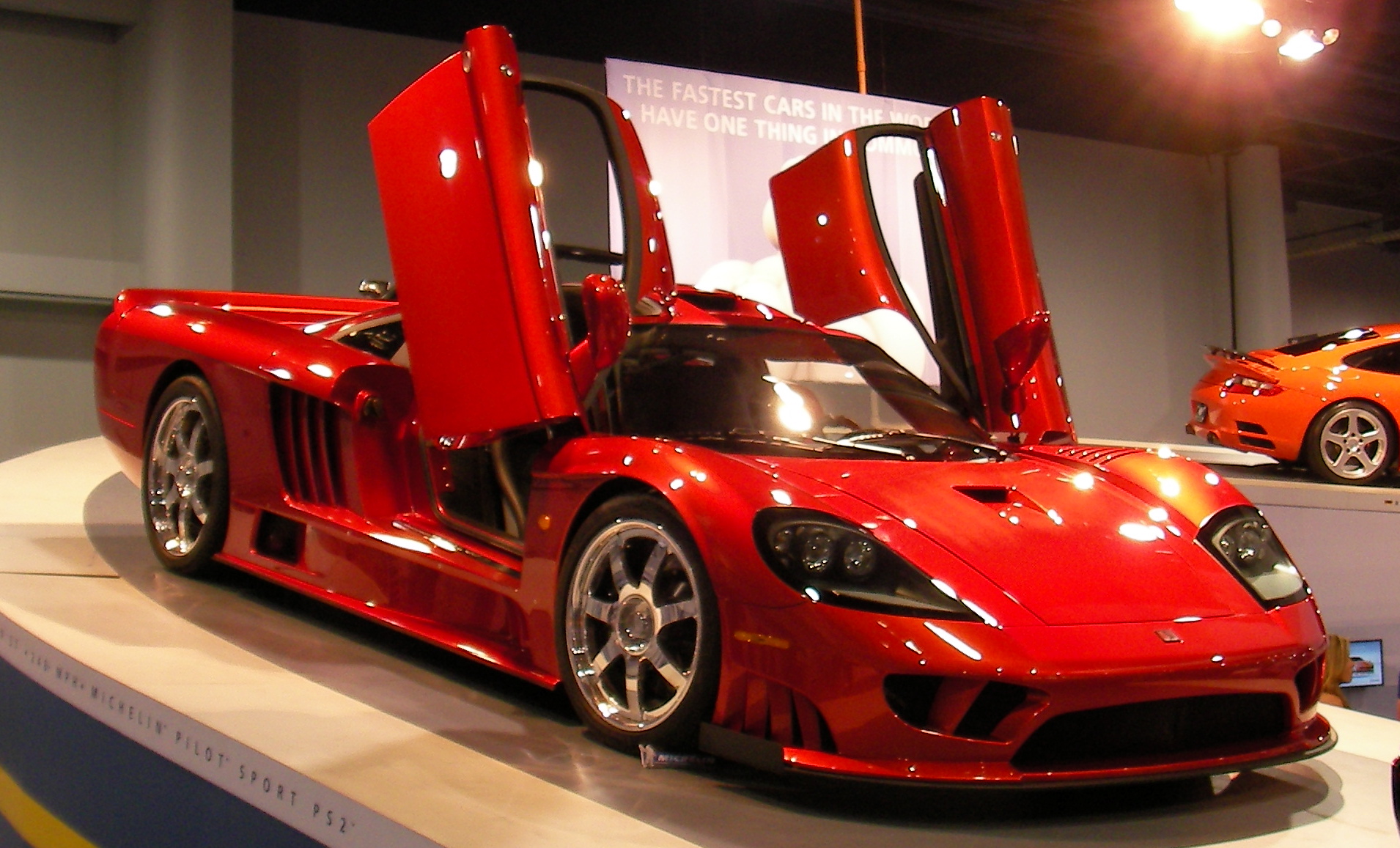
Saleen S7
Specs, engines and history
Published Sources (1) Report an error
By Felix Hartmann, Automotive Technology & EV Contributor
- Built
- 2000–2009
- Top power
- 559 kW (760 PS)
Which Saleen S7 to choose
Our verdict · Felix Hartmann
- S7 (2000–2004): the naturally aspirated original, with 410 kW and the cleaner first aerodynamics.
- S7 Twin Turbo (2005–2009): 559 kW, 949 Nm and 60 % more downforce from the revised diffusers and spoiler.
- Competition package (2006): about 746 kW, uprated suspension and revised aerodynamics.
- S7R: a race car; only 14 were completed, so each has its own history.
Saleen is the Californian company of Steve Saleen, a former Formula Atlantic driver who set up Saleen Autosport in 1983 to build faster Ford Mustangs. The first production run, in 1984, was just three cars. Saleen went on to build the SR racer of 1995 and the S281 Mustang. In 2002 it won the contract to assemble and paint the Ford GT, which made it a tier-1 supplier to Ford. Its later years were turbulent: the company went public through a reverse merger on 26 June 2013, was close to bankruptcy by the end of 2014 and became private again in 2017. It is now based in Corona, California.
The S7 is the car that made Saleen a name outside the Mustang world. Shown on 19 August 2000 at the Monterey Historic Races, it was Saleen's first fully proprietary car and its only production model not based on an existing design or chassis. English Wikipedia counts it as America's sixth mid-engined production sports car, after the Pontiac Fiero, Consulier GTP, Mosler Raptor and the Vector W8 and M12. It was built in Irvine, California, from 2000 to 2009. The racing S7R won its class at Le Mans in 2010.
Specs by version
Engines
Dimensions and weight
Show all 2 versions
| Version | Kerb weight |
|---|---|
| 7.0 V8 | 1,300 kg2,866 lb |
| 7.0 V8 Twin Turbo | 1,300 kg2,866 lb |
Verified Manufacturer and type-approval data from our catalog · Sources and methodology
In short
- Mid-engined two-seat coupé with butterfly doors, a 4130 steel spaceframe with aluminium honeycomb panels and an all-carbon-fibre body; kerb weight 1,300 kg.
- 427 cu in (7.0-litre) all-aluminium V8 built in-house: 410 kW (550 hp) at 6,400 rpm.
- Twin Turbo from 2005: 559 kW (750 hp) at 6,300 rpm and 949 Nm, estimated top speed 402 km/h (250 mph).
- At launch in 2000 it cost just under US$400,000; 14 race-ready S7Rs were completed.
Saleen S7 at a glance
| Specification | Value |
|---|---|
| Maker | Saleen, Irvine, California |
| Production | 2000–2009 |
| Designers | Steve Saleen (concept, direction, engine) and Phil Frank (aerodynamics, body and interior CAD) |
| Body | two-door coupé with butterfly doors |
| Layout | rear mid-engine, rear-wheel drive |
| Chassis | 4130 steel spaceframe, aluminium honeycomb composite panels, carbon-fibre body |
| Engine | 7.0 l (427 cu in) all-aluminium V8; twin-turbo from 2005 |
| Power | 410 kW (550 hp); Twin Turbo 559 kW (750 hp) |
| Torque | Twin Turbo 949 Nm at 4,800 rpm |
| Gearbox | six-speed manual |
| Length × width × height | 4,775 × 1,981 × 1,041 mm |
| Wheelbase | 2,700 mm |
| Kerb weight | 1,300 kg |
Development and the Monterey debut
Steve Saleen led the concept, direction and engine work, and Hidden Creek Industries provided resources and the first funding. Phil Frank did the aerodynamic, body and interior design in CAD. The S7 made its debut on 19 August 2000 at the Monterey Historic Races. Saleen developed the racing S7R alongside it. The British firm Ray Mallock Ltd (RML) assembled the first few S7Rs in Britain under Saleen's engineering supervision.
The S7 also fitted Saleen's growing links with Ford: two years later Saleen won the contract to assemble the Ford GT. That car's story is in our article on the Ford GT revival.
Design, chassis and aerodynamics
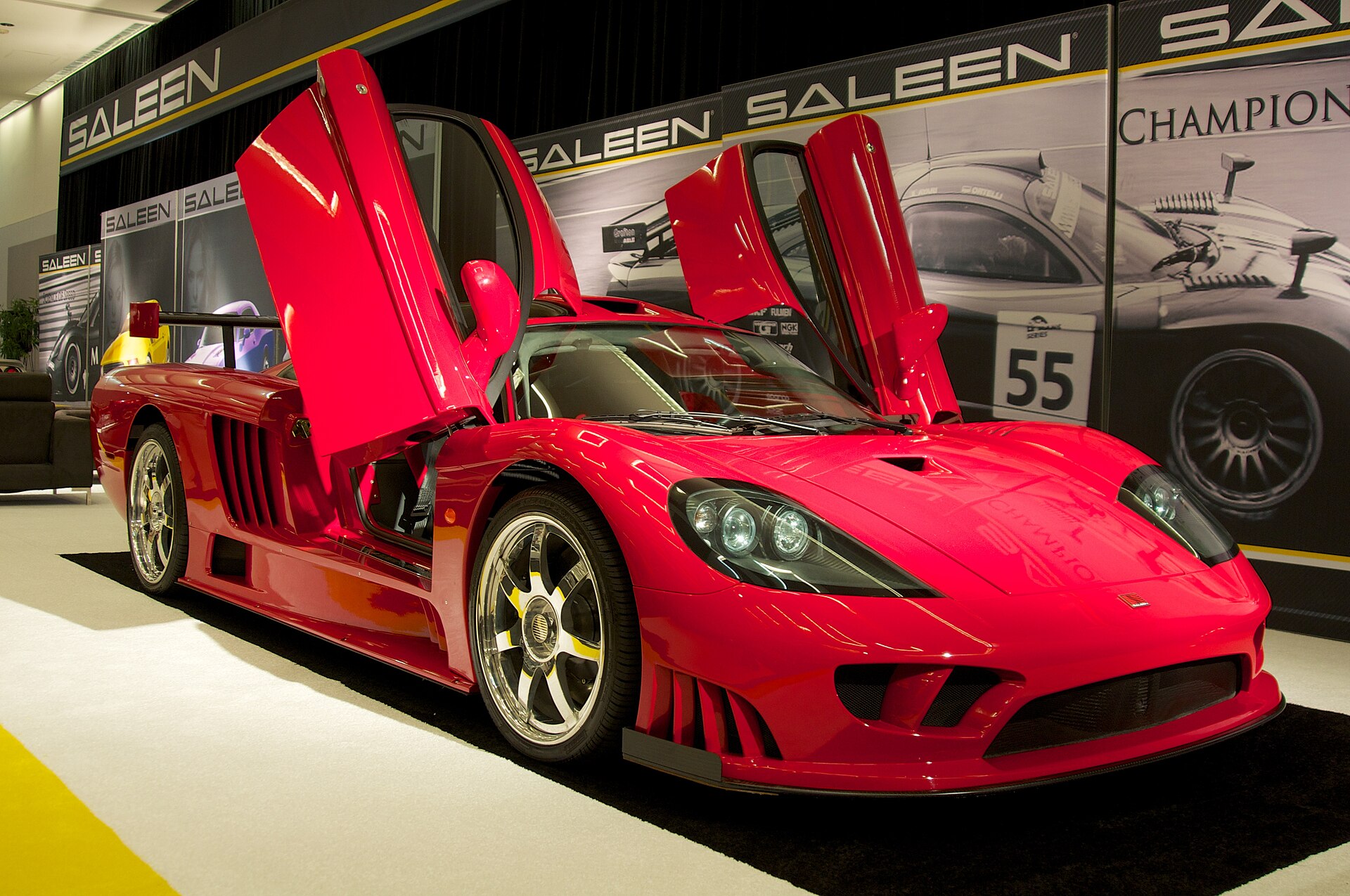
The body is made entirely of carbon fibre, with scoops and spoilers that split the airflow in what Saleen called "Split Channel" aerodynamics. At 160 mph (257 km/h) the car produces its own weight in downforce. Underneath is a space frame of lightweight 4130 steel, reinforced with aluminium honeycomb composite panels and divided into bolted sub-assemblies.
| Item | Detail |
|---|---|
| Front / rear track | 1,748 / 1,710 mm |
| Tyres | 325/650R18 front, 325/705R18 rear |
| Luggage | two boots, front and rear, with custom-fitted luggage |
| Doors | butterfly-opening |
Inside, the S7 has leather with aluminium details, an LCD screen with a rear-view camera, a quick-release steering wheel and a 240 mph (390 km/h) speedometer. The driver's seat is offset towards the centre of the car.
Engines and performance
The S7's V8 is Saleen's own, built in-house. It is a bored and stroked derivative of Ford's small-block design with Cleveland-style canted-valve heads, not the FE big-block. The infobox labels it a Ford Windsor V8.
| Version | Years | Engine | Power | Torque | Top speed |
|---|---|---|---|---|---|
| S7 | 2000–2004 | 7.0 l V8, naturally aspirated | 410 kW (550 hp) at 6,400 rpm | - | claimed 354 km/h (220 mph), never confirmed |
| S7 Twin Turbo | 2005–2009 | 7.0 l V8, two Garrett turbos at 0.38 bar | 559 kW (750 hp) at 6,300 rpm | 949 Nm at 4,800 rpm | estimated 402 km/h (250 mph) |
| Competition package | 2006 | Twin Turbo, uprated | about 746 kW (1,000 hp) | - | - |
Manufacturer and press figures for the naturally aspirated car give 0–60 mph in about 3.3 seconds, 0–100 mph (161 km/h) in about 7.6 seconds and a standing quarter-mile in about 11.36 seconds at 127 mph (204 km/h). The Twin Turbo also received reworked front and rear diffusers and a new rear spoiler that raised downforce by 60 %. The Competition package of 2006 added about a third more power, suspension changes, revised diffusers and an optional carbon-fibre spoiler package.
With 410 kW for 1,300 kg, the original S7 has about 315 kW per tonne, and the Twin Turbo about 430 kW per tonne. The power-to-weight calculator compares those figures with other supercars.


S7 LM: the 2017 revival
Saleen announced the S7 LM in 2017, with a full-width rear wing, side skirts, underbody channels and forged wheels. The 2017 car had 969 kW (1,300 hp). The 2019 update had 1,119 kW (1,500 hp) and, by English Wikipedia's text, 1,895 Nm of torque; the cited Autoblog headline gives a lower figure. Saleen claimed 0–100 km/h in 2.2 seconds and a top speed of 480 km/h (298 mph), but how many cars would be built was never clear.
Saleen S7R in racing
| Item | S7R |
|---|---|
| Built | 14 completed race-ready; seven more reached VIN stage but were never finished |
| Assembly | RML for the first cars, then Saleen; Oreca did final outfitting from 2006 |
| Power with two restrictors | about 471 kW (631 hp), 827 Nm (610 lb-ft) |
| Power unrestricted | 567 kW (760 hp), 1,003 Nm (740 lb-ft) |
The first S7R raced in the American Le Mans Series at Laguna Seca in 2000 and finished 26th. In 2001 Konrad Motorsport took a class win at the 12 Hours of Sebring, and RML won the European Le Mans Series by one point. In 2002 Park Place Racing won the Grand American title and Graham Nash Motorsport took the British GT and Spanish GT championships. In 2004 at Imola, Vitaphone's S7R with Michael Bartels and Uwe Alzen won outright against Maserati MC12s, Ferrari 550s and 575s and Lamborghini Murciélagos. Vitaphone won three FIA GT races that year.
Oreca won two Le Mans Series races and the French FFSA GT title in 2006 and four races in 2007. The biggest result came in 2010: Larbre Compétition's Oreca-assembled chassis 610 won the LMGT1 class at the 24 Hours of Le Mans.

How the Saleen S7 compares
| Car | Years | Engine | Power | Notes |
|---|---|---|---|---|
| Saleen S7 Twin Turbo | 2005–2009 | 7.0 l twin-turbo V8 | 559 kW (750 hp) | 1,300 kg |
| Saleen S7 | 2000–2004 | 7.0 l V8 | 410 kW (550 hp) | naturally aspirated |
| Vector W8 | 1989–1993 | 6.0 l twin-turbo V8 | 466 kW (625 hp) | earlier American mid-engined car |
More fast cars of the period are in our supercars section, and the rest of the brand is in the Saleen catalogue.
Photo gallery


Saleen S7 in our rankings
- No. 3 of 170 · Most powerful cars of the 2000s (559 kW)
- No. 9 of 79 · Power-to-weight: coupes (430 kW/t)
- No. 9 of 301 · Power-to-weight: cars (430 kW/t)
- No. 25 of 368 · Most torque: cars (949 Nm · top 7%)
- No. 73 of 859 · Most powerful cars (559 kW · top 9%)
- No. 15 of 154 · Most powerful V8 cars (559 kW · top 10%)
More powerful than 98% of ranked cars of the 2000s in the 1CARS catalog (No. 3 of 170).
FAQ
How much horsepower does a Saleen S7 have?
The original S7 has 410 kW (550 hp) from its 7.0-litre V8. The Twin Turbo of 2005 has 559 kW (750 hp) and 949 Nm, and the 2006 Competition package about 746 kW (1,000 hp).
What engine is in the Saleen S7?
A 427 cu in (7.0-litre) all-aluminium V8 built by Saleen, derived from Ford's small-block design with Cleveland-style canted-valve heads; from 2005 it has two Garrett turbochargers.
How fast is the Saleen S7 Twin Turbo?
Saleen estimated its top speed at 250 mph (402 km/h); the naturally aspirated car's claimed 220 mph (354 km/h) was never confirmed in testing.
How many Saleen S7R race cars were built?
Fourteen S7Rs were completed race-ready, and seven more reached the stage of getting VINs but were never finished.
Did the Saleen S7 win Le Mans?
It won its class. Larbre Compétition's S7R, chassis 610, took the LMGT1 class at the 2010 24 Hours of Le Mans; in 2004 a Vitaphone S7R won the FIA GT race at Imola outright.
Data sources
Data checked by an editor against the sources below.