Ruf — From a Bavarian Garage to the Yellowbird and Beyond
Ruf Automobile is a small German car maker in Pfaffenhausen, Bavaria, that builds high-performance cars based on, and later inspired by, the Porsche 911. It began as Alois Ruf Sr.'s service garage in 1939 and turned to Porsche work under his son, Alois Ruf Jr., from the 1970s. Its CTR "Yellowbird" of 1987 reached about 340 km/h in a magazine test, faster than any production car of its time. Unlike a tuner, Ruf is treated as a manufacturer: its cars carry their own vehicle identification numbers.
Key takeaways
- Founded in 1939 in Pfaffenhausen by Alois Ruf Sr. as a service garage; still family-owned.
- Alois Ruf Jr. took over in 1974 at the age of 24; the first complete Ruf model, a 3.3-litre 911 Turbo, followed in 1977.
- The CTR of 1987 had 345 kW (469 PS); Road & Track measured it at 211 mph (340 km/h) in 1987.
- The CTR3 of 2007 was the first Ruf with its own chassis and body; the CTR Anniversary of 2017 marked 30 years of the CTR.
Ruf at a glance
| Fact | Value |
|---|---|
| Founded | 1939, Pfaffenhausen, Bavaria |
| Founder | Alois Ruf Sr. |
| Head since 1974 | Alois Ruf Jr. |
| Status | Manufacturer with its own VINs, family-owned |
| First complete model | Turbo 3.3, 1977 |
| Best-known cars | BTR, CTR "Yellowbird", CTR2, CTR3, SCR |
| CTR top speed | 340 km/h (Road & Track, 1987); 342 km/h (Auto Motor und Sport, 1988) |
| Base cars | Porsche 911 generations; own chassis from the CTR3 |
Origins: a garage in Pfaffenhausen
Alois Ruf Sr. founded Auto Ruf in Pfaffenhausen in 1939 as a service garage, and in 1949 the business added a full-service petrol station. In the late 1940s he began to experiment with designs of his own, and in 1955 he built a tour bus that was sold around Germany, later starting a separately owned bus company.
His son brought the Porsche connection. From 1960 Alois Ruf Jr., a keen admirer of the 911, serviced and restored Porsches in his father's garage. When Alois Sr. died in 1974, his son took control of the business at the age of 24, and in 1975 the first Ruf-enhanced Porsche was completed.

Turbo 3.3, SCR and BTR
The first complete model came in 1977: a Porsche 911 Turbo with an engine stroked to 3.3 litres, 223 kW (303 PS), 412 Nm and a top speed of 262.8 km/h. In 1978 the SCR 3.2 followed, the first complete car from Pfaffenhausen without a turbocharger, with 158 kW (215 PS) and 255 km/h; it attracted many customer orders.
The BTR, built from 1983 to 1989, used a 3.4-litre turbocharged flat-six with 276 kW (375 PS) and 480 Nm and reached 305 km/h. Because the German government treats the company as a full manufacturer, its cars carry their own vehicle identification numbers rather than Porsche ones.


The CTR Yellowbird
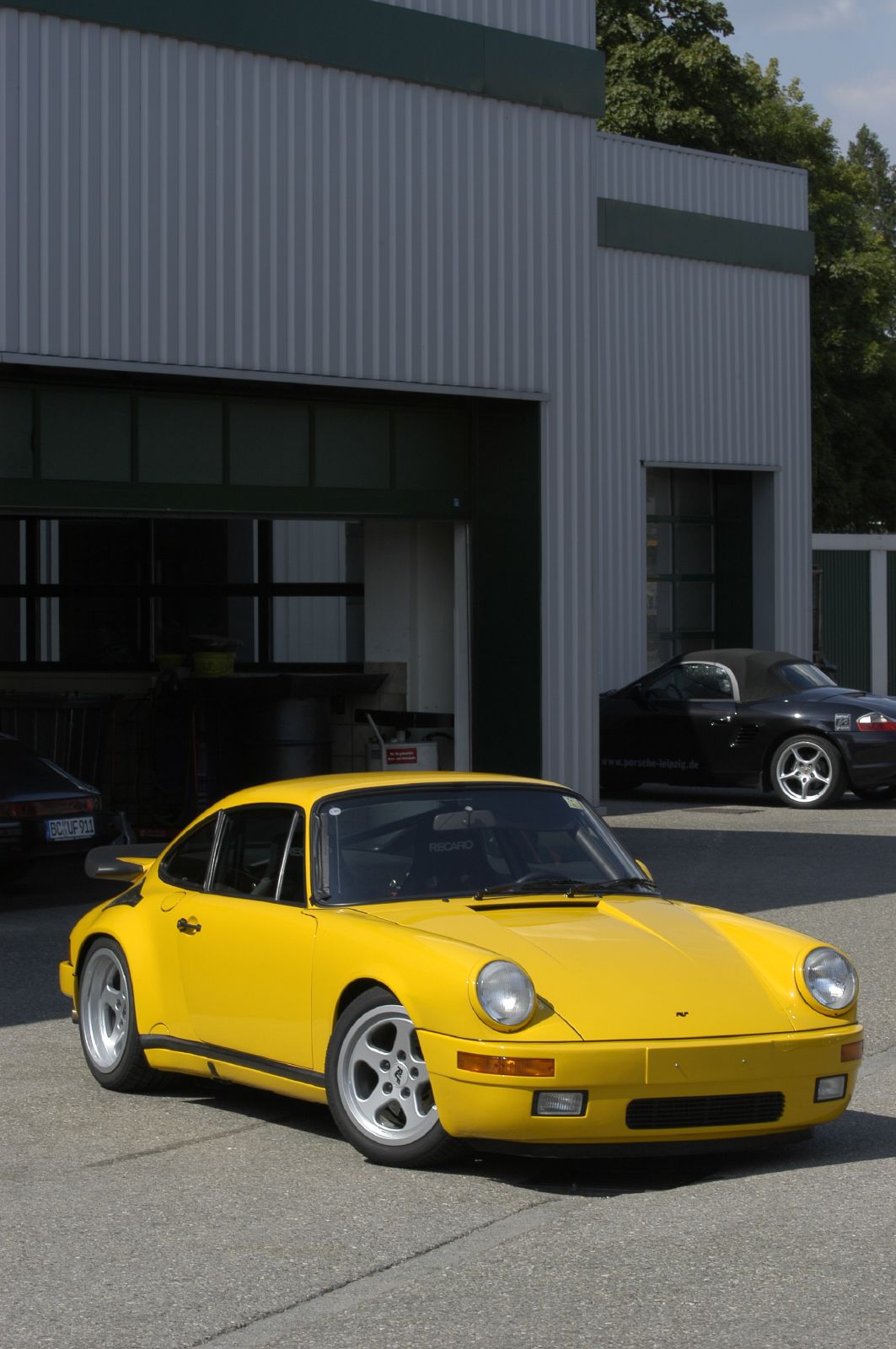
The CTR of 1987 made the name famous. It was based on the 911 Carrera 3.2 rather than the 930 Turbo. The twin-turbocharged 3,367 cc flat-six produced 345 kW (469 PS) at 5,950 rpm and 553 Nm, and the car weighed 1,150 kg. That is exactly 300 W per kg, a ratio the power-to-weight calculator shows for any modern car.
In Road & Track's 1987 test of the world's fastest cars it recorded 211 mph (340 km/h), and in 1988 Auto Motor und Sport measured 342 km/h at the Nardò ring. Both figures were above the 321 km/h claimed for the Ferrari F40. The company's film of test driver Stefan Roser lapping the Nürburgring in 1989 became widely known. Twenty-nine CTRs were built from new Porsche bodies, plus about 20 to 30 conversions of customers' Carreras. At its debut in late 1987 the price was US$142,900 in the United States. The Ruf CTR Yellowbird article covers the car in detail.
CTR2, Turbo R and the 1990s–2000s
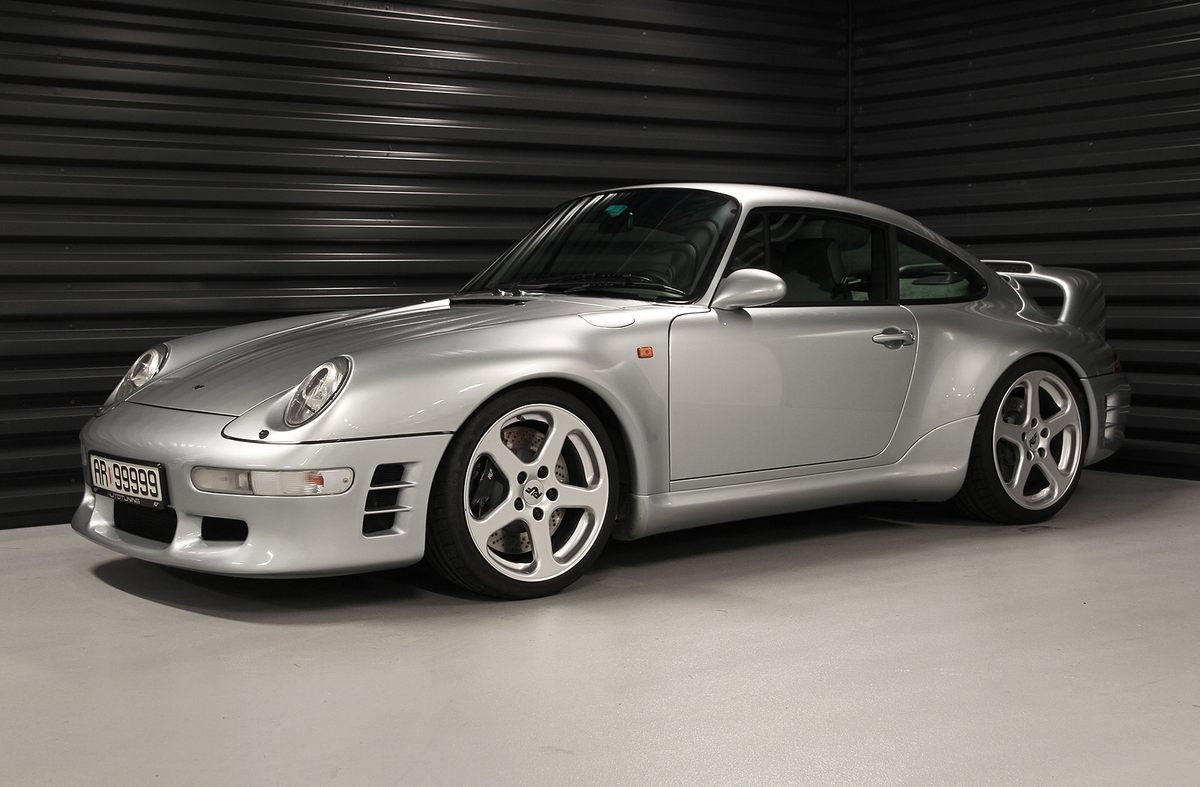
The CTR2 of 1995–1997 was based on the 993-generation 911 Turbo. Its air-cooled 3.6-litre twin-turbo flat-six, derived from the engine of the Porsche 962 racing car, produced 388 kW (520 hp), later 433 kW (580 hp), and the car reached 350 km/h. Sixteen standard cars and twelve CTR2 Sport versions were built, and for a short time the CTR2 was the fastest road-legal production car until the McLaren F1 passed it in 1998.
The Turbo R of 1998 had 365 kW (496 PS) and 650 Nm. The 2000s brought the naturally aspirated RGT (283 kW, 385 PS) and the R Turbo (382–405 kW, 520–550 PS). The Rt 12 of 2004–2012 offered up to 542 kW (737 PS) and over 350 km/h. The RGT-8 of 2010 used a 4.5-litre V8 of 405 kW (550 PS). Electric power was tried too. The eRuf Model A had a 150 kW (204 PS) motor, 649 Nm and an estimated range of 250 to 320 km, but the production planned for autumn 2009 did not start.
CTR3 and Ruf's own chassis
In April 2007, 20 years after the first CTR, the CTR3 was unveiled at the Bahrain International Circuit, together with a new factory there. Developed with the Canadian engineering firm Multimatic, it was the first model with its own chassis and body. The flat-six sat in the middle, in a layout borrowed from the Cayman, behind a billet aluminium rear frame, while the front struts came from the 911.
The 3,746 cc twin-turbo engine produced 515 kW (701 PS) at 7,600 rpm and 889 Nm, for a claimed 375 km/h. The CTR3 Clubsport, shown at the 2012 Geneva Motor Show, raised output to 571 kW (777 PS) and 980 Nm. By May 2018, 30 standard cars and 7 Clubsports had been built.

CTR Anniversary, SCR and Ruf today
At the 2017 Geneva Motor Show, 30 years after the original, the CTR Anniversary was presented. Developed with the German firm Vela Performance, it went back to a rear-engine layout and used a 3.6-litre twin-turbo flat-six of 522 kW (710 PS) with a seven-speed ZF gearbox. In 2018 the SCR used the same body and chassis with a naturally aspirated engine of 375 kW (510 PS), reviving the name of the 1978 car.
Ruf Automobile GmbH and its service centre are still based in Pfaffenhausen and remain family-owned. The company is represented in Canada, Chile, Great Britain, China, Thailand and Japan. It also sells performance parts for 911 generations from the 964 to the 992 and for the Boxster and Cayman. The models are listed in the Ruf catalogue, and the background of the base cars is told in the history of Porsche. Other fast cars are in the supercars section.

Ruf timeline
| Year | Event |
|---|---|
| 1939 | Alois Ruf Sr. opens a service garage in Pfaffenhausen |
| 1955 | Ruf tour bus |
| 1960 | Alois Ruf Jr. starts working on Porsches |
| 1974 | Alois Ruf Jr. takes over |
| 1977 | Turbo 3.3, first complete Ruf |
| 1978 | SCR 3.2 |
| 1983 | BTR |
| 1987 | CTR "Yellowbird"; 340 km/h in Road & Track test |
| 1995 | CTR2 on the 993 Turbo |
| 2004 | Rt 12 |
| 2007 | CTR3 unveiled in Bahrain (13 April) |
| 2012 | CTR3 Clubsport |
| 2017 | CTR Anniversary at Geneva |
| 2018 | New SCR |
Landmark Ruf models
| Model | Years | Why it matters |
|---|---|---|
| Turbo 3.3 | 1977 | First complete Ruf, 223 kW (303 PS) |
| SCR 3.2 | 1978 | First non-turbo Ruf model |
| BTR | 1983–1989 | 305 km/h turbo coupé |
| CTR "Yellowbird" | 1987 | 345 kW, 340–342 km/h in magazine tests |
| CTR2 | 1995–1997 | 350 km/h on the 993 Turbo |
| CTR3 | 2007 | First Ruf with its own chassis |
| CTR Anniversary | 2017 | 522 kW rear-engined tribute to the CTR |
Photo gallery

FAQ
Is Ruf a tuner or a car maker?
The German government treats Ruf as a full manufacturer, so its cars have their own vehicle identification numbers. The company itself says it builds its cars in-house.
What was the Ruf CTR Yellowbird?
A twin-turbo car based on the 911 Carrera 3.2, with 345 kW (469 PS). In 1987 Road & Track measured it at 340 km/h, faster than the other cars in its test.
How fast is the Ruf CTR3?
Ruf claimed about 375 km/h for the standard CTR3 and an estimated 380 km/h for the Clubsport.
Where is Ruf based?
In Pfaffenhausen, Bavaria, where Alois Ruf Sr. founded the business in 1939.
Who took over Ruf in 1974?
Alois Ruf Jr., aged 24, after the death of his father, the founder Alois Ruf Sr.
Sources
- Wikipedia — Ruf Automobile (accessed 24 Oct 2026)
- Wikipedia — Ruf CTR (accessed 24 Oct 2026)
- Wikipedia — Ruf CTR2 (accessed 24 Oct 2026)
- Wikipedia — Ruf CTR3 (accessed 24 Oct 2026)
- Ruf-automobile (accessed 24 Oct 2026)
Found a mistake? Report an error