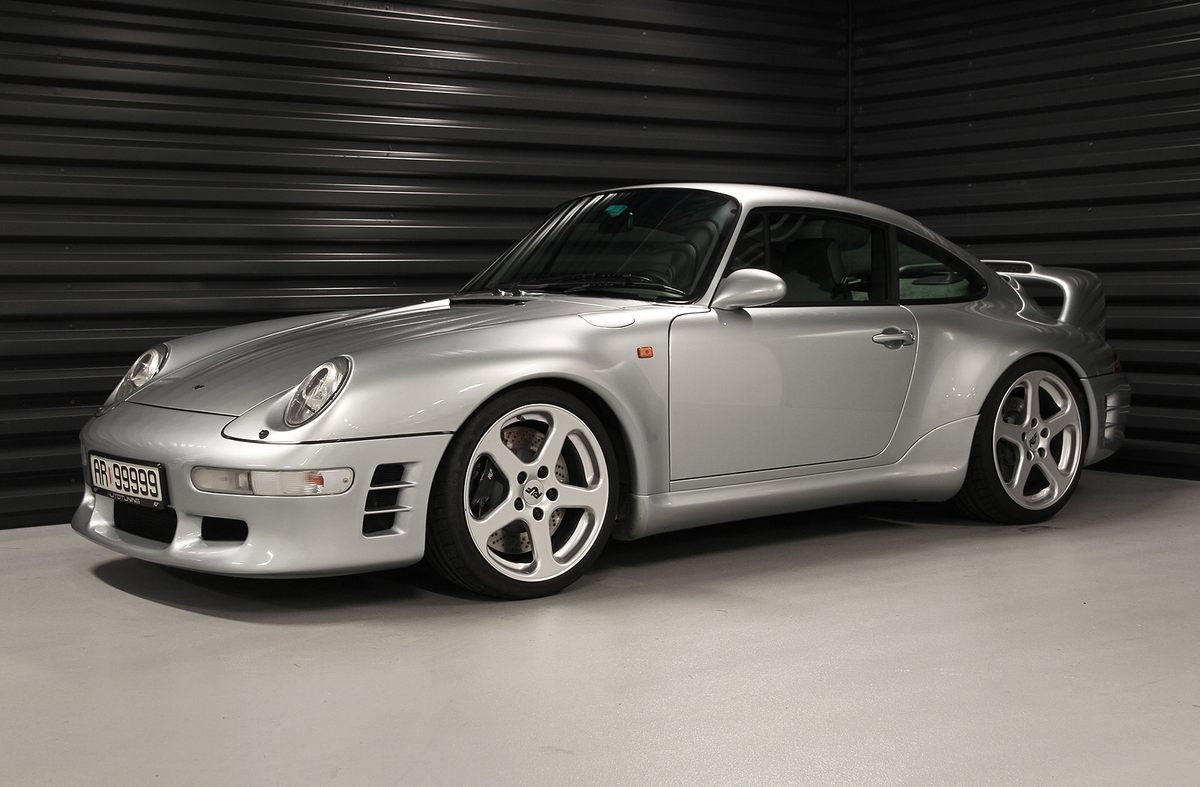
 Ruf CTR
Specs, engines and history
Published Sources (1) Report an error
By Felix Hartmann, Automotive Technology & EV Contributor
- Built
- 1987–1996
- Top power
- 345 kW (469 PS)
Ruf Automobile is a German car maker from Pfaffenhausen in Bavaria. Alois Ruf Sr. opened a service garage there, Auto Ruf, in 1939 and added a filling station in 1949. His son Alois Ruf Jr. began servicing and restoring Porsches in 1960, took over the business in 1974 at the age of 24, and built the first Ruf-enhanced Porsche in 1975. The German government treats Ruf as a manufacturer in its own right, so its cars carry their own vehicle identification numbers. Ruf is known for fast cars based on the Porsche 911, and since the CTR3 of 2007 also for cars with its own body and chassis.
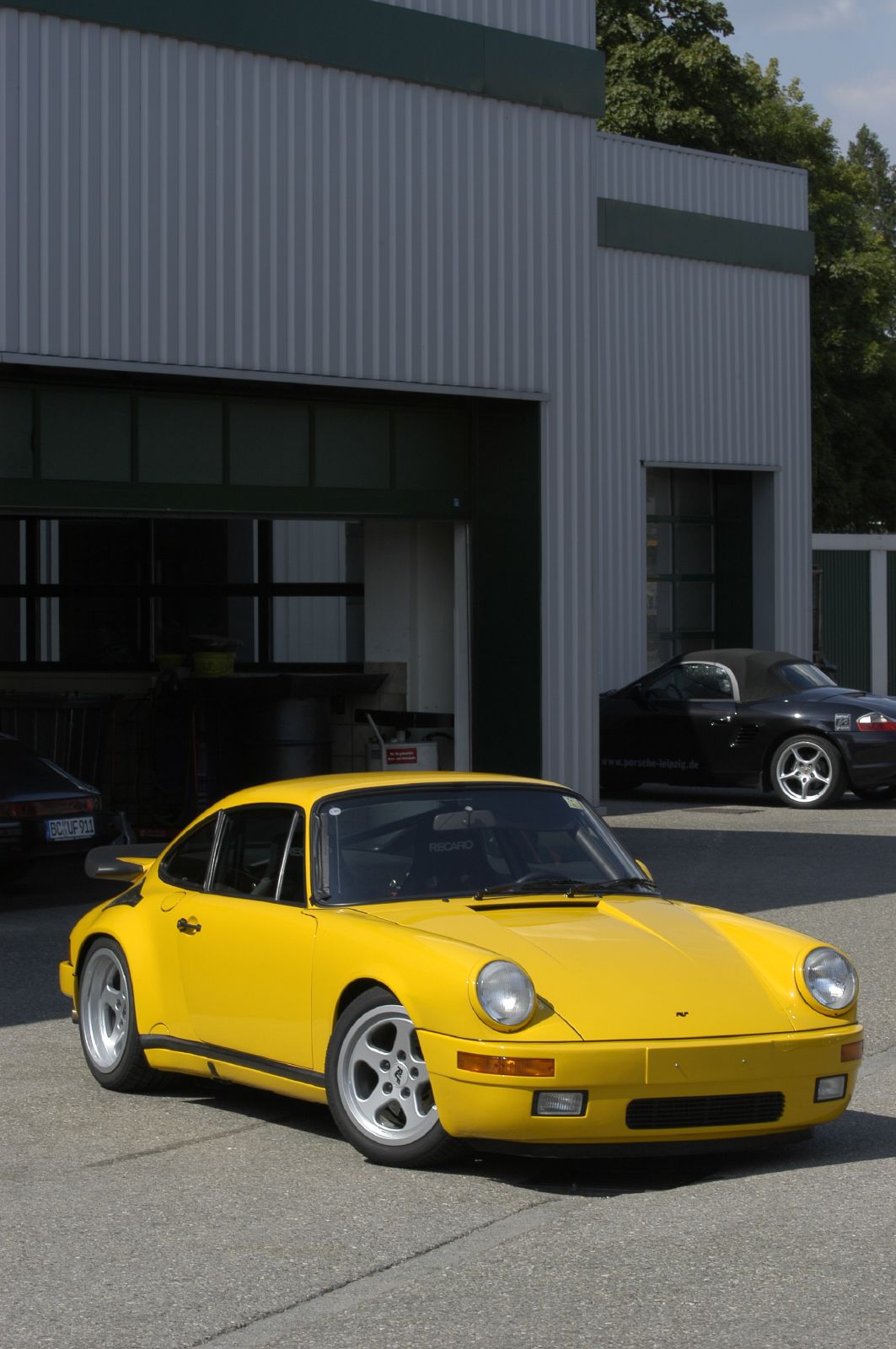
The CTR is the car that made Ruf famous. Built from 1987 to 1996 on the Porsche 911 Carrera 3.2, it has a 3.4-litre twin-turbo flat-six with 345 kW (469 PS), a Ruf five-speed gearbox and lightweight aluminium panels that cut its weight to 1,150 kg. In April 1987 Road & Track measured 340 km/h, and the magazine's testers gave it the nickname "Yellowbird" after its bright paint against the grey sky. Ruf built 29 cars from new Porsche bodies, and about 20–30 more were converted from customers' Carreras.
Specs by version
Engines
Performance
Show all 1 versions
| Version | Top speed |
|---|---|
| 3.4 flat-six twin-turbo | 342 km/h213 mph |
Dimensions and weight
Show all 1 versions
| Version | Kerb weight |
|---|---|
| 3.4 flat-six twin-turbo | 1,150 kg2,535 lb |
Verified Manufacturer and type-approval data from our catalog · Sources and methodology
In short
- Built by Ruf Automobile, Pfaffenhausen, 1987–1996: 29 complete cars plus about 20–30 conversions.
- 3,367 cc twin-turbo flat-six: 345 kW (469 PS) at 5,950 rpm and 553 Nm at 5,100 rpm; most cars tested above that.
- Road & Track, April 1987: 340 km/h; auto motor und sport at Nardò, 1988: 342 km/h.
- Price at the end of 1987: US$142,900.
Ruf CTR at a glance: maker, production years (1987–1996), purpose
| Parameter | Value |
|---|---|
| Maker | Ruf Automobile GmbH, Pfaffenhausen, Germany |
| Production | 1987 – 1996 |
| Built | 29 cars from new Porsche bodies; about 20–30 conversions of customer cars |
| Base car | Porsche 911 Carrera 3.2 (1987) |
| Purpose | high-performance road car |
| Name | CTR = Group C Turbo Ruf; nickname "Yellowbird" |
| Layout | rear engine, rear-wheel drive |
| Engine | 3,367 cc twin-turbo flat-six, SOHC, two valves per cylinder |
| Power / torque | 345 kW (469 PS) at 5,950 rpm / 553 Nm at 5,100 rpm |
| Gearbox | Ruf five-speed manual; six-speed optional |
| Kerb weight | 1,150 kg |
| Length × width × height | 4,290 × 1,775 × 1,311 mm |
| Wheelbase | 2,273 mm |
| Successor | Ruf CTR2 (1996) |
Development and production history
Ruf had built tuned Porsches since 1975; its first complete model was the 1977 Turbo 3.3. For the CTR, Ruf chose the naturally aspirated 911 Carrera 3.2 of 1987 rather than the 930 Turbo, because the Carrera was slightly lighter and had a lower drag coefficient. The CTR name abbreviates "Group C Turbo Ruf".
The car became famous in April 1987 at the Road & Track "World's Fastest Cars" contest, where it reached 340 km/h and was called the fastest production car in the world. In 1988 auto motor und sport measured 342 km/h on the Nardò ring, with an unofficial run of 346 km/h. Ruf built 29 cars from new Porsche bodies until 1996, while about 20–30 more were converted from Carreras that customers brought in. The price varied with the route a buyer chose: ordered directly from Ruf, a CTR cost US$142,900 at the end of 1987.
Design and engineering
The body looks close to a standard 911 but is lighter. The doors, bonnet and engine cover are aluminium, saving about 200 kg against the factory car, and the bumpers are plastic (English Wikipedia names fibreglass in one place and polyurethane in another). Drag-reduction work changed the details. Ducts in the rear wings feed the intercoolers, and the rear arches are slightly wider for the larger wheels. Because the intercooler sits at the side, Ruf moved the oil tank forward and fitted a side-mounted oil filler.
The car runs on 17-inch Ruf Speedline alloy wheels with 215/45 ZR17 tyres at the front and 255/40 ZR17 at the rear, and stops with a Brembo system with 330 mm discs. The tyres were Dunlop Denloc performance tyres, a type designed to stay on the rim after a puncture.

Engine and drivetrain: 3.4-litre twin-turbo
Ruf bored the Carrera's 3,164 cc engine out to 3,367 cc (98 mm bore, 74.4 mm stroke) and added two turbochargers. It is a single-overhead-cam flat-six with two valves per cylinder and a compression ratio of 7.5:1, fed by an uprated DME injection system originally designed for the Porsche 962. The rated output is 345 kW (469 PS) at 5,950 rpm and 553 Nm at 5,100 rpm, with a 6,800 rpm limit. English Wikipedia says that figure was the lowest dyno reading among CTRs tested, and that the average was closer to 368 kW (500 PS) or more.
Power goes to the rear wheels through Ruf's own five-speed manual gearbox, which gave the company free choice of ratios; a six-speed was optional. With 345 kW and 1,150 kg, the CTR has 300 kW per tonne. The power-to-weight calculator compares that with modern supercars.

Ruf CTR specifications and test results
| Data | Value |
|---|---|
| Engine | 3,367 cc twin-turbo flat-six, 98 × 74.4 mm |
| Compression ratio | 7.5:1 |
| Power | 345 kW (469 PS) at 5,950 rpm |
| Torque | 553 Nm at 5,100 rpm |
| Gearbox | five-speed manual (six-speed optional) |
| Kerb weight | 1,150 kg |
| Brakes | Brembo, 330 mm discs |
| Tyres | 215/45 ZR17 front, 255/40 ZR17 rear |
| Top speed | 340 km/h (Road & Track, 1987); 342 km/h (auto motor und sport, Nardò 1988) |
| 0–200 km/h | 10.5 s (Road & Track, 1987) |
| Quarter mile | 11.7 s at 215 km/h (Road & Track, 1987) |
No 0–100 km/h figure is given in the sources used here.
Variants and derivatives: CTR2, CTR3 and the 2017 CTR
| Model | Years | Base / layout | Engine and output |
|---|---|---|---|
| CTR | 1987–1996 | Porsche 911 Carrera 3.2 | 3.4 l twin-turbo, 345 kW (469 PS) |
| CTR2 | 1995–1997 | Porsche 993 | 3.6 l twin-turbo, 382 kW (520 PS) base; 350 km/h |
| CTR3 | 2007 | Ruf's own mid-engined chassis | 3.7 l twin-turbo, 508 kW (691 PS); 375 km/h |
| CTR (2017) | from 2017 | carbon body, aluminium chassis | 3.6 l twin-turbo, 522 kW (710 PS); 360 km/h |
The new CTR was unveiled at the 87th Geneva Motor Show in March 2017, 30 years after the original. It has a water-cooled 3.6-litre twin-turbo flat-six with 880 Nm, a six-speed manual gearbox and rear-wheel drive, weighs 1,200 kg dry and reaches 100 km/h in under 3.5 seconds. Production was limited to 50 cars. Ruf's later range also included the RGT (2000–2011) and the Rt 12 (2004–2012), both based on Porsche 911 generations, and in 2018 the SCR, a naturally aspirated car with 375 kW (510 PS) on Ruf's own body and chassis.

In service: the Nürburgring film and the legacy
The CTR held the unofficial lap record of the Nürburgring Nordschleife for several years. Ruf's test driver Stefan Roser was filmed on his laps, and Ruf released the footage as "Faszination on the Nürburgring". The film, around 20 minutes long, is published on Ruf's own YouTube channel as "RUF Faszination". The CTR also made Ruf known to a much wider audience: because of its manufacturer status, Ruf cars appeared in many racing video games in place of licensed Porsches.

Preservation and collecting today
With 29 complete cars and about 20–30 conversions, the original CTR was always a very small series. Buyers should know which kind of car they are looking at: a CTR built by Ruf from a new Porsche body, or a customer's Carrera converted by Ruf. No reliable public price data in euros was found for this article, so no market values are given.
Which CTR-family car to choose:
- For the original: one of the 29 Ruf-built CTRs on the Carrera 3.2.
- For the 993 generation: the CTR2.
- For Ruf's own engineering: the mid-engined CTR3 or the 2017 CTR.
More fast cars of the period are in the 1980s classics and the classic cars section; Ruf models are listed in the Ruf catalogue.
Photo gallery

Ruf CTR in our rankings
- No. 1 of 69 · Fastest German cars (342 km/h)
- No. 1 of 16 · Fastest cars of the 1980s (342 km/h)
- No. 2 of 59 · Most powerful cars of the 1980s (345 kW)
- No. 9 of 79 · Lightest coupes (1,150 kg)
- No. 15 of 281 · Fastest cars (342 km/h · top 6%)
- No. 31 of 301 · Power-to-weight: cars (300 kW/t · top 11%)
Faster than 98% of ranked German cars in the 1CARS catalog (No. 1 of 69).
FAQ
Why is the Ruf CTR called Yellowbird?
Road & Track testers gave it the nickname in 1987 because its yellow paint stood out against the overcast sky.
How fast is the Ruf CTR?
Road & Track measured 340 km/h in April 1987, and auto motor und sport measured 342 km/h at Nardò in 1988.
How many Ruf CTRs were built?
Ruf built 29 cars from new Porsche bodies between 1987 and 1996, and about 20–30 more were converted from customers' Carreras.
What engine does the Ruf CTR have?
A 3,367 cc twin-turbo flat-six based on the Carrera 3.2 engine, rated at 345 kW (469 PS) and 553 Nm.
Is the Ruf CTR a Porsche?
It is built on a Porsche 911 Carrera 3.2 body, but Ruf is recognised as a manufacturer in Germany and the car carries a Ruf vehicle identification number.
Data sources
Data checked by an editor against the sources below.