Nash — The Kenosha Company That Made Small Cars Respectable
Nash Motors was an American car maker from Kenosha, Wisconsin, founded in 1916 when Charles W. Nash, a former president of General Motors, bought the Thomas B. Jeffery Company. Over 41 years Nash introduced the fresh-air Weather Eye heater, the first mass-produced American unibody car and the Rambler compact of 1950. It merged with Hudson in 1954 to form American Motors, and the Nash name was dropped in 1957.
Key takeaways
- Founded in 1916 by Charles W. Nash on the base of the Jeffery company, makers of the Rambler since 1902.
- Merged with the refrigerator maker Kelvinator on 4 January 1937; George W. Mason then led Nash-Kelvinator.
- The 600 of 1941 was the first mass-produced unibody car made in the United States, and the Rambler of 1950 created the American compact class.
- Merged with Hudson in 1954 to form American Motors Corporation; the last Nash was built on 25 June 1957.
Nash at a glance
| Fact | Value |
|---|---|
| Founded | 1916, Kenosha, Wisconsin |
| Founder | Charles W. Nash (1864–1948) |
| Predecessor | Thomas B. Jeffery Company (Rambler, from 1902) |
| Related makes | LaFayette, Ajax, Nash-Healey, Metropolitan |
| Corporate names | Nash Motors (1916), Nash-Kelvinator (1937), American Motors (1954) |
| Best-known models | Ambassador, 600, Airflyte, Rambler, Nash-Healey, Metropolitan |
| Peak output | 167,869 cars (1950) |
| Last car | Hornet, 25 June 1957 |
Origins: Jeffery, Rambler and Charles Nash
The Kenosha works already had a long history when Nash arrived. Thomas B. Jeffery began mass production of the Rambler there in 1902, and between 1913 and 1919 the plant built about 11,500 Jeffery Quad four-wheel-drive trucks for the First World War. Thanks to the Quad, the business ended the war as the leading producer of military trucks.
Charles W. Nash, born in Cortland, Illinois, on 28 January 1864, grew up as a farm labourer. William C. Durant hired him as an upholstery stuffer at the Durant-Dort Carriage Company in 1890, and he rose to general manager. He became vice-president of Buick in December 1910 and on 19 November 1912 was elected the fifth president of General Motors. When William Durant regained control of GM, Nash resigned on 1 June 1916 and bought the Jeffery company in a deal worth about US$5 million (1916). The first car with his name, the Model 671, followed in 1917, with an overhead-valve engine by Nils Erik Wahlberg.

Growth in the 1920s
Production rose quickly: 12,179 cars in 1917, 40,984 in 1920 and 137,376 in 1926. In 1920 the company became the main shareholder of LaFayette Motors in Indianapolis, a maker of expensive cars, and in 1924 it absorbed LaFayette and turned its plant over to the Ajax, a cheaper car launched in 1925 at the former Mitchell plant in Racine. The Ajax was renamed the Nash Light Six in June 1926, and existing owners received free kits to convert their cars.
Kenosha moved up the price scale at the end of the decade. A straight-eight engine with overhead valves, twin spark plugs and nine crankshaft bearings arrived in 1930, and the Ambassador Eight of 1932 offered a synchromesh gearbox and four-wheel brakes. The founder gave up the presidency in 1932 but stayed chairman. LaFayette returned in 1934 as a lower-priced companion make, and in 1936 buyers could order the "Bed-In-A-Car", an interior that turned into a sleeping compartment.

Kelvinator, the Weather Eye and the 600
On 4 January 1937 Nash merged with Kelvinator, a maker of refrigerators, and Kelvinator's George W. Mason became head of Nash-Kelvinator. LaFayette ceased to be a separate make. Engineering, rather than size, became the company's strength. In 1938 the company offered a heating and ventilation system that was the first hot-water car heater to draw in fresh outside air, and with a thermostat added in 1939 it became the Weather Eye. Independent coil-spring front suspension and sealed-beam headlights followed in 1940.
The Nash 600 of 1941 was the first mass-produced unibody car made in the United States. It was rated at about 30 mpg, and the name came from the 600 miles it could cover on one 20-gallon tank. Passenger car production resumed after the war on 27 October 1945 with an Ambassador saloon. The Airflyte of 1949 was shaped with wind-tunnel testing, and that year it became the first American maker to offer seat belts as a factory option, although only about 1,000 buyers took them.
Rambler, the Healey sports car and the post-war boom
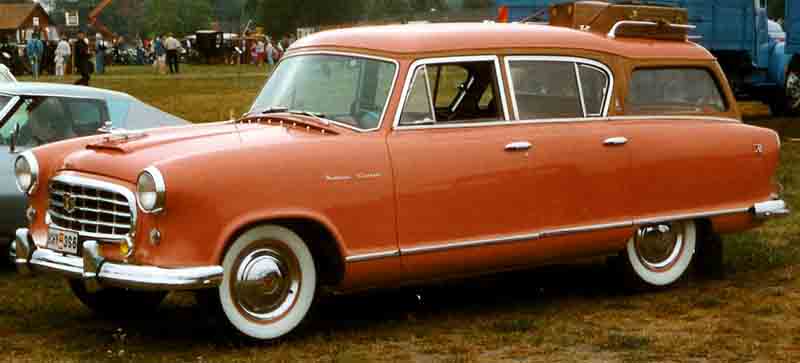
The Nash Rambler, launched on 13 April 1950, set the pattern for the American compact car. It began as a well-equipped two-door convertible with a 100-inch wheelbase, unibody construction and a 2.8-litre straight-six of 61 kW (82 hp; the power converter gives the PS figure), priced at US$1,808 in the United States in 1950. Estate and Country Club hardtop versions were added in 1951, the 1953 redesign came from Pinin Farina, and four-door models arrived for 1954. Its success also lifted the company: output peaked at 167,869 cars in 1950.
The Nash-Healey sports car, built from December 1950 to August 1954, came from a meeting between Donald Healey and George Mason after General Motors had refused Healey its V8 engines. It used the Ambassador's six-cylinder engine, 93 kW (125 hp) at first and 104 kW (140 hp) from 1952, in a chassis by Healey, with a steel body redesigned by Pinin Farina and built in Turin. Only 506 were made, but the car did well at Le Mans: fourth overall in 1950, sixth in 1951 and third overall and first in class in 1952, behind two works Mercedes-Benz 300 SLs.

Metropolitan, Hudson and American Motors
By 1953 the climate had changed. Ford and General Motors were fighting a price war, the end of the Korean War cut military contracts, and output fell to 93,504. In January 1954 the company announced the takeover of the Hudson Motor Car Company, and the two formed American Motors Corporation, with production concentrated in Kenosha. Mason died on 8 October 1954.
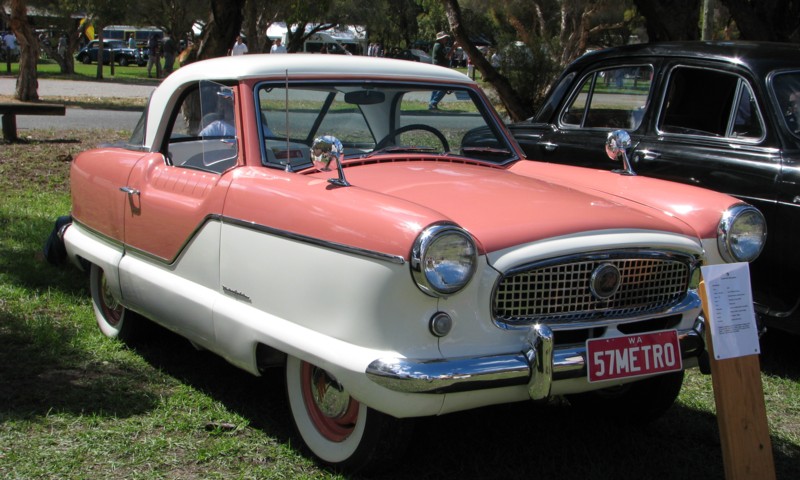
Just before the merger the company launched the Metropolitan, a small car designed in America and built by Austin at Longbridge in England, with bodies by Fisher & Ludlow. It was sold as a Nash from March 1954, also as a Hudson from August 1954, and from 1957 as a make of its own. About 94,986 were sold in the United States and Canada until 1962, and in 1959 it was second only to Volkswagen among imports to the United States. Its 1.5-litre Series IV engine produced 41 kW (55 bhp).
AMC decided to concentrate on the Rambler, which became a separate make. Production dropped to 3,561 cars in 1957, and the last Nash, a Hornet, was built on 25 June 1957. The founder himself had died on 6 June 1948 in Beverly Hills. The company's later history continues in the AMC catalogue and the cars of its merger partner in the Hudson catalogue. The Nash Metropolitan article covers the small car in detail, and other makes of the period appear on the brands timeline.

Nash timeline
| Year | Event |
|---|---|
| 1902 | Jeffery begins mass production of the Rambler in Kenosha |
| 1913–1919 | About 11,500 Jeffery Quad trucks built |
| 1916 | Charles W. Nash buys the Jeffery company |
| 1917 | First Nash, the Model 671 |
| 1925 | Ajax make launched in Racine |
| 1926 | Output reaches 137,376 cars |
| 1937 | Merger with Kelvinator (4 January); George W. Mason in charge |
| 1939 | Weather Eye heater |
| 1941 | Nash 600, first US mass-produced unibody car |
| 1949 | Airflyte; seat belts offered as an option |
| 1950 | Rambler launched (13 April); record 167,869 cars |
| 1951 | Nash-Healey in production |
| 1954 | Metropolitan; merger with Hudson forms AMC |
| 1957 | Last Nash built (25 June) |
Landmark Nash models
| Model | Years | Why it matters |
|---|---|---|
| Model 671 | 1917 | First car to carry the Nash name |
| Ambassador Eight | 1932 | Straight-eight flagship with synchromesh |
| 600 | 1941–1949 | First mass-produced US unibody car |
| Airflyte | 1949–1954 | Wind-tunnel body; first US factory seat belts |
| Rambler | 1950–1955 | Created the American compact class |
| Nash-Healey | 1951–1954 | Anglo-American sports car, third at Le Mans 1952 |
| Metropolitan | 1954–1962 | Small car built by Austin in England |
Photo gallery

FAQ
Who founded Nash Motors?
Charles W. Nash, a former president of General Motors, who bought the Thomas B. Jeffery Company of Kenosha, Wisconsin, in 1916.
What was the first Nash car?
The Model 671 of 1917, with an overhead-valve engine designed by Nils Erik Wahlberg.
Why is the Nash Rambler important?
Launched in April 1950, it was one of the first successful modern small cars in the United States and established the compact segment that American Motors later built on.
What happened to Nash?
Nash merged with Hudson in 1954 to form American Motors Corporation. AMC dropped the Nash and Hudson names in 1957 to focus on Rambler.
Who built the Nash Metropolitan?
Austin built it at Longbridge in England, with bodies from Fisher & Ludlow, from October 1953 to April 1961.
Sources
- Wikipedia — Nash Motors (accessed 24 Oct 2026)
- Wikipedia — Charles W. Nash (accessed 24 Oct 2026)
- Wikipedia — Nash Rambler (accessed 24 Oct 2026)
- Wikipedia — Nash-Healey (accessed 24 Oct 2026)
- Wikipedia — Nash Metropolitan (accessed 24 Oct 2026)
Found a mistake? Report an error