 Nash Metropolitan
Specs, engines and history
Published Sources (1) Report an error
By Sarah Whitmore, Senior Automotive Writer
- Built
- 1953–1961
- Top power
- 41 kW (56 PS)
The Nash Metropolitan came from Nash Motors, the carmaker that Charles W. Nash, a former president of General Motors, founded in Kenosha, Wisconsin, in 1916 when he bought the Thomas B. Jeffery Company. Jeffery had built the Rambler in Kenosha since 1902, and Nash claimed that heritage with the slogan "Great Cars Since 1902". Nash took control of Kelvinator on 4 January 1937, and Kelvinator's George W. Mason took over from Charles Nash. The company brought in the Weather Eye heater and, with the 1941 Nash 600, the first mass-produced unibody car made in the United States. In 1954 it merged with Hudson to form American Motors Corporation (AMC), and the Nash name ended in 1957.
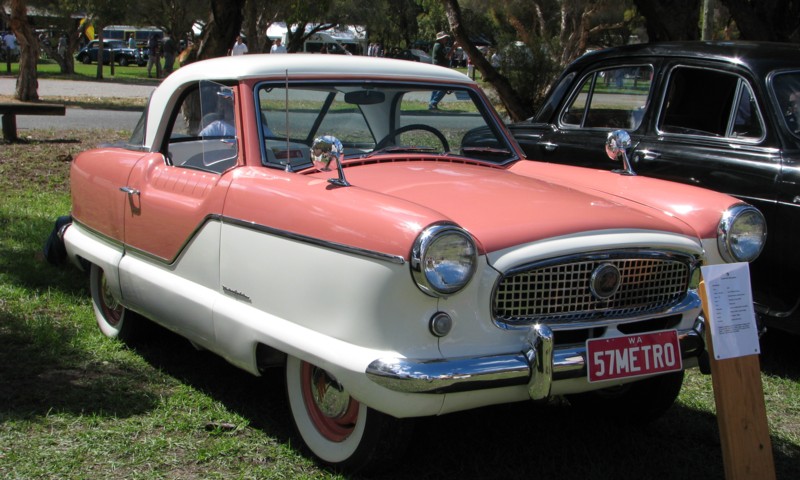
The Metropolitan is the smallest and most unusual car Nash sold. It was an American design built in England by Austin, with a body from Fisher & Ludlow, and sold in North America from March 1954 as a Nash, then as a Hudson and finally as a make of its own. Production ran from October 1953 to April 1961, and 94,986 cars were sold in the United States and Canada.
Specs by version
Verified Manufacturer and type-approval data from our catalog · Sources and methodology
In short
- Designed for Nash-Kelvinator from William J. Flajole's NXI concept; built at Austin's Longbridge plant in Birmingham from October 1953 to April 1961.
- Two-door hardtop and convertible on an 85 in (2,159 mm) wheelbase, 3,797 mm long and 810–857 kg.
- Austin engines: 1.2-litre (A40, then B-Series) and, from late 1955, the 1,489 cc B-Series; the Series IV had 41 kW (55 bhp).
- Peak year 1959 with 22,209 cars; Austin also sold about 9,400 in the UK and other markets.
Nash Metropolitan at a glance
| Parameter | Metric | Imperial |
|---|---|---|
| Maker | Austin (BMC), Longbridge, Birmingham; bodies by Fisher & Ludlow | - |
| Production | October 1953 to April 1961 (model years 1954–1962) | - |
| Sold as | Nash, Hudson (from 1954), Metropolitan (from 1957), Austin Metropolitan | - |
| Designer | William J. Flajole | - |
| Body styles | two-door hardtop, two-door convertible | - |
| Layout | front engine, rear-wheel drive | - |
| Engines | 1.2 l Austin A40 / B-Series I4; 1,489 cc B-Series I4 | 73 cu in; 91 cu in |
| Power | 41 kW (55 bhp) in the Series IV | - |
| Gearbox | three-speed manual | - |
| Wheelbase | 2,159 mm | 85 in |
| Length × width × height | 3,797 × 1,562 × 1,384 mm | 149.5 × 61.5 × 54.5 in |
| Kerb weight | 810–857 kg | 1,785–1,890 lb |
| Built for North America | 94,986 (US 83,442; Canada 11,544) | - |
From NXI concept to Austin production
The design came from the NXI, short for Nash Experimental International, drawn by the Detroit designer William J. Flajole for Nash-Kelvinator. Nash showed it to the public in a series of "surviews" that began on 4 January 1950 at the Waldorf-Astoria in New York. It also cited a survey of 250,000 questionnaires from 1950–1951. The prototype that followed was called the NKI, for Nash-Kelvinator International.
Building such a small car in Kenosha made no sense, so Nash looked abroad. On 5 October 1952 it chose Austin, part of BMC, and the body maker Fisher & Ludlow. Austin built the first pre-production prototype around 2 December 1952. Tooling for the 1953 start of production cost US$1,018,475.94 in total: US$197,849.14 for Austin and US$820,626.80 for Fisher & Ludlow, in 1953 money.
Production began in October 1953 with car number 1001. The car was first called the "NKI Custom" and became the "Metropolitan" two months before launch. Sales began in the United States and Canada on 19 March 1954, at US$1,445 for the hardtop and US$1,469 for the convertible. Nash marketed it as the first post-war American car aimed specifically at women. Its first spokesperson was Miss America 1954, Evelyn Ay Sempier.

Series I to IV: how the car changed
| Series | From | Engine | Main changes | US price at launch |
|---|---|---|---|---|
| Series I (NK1) | October 1953 | 1,200 cc Austin A40 | first 10,000 cars | US$1,445 hardtop / US$1,469 convertible (1954) |
| Series II (NK2) | 19 August 1954 | 1,200 cc B-Series | new gearbox, hydraulic clutch, 50 lb (23 kg) more weight | - |
| Series III (NK3) | 28 November 1955 | 1,489 cc B-Series | "Metropolitan 1500", sweep-spears for two-tone paint | US$1,527 / US$1,551 (1955) |
| Series IV (NK4) | 12 January 1959 | 1,489 cc B-Series, 41 kW (55 bhp) | external boot lid, one-piece rear window, vent windows | US$1,672.60 / US$1,696.80 (1959) |
The engine's compression ratio rose from 7.2:1 to 8.3:1 from car E43116, built on 15 October 1957. Colours changed twice in the Series III, after cars E35133 (16 April 1957) and E45912 (9 January 1958). Before the Series IV the car had no external boot lid, a detail many collectors still look for.

Nash, Hudson, Metropolitan and Austin badges
The badge on the grille tells when and where a car was sold. In 1953–1954 it carried a Nash badge on the grille, hubcaps and spare-wheel cover. After Nash and Hudson merged in May 1954 to form AMC, Hudson dealers sold it from August 1954 as the Hudson Metropolitan; the Hudson story of those years is in our article on the Hudson Hornet. When AMC dropped the Nash and Hudson names in September 1957, the Metropolitan became a make of its own, sold through Rambler dealers.
From October 1956 Austin sold the car outside North America. Production for those markets began in December 1956, and about 9,400 cars were sold from 2 April 1957. Only the Series III and IV were sold in the UK. New Zealand received right-hand-drive cars badged as Nashes, while Australia did not get the car.

Engine and performance
The Metropolitan was slow even by the standards of its day, but very economical. In November 1954 Motor Trend measured 39.4 mpg (US) at 45 mph, 27.4 mpg at 60 mph and 30.1 mpg in traffic. That is about 6.0, 8.6 and 7.8 l/100 km. Tests of acceleration varied widely:
| Test | Car | 0–60 mph | Other figures |
|---|---|---|---|
| Mechanix Illustrated (Tom McCahill), April 1954 | Series I | 19.3 s | over 70 mph (113 km/h) |
| Road & Track | 1.2 l | 22.4 s | 4,300 rpm at 60 mph |
| Autocar, 1961 | 1959 model | 22.4 s | quarter mile in 21.9 s |
| Raleigh Speedway, December 1953 | 24-hour run | - | 2,365 km at an average of 98 km/h |
In the Raleigh run one car covered 1,469.7 miles in 24 hours at an average of 61.2 mph, using 21.1 mpg (US) overall. A second car averaged 41.7 mpg (US) in an economy test. With 41 kW and about 830 kg, a Series IV has roughly 49 kW per tonne. The power-to-weight calculator sets that against other small cars.

Production by year
| Year | US | Canada | Total |
|---|---|---|---|
| 1953 | 571 | 172 | 743 |
| 1954 | 11,198 | 1,964 | 13,162 |
| 1955 | 3,849 | 2,247 | 6,096 |
| 1956 | 7,645 | 1,423 | 9,068 |
| 1957 | 13,425 | 1,892 | 15,317 |
| 1958 | 11,951 | 1,177 | 13,128 |
| 1959 | 20,435 | 1,774 | 22,209 |
| 1960 | 13,103 | 771 | 13,874 |
| 1961 | 853 | 116 | 969 |
| 1962 | 412 | 8 | 420 |
Austin's own production for the UK and export markets is estimated at 9,384 to 9,391 cars.
The end of the Metropolitan
North American production ended in April 1961 with car E95981, built on 19 April 1961, and remaining stock sold until March 1962. The UK Austin version ended in February 1961, and Fisher & Ludlow made its last body on 10 April 1961. Sales had become marginal, and in 1961 AMC's own Rambler American cost only a little more. Nash itself had already gone: the last Nash and Hudson cars were built in 1957, when AMC turned to the Rambler.
Owners, clubs and collecting today
The Metropolitan had famous owners. In May 1960 the London dealer Car Mart gave Princess Margaret a black convertible with gold trim as a wedding present; it was stolen in February 1961. The sources also name Steve Jobs, who had a two-tone car at 15, Elvis Presley, and Paul Newman and Joanne Woodward.
James W. Watson started the Metropolitan Club in January 1957. It published The Met Letter from May 1957 to January 1962 and was disbanded around May 1962. Today the Metropolitan Owners Club of North America (MOCNA), the UK Metropolitan Owners Club, the Pacific Northwest club and the AMC clubs AMCRC and AMO look after the cars. Writing in The Independent in 2007, Brian Sewell noted that collectors prize the 1,500 cc version. Owners have built pickups, estates, limousines, V8 conversions and even a snowmobile-powered "Metro-Sled".
What to check follows from the history: the badge (Nash, Hudson, Metropolitan or Austin), the series (an external boot lid means a Series IV) and the engine (1.2 or 1.5 litres). More cars of the decade are in the 1950s classics section, and other Nash models are in the Nash catalogue.
Photo gallery


Nash Metropolitan in our rankings
- No. 447 of 912 · Longest-running car nameplates (8 years · top 53%)
- No. 513 of 557 · Biggest engines: cars (1,489 cc · top 93%)
- No. 149 of 154 · Most powerful American cars (41 kW · top 97%)
- No. 837 of 859 · Most powerful cars (41 kW · top 98%)
In production longer than 47% of ranked nameplates in the 1CARS catalog (No. 447 of 912).
FAQ
Who built the Nash Metropolitan?
Austin built it at its Longbridge plant in Birmingham, England, with bodies by Fisher & Ludlow, from October 1953 to April 1961. Nash, Hudson and AMC sold it in North America.
What engine does the Nash Metropolitan have?
An Austin four-cylinder: 1,200 cc in the Series I and II, then the 1,489 cc B-Series from the Series III. The Series IV produced 41 kW (55 bhp).
How many Nash Metropolitans were made?
94,986 cars were sold in the United States and Canada, and Austin built an estimated 9,384 to 9,391 more for the UK and export markets.
How fast is a Nash Metropolitan?
Tests gave 0–60 mph in 19.3 to 22.4 seconds and a top speed of a little over 70 mph (113 km/h). Motor Trend measured 39.4 mpg (US) at a steady 45 mph.
How much did a Nash Metropolitan cost new?
In March 1954 the hardtop cost US$1,445 and the convertible US$1,469; by the 1959 Series IV the prices were US$1,672.60 and US$1,696.80.
Data sources
Data checked by an editor against the sources below.