Cord — the Front-Wheel-Drive Cars of E. L. Cord's Empire
Cord was an American luxury car brand built by the Auburn Automobile Company in Indiana from 1929 to 1932 and again in 1936 and 1937. Named after E. L. Cord, the head of the group, it made two very different cars. The long, low L-29 was the first American front-wheel-drive car offered to the public. The streamlined 810/812 had a "coffin nose" and hidden headlamps. Both were advanced and both sold poorly, and production ended in 1937 when Cord's business empire was sold. The name returned several times on replicas, most notably the Cord 8/10 of the 1960s.
Key takeaways
- The L-29 of 1929 beat the Ruxton to market by several months as the first American front-wheel-drive car for sale; about 4,400 were sold up to 1932.
- The 810, shown at the New York show in November 1935, had front-wheel drive, independent front suspension and retractable headlamps.
- The supercharged 812 had 127 kW (170 hp); 2,972 of the 810 and 812 were built, 205 of them convertibles.
- Production ended in 1937; Glenn Pray's 8/10 replica of 1964–1966 reached 97 cars.
Cord at a glance
| Fact | Value |
|---|---|
| Maker | Auburn Automobile Company, part of the Cord Corporation |
| Years | 1929–1932, 1936–1937 |
| Plants | Auburn and Connersville, Indiana |
| Named after | Errett Lobban Cord (1894–1974) |
| Engineers and designers | Cornelius Van Ranst (L-29), Gordon Buehrig (810/812) |
| Engines | Lycoming straight-eight (L-29), Lycoming V8 (810/812) |
| Models | L-29, 810, 812 |
| Output | about 4,400 L-29s; 2,972 810/812s |
E. L. Cord and his group
The brand was a by-product of one man's rise. Errett Lobban Cord was born in Warrensburg, Missouri, on 20 July 1894 and worked as a racing driver, mechanic and car salesman. In 1924 he was asked to run the struggling Auburn company, and by 1928 he controlled it. In 1929 he formed the Cord Corporation, a holding company for more than 150 businesses, mostly in transport. It owned Auburn, Duesenberg, Lycoming engines, the Checker taxi company, Stinson Aircraft and American Airways.
Auburn sold fast mid-priced cars and Duesenberg the most expensive chassis in America. The Cord car, which carried his own name, sat between them in price.
The L-29: front-wheel drive in 1929
The L-29 was engineered by Cornelius Van Ranst, a former engineer with the racing car builder Harry Miller. Its drive system came from Miller's front-wheel-drive Indianapolis 500 racers, with a de Dion layout and inboard brakes. It used double Hooke's joints instead of the Rzeppa constant-velocity joints chosen by Ruxton and others. Launched in 1929, it reached buyers several months before the rival Ruxton.
The engine was the Lycoming 4,934 cc side-valve straight-eight from the Auburn 120, with 93 kW (125 hp). It was turned round so that the crankshaft passed through the front of the block, with the flywheel at the front and a three-speed gearbox ahead of it. Without a propeller shaft the car could sit very low on its straight frame, and a saloon was only 61 inches (about 1,550 mm) high. The wheelbase was 3,490 mm, steering needed about four turns from lock to lock, and handling was said to be excellent.
The weakness was performance. The car weighed 2,100 kg, top speed was just over 130 km/h, and the cheaper Auburn was quicker. Its price placed it among the most expensive American luxury cars, below only the Duesenberg. Coachbuilt bodies from American and European firms won prizes, and the 1930 Chrysler Imperial and Chrysler Eight copied some of its styling. The Depression hurt sales badly, and the L-29 was dropped in 1932 after about 4,400 had been sold.

The 810 and 812: coffin nose and hidden lamps
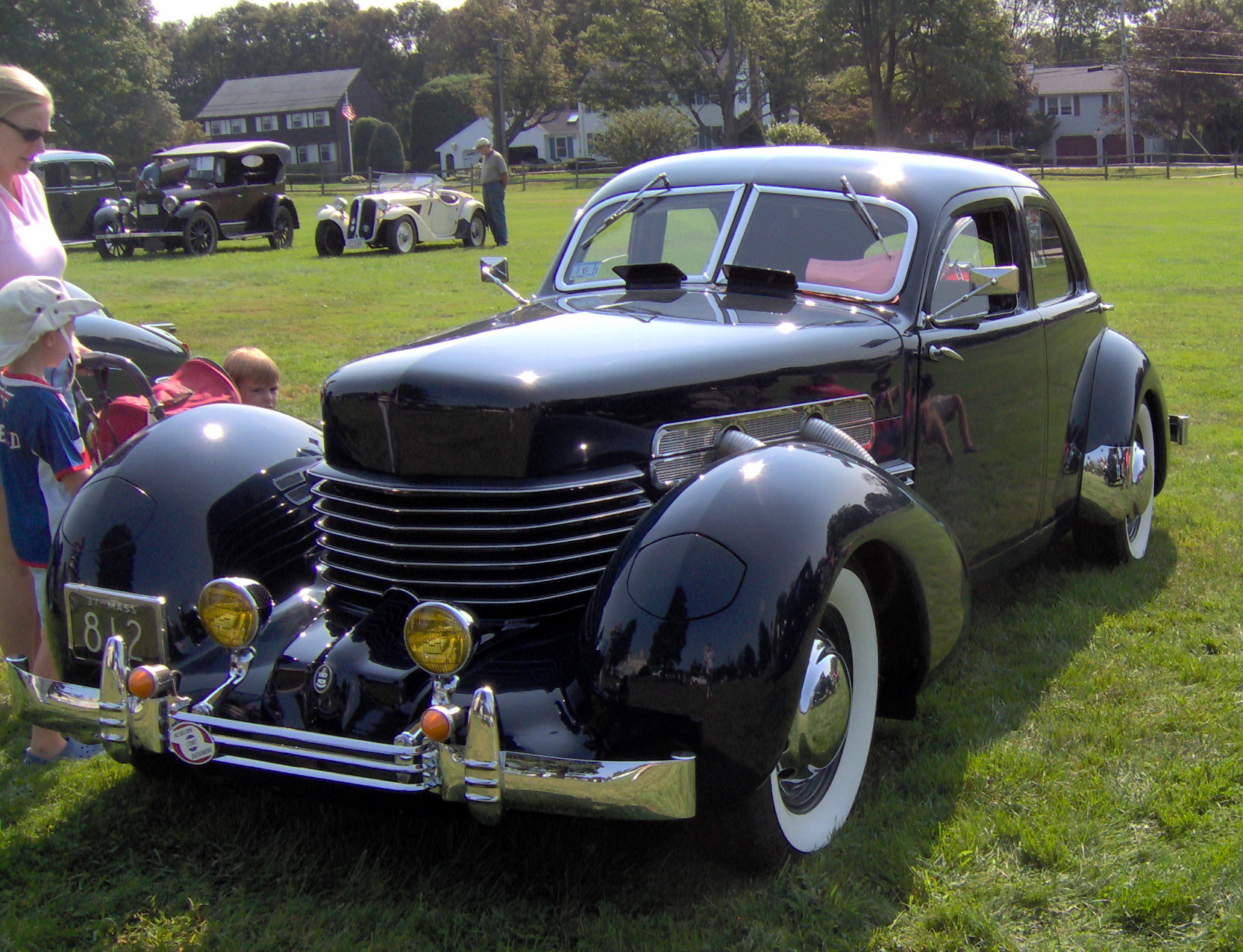
The second Cord began as a "Baby Duesenberg". Gordon Buehrig, who had styled many Model J Duesenbergs and the 1935 Auburn Speedster, led the design team with Vince Gardner and Alex Tremulis. The car was shown at the New York Auto Show in November 1935. It was the first American-designed front-wheel-drive car with independent front suspension.
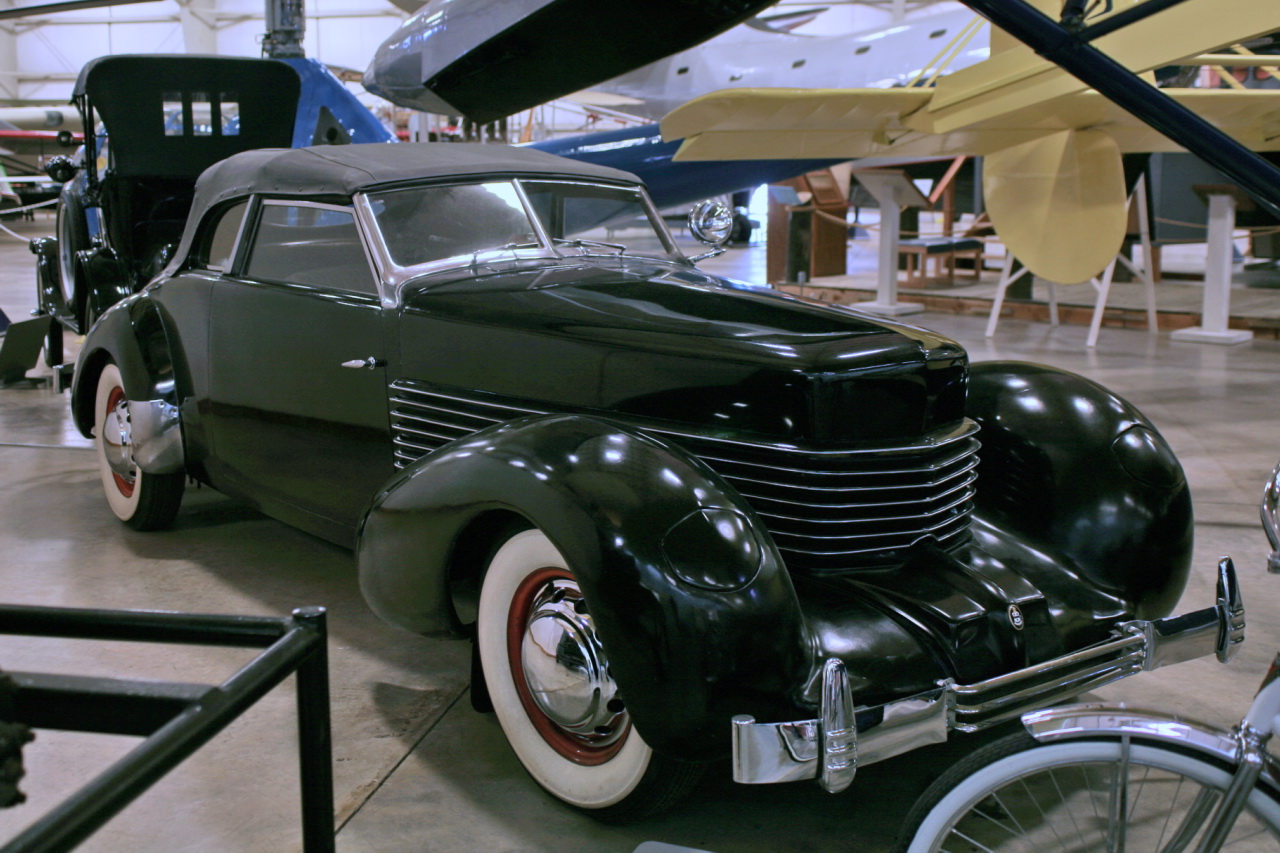
The layout was cleaner than the L-29's. Buehrig placed the gearbox ahead of the engine, so there was no transmission tunnel, and the car had no running boards. A 4,739 cc Lycoming V8 gave 93 kW (125 hp), the same as the L-29, and drove a four-speed semi-automatic gearbox selected electrically through a Bendix pre-selector. The headlamps, adapted from Stinson aircraft landing lights, folded into the wings, the first hidden headlamps on a production car. The horizontally louvred wraparound grille gave the "coffin nose" nickname. Hidden door hinges, a concealed fuel filler, variable-speed wipers, a rev counter and a standard radio completed the list.
Prices in the United States in 1936 started at US$1,995 for the saloon and reached US$2,195 for the Phaeton. For 1937 the supercharged 812 used a Schwitzer-Cummins blower and had 127 kW (170 hp), and in 1937 the long-wheelbase Custom Berline cost US$3,060.

Delays, defects and the end
The launch went wrong. Cord had promised delivery by Christmas 1935 and expected to sell 1,000 cars a month. Deliveries slipped to February 1936, and the first cars reached New York owners only in April. Only 1,174 were sold in the first model year. Early cars slipped out of gear and suffered from vapour lock, and the dealer network shrank quickly. Unsold 1936 cars were renumbered and sold as 1937 812s.
At the same time E. L. Cord was under investigation by the Securities and Exchange Commission over his dealings in Checker Cab shares. In 1937 he sold the Cord Corporation to the Aviation Corporation, and Cord production ended that year. A single prototype for 1938 was built and survived. In all, 2,972 cars of the 810 and 812 series were made, including 205 convertibles.
Body dies, replicas and later owners of the name
The body dies outlived the company. For 1940 Hupmobile and Graham-Paige used them for the Hupmobile Skylark and Graham Hollywood, both conventional rear-wheel-drive saloons with plain headlamp pods. Graham built about 1,850 cars in the 1940 model year, only about 450 of them Skylarks.
In 1938 Dallas E. Winslow bought the remains of Auburn and formed the Auburn-Cord-Duesenberg Company to sell parts and restore cars. In 1960 Glenn Pray, a school shop teacher, bought the Auburn and Cord rights, backed by the Chevrolet dealer Wayne McKinley. His Cord 8/10, an eight-tenths-scale copy of the 810 designed with Buehrig's help, used a Chevrolet Corvair drivetrain turned round for front-wheel drive and a plastic body. Pray was ousted by investors in January 1966, and the company went bankrupt in July 1966 after 97 cars. Later replicas of 1968–1970 used Ford and Chrysler engines. After Pray died in 2011, the rights were auctioned in 2014 and again in 2019.

Collecting the cars today
A Cord is a car for collectors who value engineering history over speed. The L-29 had 93 kW for 2,100 kg, about 44 kW per tonne on these figures. Compared with that, the supercharged 812 had 127 kW for 1,860 kg, about 68 kW per tonne; the power-to-weight calculator gives the same figures for modern cars. Because unsold 1936 cars became 1937 models, and replicas exist, a car's records matter. The 810 and 812 are described in detail in Cord 810/812 history and specifications, the model is listed in the Cord catalogue, and the group's top marque is in the Duesenberg catalogue. More cars of the decade are collected in 1930s classics.
Cord timeline
| Year | Event |
|---|---|
| 1924 | E. L. Cord takes charge of Auburn |
| 1929 | Cord Corporation formed; L-29 launched |
| 1932 | L-29 discontinued after about 4,400 sales |
| 1935 | 810 shown in New York (November) |
| 1936 | First deliveries (February); 1,174 sold in the first model year |
| 1937 | 812 and 812 supercharged; production ends |
| 1940 | 810 body dies used for the Hupmobile Skylark and Graham Hollywood |
| 1964 | Cord 8/10 replica |
| 1966 | Cord 8/10 company bankrupt (July) after 97 cars |
Landmark Cord models
| Model | Years | Why it matters |
|---|---|---|
| L-29 | 1929–1932 | First American front-wheel-drive car for sale |
| 810 | 1936 | Hidden headlamps, coffin nose, front-wheel drive |
| 812 supercharged | 1937 | 127 kW (170 hp) Schwitzer-Cummins blower |
| Cord 8/10 | 1964–1966 | Scaled replica with Corvair power; 97 built |
Photo gallery

FAQ
Who made Cord cars?
The Auburn Automobile Company in Indiana, part of E. L. Cord's Cord Corporation. The cars carried his name.
Was the Cord the first front-wheel-drive car?
The L-29 of 1929 was the first American front-wheel-drive car offered to the public, a few months ahead of the Ruxton.
What is a coffin-nose Cord?
The nickname of the 810 and 812 of 1936–1937, after the square, louvred front end that replaced a normal radiator grille.
How many Cord 810 and 812 cars were built?
2,972, including 205 convertibles.
Why did Cord fail?
The L-29 was slow and arrived as the Depression began. The 810 was late, had early defects, and the Cord group was sold in 1937.
Sources
- Wikipedia — Cord (automobile) (accessed 24 Oct 2026)
- Wikipedia — Cord 810/812 (accessed 24 Oct 2026)
- Wikipedia — Errett Lobban Cord (accessed 24 Oct 2026)
- Wikipedia — Gordon Buehrig (accessed 24 Oct 2026)
- Wikipedia — Auburn Automobile (accessed 24 Oct 2026)
Found a mistake? Report an error