 Cord 810
Specs, engines and history
Published Sources (1) Report an error
By Sarah Whitmore, Senior Automotive Writer
- Built
- 1936–1937
- Top power
- 127 kW (173 PS)
Which Cord to choose
Our verdict · Sarah Whitmore
- For performance: an 812S, with the supercharger and the chromed exhaust pipes, 127 kW instead of 93 kW.
- For open-air driving: the Sportsman or the Phaeton; only 205 convertible cabriolets were made.
- For rarity: the 1937 Custom Beverly or Westchester on the longer chassis.
- Know the weak point: the semi-automatic gearbox, which caused most of the original complaints.
More veteran and pre-war cars are in our classic cars section.
The Cord 810 and 812 are the front-wheel-drive cars with hidden headlights that the Auburn Automobile Company built under the Cord name for the 1936 and 1937 model years. Styled by Gordon Buehrig, the 810 was the first American-designed and built front-wheel-drive car with independent front suspension, and it is still admired for its "coffin nose" design. Mechanical trouble ruined its sales: about 3,000 were made before E. L. Cord's car business closed in 1937. The supercharged 812 is the most sought-after version.
In short
- 4,739 cc Lycoming V8 with 93 kW (125 hp); the supercharged 810S and 812S had 127 kW (170 hp).
- Front-wheel drive, with a four-speed semi-automatic gearbox mounted ahead of the engine.
- Among the first production cars with pop-up headlights, made from Stinson aircraft landing lights.
- English Wikipedia gives 2,972 cars in total, including 205 convertibles; German Wikipedia gives 2,320.
Cord 810/812 at a glance
| Parameter | Metric | Imperial |
|---|---|---|
| Maker | Auburn Automobile Company, Cord division, Auburn, Indiana | - |
| Model years | 810: 1936; 812: 1937 | - |
| Built | 2,972 incl. 205 convertibles (English Wikipedia); 2,320 (German Wikipedia) | - |
| Designer | Gordon M. Buehrig, with Vince Gardner and Alex Tremulis | - |
| Layout | front-wheel drive, gearbox ahead of the engine | - |
| Engine | Lycoming V8, 4,739 cc | 289 cu in |
| Power | 93 kW (125 hp); 127 kW (170 hp) supercharged | - |
| Gearbox | four-speed semi-automatic (three speeds plus overdrive) | - |
| Brakes | hydraulic drums, 305 mm | 12 in |
| Wheelbase | 3,175 mm; 3,353 mm on the 1937 Custom models | 125 / 132 in |
| Length × width × height | 4,966 × 1,803 × 1,524 mm | 195.5 × 71.0 × 60.0 in |
| Weight | 1,860 kg | 4,110 lb |
| Top speed | about 160 km/h for the supercharged car (German Wikipedia) | about 100 mph |
E. L. Cord and the road to the 810
Errett Lobban Cord took control of the Auburn Automobile Company in 1924–1925 and built a holding company around it that included Duesenberg, the engine maker Lycoming and the aircraft maker Stinson. In 1929 he put his own name on the Cord L-29, one of the first mass-produced front-wheel-drive cars, with a Lycoming straight-eight. About 4,400 L-29s were sold before production stopped in 1932. German Wikipedia adds that its three-speed gearbox was first shifted through a linkage and later electro-pneumatically, and that a 1930 attempt to sell factory bodies under the invented coachbuilder name LaGrande failed. The Cord Corporation also owned Checker Motors; after the group was sold to the Aviation Corporation amid fraud allegations, E. L. Cord moved to Nevada and made a new fortune in property.
The 810 was the second Cord. Its predecessors in front-wheel drive were the L-29 and the Citroën Traction Avant of 1934; English Wikipedia notes that the 810/812 sold less well than both. The car was shown at the New York Auto Show in November 1935. Cord rushed to build the 100 cars needed to qualify for the show, but the transmission was not ready, and first deliveries had to wait until February 1936; cars reached New York City in April 1936.
Design: coffin nose and hidden headlights
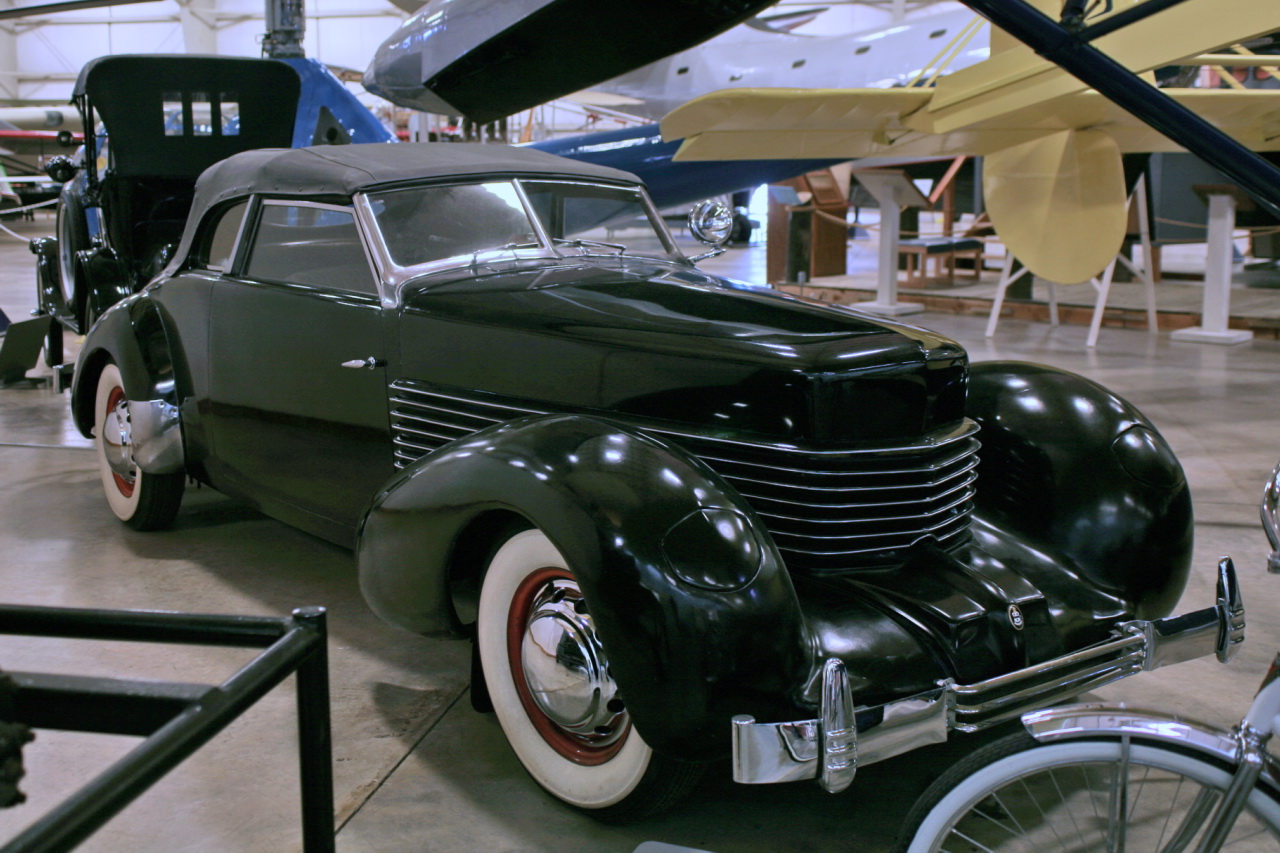
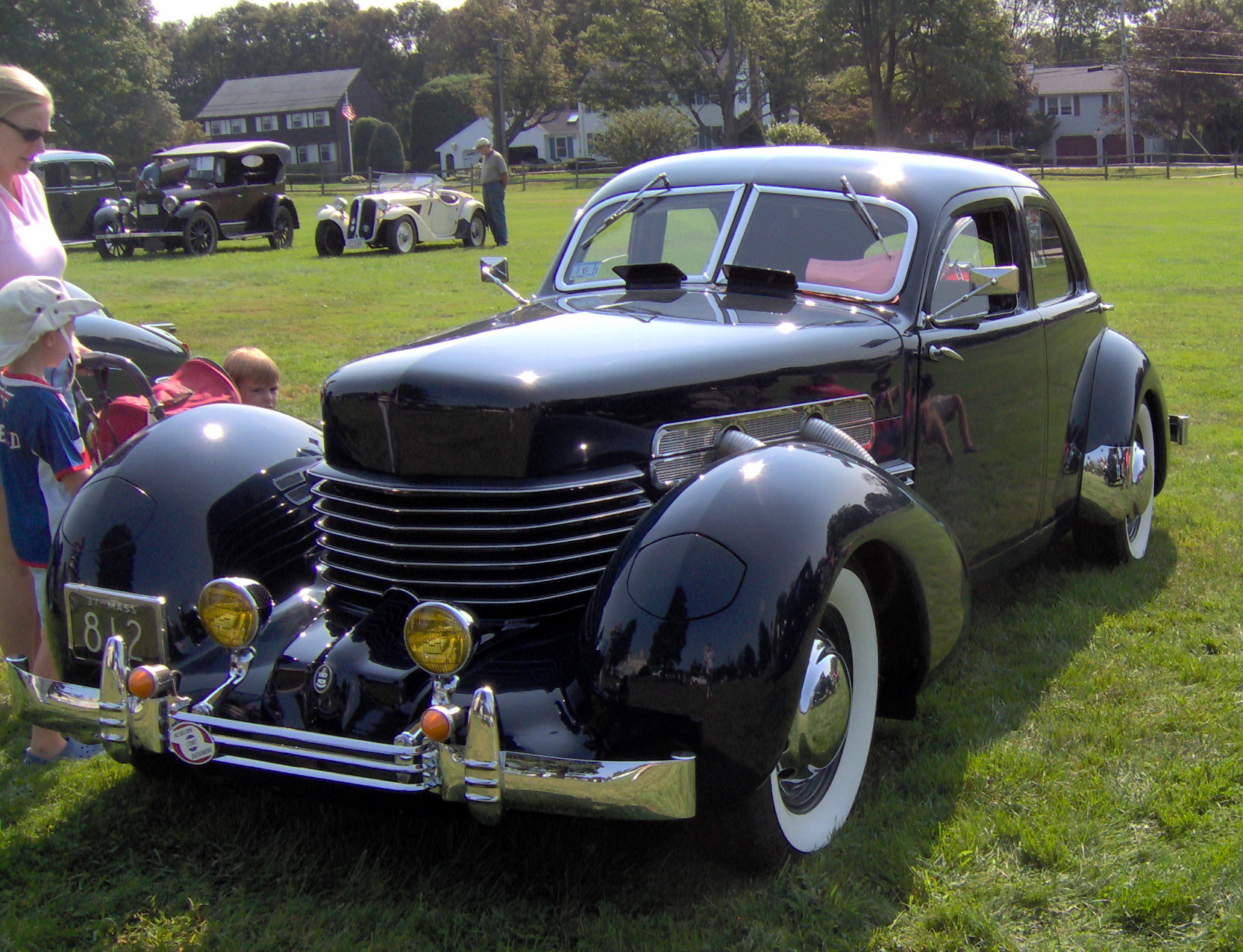
Gordon Buehrig, who had also styled the Auburn 851 Speedster, gave the 810 a low body without running boards. The nose had a horizontally louvred grille wrapping around the front instead of an upright radiator, which earned the car its "coffin nose" nickname. American Heritage called the 810 sedan "The Single Most Beautiful American Car" in 1996.
The details were as new as the shape:
- headlights hidden in the wings, modified Stinson landing lights raised by hand cranks on the dashboard;
- hidden door hinges, a rear-hinged bonnet and pontoon wings;
- a concealed, lockable fuel filler door;
- variable-speed windscreen wipers and a standard radio;
- an engine-turned dashboard with full instruments and a rev counter.

Front-wheel drive and the Lycoming V8
The 4,739 cc Lycoming V8 produced 93 kW (125 hp), the same as the L-29's straight-eight. German Wikipedia points out that the V8 was short compared with an inline engine, which suited the layout. The gearbox sat in front of the engine, as in the Traction Avant, so the car needed no driveshaft and no transmission tunnel. It had three speeds plus an overdrive and was shifted semi-automatically; English Wikipedia names this unit as the main source of the car's troubles.
The front wheels were independently suspended on trailing arms with leaf springs and friction dampers; at the rear a tube axle ran on semi-elliptic springs. Ground clearance was 229 mm. With 1,860 kg and 93 kW, the standard car had about 50 kW per tonne, and the supercharged version about 68 kW per tonne. Our power-to-weight calculator compares that with later cars.

810, 812 and the supercharged cars
| Version | Model year | Engine | Bodies |
|---|---|---|---|
| 810 | 1936 | 93 kW (125 hp) | Sedan, Beverly sedan, Sportsman convertible coupé, Phaeton |
| 810S | 1936 | supercharged, 127 kW (170 hp) | as 810 |
| 812 | 1937 | 93 kW (125 hp) | as 810, plus Custom Beverly and Custom Berline "Westchester" on 3,353 mm |
| 812S | 1937 | supercharged, 127 kW (170 hp) | all bodies |
| 814 | planned for 1938 | - | one prototype, found in 1989 |
The supercharger was a mechanically driven Schwitzer-Cummins unit, and supercharged cars are easy to spot by the chromed external exhaust pipes on each side of the bonnet. Unsold 1936 810s were renumbered and sold as 1937 812s. Supercharging added 34 kW, about 37% more power, and the two 1937 Custom models gained 178 mm of wheelbase. The total of 2,972 cars in English Wikipedia includes 205 convertible cabriolets and a one-off 1938 Custom Cabriolet prototype.

Why the Cord failed
Cord planned 1,000 cars a month, a rate that was never reached. Early cars jumped out of gear and suffered from vapour lock, the dealer network shrank quickly, and only 1,174 810s were sold in the first model year. German Wikipedia adds that E. L. Cord's withdrawal from the car business hurt sales further. Production ended in 1937, together with the Auburn brand; Cord sold his holdings in August 1937. By German Wikipedia's figures the Cord brand built 7,823 cars over 1929–1937; its 2,830 cars for 1936–1937 do not match the 2,320 it quotes for the 810/812, another sign of how uncertain the totals are.
Legacy: from Hupmobile to the Toronado
The body dies did not go to waste. In 1940 Hupmobile and Graham-Paige used them for the Hupmobile Skylark and the Graham Hollywood, with conventional front engines, rear-wheel drive and plain headlight pods. About 1,900 were built before production ended in the autumn of 1940.
The 810/812 remained the last American front-wheel-drive car until the 1966 Oldsmobile Toronado and the 1967 Cadillac Eldorado, both of which used hidden headlights in homage; the second-generation Toronado's bonnet even echoed the coffin nose. Those General Motors cars are part of our history of General Motors. Its layout, with the gearbox ahead of the engine, was never used again on an American front-wheel-drive car. Replicas followed in the 1960s: SAMCO built the Cord 8/10 from 1964 to 1966, and two companies in Tulsa, Oklahoma, tried versions with Corvair, Ford and Chrysler powertrains until 1970. German Wikipedia also mentions replicas by Glenn Pray's Cord Automobile Company built with original material on Chevrolet chassis.
The car had a screen career too. A white 1937 812SC Sportsman appeared in the 1938 film Gangster's Boy, and in the 1965 film Where the Spies Are, based on James Leasor's Jason Love novels, a Cord is promised to a character; Leasor himself owned an 810 and an 812.
| Year | Cord cars built (German Wikipedia) |
|---|---|
| 1929–1932 (L-29) | 1,819 / 1,873 / 1,243 / 58 |
| 1933–1935 | none |
| 1936 (810) | 1,764 |
| 1937 (812) | 1,066 |
| Total | 7,823 |

Photo gallery


Cord 810 in our rankings
- No. 630 of 859 · Most powerful cars (127 kW · top 74%)
- No. 132 of 154 · Most powerful American cars (127 kW · top 86%)
- No. 874 of 912 · Longest-running car nameplates (1 year)
More powerful than 26% of ranked cars in the 1CARS catalog (No. 630 of 859).
FAQ
What was special about the Cord 810?
It was the first American-designed and built car with front-wheel drive and independent front suspension, and one of the first production cars with hidden headlights.
How many Cord 810 and 812 were built?
English Wikipedia gives 2,972, including 205 convertibles; German Wikipedia gives 2,320 sold.
What engine does the Cord 812 have?
A 4,739 cc Lycoming V8 with 93 kW (125 hp), or 127 kW (170 hp) with the Schwitzer-Cummins supercharger.
Who designed the Cord 810?
Gordon M. Buehrig, with Vince Gardner and Alex Tremulis in his team.
Why did the Cord 810 fail?
The semi-automatic gearbox was not ready at launch and gave trouble, cars jumped out of gear and suffered vapour lock, and only 1,174 were sold in the first model year.
Data sources
Data checked by an editor against the sources below.