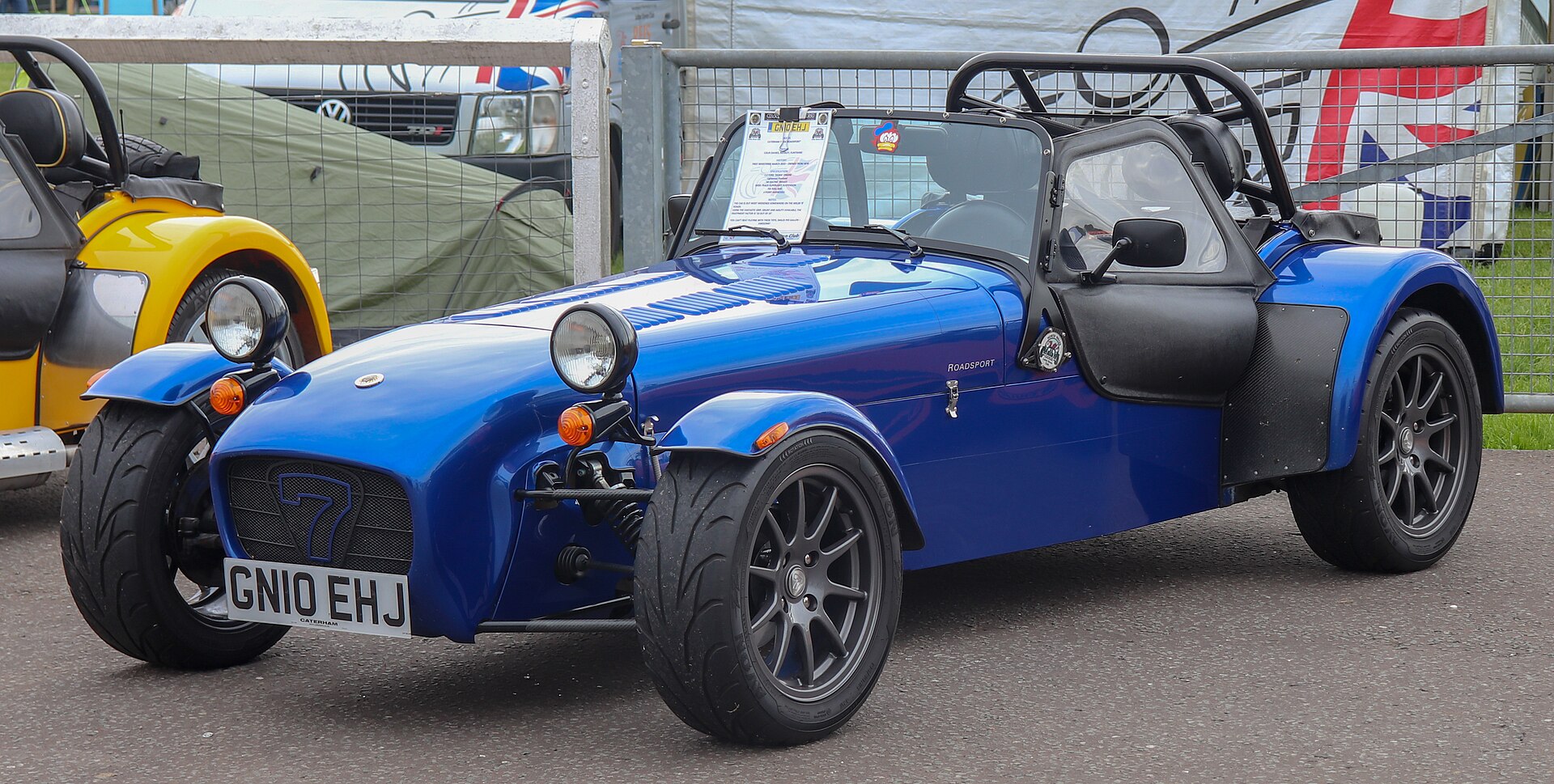
Caterham — Fifty Years of Building the Seven
Caterham is the British company that has built the Seven, Colin Chapman's lightweight open two-seater, since Lotus stopped making it in 1973. Graham Nearn, a Lotus dealer in Caterham, Surrey, bought the rights that year, and his company has made the car in Surrey and Kent ever since, with engines from Lotus, Ford, Vauxhall, Rover and Suzuki. Over five decades the Seven has kept its basic shape while its power has grown from about 100 kW to more than 230 kW. Caterham has been owned by VT Holdings, a car retailer from Japan, since April 2021 and showed its first electric design, Project V, in 2023.
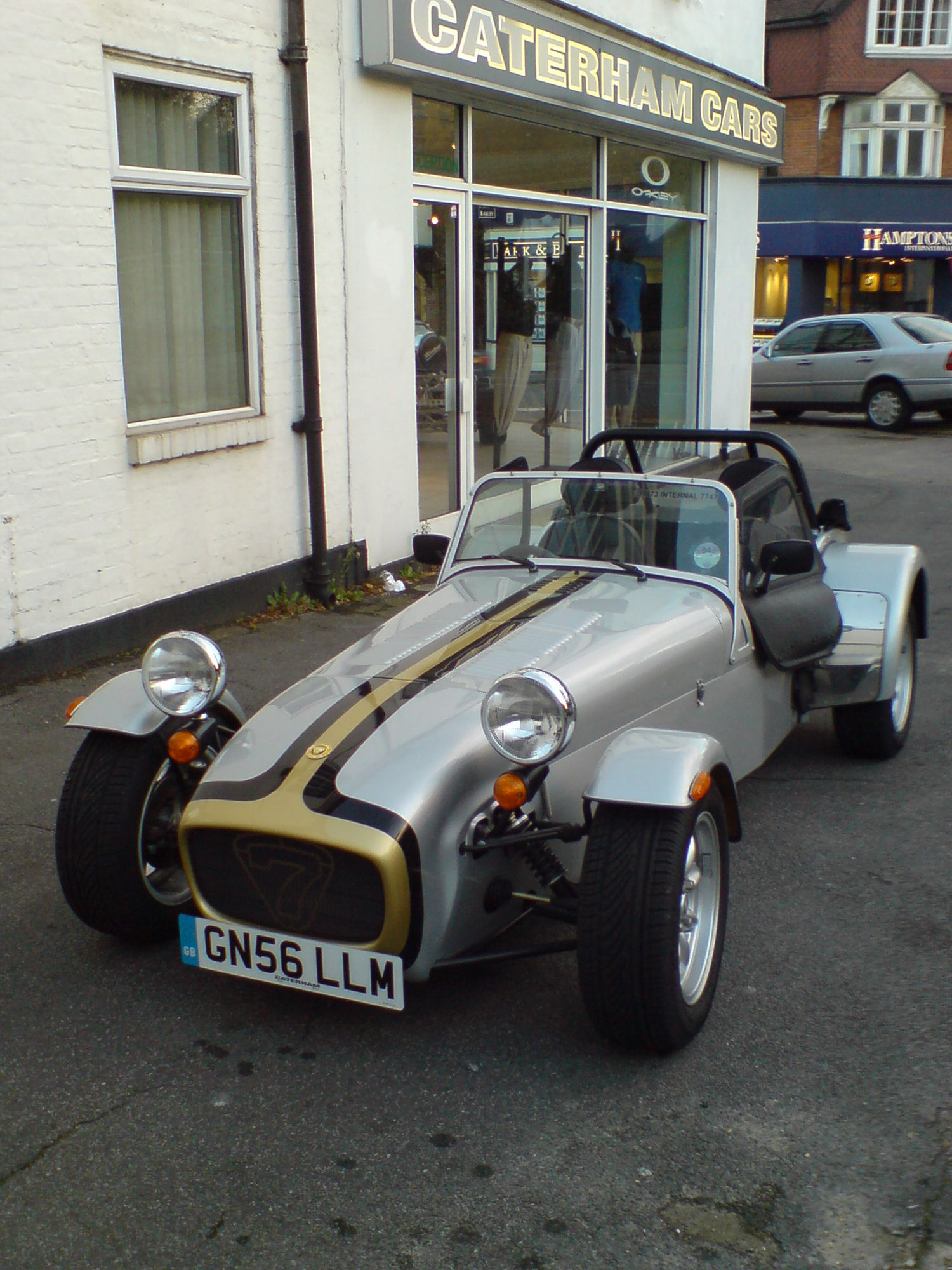
Key takeaways
- Lotus built the Seven from 1957; Graham Nearn bought the rights from Colin Chapman in 1973 and built 21 cars in 1974.
- Production moved from Caterham, Surrey, to Dartford, Kent, in 1987 and to a new Dartford factory in 2024.
- The supercharged 620R of 2013 had 232 kW (315 PS) and reached 60 mph in 2.79 seconds; the 2021 Seven 170 has a 62 kW Suzuki engine and weighs 440 kg.
- Tony Fernandes bought Caterham in 2011–2012 and ran the Caterham F1 team from 2012 to 2014; VT Holdings took over in April 2021.
Caterham at a glance
| Fact | Value |
|---|---|
| Company | Caterham Cars (traded as Seven Cars Ltd, 1974–1989) |
| Founder | Graham Nearn |
| Founded | 1959 as a dealer (company history); car maker from 1973 |
| Plants | Caterham, Surrey (to 1987); Dartford, Kent (from 1987) |
| Main model | Seven, in S3, SV and CSR chassis |
| Engines | Lotus Twin Cam, Ford, Cosworth, Vauxhall, Rover K-Series, Suzuki |
| Owners | Nearn family; Corven Ventures (2005); Tony Fernandes (2011–2012); VT Holdings (2021) |
| Racing | Caterham Academy (1995); Caterham F1 Team (2012–2014) |
Colin Chapman's Seven
The car began at Lotus. Colin Chapman launched the Seven in 1957 as the company's entry-level model, and the design followed his rule "simplify, then add lightness". The Series 1 had a 1,172 cc Ford side-valve engine of 27 kW (36 bhp), and early cars weighed about 500 kg. In 1958 The Motor tested a tuned car that cost £1,157 in Britain including £386 of taxes, and recorded 0–60 mph in 6.2 seconds.
Most British Sevens were sold as kits. Kit cars avoided purchase tax, so buyers assembled their own. The Series 2 of 1960 used Ford Kent engines, and 1,310 were built by August 1968. A Series 2 appeared in the opening titles of the television series The Prisoner. The Series 3 arrived in 1968, and the Series 4 followed in 1970. More than 2,500 original Sevens were sold. The Lotus years are covered in Lotus Seven history and specifications.
Graham Nearn takes over
Graham Nearn was a major Lotus Seven dealer in the 1960s; Caterham's own history dates his business to 1959 in Caterham Hill, Surrey. When the United Kingdom joined the EEC on 1 January 1973, VAT replaced purchase tax and the kit advantage ended. Lotus decided to drop the Seven, and in 1973 Nearn bought the rights to build it. Steel Brothers in New Zealand also received rights and assembled Series 4 cars until March 1979.
Caterham first sold the Series 4, which sold poorly. Once the Lotus kits ran out, it began building its own version of the Series 3 in 1974. That year it made 20 production cars and one prototype, all but one with the 1,557 cc Ford-Lotus Twin Cam. Caterham took over development of the Twin Cam in 1977. The Seven was banned from British production car racing in 1976, and the RAC lifted the ban in 1980.

Engines over five decades
Engine changes mark the Seven's history. Cosworth-based BDA and BDR units of 1.6 and 1.7 litres gave 104–112 kW (140–150 bhp) in the early 1980s. Vauxhall's 2.0-litre engine reached 130 kW (175 bhp) by 1990, and the JPE of 1993, with about 186 kW (250 bhp), once held the 0–60 mph record for production cars at 3.4 seconds. Rover K-Series engines of 1.4, 1.6 and 1.8 litres arrived from 1991, and in 2001 MG Rover became the only supplier for factory-built cars.
The R500 of 1999 had a tuned 1.8-litre K-Series of about 172 kW (230 bhp) and weighed 460 kg, about 373 kW per tonne on these figures. After MG Rover's collapse, Ford Sigma and Duratec engines replaced the K-Series from 2005. The supercharged 620R of 2013 had 232 kW (315 PS) at 7,700 rpm. At the other end, the 160 of 2013 used a 660 cc Suzuki turbo three of 60 kW (81 PS). The 170 of 2021 has a 62 kW (84 hp) Suzuki engine and weighs 440 kg in R form, about 141 kW per tonne. The power-to-weight calculator compares those figures with any other car.
New chassis: SV, CSR and the 21
The original Series 3 frame was used alone until 2000, when the SV arrived for taller drivers, 110 mm wider in the cockpit and 25 kg heavier. A De Dion rear axle had replaced the live axle in the mid-1980s. The CSR of October 2004 brought pushrod front suspension, independent rear suspension and 25% more stiffness, with Cosworth Duratec engines of 149 or 194 kW (200 or 260 bhp). Caterham also tried a different car: the 21 of 1994, a roadster with a glass-fibre body on a modified Seven chassis, of which only 48 were made. The track-only SP/300.R, developed with Lola, followed around 2010.

New owners and Formula One
The Nearn family sold Caterham to Corven Ventures in 2005, and an ex-Lotus team led by Ansar Ali ran it. The businessman Tony Fernandes and Kamarudin Meranun bought it next; Wikipedia gives 2011, when Fernandes's Team Lotus formed the Caterham Group, and the company's history gives 2012. Fernandes renamed his Formula One team Caterham for 2012, with a base at Leafield, Oxfordshire.
The F1 team ran 56 races with Renault engines from 2012 to 2014. Its best finish in the constructors' championship was 10th in 2012, and it never scored a point; Heikki Kovalainen's 13th place at Monaco in 2012 was among its best results. It went into administration on 21 October 2014 and became the first F1 team to use crowdfunding to reach a race, at Abu Dhabi. It was removed from the 2015 entry list on 27 February 2015.
VT Holdings and the electric future
The car company survived. Graham Macdonald, chief financial officer from 2007, became chief executive in 2012. In April 2021 VT Holdings, one of Japan's largest car retail groups and the Seven's importer in Japan since 2009, bought Caterham. The 2021 Seven 170 was built in under six hours at the top of Brighton's i360 tower. In 2023 the company marked its 50th anniversary and unveiled Project V, an all-electric sports car, at Goodwood. It moved into a new 54,000 sq ft factory in 2024, and the 2025 Seven 310 Encore, limited to 25 cars, was the last to use the Ford Sigma engine.
Who a Seven suits
A Seven is best suited to drivers who value low weight, steering feel and track use over comfort and luggage space. The Suzuki-engined 170 is the lightest and least powerful; the Duratec 420 and 620 suit track-day drivers; the SV chassis suits taller owners. Racing is part of the brand: the novice Caterham Academy began in 1995 and, according to Caterham, has produced more than 1,000 racing drivers; in 2017 a place started at £24,995 in Britain. The Seven's generations are covered in Caterham Seven models, engines and history, the current car is in the Caterham catalogue, and the original maker's story is in the history of Lotus.
Caterham timeline
| Year | Event |
|---|---|
| 1957 | Lotus Seven launched |
| 1959 | Graham Nearn's business founded (company history) |
| 1973 | Nearn buys the Seven rights from Lotus |
| 1974 | First Caterham-built Series 3 cars |
| 1987 | Move from Caterham to Dartford |
| 1994 | Caterham 21 roadster |
| 1995 | Caterham Academy racing series |
| 2000 | Wider SV chassis |
| 2005 | Sold to Corven Ventures; Ford engines |
| 2012 | Caterham F1 Team's first season |
| 2013 | 620R with 232 kW (315 PS) |
| 2021 | VT Holdings buys Caterham (April) |
| 2023 | 50th anniversary; Project V shown at Goodwood |
| 2024 | New factory in Dartford |
Landmark Caterham models
| Model | Years | Why it matters |
|---|---|---|
| Seven Series 3 | from 1974 | Caterham's own version of the Lotus design |
| JPE | 1993 | About 186 kW (250 bhp), 0–60 mph in 3.4 s |
| R500 | 1999–2005 | 460 kg, about 172 kW (230 bhp) |
| CSR | from 2004 | Independent rear suspension, stiffer chassis |
| 620R | 2013 | Supercharged, 232 kW (315 PS) |
| Seven 170 | from 2021 | 62 kW Suzuki turbo, 440 kg |
FAQ
Is a Caterham a Lotus?
The Seven was designed by Colin Chapman at Lotus in 1957. Caterham bought the rights in 1973 and has built and developed it since.
Where are Caterhams built?
In Dartford, Kent, since 1987, in a new factory since 2024. Before 1987 they were built in Caterham, Surrey.
Who owns Caterham?
VT Holdings of Japan, since April 2021.
What is the fastest Caterham?
The supercharged 620R of 2013, with 232 kW (315 PS), reached 60 mph in 2.79 seconds. In 2024 Caterham described the new Seven 485 as its fastest production model for Europe.
Sources
- Wikipedia — Caterham Cars (accessed 24 Oct 2026)
- Wikipedia — Caterham 7 (accessed 24 Oct 2026)
- Wikipedia — Lotus Seven (accessed 24 Oct 2026)
- Wikipedia — Caterham F1 (accessed 24 Oct 2026)
- Caterham Cars — History (accessed 24 Oct 2026)
Found a mistake? Report an error