 Tucker 48
Specs, engines and history
Published Sources (1) Report an error
By Sarah Whitmore, Senior Automotive Writer
- Built
- 1947–1948
- Top power
- 124 kW (169 PS)
Tucker was the car company of Preston Tucker, a salesman, racing enthusiast and inventor born in Capac, Michigan, on 21 September 1903. In 1935 he and Harry Miller formed Miller and Tucker, Inc. Before and during the Second World War he worked on the Tucker Combat Car, a fast armoured vehicle, and on a gun turret. After 1943 he went back to Michigan to start a car company. In July 1946 he leased the former Dodge Chicago aircraft engine plant from the War Assets Administration. The company built just one model before it closed in 1949, and Tucker died on 26 December 1956.
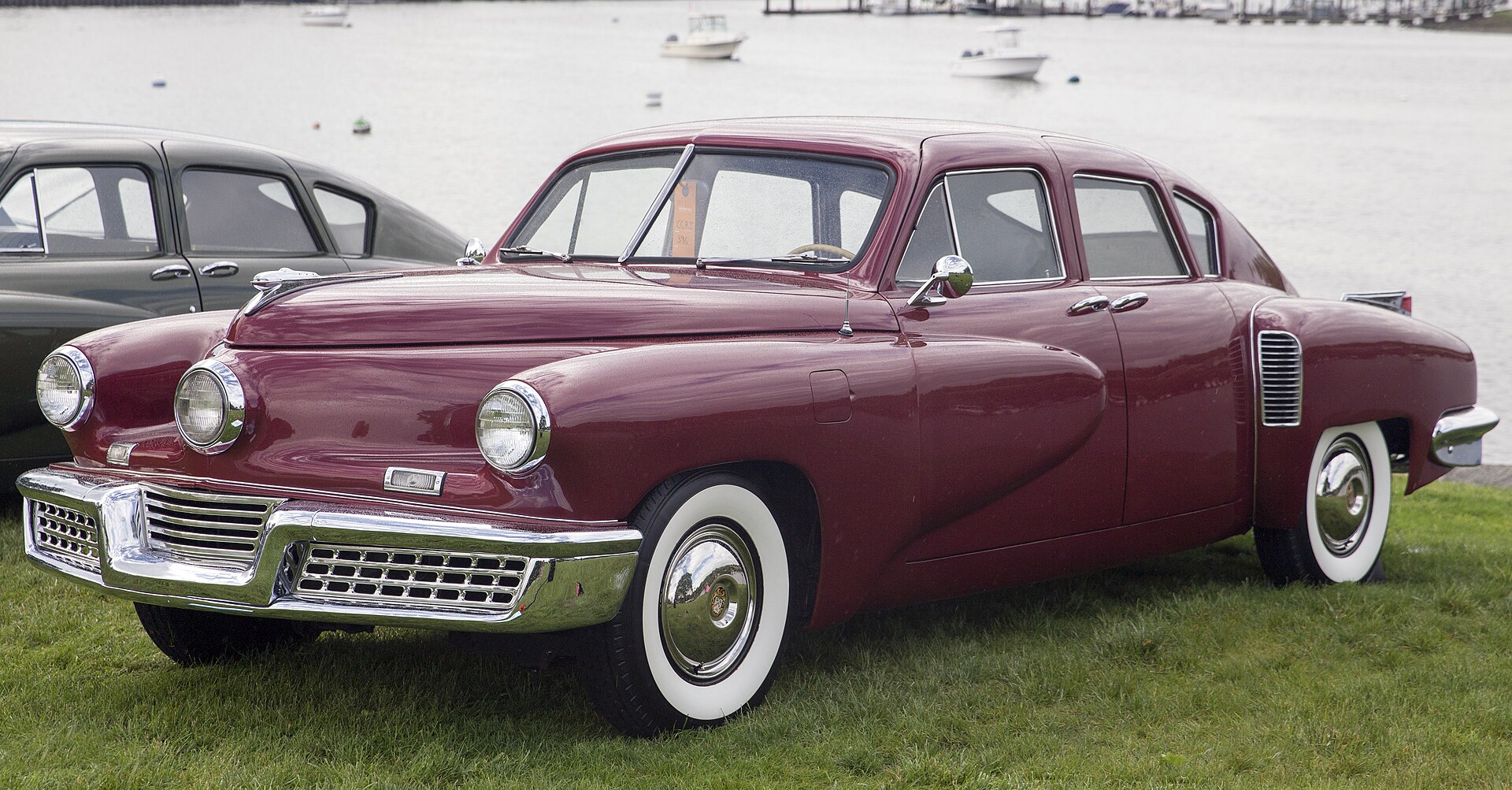
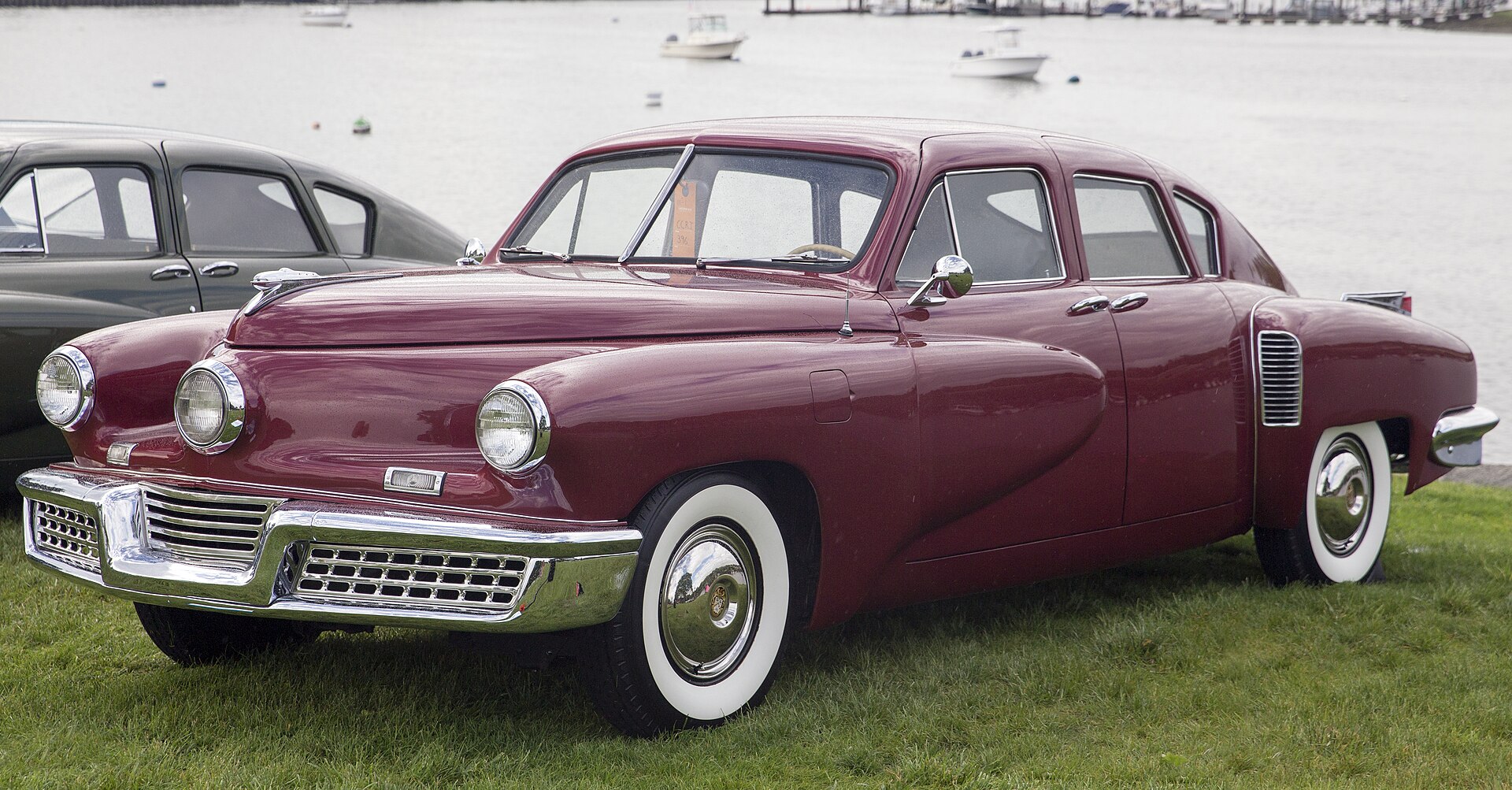
That model is the Tucker 48, also known as the Tucker Torpedo. It is a large rear-engined sedan with a third, steering headlamp, a padded "crash chamber" and a pop-out windscreen. Only 50 cars were completed, plus a 51st left partly built, before an investigation by the US Securities and Exchange Commission (SEC) and a fraud trial ended the venture. Tucker and his executives were acquitted in January 1950, but the factory never reopened.
Specs by version
Engines
Dimensions and weight
Show all 1 versions
| Version | Kerb weight |
|---|---|
| 5.5 flat-six | 1,900 kg4,189 lb |
Verified Manufacturer and type-approval data from our catalog · Sources and methodology
In short
- 50 cars completed in Chicago in 1947–1948, plus a 51st partly finished; English Wikipedia's lead counts 51 including the prototype.
- Rear-mounted Franklin O-335 flat-six of 5,475 cc, converted to water cooling, with 124 kW (166 bhp) and 504 Nm.
- Safety ideas: a central headlamp that turned with the steering, a padded dashboard, a crash chamber, a pop-out windscreen and a roll bar in the frame.
- Production stopped on 3 March 1949; the jury cleared Tucker on 22 January 1950.
Tucker 48 at a glance
| Parameter | Metric | Imperial |
|---|---|---|
| Maker | Tucker Corporation, Chicago, Illinois | — |
| Production | 1947–1948; operations ended 3 March 1949 | — |
| Built | 50 completed, 51st partly built | — |
| Designers | George S. Lawson, Alex Tremulis, Read Viemeister, Budd Steinhilber, Tucker Madawick, Hal Bergstrom, Philip S. Egan | — |
| Layout | rear engine, rear-wheel drive, four-door sedan | — |
| Engine | Franklin O-335 flat-six, 5,475 cc, water-cooled | 334.1 cu in |
| Power | 124 kW (166 bhp) | — |
| Torque | 504 Nm | 372 lb-ft |
| Gearbox | Cord 810/812 unit, Tucker Y-1 or TuckerMatic | — |
| Wheelbase | 3,251 mm | 128.0 in |
| Length × width × height | 5,563 × 2,007 × 1,524 mm | 219.0 × 79.0 × 60.0 in |
| Kerb weight | 1,900 kg | 4,200 lb |
Preston Tucker and the road to Chicago
Tucker spent the early 1930s in sales jobs in Memphis, Buffalo and Detroit and went to the Indianapolis Motor Speedway every year. With Harry Miller he built ten modified Ford V8 racers for Henry Ford in 1935; they overheated and dropped out of the race. His Combat Car of late 1937 was rejected by the US military as too fast, though the Navy showed interest in its gun turret. Tucker Aviation Corporation was formed in 1940.
The car project began in Ypsilanti, Michigan. Production needed a plant, and Tucker found one in Chicago. The former Dodge Chicago Aircraft Engine Plant had built Wright R-3350 engines for the B-29 bomber, on a site of 475 acres (1.92 km²). He signed the lease in July 1946 on condition that he raise US$15 million by March 1947. A dispute with the Lustron Corporation kept him out of the building until September 1947.
Money: shares, dealers and accessories
Tucker floated a US$20 million share issue through the Chicago broker Floyd D. Cerf and had more than US$17 million in the bank by 1947. He also sold dealerships and distributorships across the country. The idea that later drew the investigators was the accessories programme. Buyers who paid in advance for accessories secured a place on the dealer waiting list, and the scheme had brought in about US$2,000,000 by the time of the 1949 investigation.
The car's price was another issue. Tucker first proposed a price of US$1,000; the actual selling price was closer to US$4,000. Negative press began in late 1947, and on 15 June 1948 Tucker published an "open letter to the automobile industry" in reply.

Design and safety features
The design team around Alex Tremulis and George S. Lawson drew a long, low four-door body. The first prototype was nicknamed the "Tin Goose", a name Tremulis claimed to have coined. The car was renamed Tucker '48 during development, reportedly so as not to remind the public of the war, but its first name is still widely used. The doors were cut into the roof to make getting in and out easier. The car's safety features were its main selling point:
- a central third headlamp that turned with the front wheels once the steering moved more than 10 degrees;
- a padded dashboard;
- a padded "crash chamber" ahead of the front passenger;
- a windscreen designed to pop out in a collision;
- a perimeter frame with an integrated roll bar.


Engine and gearbox
Tucker's own first engine was a 9.7-litre (589 cu in) flat-six with hemispherical combustion chambers, fuel injection and valves worked by oil pressure instead of a camshaft. It was meant to give about 149 kW (200 hp) and 610 Nm (450 lb-ft) at 1,800 rpm. Six were built, but in practice the engine made about 66 kW (88 hp) and needed a 24-volt system and up to 60 volts to start. Only the test chassis and the first prototype received one.
After almost a year lost on the 589, Tucker chose the Franklin O-335, an air-cooled flat-six of 5,475 cc built by Air Cooled Motors for the Bell 47 helicopter. He bought four samples and had the engine converted to water cooling, a choice English Wikipedia says has puzzled historians. He then bought Air Cooled Motors itself for US$1.8 million in the late 1940s. The production engine gives 124 kW (166 bhp) and 504 Nm (372 lb-ft), and it was run at full throttle for 150 hours in testing.
Gearboxes were the weak spot. As a stopgap, Tucker used the four-speed Cord 810/812 transmission with Bendix electro-vacuum shifting: 22 used units were bought and refurbished, and 18 went into cars. The Tucker Y-1 was a stronger redesign. The TuckerMatic was designed by Warren Rice, the creator of Buick's Dynaflow. It was a continuously variable unit with a single torque converter and 27 basic moving parts, about 90 fewer than a typical automatic of the time, and versions of it went into cars 1026 and 1042. Because it was long, the fuel tank moved from behind the rear seat to the front of the dashboard from car 1026 on.
With 124 kW for 1,900 kg, the car has about 65 kW per tonne, and the power-to-weight calculator compares that with other post-war cars. The car is 5,563 mm long and 2,007 mm wide; the size comparison tool sets such figures against a modern car.
Chassis, testing and the premiere
Instead of steel springs, the Tucker used rubber elements developed with Firestone. Cars 1001 and 1002 had a rubber torsion tube that toed in under hard braking. Cars 1003 to 1025 had a very stiff rubber "sandwich", and from car 1026 a modified torsion tube cured the problem. Disc brakes were on the original specification but were dropped for cost and time. The steering box sat behind the front axle to protect the driver in a frontal crash, and the steering columns came from the 1941 Lincoln. Seventeen states banned more than two headlamps, so Tucker supplied a cover for the central light.
The prototype premiered at the Chicago factory on 19 June 1947, in front of more than 3,000 people; the night before, two suspension arms had broken under its weight. During endurance tests at the Indianapolis Motor Speedway, car 1027 rolled three times at 95 mph (153 km/h). The windscreen popped out as designed, the chief mechanic Eddie Offutt walked away with bruises, and after a tyre change the car was driven off the track.
The SEC case and the end of Tucker
The SEC and the US Attorney investigated the accessories programme and the share sale. Operations stopped on 3 March 1949. On 10 June 1949 Tucker and six other executives were indicted on 25 counts of mail fraud, five SEC violations and one count of conspiracy. The trial began on 4 October 1949 before Judge Walter J. LaBuy, the day the factory closed. On 22 January 1950, after 28 hours of deliberation, the jury found all defendants not guilty on every count.
| Date | Event |
|---|---|
| July 1946 | lease of the Chicago plant signed |
| by 1947 | more than US$17 million raised from shares |
| September 1947 | Tucker moves into the plant |
| 1947–1948 | 36 sedans finished from 58 frames and bodies |
| 3 March 1949 | production and operations cease |
| 10 June 1949 | indictment of Tucker and six executives |
| 22 January 1950 | not-guilty verdict on all counts |
| 26 December 1956 | Preston Tucker dies, aged 53 |
Of 58 frames and bodies, 36 sedans were finished before the factory closed. Tucker's remaining staff completed 14 more, for 50 cars, and a 51st was partly built. The English Wikipedia article on Preston Tucker gives 37 cars built before the closure and 13 later, again 50 in all. In the early 1950s he worked with Brazilian investors and the designer Alexis de Sakhnoffsky on a sports car called the Carioca, which was never completed.
Survivors and auction prices
English Wikipedia keeps a car-by-car list of the Tuckers. By that list, four cars (numbers 1018, 1023, 1027 and 1042) were destroyed and one (1035) has been modified; the part-built cars from 1051 upward are listed separately. Many survivors are in museums. Among them are The Henry Ford in Dearborn (car 1016), the Smithsonian National Museum of American History in Washington (1039), the Petersen Automotive Museum in Los Angeles (1030). Others are at the AACA Museum in Hershey (1001, 1022 and 1026) and the Toyota Automobile Museum in Japan (1004). Car number 1049 was sold by RM Sotheby's in Monaco on 14 May 2016 for €1,344,000. In 1988 Francis Ford Coppola told the story in the film Tucker: The Man and His Dream; Coppola owns a Tucker and displays it at his winery. More cars of the decade are in the 1940s classics section.

Which Tucker 48 to look for
There is no real choice of versions: all completed cars are four-door sedans with the same engine. The differences are in the details:
- Gearbox: cars with the Cord-derived unit, the Y-1 or the TuckerMatic.
- History: the prototype "Tin Goose" and the 14 cars finished by the remaining staff after the factory closed have their own stories.
- Originality: car 1035 is listed as modified, so any car's number should be checked against the car-by-car list.
Photo gallery

Tucker 48 in our rankings
- No. 23 of 131 · Biggest engines: sedans (5,475 cc · top 18%)
- No. 117 of 557 · Biggest engines: cars (5,475 cc · top 22%)
- No. 12 of 53 · Heaviest sedans (1,900 kg · top 23%)
- No. 91 of 304 · Heaviest cars (1,900 kg · top 30%)
- No. 22 of 68 · Most torque: sedans (504 Nm · top 33%)
- No. 163 of 368 · Most torque: cars (504 Nm · top 45%)
Bigger engine than 82% of ranked sedans in the 1CARS catalog (No. 23 of 131).
FAQ
How many Tucker 48s were made?
50 cars were completed, and a 51st was partly built; English Wikipedia's lead counts 51 including the prototype.
What engine does the Tucker 48 have?
A rear-mounted Franklin O-335 flat-six of 5,475 cc, converted to water cooling, with 124 kW (166 bhp) and 504 Nm.
What was the third headlight on the Tucker for?
The central headlamp switched on and turned with the steering once the wheels moved more than 10 degrees.
Was Preston Tucker guilty of fraud?
No. He and six other executives were tried for mail fraud, SEC violations and conspiracy, and the jury found them not guilty on all counts on 22 January 1950.
What is a Tucker 48 worth?
Car 1049 sold at RM Sotheby's in Monaco on 14 May 2016 for €1,344,000.
Data sources
Data checked by an editor against the sources below.