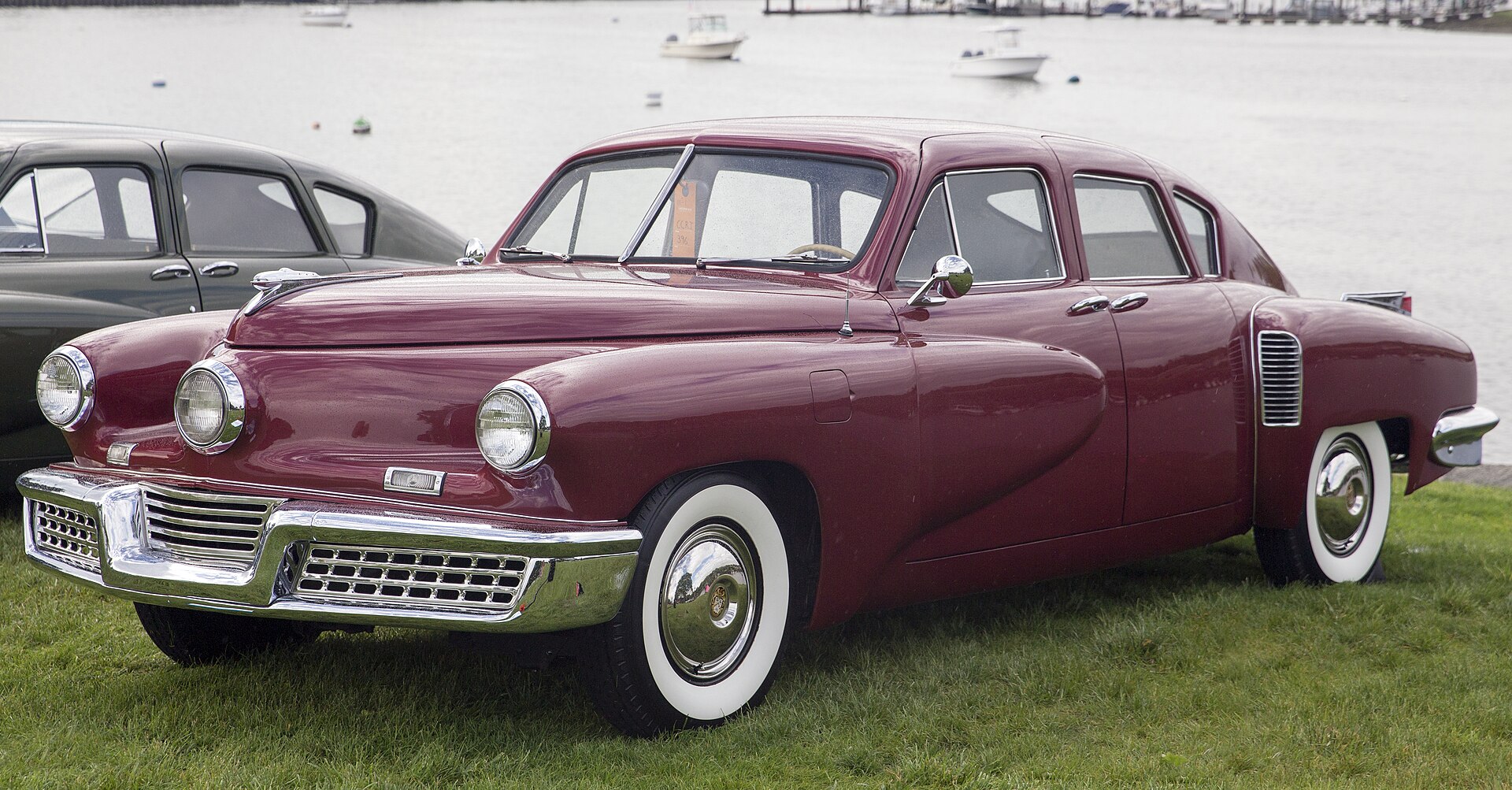
Tucker — Preston Tucker's Short-Lived Chicago Car Company
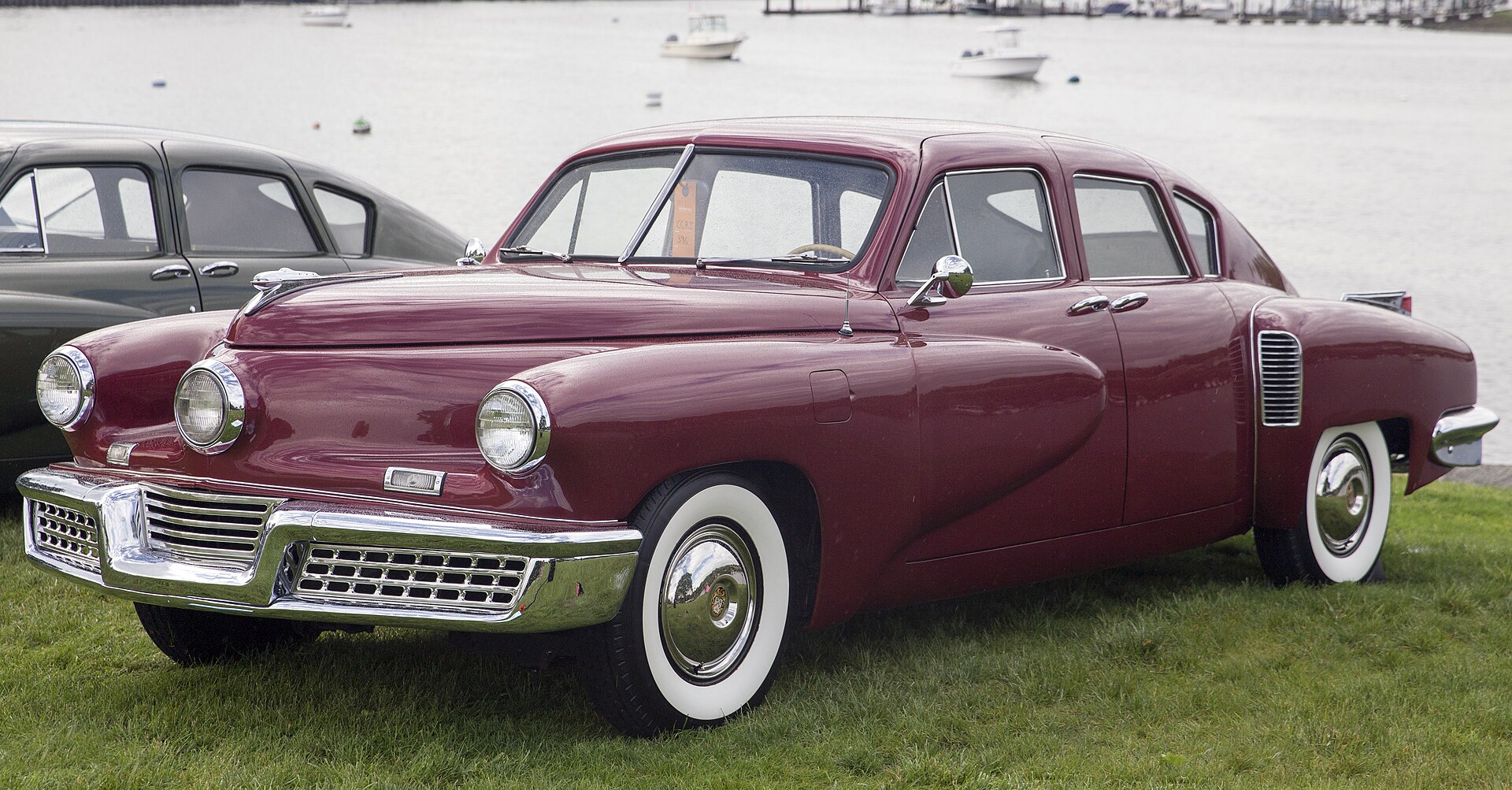
Tucker was a short-lived American car company founded by Preston Tucker after the Second World War to build a new kind of saloon, the Tucker 48. The car had a rear-mounted flat-six, a third headlamp that turned with the steering and a long list of safety features, and its premiere in Chicago in June 1947 drew more than 3,000 people. Only about 50 cars were finished before the company ceased operations on 3 March 1949, amid an investigation by the Securities and Exchange Commission. Tucker and his colleagues were acquitted in January 1950, but the company never recovered.
Key takeaways
- Preston Tucker (1903–1956) leased the former Dodge aircraft engine plant in Chicago in 1946 to build his car.
- The Tucker 48 used a 5.5-litre Franklin flat-six of 124 kW (166 hp), converted to water cooling, mounted at the rear.
- Fifty cars were completed and a 51st partly finished; the company closed on 3 March 1949.
- Tucker and six colleagues were found not guilty of fraud on 22 January 1950.
Tucker at a glance
| Fact | Value |
|---|---|
| Founder | Preston Tucker (born 21 September 1903, Capac, Michigan) |
| Plant | Former Dodge aircraft engine plant, Chicago (leased 1946) |
| Only model | Tucker 48 |
| Engine | Franklin O-335 flat-six, 5.475 litres, 124 kW (166 hp) |
| Layout | Rear engine, rear-wheel drive, independent suspension |
| Cars built | 50 completed plus one partly finished |
| Company closed | 3 March 1949 |
| Trial verdict | Not guilty, 22 January 1950 |
Preston Tucker before the car
Preston Tucker was born on a peppermint farm near Capac, Michigan, on 21 September 1903. As a teenager he bought and resold used cars, then worked as an office boy at Cadillac, on the Ford assembly line and as a car salesman in Memphis, Buffalo and Detroit. In 1935 he formed Miller and Tucker, Inc. with the race-engine builder Harry Miller; their first job was ten Ford V8 racing cars for Henry Ford, which failed in the race because their steering boxes overheated.
In late 1937 the former salesman conceived a fast armoured vehicle, the Tucker Combat Car. A version for the Dutch government ended with the German invasion of the Netherlands in 1940, and the US Army rejected the vehicle, though the Navy took an interest in its gun turret. The family moved to Ypsilanti, Michigan, in 1939, where the workshop began turret production, and Tucker Aviation followed in 1940.
Designing the car
The car was conceived in Ypsilanti. Its creator hired the designer George S. Lawson in the summer of 1944, and Lawson became chief stylist in February 1946, when the company was formed. After Lawson resigned in December 1946, Alex Tremulis of Tammen & Denison in Chicago, who had been chief stylist of Auburn-Cord-Duesenberg in 1936–1937, developed the design. Tremulis also gave the first prototype its nickname, the "Tin Goose". Five designers from J. Gordon Lippincott then produced a clay model whose side profile was used for production. The name Tucker '48 was adopted around the time Lawson left.
The world premiere took place in Chicago on 19 June 1947 before more than 3,000 people. To finance the project the company raised US$17,000,000 in a stock issue, one of the first speculative public offerings, and an accessories programme brought in more money. The columnist Drew Pearson publicly called the car a fraud.

Engine, safety and engineering
The original engine, a 589 cu in flat-six, was loud and hard to start and produced only about 66 kW (88 hp) against the 112 kW (150 hp) Tucker had promised. The company therefore bought Air Cooled Motors, cancelled its aircraft contracts and used its Franklin O-335, a 5.475-litre flat-six rated at 124 kW (166 hp), which the engineers in Chicago converted to water cooling in 1947. That is about 23 kW per litre, a modest figure next to later engines in the output per litre data. In aircraft form the same engine powered helicopters such as the Bell 47, and the Tucker family owned the engine company until 1961.
Engine and gearbox sat on a subframe held by six bolts so that the drivetrain could be removed quickly. Early cars used modified Cord 810/812 four-speed gearboxes, later the Tucker Y-1; the Tuckermatic continuously variable transmission by Warren Rice was fitted only to cars 1026 and 1042.
The chassis had rubber torsion-tube independent suspension on all four wheels. A third, central headlamp turned with the steering at angles over 10 degrees, and in states whose laws limited headlamps it could be covered. Safety features included a perimeter frame, an integrated roll bar, a shatterproof windscreen designed to pop out in a collision, a padded dashboard and a "crash chamber" in front of the passenger seat.


The trial and the end of the company
The company's problems grew. The War Assets Administration rejected the company's bids for two steel mills, and the Securities and Exchange Commission investigated the accessories programme. Of the 58 frames and bodies built, 36 saloons were finished before the factory closed; a core crew then completed 14 more, for 50 in all, and a 51st was partly built. The company ceased operations on 3 March 1949.
Tucker and six colleagues were indicted in June 1949, and the trial began on 4 October 1949. On 22 January 1950 the jury found all of them not guilty, but the company never recovered. Tucker then worked with investors in Brazil and the designer Alexis de Sakhnoffsky on a sports car called the Carioca, which was never built. The Tucker name could not be used because another party had bought it. Preston Tucker died of pneumonia linked to lung cancer in Ypsilanti on 26 December 1956, aged 53.

The film and the surviving cars
In 1988 Francis Ford Coppola directed Tucker: The Man and His Dream, with Jeff Bridges as Preston Tucker and George Lucas as executive producer. Twenty-one cars were borrowed from members of the Tucker Automobile Club of America for filming, and Martin Landau won a Golden Globe for his supporting role. According to the film article, 47 of the 51 cars still exist.
The surviving cars now sell for seven-figure sums. Car number 1043 sold for US$2,915,000 at Barrett-Jackson on 21 January 2012, and number 1003 for US$2,035,000 at Pebble Beach in 2014. The Tucker 48 article covers the car's specifications, the make is listed in the Tucker catalogue, and other post-war American cars are in the classic cars section.
Tucker timeline
| Year | Event |
|---|---|
| 1903 | Preston Tucker born in Capac, Michigan (21 September) |
| 1935 | Miller and Tucker, Inc. formed with Harry Miller |
| 1937 | Tucker Combat Car conceived |
| 1944 | Designer George S. Lawson hired |
| 1946 | Chicago plant leased; Alex Tremulis takes over the design |
| 1947 | Tucker 48 premiere in Chicago (19 June) |
| 1949 | Company ceases operations (3 March); trial begins (4 October) |
| 1950 | Tucker and colleagues acquitted (22 January) |
| 1956 | Death of Preston Tucker (26 December) |
| 1988 | Coppola's film Tucker: The Man and His Dream |
Landmark Tucker models
| Model | Years | Why it matters |
|---|---|---|
| Tucker Combat Car | 1937 onwards | Armoured vehicle whose turret interested the US Navy |
| "Tin Goose" prototype | 1940s | First prototype, nicknamed by Alex Tremulis |
| Tucker 48 | 1947–1949 | Rear-engined saloon with a steering headlamp, about 50 built |
| Carioca (project) | early 1950s | Sports car planned in Brazil, never built |
Photo gallery

FAQ
How many Tucker 48s were made?
Fifty cars were completed and a 51st was partly finished, counting the prototype; 47 of the 51 are said to survive.
Why did Tucker fail?
The company was investigated by the Securities and Exchange Commission, faced negative press and lawsuits, and ceased operations on 3 March 1949. Tucker was acquitted in January 1950, but the company never recovered.
What engine did the Tucker 48 have?
A Franklin O-335 flat-six of 5.475 litres, rated at 124 kW (166 hp), converted to water cooling and mounted at the rear.
What was the Tucker's third headlight for?
The central headlamp turned with the steering at angles above 10 degrees; in states that limited the number of headlamps it could be covered.
Who designed the Tucker 48?
George S. Lawson began the design; Alex Tremulis developed it from December 1946, and designers from J. Gordon Lippincott shaped the final side profile.
Sources
- Wikipedia — Tucker 48 (accessed 24 Oct 2026)
- Wikipedia — Preston Tucker (accessed 24 Oct 2026)
- Wikipedia — Alex Tremulis (accessed 24 Oct 2026)
- Wikipedia — Tucker: The Man and His Dream (accessed 24 Oct 2026)
- Wikipedia — Franklin O-335 (accessed 24 Oct 2026)
Found a mistake? Report an error