 Innocenti Mini
Specs, engines and history
Published Sources (1) Report an error
By Felix Hartmann, Automotive Technology & EV Contributor
- Built
- 1974–1982
- Top power
- 48 kW (65 PS)
Innocenti was an Italian company from Lambrate, on the eastern edge of Milan, founded by Ferdinando Innocenti in 1933. After the Second World War it became famous for the Lambretta scooter, built from 1945 to 1971. Cars followed in 1960 with the Innocenti A40, a hatchback version of the Austin A40 Farina, and the 950 Spider on Austin-Healey Sprite mechanicals with a Ghia body. Innocenti built BMC and later British Leyland cars under licence, came under British Leyland control in 1972, passed to Alejandro de Tomaso in 1976 and to Fiat in 1990. Fiat ended the marque, and the last sales were planned for June 1997.
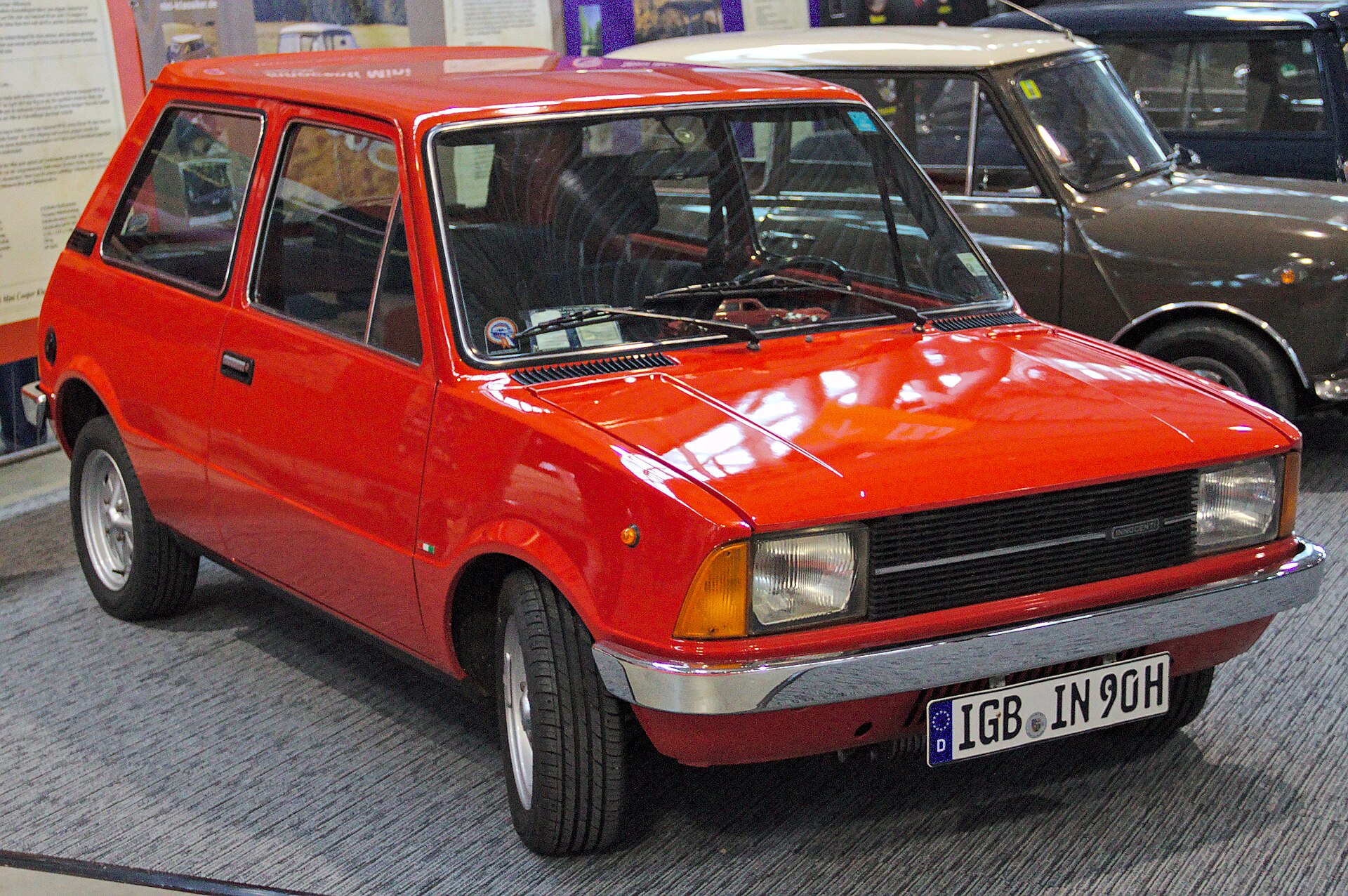
The Mini is the car that defined Innocenti. From November 1965 the company built its own versions of the BMC Mini, and in 1974 it launched the Innocenti Mini 90 and 120, a Bertone-designed three-door hatchback on the Mini's mechanicals. Marcello Gandini styled it, and the car stayed in production in many forms, from A-series four-cylinders to Daihatsu three-cylinders, until 31 March 1993.
Specs by version
Verified Manufacturer and type-approval data from our catalog · Sources and methodology
In short
- Licence-built BMC Mini from November 1965 to early 1975 (Mini 850, 1000, 1001, Cooper, Cooper 1300, Mini T estate).
- Bertone Mini 90 and 120 from the 1974 Turin Show: 998 cc and 1,275 cc A-series engines, 32–48 kW (44–66 PS).
- From April 1982 Daihatsu three-cylinder engines (993 cc, also turbo and diesel); production ended on 31 March 1993.
- Built at Lambrate, Milan; output 23,187 in 1981, 21,646 in 1982 and 13,688 in 1983.
Innocenti Mini at a glance: maker, production years (1965–1993), purpose
| Parameter | Value |
|---|---|
| Maker | Innocenti (Nuova Innocenti from 1976), Lambrate, Milan, Italy |
| Production | November 1965 – early 1975 (BMC Mini); 1974 – 31 March 1993 (Bertone Mini) |
| Purpose | small city car |
| Body | two-door saloon and Mini T estate (BMC type); three-door hatchback (Bertone) |
| Layout | transverse front engine, front-wheel drive |
| Engines (Bertone) | 998 and 1,275 cc A-series four-cylinder; from 1982 Daihatsu 993 cc three-cylinder; later 550–660 cc |
| Power (Bertone) | 32 kW (44 PS) to 55 kW (75 PS) |
| Gearbox | four-speed manual (A-series); usually five-speed manual (Daihatsu); Minimatic two-speed from 1984 |
| Wheelbase | 2,040 mm (990: 160 mm longer) |
| Length × width × height | 3,120–3,170 × 1,500 × 1,365 mm |
| Kerb weight | about 730 kg |
| Designer | Marcello Gandini at Bertone |
Development and production history
Innocenti introduced its Mini 850 in November 1965. Only the earliest cars were assembled from kits; most used body shells and parts made in Italy, which made them differ from the Minis built in Britain in the same years. The range grew to the 1000, 1001, Cooper and Cooper 1300, and the Mini T estate was the only body other than the saloon. This assembly ended in early 1975.
British Leyland, which bought the company's land, buildings and equipment in 1972 for about £3 million, developed a re-bodied Mini for Innocenti. Production at Innocenti peaked at 62,834 cars in 1972, and exports rose from one car in 1971 to more than 17,000 in 1974. The new Mini 90L and 120L were shown at the 1974 Turin Show. Within a year British Leyland was in financial trouble, and in 1976 Innocenti was sold to De Tomaso and the state holding GEPI. The renamed Nuova Innocenti recovered to 38,120 cars in 1977 and 40,719 in 1978.
In April 1982 Daihatsu engines replaced the Leyland units. De Tomaso said in 1984 that this cut warranty repairs by 70%, but output kept falling: from 23,187 cars in 1981 to 13,688 in 1983 and 10,331 in 1988. Fiat took over in 1990, renamed the car the Innocenti Small and ended production on 31 March 1993, with sales continuing into 1994.
Design and engineering
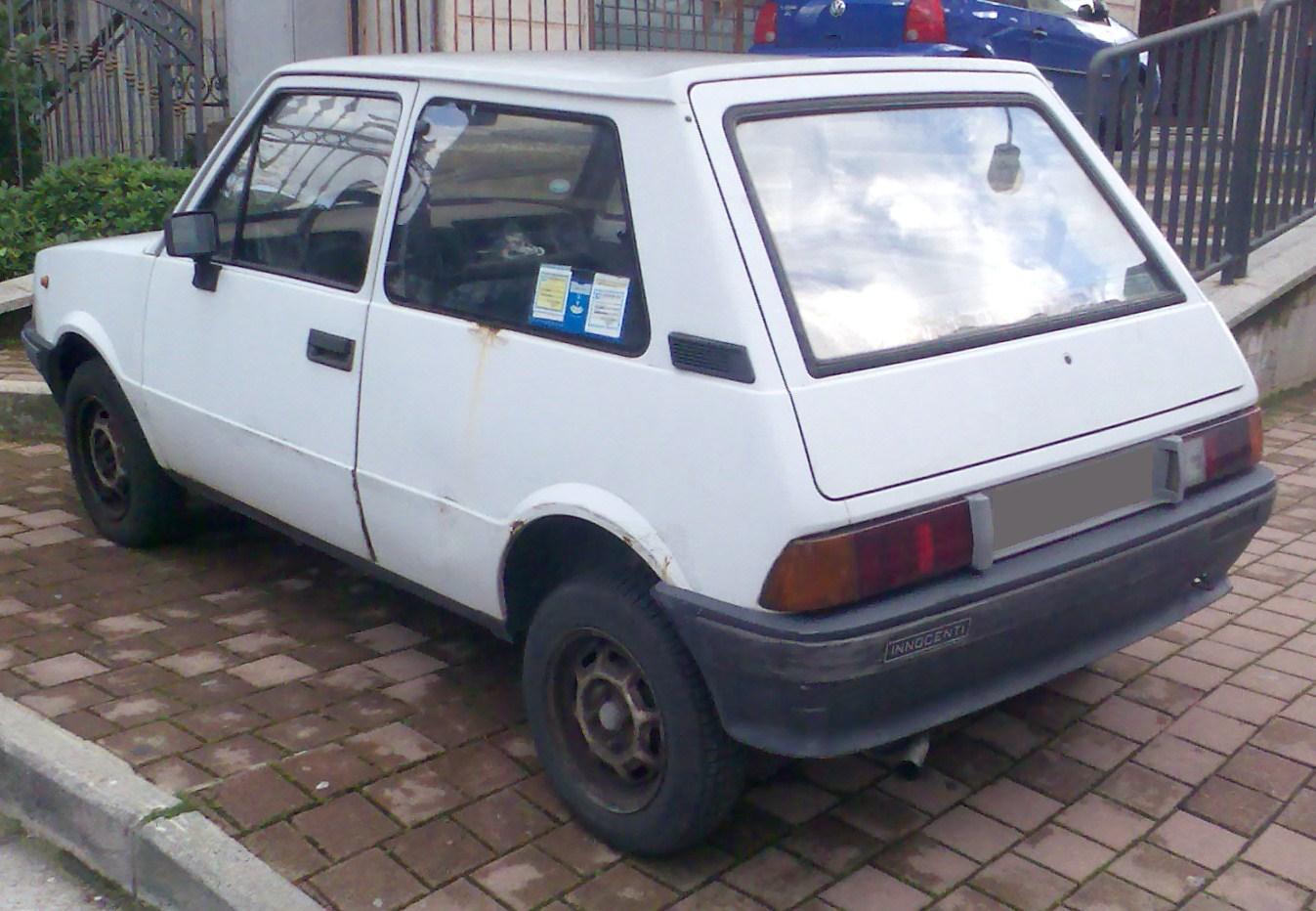
Marcello Gandini at Bertone gave the Mini a new three-door body with a rear hatch that made the boot much easier to load. The drag coefficient fell slightly, to 0.41 against 0.42 for the original Mini. The short-wheelbase car is 2,040 mm between the axles and 3,120–3,170 mm long, 1,500 mm wide and 1,365 mm high, and weighs about 730 kg.
Under the new body the first cars kept the Mini's rubber cone suspension, which handled well but rode harshly. The Daihatsu-engined cars of 1982 changed that: MacPherson struts replaced the rubber springs at the front, and a new independent rear suspension was fitted, adding about 55 kg. From January 1984 the car was called Minitre, with most new parts from the Daihatsu Charade. The longer-wheelbase 990 of 1986 added 160 mm between the axles and raised the boot from 280 to 295 litres.

Engine and drivetrain
| Engine | Years | Power | Gearbox |
|---|---|---|---|
| 998 cc A-series four (90) | 1974–1982 | 32 kW (44 PS), later 37 kW (50 PS) | four-speed |
| 1,275 cc A-series four (120, Mille) | 1974–1982 | up to 48 kW (66 PS) | four-speed |
| 1,275 cc De Tomaso | 1977–1982 | 53 kW (72 PS), 55 kW (75 PS) from 1978 | four-speed |
| 993 cc Daihatsu three | 1982–1993 | 38 kW (52 PS) | usually five-speed |
| 993 cc Turbo De Tomaso | 1984–1990 | 53 kW (72 PS) | five-speed |
| 993 cc Diesel | 1984–1990 | 27 kW (37 PS) | five-speed |
| 617 cc two-cylinder (Mini 650) | from 1984 | 23 kW (31 PS) | - |
| 550/659 cc three (Mini 500, Small) | 1988–1993 | 23 kW (31 PS) | - |
The diesel of April 1984 was, at launch, the smallest diesel engine in a passenger car and had the highest specific output of any naturally aspirated production diesel. It took about 30% of production, against an expected 20%. A two-speed semi-automatic called Minimatic was offered from July 1984. The Mini 500 of 1988 had 23 kW (31 PS) at 6,400 rpm and a top speed of 116 km/h, and in late 1988 about 75% of home-market sales were 500s.

Innocenti Mini specifications (Bertone body)
| Data | Value |
|---|---|
| Wheelbase | 2,040 mm (990: about 2,200 mm) |
| Length | 3,120–3,170 mm |
| Width / height | 1,500 / 1,365 mm |
| Kerb weight | about 730 kg |
| Drag coefficient | 0.41 |
| Boot | 280 litres; 295 litres in the 990 |
| Top speed | 116 km/h (Mini 500); 120 km/h (Small 500, 1990) |
Variants and derivatives: from Mini 90 to Small
| Version | Years | Notes |
|---|---|---|
| Mini 850, 1000, 1001, Cooper, Cooper 1300, Mini T | 1965–1975 | licence-built BMC Mini |
| Mini 90L / 120L | 1974–1982 | Bertone body, A-series engines |
| Mini De Tomaso | 1977–1982 | plastic bumpers, fog lamps, bonnet scoop, wider arches |
| Mini Mille | from 1980 | replaced the 120 in most markets; about 5 cm longer |
| Tre Cilindri / Minitre | 1982–1993 | Daihatsu three-cylinder; S, SL, SE trims |
| Turbo De Tomaso | 1984–1990 | presented December 1983 |
| 990 | 1986–1993 | longer wheelbase; Serie Speciale with Missoni interior from 1991 |
| Mini 500 / Small 500 | 1988–1993 | 550–660 cc three-cylinder |


In service: operation and legacy
The Daihatsu engines improved reliability, and the diesel sold better than planned, but the small car never regained the volumes of the 1970s. Canada imported it from 1984, but sales fell from about 2,000 in the first year to 196 in the first half of 1986. After Fiat's takeover, the Innocenti name also appeared on cars made elsewhere, such as the Yugo-based Innocenti Koral and Brazilian-built Uno variants, until the brand ended in 1997. The Innocenti Mini linked British, Italian and Japanese engineering in one small car. Fiat's side of the story is in the history of Fiat.
Preservation and collecting today
The Bertone Mini was built for almost two decades, so many versions survive. The De Tomaso models are the sporting versions, the diesel was a record-breaker for its size, and the 990 Serie Speciale of 1991 has an Alcantara interior by Missoni. No reliable public price data was found for this article, so no market values are given.
Which Innocenti Mini to choose:
- For the original Mini feel: a licence-built Innocenti Mini Cooper 1300 (1965–1975).
- For Gandini's design with British mechanicals: a Mini 90 or 120 (1974–1982).
- For performance: a Mini De Tomaso or the Turbo De Tomaso.
- For economy: the 993 cc Diesel.
More small cars of the period are in the 1970s classics and the classic cars section; every model of the brand is in the Innocenti catalogue.
Photo gallery

Innocenti Mini in our rankings
- No. 455 of 912 · Longest-running car nameplates (8 years · top 53%)
- No. 64 of 70 · Biggest engines: hatchbacks (1,275 cc · top 92%)
- No. 84 of 88 · Most powerful cars of the 1970s (48 kW · top 96%)
- No. 831 of 859 · Most powerful cars (48 kW · top 97%)
- No. 536 of 557 · Biggest engines: cars (1,275 cc · top 97%)
- No. 103 of 106 · Most powerful hatchbacks (48 kW · top 99%)
In production longer than 47% of ranked nameplates in the 1CARS catalog (No. 455 of 912).
FAQ
Who designed the Innocenti Mini?
The 1974 Mini 90 and 120 were styled by Marcello Gandini at Bertone; the earlier Innocenti Minis were licence-built versions of the BMC Mini.
What engines did the Innocenti Mini use?
BMC/Leyland A-series four-cylinders of 998 and 1,275 cc until 1982, then Daihatsu three-cylinders of 993 cc, including a turbo and a diesel, and later 550–660 cc engines.
When did Innocenti stop making the Mini?
Production ended on 31 March 1993, and sales continued into 1994.
How powerful is the Innocenti Mini De Tomaso?
The 1,275 cc De Tomaso had 53 kW (72 PS), and 55 kW (75 PS) from 1978; the later Turbo De Tomaso had a 993 cc three-cylinder with 53 kW (72 PS).
Was the Innocenti Mini sold outside Italy?
Yes; exports reached more than 17,000 cars in 1974, and Canada imported the Daihatsu-engined car from 1984.
Data sources
Data checked by an editor against the sources below.