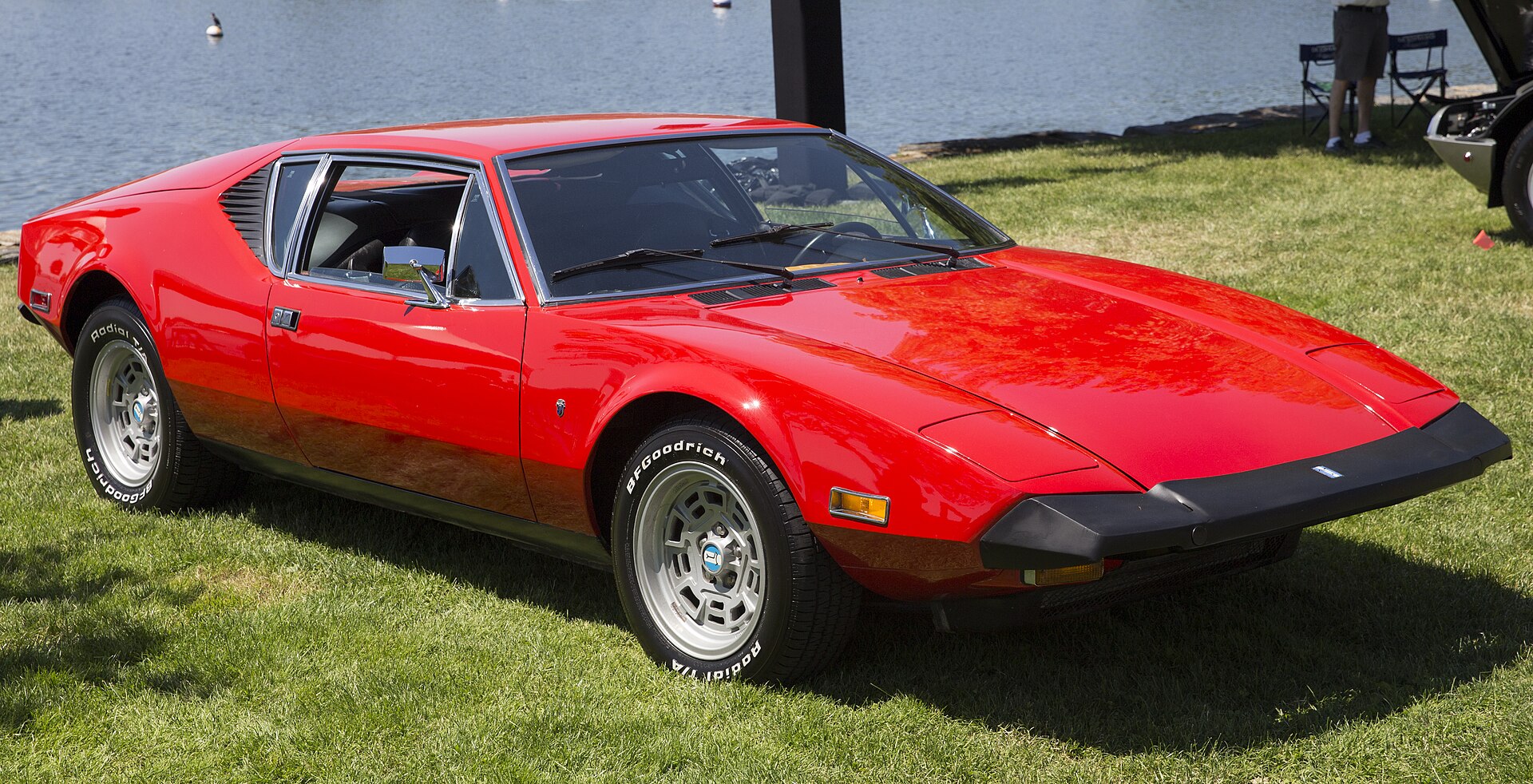
De Tomaso — Alejandro de Tomaso's Italian-American Sports Cars
De Tomaso is the Italian sports car maker founded in Modena in 1959 by the Argentine racing driver Alejandro de Tomaso. It combined Italian chassis and coachwork with American Ford V8 engines, most famously in the Pantera of 1971, which Ford sold in the United States through Lincoln-Mercury dealers. In the 1970s and 1980s de Tomaso also controlled Maserati, Innocenti and Moto Guzzi. After his death in 2003 the company was liquidated, and the name passed through several owners before the P72 was shown in 2019.
Key takeaways
- Alejandro de Tomaso, born in Buenos Aires on 10 July 1928, founded the company in Modena in 1959 and raced his own cars in Formula One from 1961 to 1963.
- The Mangusta of 1967–1971, styled by Giorgetto Giugiaro at Ghia, was the first De Tomaso with a Ford V8; 401 were built.
- About 7,260 Panteras were made from 1971 to 1993, around 5,500 of them sold in the United States by 1975.
- The company went into liquidation in June 2004; the P72 of 2019 has a supercharged Ford V8 and is planned in 72 examples.
De Tomaso at a glance
| Fact | Value |
|---|---|
| Founded | 1959, Modena, Italy |
| Founder | Alejandro de Tomaso (1928–2003) |
| Early backer | Amory Haskell Jr. |
| Engines | Ford V8s (Mangusta, Pantera, Deauville, Longchamp) |
| Best-known models | Vallelunga, Mangusta, Pantera, Deauville, Longchamp, Guarà, P72 |
| Group holdings | Ghia, Vignale, Benelli, Moto Guzzi, Innocenti, Maserati |
| Liquidation | June 2004 |
| Owner from 2014 | Ideal Team Ventures, Hong Kong |
An Argentine driver in Modena
Alejandro de Tomaso was born in Buenos Aires on 10 July 1928. His paternal grandfather had emigrated from Italy. Implicated in a 1955 plot against President Juan Perón, de Tomaso fled to Italy, settled in Modena and married the American heiress Isabelle Haskell. His Formula One record is two World Championship starts. In the 1957 Argentine Grand Prix a Ferrari 500 took him to ninth place. In the 1959 United States Grand Prix his Cooper's brakes failed after 13 laps.
The company was founded in 1959 as De Tomaso Modena SpA, with most of the early money from Amory Haskell Jr. It built sports prototypes and racing cars and entered Formula One with its own chassis from 1961 to 1963; the 801 failed to qualify for the 1962 Italian Grand Prix. In 1970 it built the 505/38 chassis for Frank Williams's team. It was uncompetitive, and Piers Courage was killed in it at the Dutch Grand Prix, after which the partnership ended.

Vallelunga and Mangusta
The Vallelunga of 1963 was the first road car. It had a mid-mounted four-cylinder engine from the Ford Cortina of 78 kW (104 hp) and a top speed of 215 km/h, and about 60 were built. Like the later sports cars, it used a backbone chassis.
The Mangusta made the brand known. A single car was shown at the 1965 Turin show, and production ran from 1967 to 1971.
Giorgetto Giugiaro styled the body at Ghia, with a bonnet in two halves that opened like gull wings. Early European cars had a Ford 289 V8 of 228 kW (306 hp); most others used an unmodified 302 of 170 kW (230 hp), with a five-speed ZF transaxle. The name is Italian for mongoose, the animal said to kill cobras, and it was rumoured to be a reply to a failed deal with Carroll Shelby, maker of the Cobra. Of 401 cars, about 150 stayed in Europe and about 251 went to North America. With 170 kW for 1,300 kg, the 302 cars had about 131 kW per tonne on these figures.

The Pantera and the Ford years
The Pantera replaced the Mangusta in 1971. Tom Tjaarda drew its wedge-shaped body at Ghia, and its 5.8-litre Ford 351 Cleveland V8 had 246 kW (335 PS). Car and Driver recorded 0–60 mph in 5.5 seconds for the 1971 car. The European GTS of 1972 had 257 kW (350 PS).
Ford was more than an engine supplier. In 1971 it bought 84% of De Tomaso and later all the shares, and from 1972 the Pantera was sold through Lincoln-Mercury dealers. From 1971 to 1973 Modena built 6,128 cars, its highest output ever. Ford ended the arrangement at the end of 1973, partly because of the oil crisis, and stopped importing the car in 1975 after selling about 5,500 in the United States. Ghia itself went to Ford in 1973.
De Tomaso kept the rights to sell the Pantera elsewhere and built fewer than 100 a year through the 1970s and 1980s, with the GT5 of 1980 and the GT5-S of 1984. Marcello Gandini gave new lines to the Pantera 90 Si of 1990, which had a 4.9-litre Ford 302; only 41 were made. Production ended in 1993 after about 7,260 cars. The car is covered in De Tomaso Pantera history and specifications.
Deauville, Longchamp and an industrial group
De Tomaso also tried luxury cars. The Deauville of 1971 was a four-door saloon with the Pantera's V8 at the front; 244 were made until 1985, plus one estate for Isabelle Haskell. The Longchamp of 1972 was a coupé on a shortened Deauville chassis, and 409 were built until 1989.
The founder's ambitions went further. The group gathered Ghia, Vignale, Benelli, Moto Guzzi and Innocenti, and in 1975–1976, after Citroën withdrew its support, it took over Maserati. Under De Tomaso ownership Maserati built the Kyalami, the Quattroporte III, the Biturbo range and the Shamal; the Kyalami is covered in Maserati Kyalami and the De Tomaso era. Innocenti, reorganised as Nuova Innocenti, built the sporty Mini De Tomaso from 1976 to 1987. Both were sold to Fiat in 1993.
Stroke, liquidation and new owners
In 1993 Alejandro de Tomaso suffered a stroke and handed the company to his son Santiago. The Pantera's successor, the Guarà of 1993, had a composite body and Ford and BMW parts but was built only in small numbers. A Gandini-styled convertible, the Biguà, was developed with the American importer Qvale. The relationship broke down, and Qvale sold the car itself as the Qvale Mangusta. De Tomaso died in Modena on 21 May 2003, and the company went into voluntary liquidation in June 2004.
The name then changed hands several times. In 2009 Gian Mario Rossignolo bought the trademark and planned 8,000 cars across three models; a Deauville concept was shown at Geneva in 2011 but never built. The firm failed to find finance. In July 2012 Rossignolo was arrested over the alleged misuse of €7.5 million of public funds, about 900 workers lost their jobs, and a court sentenced Rossignolo in 2018 to five and a half years for fraud and embezzlement. Norman Choi's Hong Kong company, Ideal Team Ventures, acquired the brand rights in 2014, and in April 2015 an Italian court approved the sale of the company for €1,050,000.

The P72 and the return
The P72 was unveiled at the Goodwood Festival of Speed in 2019, the brand's 60th anniversary, as a tribute to the P70 racing car of the 1960s. Designed by Jowyn Wong, it uses a carbon-fibre monocoque built to LMP1 standards and shared with the Apollo Intensa Emozione. Its 5.0-litre Ford Coyote V8, supercharged by Roush, gives about 559 kW (750 hp) and 900 Nm through a six-speed manual gearbox. Trial assembly began in Affalterbach, Germany, in December 2024, with series production planned for 2025 and 72 cars in total. A track-only P900 with a V12 of 670 kW (900 hp), announced in November 2022 at a starting price of US$3 million, was later cancelled.

Collecting a De Tomaso today
The Pantera is the obvious choice: it was built in the largest numbers, it uses a widely known Ford V8, and most cars were sold in North America. The Mangusta is rarer, with 401 built, and the Deauville and Longchamp were made in only a few hundred each. Compared with the Mangusta, the 1971 Pantera had 76 kW more than the 302-engined car. The power-to-weight calculator compares these figures with modern cars, and the brand's models are listed in the De Tomaso catalogue.
De Tomaso timeline
| Year | Event |
|---|---|
| 1959 | Company founded in Modena |
| 1961–1963 | Formula One entries with its own chassis |
| 1963 | Vallelunga, the first road car |
| 1967 | Mangusta production begins |
| 1971 | Pantera; Ford buys 84% |
| 1973 | Ford ends the arrangement; Ghia goes to Ford |
| 1975–1976 | Maserati and Innocenti taken over |
| 1993 | Founder's stroke; Maserati and Innocenti sold to Fiat; Guarà |
| 2003 | Alejandro de Tomaso dies (21 May) |
| 2004 | Voluntary liquidation (June) |
| 2014 | Ideal Team Ventures acquires the brand |
| 2019 | P72 at Goodwood |
Landmark De Tomaso models
| Model | Years | Why it matters |
|---|---|---|
| Vallelunga | 1963 | First road car, Ford Cortina engine; about 60 built |
| Mangusta | 1967–1971 | First Ford V8 De Tomaso; 401 built |
| Pantera | 1971–1993 | About 7,260 built; sold by Lincoln-Mercury |
| Longchamp | 1972–1989 | Luxury coupé; 409 built |
| P72 | from 2019 | Supercharged Ford V8, about 559 kW (750 hp) |
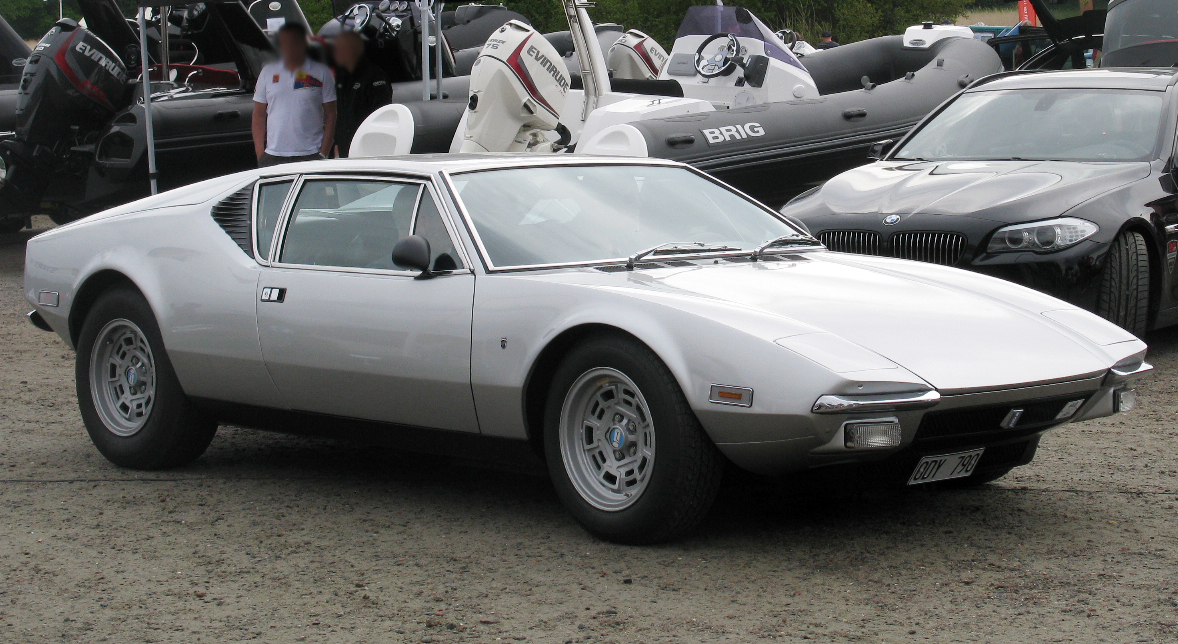
Photo gallery

FAQ
Who founded De Tomaso?
Alejandro de Tomaso, an Argentine racing driver, in Modena, Italy, in 1959.
What engine does the De Tomaso Pantera have?
Most Panteras have a 5.8-litre Ford 351 Cleveland V8; the 1990 Pantera 90 Si used a 4.9-litre Ford 302.
Why did Lincoln-Mercury dealers sell the Pantera?
Ford bought 84% of De Tomaso in 1971 and sold the Pantera in the United States from 1972 until 1975.
Did De Tomaso own Maserati?
Yes, from the mid-1970s until the sale to Fiat in 1993.
Sources
- Wikipedia — De Tomaso (accessed 24 Oct 2026)
- Wikipedia — Alejandro de Tomaso (accessed 24 Oct 2026)
- Wikipedia — De Tomaso Mangusta (accessed 24 Oct 2026)
- Wikipedia — De Tomaso Pantera (accessed 24 Oct 2026)
- Wikipedia — De Tomaso P72 (accessed 24 Oct 2026)
Found a mistake? Report an error