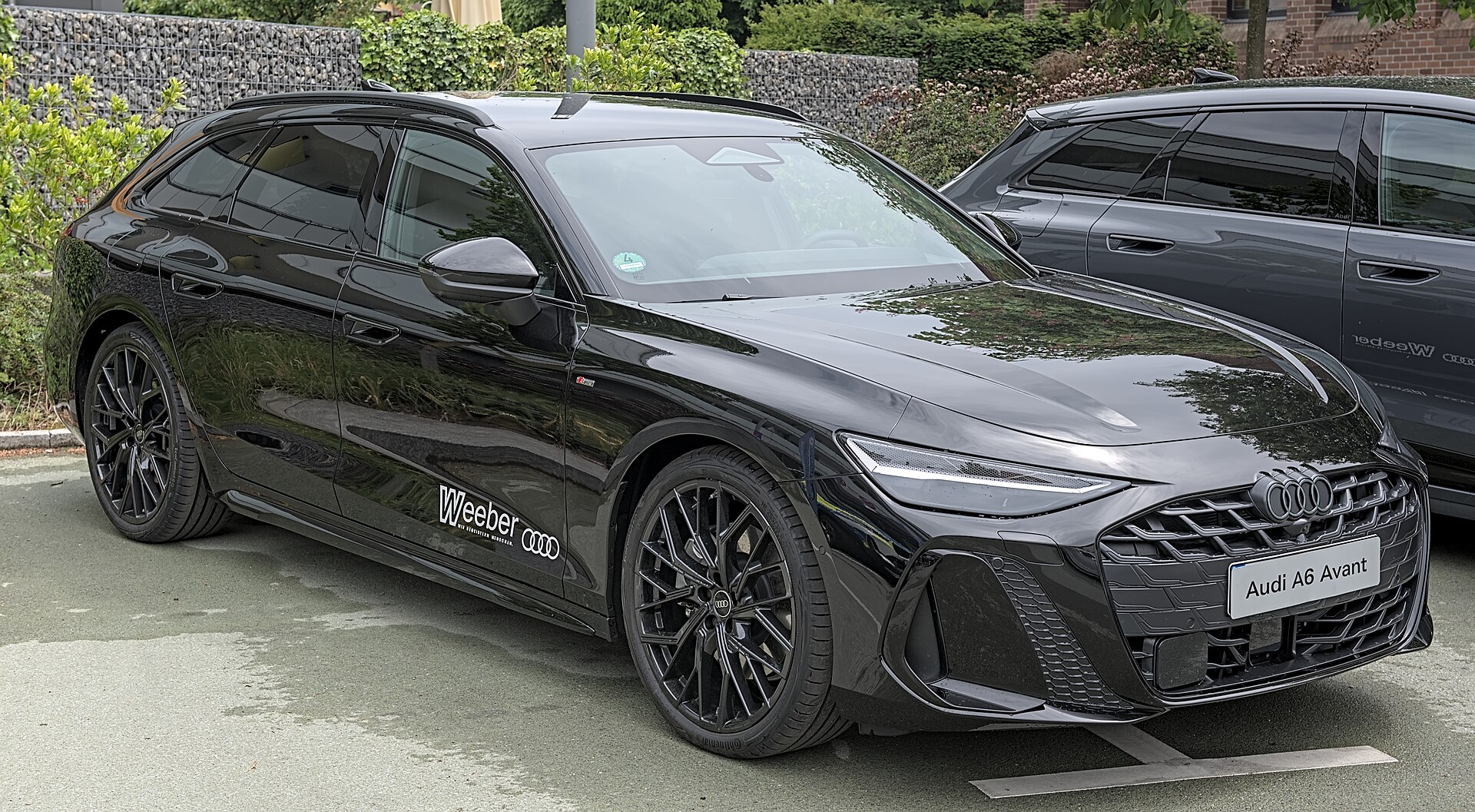
Audi A4 — Thirty Years of Audi's Mid-Size Saloon and Avant
The Audi A4 was Audi's mid-size saloon and estate from 1994 to 2025, the successor to the Audi 80 and one of the brand's best-selling cars. Over five generations — B5, B6, B7, B8 and B9 — the car grew considerably. The last ones sit on the MLB platform and use mild-hybrid engines. In 2024 Audi presented the A5 (B10) as its successor, so the B9 is the last car sold under the A4 name in Europe.
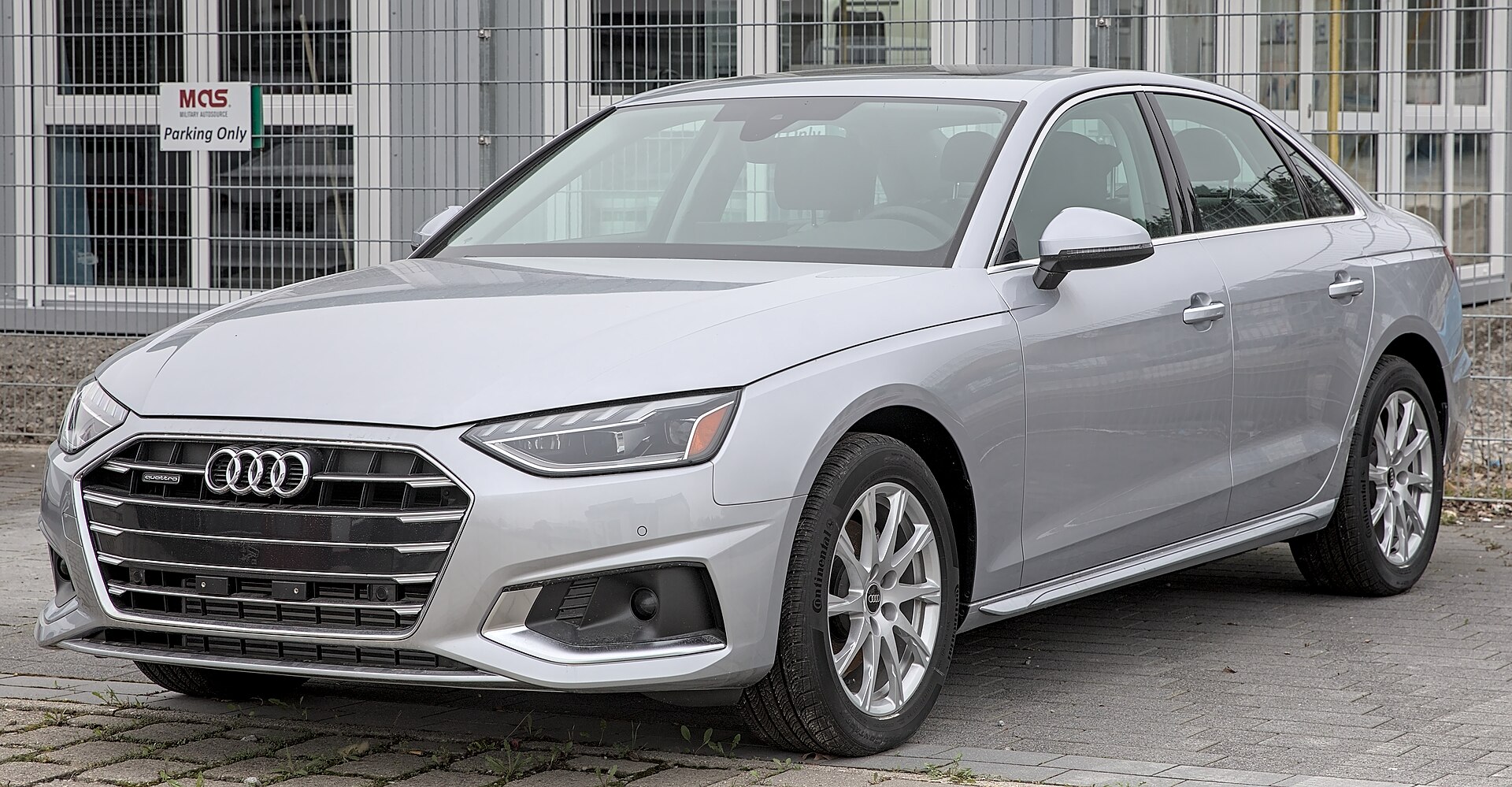
Key takeaways
- Five generations: B5 (1994–2001), B6 (2000–2005), B7 (2004–2008), B8 (2007–2015) and B9 (2015–2024).
- The weakest A4 engine, the B5 1.9 TDI, had 66 kW (90 PS); the RS4 of the B8 and B9 had five times as much, 331 kW (450 PS).
- The B8 (2009) and the B9 (2015) both received five Euro NCAP stars.
- In Germany the facelifted B9 started at €35,900 for the 35 TFSI S tronic saloon in 2019.
Audi A4 at a glance
| Specification | Audi A4 |
|---|---|
| Production | November 1994 – 2024 in Europe; the long-wheelbase A4L was still sold in China in 2025 |
| Predecessor / successor | Audi 80 / Audi A5 (B10, 2024) |
| Plants | Ingolstadt; Neckarsulm (B9 saloon); FAW-VW in China |
| Bodies | saloon, Avant estate, Cabriolet (B6, B7), allroad quattro (from 2009) |
| Drive | front-wheel drive or quattro all-wheel drive |
| Fuel | petrol and diesel; 12-volt mild hybrid on many engines from 2019 |
| Most powerful | RS4 (B8 and B9): 331 kW (450 PS) |
| Built | 1,674,943 cars of the first generation alone |
| Euro NCAP | five stars (B8 in 2009, B9 in 2015) |
The Audi catalogue page collects every Audi model with its generations. The car the A4 replaced is described in the history of the Audi 80.
Size at a glance
Audi A4 B8
The Audi A4 B9 is 23 mm longer and 16 mm wider than the Audi A4 B8.
| Dimensions | Audi A4 B9 | Audi A4 B8 | Difference |
|---|---|---|---|
| Length | 4,726 mm186.1 in | 4,703 mm185.2 in | +23 mm+0.9 in |
| Width | 1,842 mm72.5 in | 1,826 mm71.9 in | +16 mm+0.6 in |
| Height | 1,427 mm56.2 in | 1,427 mm56.2 in | Same |
| Wheelbase | 2,820 mm111.0 in | 2,808 mm110.6 in | +12 mm+0.5 in |
| Boot | 460 L16.2 cu ft | 480 L17.0 cu ft | −20 L−0.7 cu ft |
B5 (1994–2001): the successor to the Audi 80
Production of the B5 (Typ 8D) began in November 1994, and European sales started in January 1995. The saloon was joined by the Avant estate in February 1996; there was no cabriolet. The car used the PL45 platform of the Volkswagen Group and was built at Ingolstadt. It came with front-wheel drive or quattro all-wheel drive and introduced the 1.8-litre turbocharged petrol engine: the 1.8T with 110 kW (150 PS) and 210 Nm.
For diesel drivers there was a 1.9 TDI rated at 66 kW (90 PS) or 81 kW (110 PS) and the 2.5 V6 TDI with 110 kW (150 PS) and 310 Nm. From 1997 the S4 used a 2.7-litre twin-turbo V6 with 195 kW (265 PS). The first RS4 followed in 1999: sold only as an Avant until 2001, it had 279 kW (380 PS) and 440 Nm. The facelift came in 1999, and 1,674,943 cars of the first generation were built.

B6 and B7 (2000–2008): Cabriolet, multitronic and a V8 RS4
The B6 (Typ 8E) made its debut on 10 October 2000 on the new PL46 platform. It brought the multitronic continuously variable transmission in place of the earlier automatic gearbox. A Cabriolet (8H), built by Karmann, followed in 2002; it measured 4,573 mm in length on a 2,654 mm wheelbase. Engines included the 2.0 FSI with 110 kW, the 3.0 V6 with 162 kW (220 PS) and diesels up to the 2.5 V6 TDI. The S4 switched to a 4.2-litre V8 with 253 kW (344 PS); there was no RS4 of this generation.
The B7 of late 2004 was a heavy facelift of the B6 rather than a new design. Audi used it to launch the 2.0 TFSI turbo petrol engine with 147 kW (200 PS) and a 3.2-litre FSI V6 rated at 188 kW (255 PS). The 3.0 TDI was raised to 171 kW (233 PS) in 2006. The RS4 returned with a 4.2-litre V8 of 309 kW (420 PS) and was sold as a saloon, Avant and Cabriolet. When the B8 arrived, the B7 production line moved to SEAT in Martorell, Spain, where it was used for the SEAT Exeo of 2008.

B8 (2007–2015): a longer wheelbase on the MLB platform
The B8 (Typ 8K) made its public debut at Frankfurt in September 2007, and the Avant was added in March 2008. It was the first A4 on a version of the Modular Longitudinal Platform (MLB). Compared with the B7 it was about 117 mm longer and 54 mm wider, and the wheelbase grew by 160 mm, giving much more room in the back. The Cabriolet was dropped — its role passed to the A5 — while an allroad quattro arrived in 2009 and a long-wheelbase A4L for China in the same year.
Petrol engines ran from the 1.8 TFSI (118 kW, later 125 kW and 320 Nm) to the 2.0 TFSI with up to 165 kW and the supercharged 3.0 TFSI V6 with 200 kW. Diesels ranged from 88 to 140 kW in the 2.0 TDI and up to 180 kW and 500 Nm in the 3.0 TDI. The S4 used the supercharged 3.0 V6 with 245 kW (333 PS); the RS4 Avant of 2012–2015 kept a 4.2-litre V8, now with 331 kW (450 PS). The 2012 facelift added LED daytime running lights and an improved MMI. In 2009 Euro NCAP awarded five stars, with 93 percent for adult occupant protection.

B9 (2015–2024): lighter, digital and the last A4
The B9 (Typ 8W) was revealed in June 2015, shown at Frankfurt in September and delivered from October 2015. It was slightly larger than the B8 and about 120 kg lighter. The saloon was built at Ingolstadt and Neckarsulm, the Avant and the S models at Ingolstadt. The interior became more minimalist, and most engines had a capacity of 2.0 litres. An allroad quattro was offered again.
After a small update in 2018, the main facelift of May 2019 brought a new front, a touchscreen and standard LED lights. Five engines received a 12-volt mild-hybrid system. In Europe the S4 became a diesel: the S4 TDI has a 3.0 V6 with 255 kW (347 PS) and 700 Nm, helped by a 48-volt system and an electric compressor. The RS4 Avant of 2017–2024 used a 2.9-litre V6 TFSI with 331 kW (450 PS) and 600 Nm. The 2019 German price list started at €35,900 for the 35 TFSI saloon with 110 kW (150 PS) and the S tronic gearbox, or €33,600 with a manual. In that 2019 list the Avant cost €1,650 more, and the S4 TDI €62,600.

Engines and versions by generation
| Generation | Years | Bodies | Typical engines | Top version |
|---|---|---|---|---|
| B5 (8D) | 1994–2001 | saloon, Avant | 1.8T, 1.9 TDI, 2.5 V6 TDI | RS4 Avant, 279 kW (380 PS) |
| B6 (8E/8H) | 2000–2005 | saloon, Avant, Cabriolet | 1.8T, 2.0 FSI, 3.0 V6, 1.9/2.5 TDI | S4 4.2 V8, 253 kW (344 PS) |
| B7 (8E/8H) | 2004–2008 | saloon, Avant, Cabriolet | 2.0 TFSI, 3.2 FSI, 2.0/3.0 TDI | RS4 4.2 V8, 309 kW (420 PS) |
| B8 (8K) | 2007–2015 | saloon, Avant, allroad | 1.8/2.0 TFSI, 3.0 TFSI, 2.0/3.0 TDI | RS4 Avant, 331 kW (450 PS) |
| B9 (8W) | 2015–2024 | saloon, Avant, allroad | 35/40/45 TFSI, 2.0/3.0 TDI | RS4 Avant, 331 kW (450 PS) |
All A4 versions in the catalogue can be compared with each other and with rivals in the car comparison tool. Its main competitors are the Mercedes-Benz C-Class and the BMW 3 Series.
Safety and reliability
The early Euro NCAP test of the B5 gave three stars, with the last star flagged for a high risk of chest injury in a side impact. The B8 reached five stars in 2009 and the B9 again five stars in 2015.
Recent cars break down rarely: the ADAC statistics give 0.9 breakdowns per 1,000 cars for 2022 registrations and 1.0 for 2023, against 5.5 to 6.9 for cars registered in 2016–2018. The AudiWorld buyer's guide lists the typical faults of older A4s. Oil leaks from the valve cover and timing-chain tensioner gaskets come first, followed by failing ignition coils and spark plugs. High-pressure fuel pumps, water pumps and thermostats also fail. On the direct-injection FSI and TFSI engines that arrived with the B7, carbon build-up is the issue to watch. On the B8 S4, a timing chain replacement requires the engine to be removed, so a cheap S4 without service records is a risk.
The successor: A4 becomes A5 (B10)
In March 2023 Audi's chief executive announced a new naming scheme with odd numbers for combustion cars and even numbers for electric ones. As a result, the next mid-size saloon and Avant, presented in July 2024, is called the A5 (B10); it also replaced the earlier A5 Coupé, Cabriolet and Sportback. In China the long-wheelbase A4L continued: 79,630 were sold there in 2025.
Which A4 to buy
For most buyers the facelifted B9 from 2019 is the best compromise. The cinch generations guide picks it for its design and technology, it has the mild-hybrid engines and five-star safety, and it costs much less than the new A5. The 35 TFSI or 35 TDI with front-wheel drive is enough for daily use; the 40 TDI quattro suits high-mileage drivers who tow or drive in winter. The fuel bill of each version can be estimated with the fuel cost calculator.
On a smaller budget, AudiWorld calls a late B7 or B8 with the 2.0-litre turbo and quattro "hard to beat". Check such a car for oil leaks and ask for the full service history first.

Photo gallery


FAQ
How many generations of the Audi A4 are there?
Five: B5 (1994), B6 (2000), B7 (2004), B8 (2007) and B9 (2015). The B7 was a heavy facelift of the B6.
Why did Audi stop making the A4?
Audi changed its naming scheme in 2023: odd numbers for combustion cars, even numbers for electric ones. The A4's successor, presented in 2024, is therefore called the A5.
Which Audi A4 is the most reliable?
The newest cars have the lowest ADAC breakdown rates. Among older generations, AudiWorld points to a late B7 or B8 with the 2.0 TFSI and quattro, and warns about expensive timing chain work on the B8 S4.
Is the Audi A4 safe?
The B8 received five Euro NCAP stars in 2009 and the B9 five stars in 2015.
What is the fastest Audi A4?
The RS4 Avant of the B8 and B9 generations, both with 331 kW (450 PS): a 4.2-litre V8 in the B8 and a 2.9-litre V6 TFSI in the B9.